
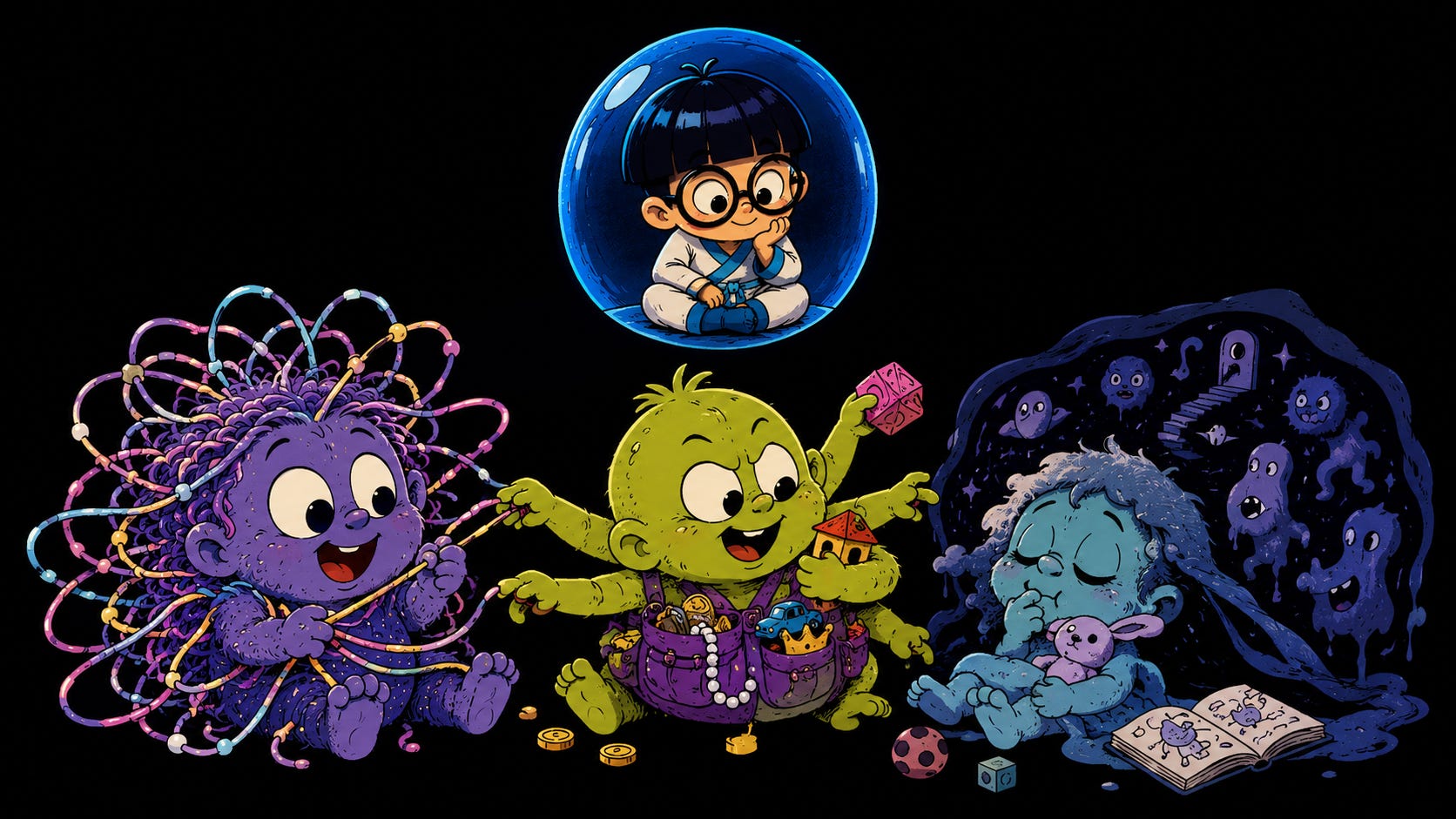
I have developed a command I use with AI constantly, and it sounds much stupider than it is.
Toddlerize this.
I use it when I’m trying to understand a difficult concept. I use it when a conversation has gotten too abstract. I use it on academic arguments. I use it on my own essays when I suspect I have successfully written 1,500 words without actually knowing what I am trying to say.
“Explain it simply” doesn’t quite do the same thing. Neither does the old internet standby “ELI5.” Five-year-olds are already sophisticated little creatures. They understand rules. They have learned that adults possess certain kinds of authority. They can sit through an explanation they don’t understand and decide that perhaps the problem is them.
A toddler has considerably less respect for the institution.
A toddler wants to know: What happened?
Then: Why?
And then, catastrophically: Why?
So here are eight reasons I keep asking AI to toddlerize things.
Sophisticated language can hide astonishing amounts of intellectual mush.
Academics are especially good at this. We inherit specialized vocabularies because specialized vocabularies are useful. Sometimes you really do need a word like overdetermination because otherwise you have to spend a paragraph describing a thing that Freud and Marx already gave you a perfectly good word for.
But specialized language can also become a storage unit where we put ideas we have stopped examining.
I have an old essay about It’s Alive and its murderous baby that I wrote as a graduate student. Parts of it embarrass me now, not because I no longer believe the argument, but because you can hear me trying to prove that I deserve to make one. Every sentence is auditioning.
Toddlerize it and the graduate-student plumage falls away. What are you actually saying?
Oh.
That.
Toddlerizing doesn’t necessarily make the argument less sophisticated. It tells me what all the sophistication is attached to.
I did something considerably more alarming with my first book, The Revolting Child in Horror Cinema.
Years of research. Queer theory. Childhood studies. Film history. Close readings. Qualifications. Citations.
Toddlerize the whole thing.
Grown-ups have an idea about what children are supposed to be like. Children are supposed to be innocent. They’re supposed to be cute. They’re supposed to listen to adults. They’re supposed to grow up the right way and eventually become the same kinds of grown-ups who raised them.
Horror movies sometimes give us children who say no.
They won’t behave correctly. They don’t want what adults want them to want. Sometimes they are strange. Sometimes they hurt people. Sometimes they refuse to grow up. Sometimes they become monsters.
The movie says, “Look! There’s something wrong with this child.”
My book says: Wait. Why does this child scare you so much?
And underneath several years of scholarship was the little idea holding the whole thing up:
Maybe the child is scary because the child won’t become what the grown-ups planned.
That sentence isn’t my book. But now I can see what the book is built around.
This may be the strangest thing toddlerizing does.
Take something abstract and ask AI to explain it to a toddler, and it starts reaching for a completely different vocabulary. Not theory. Bodies. Rooms. Toys. Cars. Costumes. Somebody hiding. Somebody wanting something. Somebody getting scared.
I once asked AI to toddlerize the horror genre. The explanation it gave me was something like this:
Sometimes feelings get too big. So they go into the closet, put on a different costume, come back out, and do a show.
That has stayed with me.
It isn’t a definition of horror I would put in a film studies textbook. But I have taught horror for years, and there is something in that ridiculous little image that gets surprisingly close to what horror does. Fear puts on a vampire costume. Grief comes back as a ghost. Anxiety grows claws. Something we cannot quite look at directly goes into the closet, changes clothes, and comes back out where we can look at it.
That’s what I mean by feeling-forward language.
A toddler doesn’t have access to dissociation, hegemony, ideology, or epistemology. A toddler understands hiding, wanting, losing, being scared, somebody taking something, somebody being left out.
I suggested the technique to my therapist and told him to choose something difficult from his own field. He chose dissociative identity disorder. The toddlerized explanation reached for a car: imagine different people riding together, with one person usually driving. Sometimes that person can’t keep driving, and someone else takes the wheel.
Obviously, that isn’t a clinical definition. Neither is the closet full of feelings a theory of horror.
But you can feel your way into both of them.
Toddlerizing forces abstraction to acquire a body. If you can’t use the word power, show me who gets to decide. If you can’t say alienation, show me the person outside the room. If you can’t say hegemony, show me who has all the cookies.
Sometimes the shortest route into a complicated idea isn’t another definition. It’s a story you can picture.
Consider this sentence:
“AI detectors identify statistical patterns associated with machine-generated prose.”
Perfectly respectable sentence.
Toddlerize it.
The computer looks at some writing and says, “This looks like the kind of writing I have seen computers make before.”
Already, something has changed. The aura of scientific certainty has started leaking out of the room.
Toddlerize it again.
“Does it know who wrote it?”
No.
“Does it know how they wrote it?”
No.
“Then what does the percentage mean?”
Ah.
Now we have arrived somewhere interesting.
The toddler hasn’t made the subject less complicated. The toddler has exposed where the complication actually lives.
This is the distinction I find useful: simplification tries to remove complexity. Toddlerizing tries to remove camouflage.
AI conversations can become enormous.
I start with one question, follow an interesting tangent, follow another tangent off that tangent, introduce a counterexample, discover an adjacent theory, and twenty exchanges later I am staring at the intellectual equivalent of the wall in a detective movie where someone has connected photographs with red string.
So I type:
Toddlerize this conversation.
Suddenly: here is where you started. Here is what changed. Here are the two things you discovered. Here is the question you are actually asking now.
The problem with rabbit holes isn’t necessarily that you went down one. Rabbit holes are frequently where the interesting things live. The problem is losing the string that gets you back out.
Toddlerizing hands me the string.
Toddlerizing doesn’t only help me understand things I find difficult. Sometimes I use it on things I understand so well that I can no longer see them.
Toddlerize Christianity.
Suddenly two thousand years of theology temporarily disappears and you are left with an extremely peculiar story: God becomes a person, people kill him, he comes back, and everyone has been arguing ever since about what this means for the rest of us.
An adult sees communion and thinks sacrament. A toddler sees a room full of adults lining up to eat the body of God.
The toddler has accidentally become an anthropologist.
This is defamiliarization by way of limited vocabulary. The toddler doesn’t know which parts of the story everyone has agreed not to find strange.
And there’s almost no limit to what you can try this on. Toddlerize capitalism. Neoliberalism. Trans identity. Camp. Liminality. The unconscious. Buddhist emptiness. Structural racism. Fascism. Quantum superposition. String theory. Simulation theory. Auteur theory. The history of the romantic comedy. Artificial intelligence itself.
The stranger the combination, the better. The point isn’t that all of these things can be reduced to equally simple explanations. They can’t. The point is to find the first human-sized handhold.
Occasionally I take this one step further and ask AI to Muppet Baby this.
I cannot yet defend Muppet Babying as a distinct intellectual methodology, but give me time.
AI can toddlerize something badly. It can flatten an essential distinction. It can decide two things are equivalent when the entire point is that they are not. It can reduce something until the reduction becomes distortion.
Good.
That failure is information.
If I tell AI what I think my essay is about and then ask it to toddlerize the essay, sometimes it hands me back a different essay. Now I have something to investigate.
Maybe the machine missed the point. Maybe I didn’t put the point on the page. Maybe I buried my argument six paragraphs down. Maybe I was following language instead of thought.
The machine hasn’t supplied the answer. It has created resistance.
This is the AI relationship I find much more intellectually interesting than outsourcing prose. I don’t particularly need a machine that agrees with me. I need one I can push against.
This may be the biggest reason I keep doing it.
Our current argument about AI and writing keeps collapsing hundreds of possible interactions into one question: Did the machine write it?
That question makes sense if the only model we have for AI is ghostwriting. Give a language model a topic and ask it to produce an essay, and it can generate something smooth, plausible, orderly and almost completely dead. It knows what an essay about something is statistically supposed to sound like.
That isn’t the same thing as having something to say.
But language models can also function as adversarial readers, translators between registers, argument maps, misunderstanding machines, skeptical students, developmental editors or—apparently—extremely persistent toddlers.
Those uses don’t eliminate authorship. Some of them demand more of it.
Because after the machine gives me the toddler version, I still have to decide whether it is right.
And then I put the complexity back.
The terminology comes back. The ambiguity comes back. The exceptions and historical context come back. The citations come back. The arguments between people who have spent forty years disagreeing about what one sentence means come back.
The point isn’t to remain a toddler. The point is to find out whether there is actually something underneath all those grown-up words.
A toddler does not care that my paragraph sounds authoritative. A toddler does not care that everyone in my field uses the term. A toddler cannot be intimidated by my bibliography.
A toddler is standing in the kitchen holding one shoe and demanding to know why the moon follows the car.
And the irritating thing is that sometimes the toddler has found the actual question.
“Explain this to me like I’m a toddler” sounds like a request to become less intelligent.
In practice, I use it when I am trying to become more difficult to fool. Including by AI. Including by academics. Including, most frequently, by myself.
Adults learn to nod.
Toddlers ask why again.
And again.
And again.
Eventually either the explanation gets clearer—or you discover there was never much underneath it in the first place.
Comments
Nothing yet. Say the first thing.
Sign in to join the conversation.