
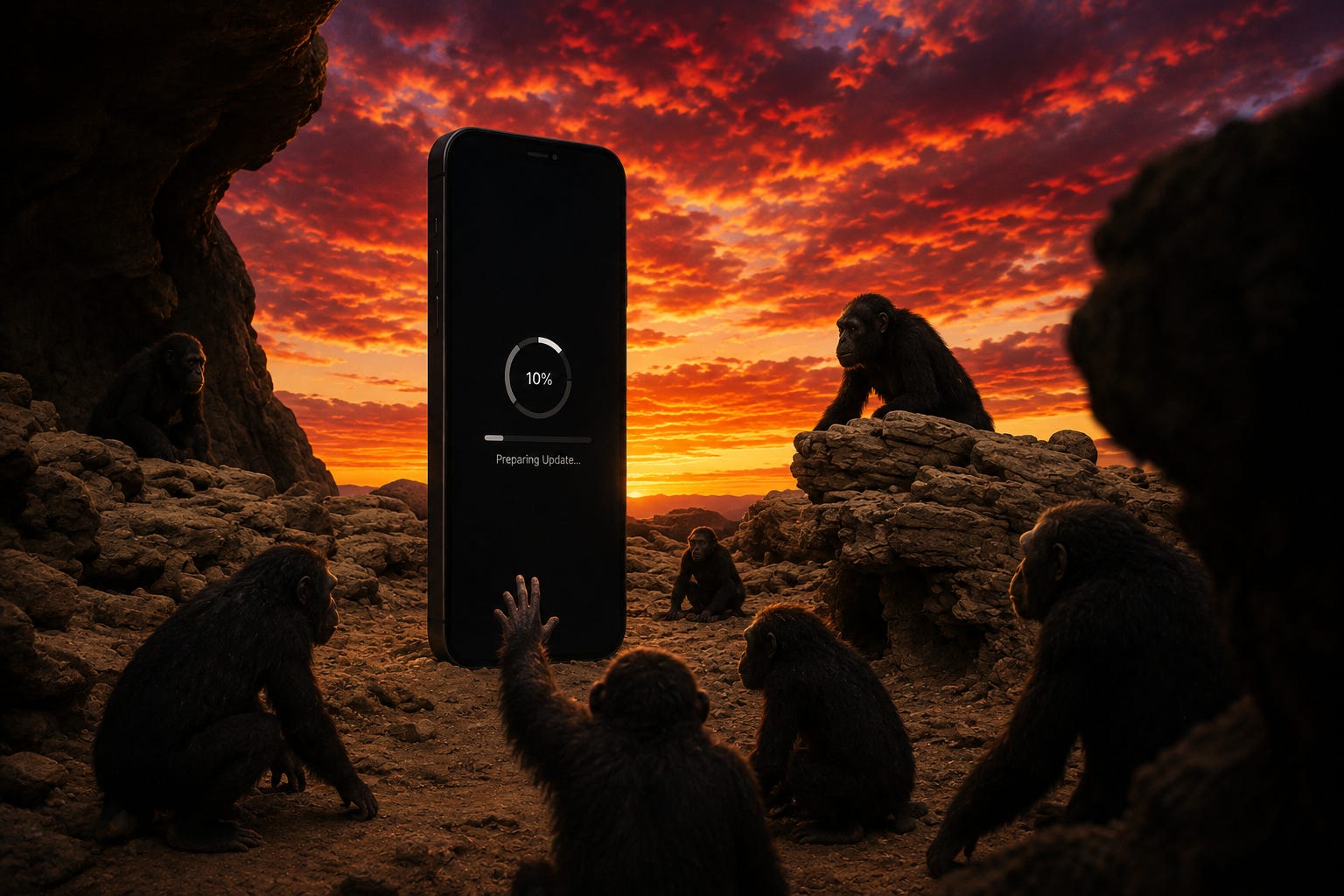
Every now and then your phone asks you to stop.
Not politely, exactly. More like a tiny bureaucrat announcing that operations will pause while the system improves itself.
A message appears:
Software Update Available.
You tap install.
And suddenly the most powerful object in your daily life becomes a small glowing brick that says something like “Preparing Update.”
This is when the thoughts begin to surge.
Modern life has trained us to expect instant responsiveness from our devices. Tap a screen, something happens. Send a message, it travels across continents in seconds. Ask a question, a satellite somewhere whispers the answer back to you.
But the software update interrupts this rhythm.
Your phone shuts down. A black screen appears. A progress bar begins creeping across the glass like a cautious glacier.
For the next ten minutes, you are locked out of the nervous system of your life.
No messages.
No scrolling.
No weather updates, breaking news alerts, or mild social comparison disguised as casual browsing.
Your phone is busy becoming a slightly better version of itself.
And you, unexpectedly, are idle.
This is a strange modern silence.
It’s not the deep quiet of a forest or the peaceful stillness of a library. It’s a technological pause, a moment when the digital scaffolding of your daily routine temporarily disappears.
The first thought that usually surges up in this moment concerns dependence.
Because without your phone, you suddenly notice how many small decisions it normally handles.
What time is it?
What’s the weather tomorrow?
How do you spell that word?
Where is that restaurant again?
Your phone answers these questions so smoothly that you rarely notice the assistance. It has become a kind of portable external brain, a glowing prosthetic memory.
When it goes offline, even briefly, you feel the absence.
You reach for it instinctively.
Still updating.
The progress bar has moved approximately three millimeters.
This leads to the second category of update thoughts: time.
Software updates are masters of vague duration.
The phone never says “This will take eleven minutes.”
Instead it offers phrases like:
“Preparing update.”
Or the even more philosophical:
“Estimating time remaining.”
This could mean two minutes.
It could mean twenty.
The progress bar itself is suspiciously calm about the entire situation. It advances with the slow, confident patience of someone who knows you have absolutely no alternative.
Which, of course, you don’t.
There’s something almost monastic about this forced waiting.
For a brief window, the machine that normally feeds you information has closed the buffet.
You look around.
You notice the room again.
You remember that chairs exist. That walls have textures. That your coffee is getting cold.
The update creates a tiny pocket of technological fasting.
And in that pocket, another thought begins to surge: improvement.
Because the entire premise of a software update is that things will be better afterward.
Your phone will be faster.
More secure.
Perhaps slightly wiser.
There will be new features you will discover accidentally three weeks from now.
A redesigned icon.
A setting you didn’t know you needed.
The update is a promise that the system can still grow.
Humans are oddly attracted to this idea.
We like the fantasy that somewhere, behind the scenes, an invisible process is installing a better version of ourselves.
Imagine if personal development worked like a phone update.
A message appears while you’re brushing your teeth:
Update Available.
Improved patience.
Enhanced emotional security.
Bug fixes in the area of late-night texting.
Install now?
You tap yes.
The lights dim. A progress bar appears above your head.
Preparing update.
You lie down for ten minutes and wake up with slightly improved decision-making and a new ability to ignore people who drain your energy.
Unfortunately, human upgrades are slower.
They require conversations, mistakes, reflection, and occasionally a long walk after realizing you were wrong about something.
No convenient progress bar appears.
Which might be why watching the phone update is oddly comforting.
The machine is doing the quiet maintenance we sometimes wish life would do for us.
Patching vulnerabilities.
Closing security gaps.
Installing small improvements to the operating system.
The progress bar inches forward.
Seventy percent.
Eighty.
You realize that while the phone has been updating, your mind has been doing a smaller update of its own.
Without notifications tugging at your attention, a few neglected thoughts have had time to surface.
A conversation you’ve been postponing.
An idea for something you might write.
The memory of someone you should probably call.
Then the screen lights up.
The phone restarts.
Suddenly the device returns to life, brighter and more capable than before. Messages rush in. Notifications bloom across the screen like tiny electronic confetti.
The system is ready again.
And just like that, the quiet pocket closes.
But for a few minutes there, while the phone was becoming a better version of itself, your mind had the rare chance to update too.
Thanks for reading Andy Might! This post is public so feel free to share it.
Comments
Nothing yet. Say the first thing.
Sign in to join the conversation.