
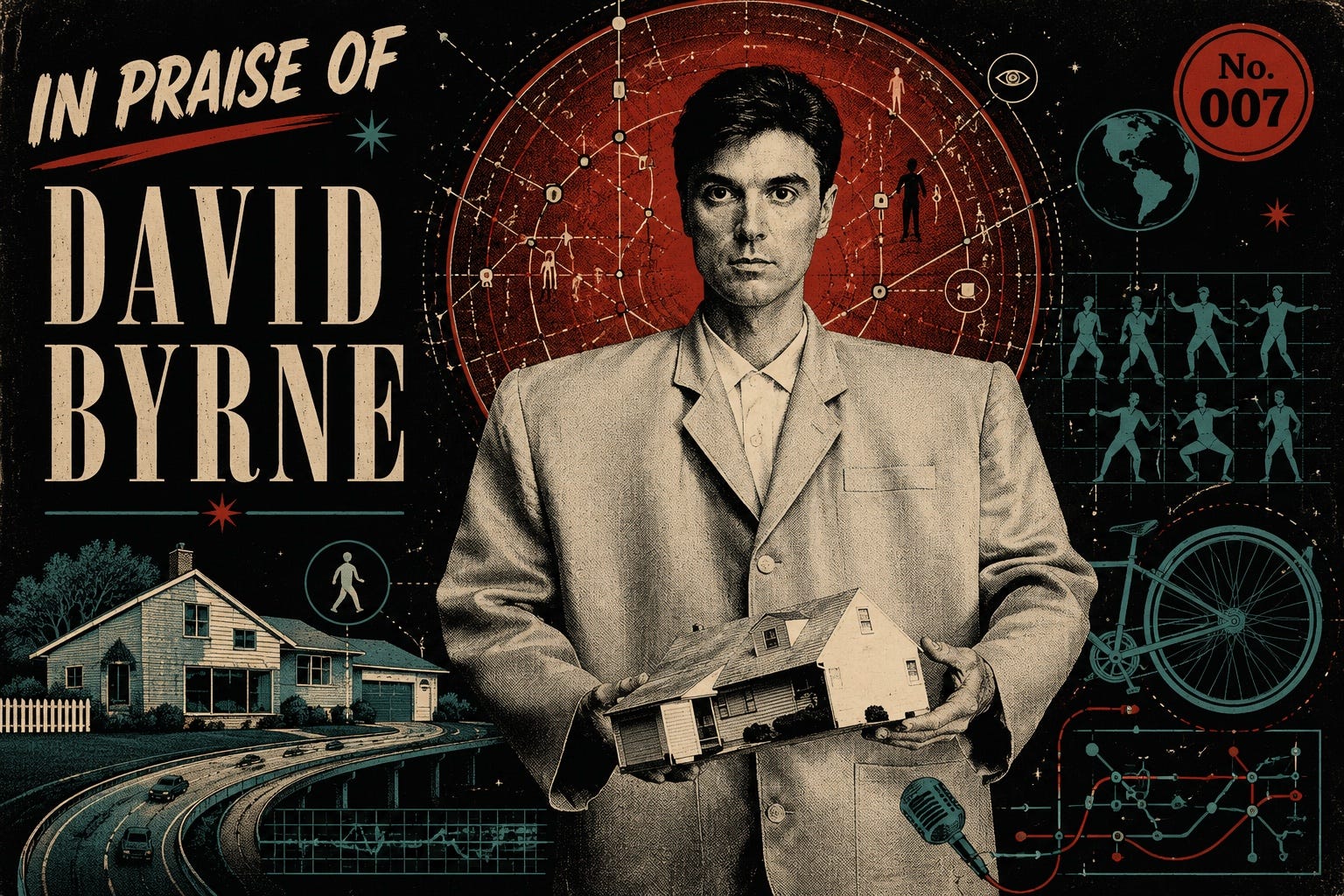
I didn’t discover David Byrne because I loved New Wave. I discovered him because he sounded like someone trying to understand humans.
As a kid, I couldn’t have explained why Talking Heads felt different from everything else on the radio. I only knew that Byrne wasn’t singing at the world so much as studying it. His songs seemed fascinated by ordinary life in a way that was both affectionate and bewildered. Shopping malls. Office buildings. Dinner conversations. Houses. Highways. Dancing. He approached them with the curiosity of someone who had just arrived on Earth and was trying to decipher the customs.
Years later, I learned that Byrne had been described as “a cultural anthropologist from Mars.” He initially resisted the label before admitting there was something to it. I’ve never heard a better description of his art.
Listen to Once in a Lifetime through that lens and it stops sounding like a song about a midlife crisis. Instead, it becomes an ethnography of adulthood. Byrne isn’t simply asking whether the American Dream delivers happiness. He’s asking how an entire civilization collectively decided that this was the way life was supposed to unfold. “This is not my beautiful house.” It’s less a cry of despair than a field note from someone who suddenly notices the invisible rules everyone else accepted without question.
That perspective is what has always made Byrne such a singular artist. While most rock musicians write from the center of experience, Byrne often writes from its edge. He isn’t the loudest voice at the party. He’s the one standing in the corner wondering why everyone instinctively knows when to laugh, when to dance, and when to pretend they’re having a good time.
Whether Byrne consciously rejected the rituals of rock stardom or simply never absorbed them in the first place is almost beside the point. The effect was the same. He made visible behaviors everyone else had stopped noticing. Talking Heads emerged with little interest in rock’s inherited swagger or mythology. Byrne seemed less interested in becoming a rock star than in asking why rock stars behaved the way they did at all.
Only recently have I realized why so many people, especially neurodivergent listeners, feel an almost immediate kinship with his work.
In recent years Byrne has said that he recognizes traits of autism in himself while also making clear that he has never received a formal diagnosis and doesn’t want to reduce his identity to one. I find that illuminating, but not because it explains him. If anything, it explains why so many people recognize themselves in his work. The diagnosis isn’t the interesting part.
The perspective is.
Long before autism entered the cultural mainstream, David Byrne had already created one of popular music’s most recognizable artistic voices from just outside the social choreography the rest of us take for granted. He didn’t write songs that explained what it felt like to be different. He wrote songs that quietly asked why everyone else seemed so certain they weren’t.
Looking back, I don’t think I admired David Byrne because he was strange. I admired him because he gave me permission to trust a way of thinking I hadn’t yet learned to name. He treated curiosity as a discipline. He assumed ordinary life could withstand unusually close inspection.
That habit of mind eventually expanded beyond songs.
Most artists have a medium.
David Byrne’s medium is systems.
Music is simply one of the systems he happened to investigate.
In How Music Works, Byrne dismantles another cherished myth: the solitary genius waiting for inspiration to strike. Instead, he argues that creativity is ecological. Architecture shapes music. Recording technology shapes music. Economics shape music. Audiences shape music. Songs written for churches sound different from songs written for punk clubs because environments become silent collaborators. The artist is never working alone.
The room is writing, too.
It’s a deceptively radical idea because it relocates creativity from the individual to the relationship between individuals and the systems they inhabit. Byrne’s work repeatedly asks the same question in different forms: What happens when you change one rule?
What happens if a rock singer refuses to move like a rock singer?
What happens if a concert assembles itself in front of the audience?
What happens if a building becomes a musical instrument?
What happens if PowerPoint becomes an art medium?
What happens if bicycle racks become public sculpture?
On the surface these seem like wildly different projects. They’re actually the same experiment performed on different materials.
Byrne’s career isn’t a collection of eclectic interests. It’s a sustained investigation into invisible systems.
That realization changed the way I understood Stop Making Sense. I used to think the oversized suit was simply an unforgettable image. Now it feels like the visual expression of Byrne’s entire philosophy. Earlier in his career he had stripped away the familiar body language of the rock star. The oversized suit replaces naturalism with something obviously constructed. Suddenly every gesture becomes visible again. The performance isn’t pretending to be authentic. It’s reminding us that authenticity has always been, at least in part, another performance.
Even his collaborations reveal the same impulse. Byrne has always sought out artists unlike himself—not because they reinforce his instincts, but because they interrupt them. Brian Eno. St. Vincent. Twyla Tharp. Musicians from around the world. Broadway choreographers. Each collaboration is another experiment in what becomes possible when one system of thought encounters another.
Music, Byrne has said, also became one of the ways he learned to relate to other people. Rhythm provided structure. Rehearsal provided rules. Collaboration transformed social interaction into something that could be practiced, refined, and eventually enjoyed. Music wasn’t simply an escape from the social world. It became one of the ways he entered it.
That strikes me as profoundly hopeful.
Not because it turns difference into a superpower, but because it suggests perspective itself can become a bridge.
I’ve come to realize these essays are less about celebrating artists than tracing my own inheritances. Maurice Sendak taught me that childhood was a symbolic landscape. Patricia Highsmith taught me that identity was unstable. Sinéad O’Connor taught me that witness sometimes matters more than acceptance.
David Byrne taught me to look for systems.
When I watch a film now, I find myself asking what invisible rules produced it. When I read history, I wonder what structures made certain outcomes seem inevitable. When I write, I gather fragments until a hidden pattern emerges. Looking back, I can see that Byrne gave me permission to trust that way of thinking long before I had the vocabulary to describe it.
I used to think David Byrne was writing songs about strange people.
Now I think he was drawing maps for anyone who couldn’t stop noticing invisible systems.
I recognized him long before I understood why.
Looking back, I wasn’t just listening to a musician.
I was finding one of my earliest teachers.
Comments
Nothing yet. Say the first thing.
Sign in to join the conversation.