
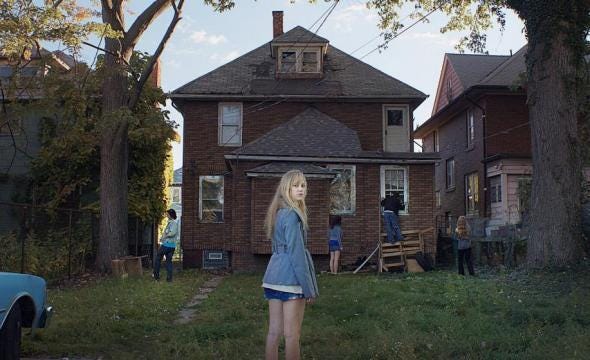
The first thing I hear when I watch It Follows is Halloween.
Not Halloween exactly. Something stranger. Halloween reverberating.
Reverberation is what happens when a sound continues after its source has stopped. It strikes a surface, reflects, strikes another, reflects again, until the original sound begins overlapping with all the versions of itself bouncing around the room. An echo gives you something recognizable back. Reverberation gives you what the room has done to it.
That distinction helps explain the peculiar elsewhenness of It Follows. Released in 2014, the movie never quite seems to live there. Disasterpeace’s synthesizers remember John Carpenter. The cars seem older than the people driving them. The televisions belong to another era while one character reads Dostoevsky from a clamshell e-reader that has never existed. The houses could belong to 1978, 1994, or 2014.
It Follows doesn’t take place in the 1980s. The 1980s are still reverberating inside it.
Somewhere in the middle of thinking about this, I remembered that Millennials used to have another name: the Echo Boomers.
This is a coincidence. David Robert Mitchell didn’t call them that, and demographers weren’t secretly doing film theory when they coined it. The Baby Boom simply produced another large generation when its members had children. Boom. Echo.
Still, once the phrase enters the room, it’s difficult to get it back out.
The generation coming of age around the time It Follows was made had become unusually familiar with inheriting structures whose origins preceded them: houses without affordable home ownership, universities without affordable tuition, and the rhetoric of individual responsibility after many of the structures that had made middle-class stability possible were disappearing.
Reverberation is more useful than echo, though, because the source doesn’t determine what survives.
The room does.
Different materials preserve different frequencies. Tile reflects what carpet absorbs. Architecture determines what carries and what dies quickly.
History, apparently, has selective acoustics. Affordable housing had a remarkably short decay time. Individual responsibility really carries.
This may be why It Follows feels like an ’80s nostalgia movie from which somebody has removed most of the nostalgia. Stranger Things reconstructs the signal: bicycles, arcades, synthesizers, walkie-talkies, Spielbergian childhood adventure. It rebuilds the room and plays the record again.
It Follows asks what remains after that signal has spent thirty years bouncing around the room.
The synthesizers survived. So did the suburbs, swimming pools, detached houses, teenage sex, and the stalking grammar of Halloween. The economic confidence beneath those images has disappeared.
Stranger Things resurrects the pleasures of the 1980s.
It Follows resurrects the bill.
Russell Meeuf has already placed that bill at the center of the film. In White Terror, he reads It Follows alongside Don’t Breathe as horror organized around the economic anxiety of white youth after the housing crisis. More broadly, Meeuf argues that post-recession horror repeatedly transforms threats to white middle-class security into monsters, often through housing itself.
Detroit makes that argument particularly difficult to separate from race. The metropolitan landscape records a history of industrial prosperity, segregation, suburban expansion, white flight, deindustrialization, and disinvestment. Those histories haven’t replaced one another cleanly. They remain physically adjacent.
It Follows moves across that geography. Jay and her friends begin among leafy streets and detached suburban houses. Once Jay is marked for death, those spaces stop protecting her. The characters move toward more visibly distressed parts of Detroit, toward vacant lots and abandoned buildings, into the landscape their version of middle-class security was historically constructed to escape.
It’s suburban flight played backward.
But Meeuf’s argument about precarity raises another question.
Why does precarity take this monstrous form?
What does the monster actually do?
The thing walks.
It doesn’t sprint when Jay escapes. It doesn’t level up. It doesn’t become angrier. Drive far enough and you can buy yourself time, but eventually it will arrive. Have sex with somebody and you can pass the curse along. But if that person dies, the creature works backward through the chain toward you.
The system remembers.
This makes the sexual rule more disturbing than a simple metaphor for infection. Jay’s safest position is not outside the chain. There is no outside. Her safest position is having as many other bodies as possible standing between herself and the consequence.
Security means making somebody else more vulnerable than you are.
Suddenly the creature isn’t merely expressing middle-class precarity. Its rules reproduce one of the mechanisms by which middle-class security can be maintained.
Move the danger somewhere else.
The curse does it socially. The suburb does it geographically.
In It Follows, middle-class security isn’t freedom from the curse. It’s the privilege of keeping the curse somewhere else.
That makes Detroit more than a symbolically loaded backdrop. These white suburban kids become marked for death and retreat into the urban landscape where the costs of an earlier version of middle-class security have already been deposited. The twentieth-century middle class fled Detroit for the suburbs; Mitchell sends his cursed suburban children back toward the city.
And the strategy still doesn’t work.
Because it follows.
The creature crosses the boundary. It walks through neighborhoods. Distance can delay the consequence, but displacement cannot make it disappear.
That is also why the AIDS reading of It Follows remains unavoidable without becoming the answer to the movie. The film inherits the procedural language of sexual transmission: disclosure, unknowable histories, chains of previous partners, the discovery that somebody else’s past can suddenly become your future. The creature doesn’t have to secretly “be” HIV. The AIDS crisis changed the cultural acoustics of sex. Those frequencies were still bouncing around when Jay entered the room.
So were the economic ideas of the 1980s: individual responsibility, privatized risk, the retreat from collective solutions, and perhaps most importantly the fantasy that private security can survive collective deterioration.
Your neighborhood can remain safe while another deteriorates.
Your property can appreciate while somebody else gets priced out.
Your life can remain comfortable provided the monster is walking toward somebody else.
The curse turns that arrangement into monster mechanics.
This is where It Follows differs from a ghost story. Ghosts return. They announce that something supposedly finished has unfinished business. A curse is different. A curse is a rule that continues executing.
The source can disappear.
The rule keeps running.
William Faulkner famously wrote, “The past is never dead. It’s not even past.”
Reverberation suggests something stranger.
The past can be dead. Its effects don’t have to be.
The person who made the sound can leave the room. An administration can end. A factory can close. The generation that built the suburbs can retire. None of that stops what has already been set in motion.
The sound keeps traveling because the room keeps reflecting it.
After enough reflections, the source becomes difficult to locate. What began as policy becomes environment. What began as ideology becomes common sense. Eventually you stop experiencing an arrangement as something somebody designed.
The sound becomes the room.
Maybe that’s why It Follows makes such a strange companion to The End of Oak Street. Both return to the American suburb and discover the 1980s still rattling around inside it. The houses survived. The fences survived. The idea that safety means getting far enough away from somebody else’s problem survived particularly well.
The prosperity?
Not so much.
An echo tells you something happened again.
Reverberation tells you it never finished happening.
Comments
Nothing yet. Say the first thing.
Sign in to join the conversation.