
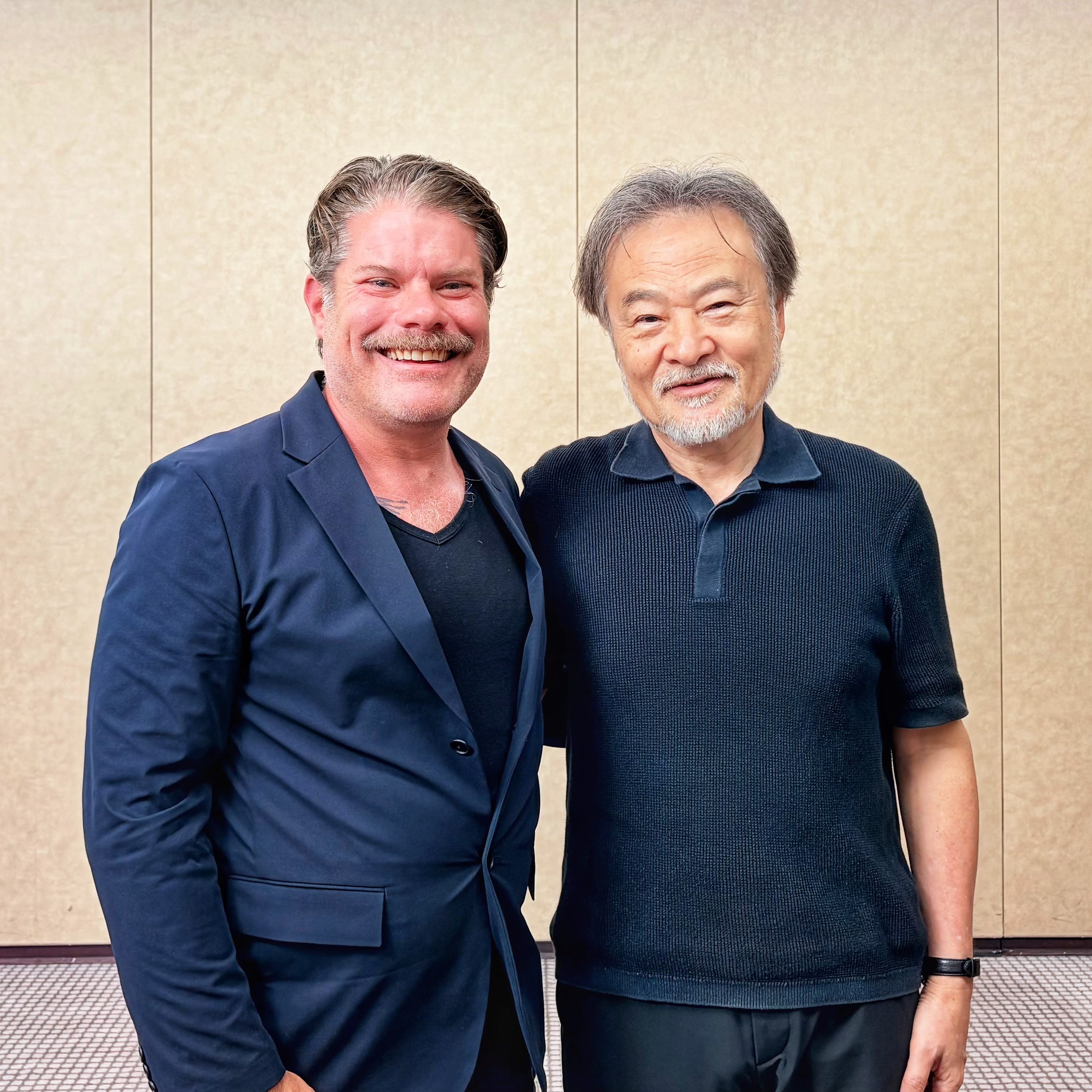
Just a month ago, I sat across from director Kiyoshi Kurosawa in Tokyo. The interview came through the day before I was scheduled to end my sabbatical in Japan.
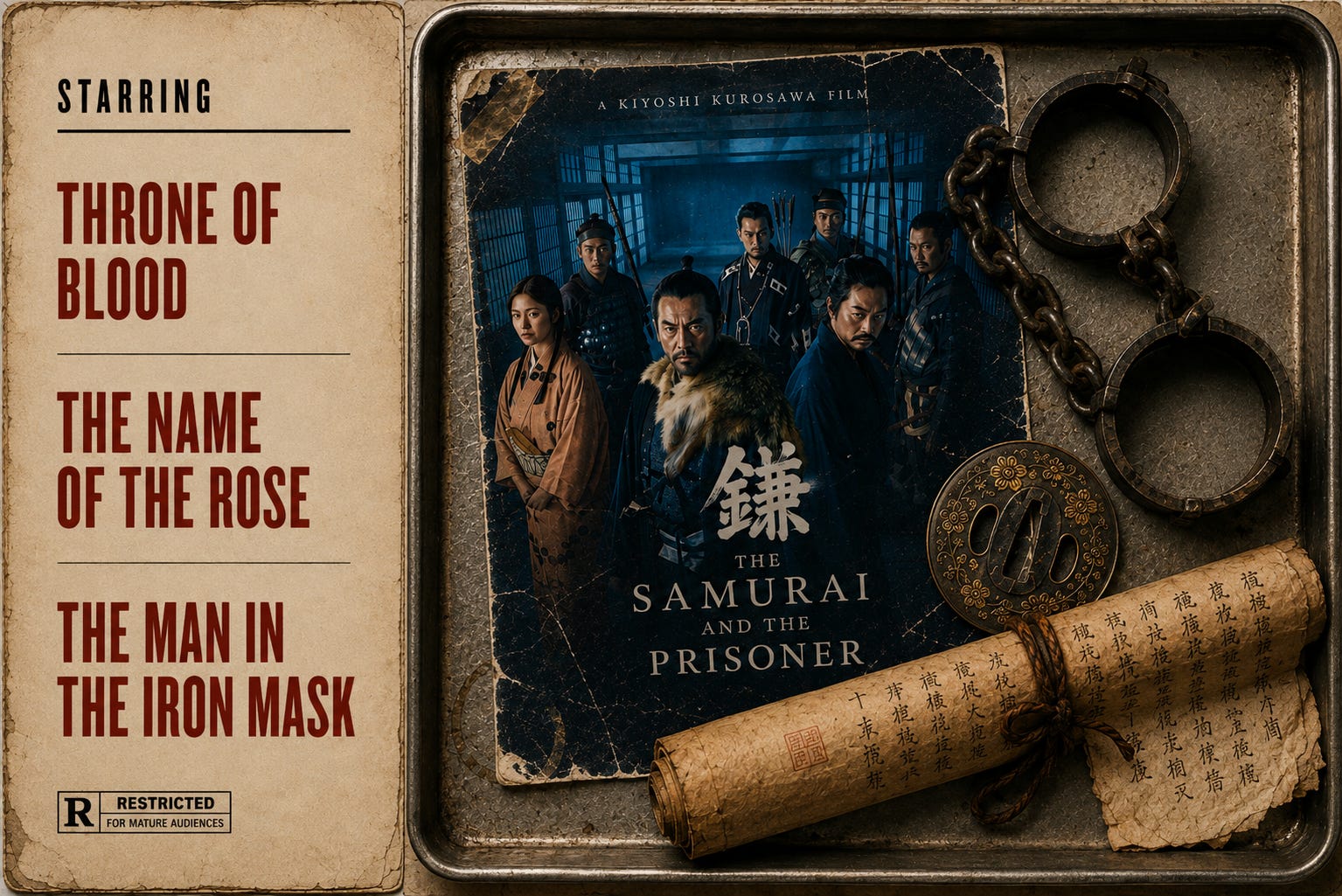
Kurosawa (no relation to Akira) made his name in horror — Cure, Pulse — before branching into war dramas and espionage thrillers, winning the Silver Lion for Best Director at Venice in 2020 for Wife of a Spy. The Samurai and the Prisoner is his first samurai film. It’s also, characteristically, not really one: less a war epic than a murder mystery that happens to be wearing samurai armor.
I’d gone in with an hour of prepared questions. I left with a better one, courtesy of the film itself: if we took this movie apart, which earlier films donated its organs?
Not homage. Not reference. A single film can inherit its visual language from one place, its narrative engine from another, and the question it can’t stop asking from somewhere else entirely.
Film scholar Rick Altman offers a useful way to begin. He argued that genres aren’t just collections of familiar images. They also have recurring story structures. He called these semantic and syntactic elements.
The semantic side is easy to spot. We sometimes refer to this as “outer genre.” It’s the stuff you can point at: spaceships, haunted houses, detectives, six-shooters, samurai armor. Where is the story set?
Syntax is the grammar—the “inner genre.” It’s how those pieces interact. A detective story doesn’t become a detective story because someone wears a trench coat. It becomes one because clues accumulate, suspects emerge, assumptions collapse, and a hidden pattern slowly comes into focus.
Once someone explains the distinction, it provides a whole new vocabulary to discuss how films blend, transform, and move in and out of multiple genres.
There’s an obvious objection to raise before any cutting begins. The Samurai and the Prisoner isn’t an original screenplay. It’s adapted from Kokurojo, Honobu Yonezawa’s Naoki Prize–winning 2021 novel, which is itself already a retelling of history: the 1578 siege of Arioka Castle, where the samurai lord Murashige Araki turned against Oda Nobunaga and locked himself inside his own fortress with the captured strategist Kanbei Kuroda chained in the dungeon below. If the story already existed on the page, and existed in the historical record before that, how much can it really have inherited from Throne of Blood, The Name of the Rose, or The Man in the Iron Mask?
The honest answer is that adaptation doesn’t exempt a film from the autopsy. It just adds a second body to the table.
Yonezawa’s novel supplies the raw material: Murashige, the siege, the strategist in the dungeon. It doesn’t supply the grammar. Every adaptation is a series of decisions about which cinematic tradition will do the telling, and that’s where the donor organs get transplanted in. Kurosawa could have filmed The Samurai and the Prisoner as a battle epic. He could have filmed it as a chamber drama, or a tragedy in the Akira Kurosawa mode with no mystery at all. Instead he filmed it through Throne of Blood’s eye, The Name of the Rose’s structure, and Iron Mask’s politics. Those choices belong to him. History and Yonezawa gave him raw material. He’s the one who decided what to build with it.
Beneath its feudal surface, then, The Samurai and the Prisoner is assembled from three remarkably familiar donors — and Kurosawa, characteristically, never lets you see the sutures until it’s too late.
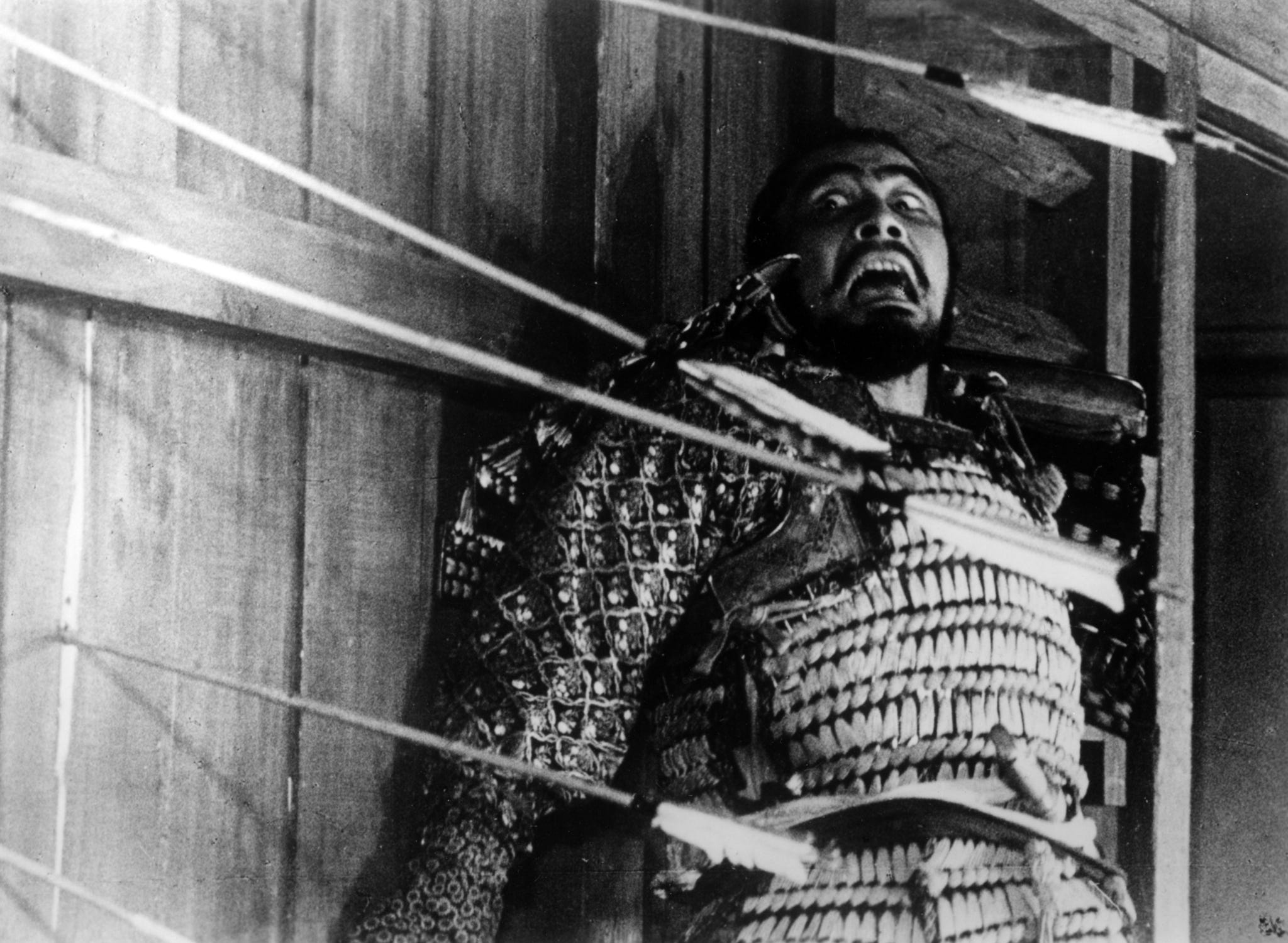
If The Name of the Rose supplies the syntax, Throne of Blood supplies the semantics — everything you’d point to in a single frame before any plot has unfolded.
Akira Kurosawa’s 1957 samurai Macbeth is, fittingly, its own adaptation of a foreign text bent into feudal Japan: a fog-wrapped castle, a lord undone as much by prophecy as by ambition, paranoia thickening in the corridors. The Samurai and the Prisoner borrows that same claustrophobic architecture — a single fortress standing in for an entire war, one man convincing himself of a story that will eventually kill him.
That’s the semantic layer. The armor, the walls, the wide, patient shots. The nouns. It’s what you see before the film has done anything at all — the skin, not the body underneath it.
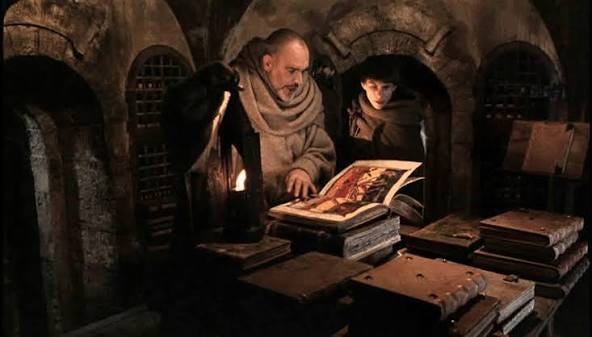
Underneath its feudal surface, The Samurai and the Prisoner isn’t really a war story. It’s a murder mystery.
Every new death opens another conversation. Every conversation uncovers another secret. The investigation doesn’t simply identify a killer; it exposes the belief system holding the entire castle together. As in The Name of the Rose, solving the mystery requires understanding the institution itself. The clues aren’t scattered randomly. They’re embedded in the culture.
That inheritance isn’t just a resemblance Kurosawa’s film happens to share. Yonezawa’s novel belongs to honkaku — Japan’s own formal codification of the fair-play Western detective puzzle, imported in the 1920s and revived as a self-conscious movement decades later. The genre grammar isn’t layered on after the fact. It was already in the source material Kurosawa was adapting.
It also gets to cheat a little, in the genre’s favor. Every locked-room mystery runs on a faintly artificial premise: why doesn’t anyone simply leave? Here, nobody has to invent a reason. An army outside the walls supplies one. The castle is a locked room the genre doesn’t have to lie about.
That’s the skeleton — the hidden grammar the whole film stands on. It’s not what you see first. It’s what everything else is built around.
The film keeps advancing one revelation at a time, not one battle at a time.
Then there’s the prisoner.
At first I wondered whether the obvious comparison was The Silence of the Lambs. After all, everyone eventually finds themselves drawn back to the captive, hoping he possesses the missing piece of the puzzle.
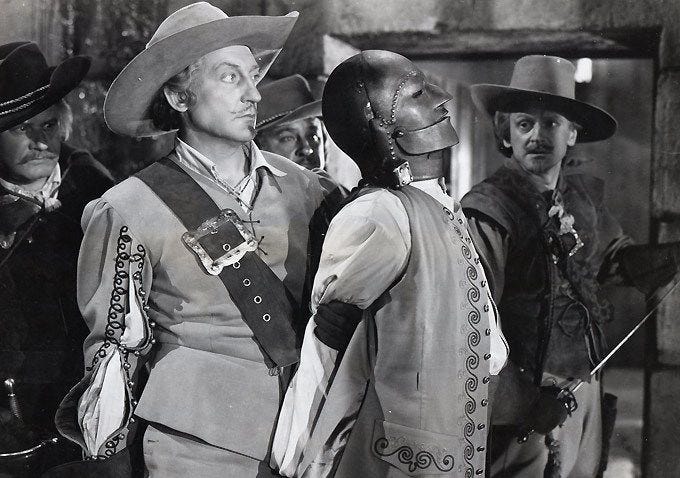
The closer analogue, I think, is The Man in the Iron Mask.
Not because both films contain prisoners. Because both understand imprisonment as a political act.
Sometimes a prisoner is locked away because he’s dangerous. Sometimes he’s locked away because his very existence threatens the official story.
Japanese folklore already knows this shape, and from closer to home than Alexandre Dumas. The onryō — the vengeful spirit born of unjust confinement or wrongful death — is a stock figure precisely because unresolved imprisonment was never trusted to stay contained. The Samurai and the Prisoner secularizes that old fear. Kanbei’s cell doesn’t produce a ghost. It produces the one thing the castle is most afraid of: the truth.
That distinction becomes literal about halfway through the film. A guard beats Kanbei in his cell — and Kanbei, chained and bleeding, whispers something into the man’s ear that the audience never hears. Moments later the guard turns and attacks Murashige, who cuts him down. Kanbei remarks, afterward, that he’s capable of killing from inside a locked cell. It’s a small scene, almost a throwaway, and it recalls Mamiya’s mesmeric killings in Cure — Kurosawa’s 1997 breakthrough, in which a drifter needs no weapon at all to make ordinary people commit murder. The lock on the door was never the thing keeping anyone safe.
That’s the idea Kurosawa’s film keeps returning to. The prisoner isn’t simply another suspect or another witness. He’s a contradiction that refuses to disappear, a reminder that power often depends less on defeating the truth than on containing it.
By the end, the mystery almost feels secondary. The murders matter, of course, but they’re really symptoms. The deeper question is whether any political order built on secrecy, fear, and carefully managed narratives can remain stable once those narratives begin to fracture.
That’s what I found myself thinking about as I left the interview.
I’d spent a half-hour asking Kiyoshi Kurosawa questions about making movies. The film, meanwhile, had been asking me questions about genre.
It arrived wearing the clothes of a samurai epic. It borrowed the investigative engine of a medieval murder mystery. And somewhere deep inside, it inherited the political imagination of a story about a prisoner whose existence threatened an entire kingdom.
None of those donors, on its own, explains what the film becomes. Throne of Blood is a tragedy of one man’s conscience, not an institution’s; it never asks whether truth can survive a system built to bury it. The Name of the Rose comes closer, but its abbey burns while its church endures. Iron Mask is a costume drama at heart, more interested in twins than institutions.
By the film’s climactic confrontation, Murashige finally stands face to face with the person behind the season’s schemes. After two and a half hours of Kurosawa holding his camera at a careful, deliberate distance, the two men’s bodies collide for the first time in the film — faces suddenly, violently close. No blade is drawn. It’s the most violent image in the movie anyway. That’s the shot none of the three donors could have handed him on their own: not Throne of Blood’s solitary guilt, not The Name of the Rose’s institutional unmasking, not Iron Mask’s political theater. It took Kurosawa’s own patience, held for two and a half hours, to make proximity itself feel like violence.
The body always looks familiar.
It’s only after you open it up that you discover where all the parts came from.
I’m currently transcribing the interview with Kurosawa for a larger project. I look forward to updating you all as it proceeds! -Andy
Thanks for reading Andy Might! This post is public so feel free to share it.
Comments
Nothing yet. Say the first thing.
Sign in to join the conversation.