
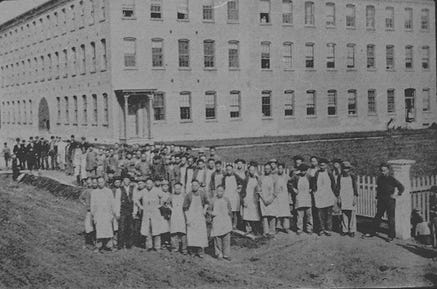
There they are, lined up in front of a shoe factory in North Adams, Massachusetts.
Seventy-five Chinese men and boys, recently arrived from California, stand in several rows beneath the factory windows. Factory owner Calvin T. Sampson had transported them more than 3,000 miles to replace his striking employees. Then, before the newcomers had properly entered the life awaiting them, he stopped the procession and had them photographed.
The image is the starting point for Anthony W. Lee’s remarkable book A Shoemaker’s Story, which treats the photograph not as an illustration of history but as the scene of the historical action itself. Lee reconstructs what the manufacturer, the photographers, the union, the Chinese workers, and the people who later encountered the image believed they were seeing. The photograph contains an argument about labor before anyone has written a caption beneath it.
Sampson may have intended it as proof of victory.
The workers had been brought to North Adams because the existing labor force had become inconvenient.
By 1870, North Adams was a booming industrial town. Its mills and factories produced millions of dollars in goods each year, while shoemaking, once a skilled and relatively independent craft, was being reorganized around machinery and factory discipline. Sampson’s factory employed roughly 150 people and produced hundreds of thousands of pairs of shoes annually. Mechanization allowed manufacturers to divide production into smaller tasks, making individual workers easier to train and, from management’s perspective, easier to replace.
The workers understood what that transformation meant. Many belonged to the Order of the Knights of St. Crispin, then the largest labor organization in the United States. Named for the patron saint of shoemakers, the Crispins attempted to protect wages and preserve workers’ control over their trade as factory owners steadily dismantled both.
The immediate dispute began when Sampson demanded a 10 percent wage reduction during the industry’s slow season. His workers walked out. He tried to replace them with European immigrants, French Canadians, and native-born Americans, but the union persuaded many of the replacements not to remain.
Sampson responded by widening the labor market to the size of a continent.
He sent his superintendent, George W. Chase, to San Francisco to recruit Chinese workers. There, Chase worked through a Chinese labor contractor and assembled a group of seventy-five young Chinese laborers already living in California. Most were between sixteen and twenty-two years old. They apparently did not know they had been hired to break a strike.
That ignorance was useful to the employer.
The Chinese workers were not the architects of Sampson’s labor strategy. They were its raw material. They had been offered stable employment after years of economic uncertainty in California. Instead, they were dropped into the middle of a labor dispute they neither created nor fully understood, then watched as the town and the national press transformed their arrival into a racial spectacle.
The transcontinental railroad had been completed only the year before. Celebrated as the great machine that would bind the nation together, it was almost immediately used to move replacement labor from one coast to the other. The railroad did not merely connect markets. It allowed employers to reach beyond the workers standing outside their own gates.
On June 13, 1870, the train carrying the Chinese workers arrived in North Adams.
Hundreds, and by some accounts thousands, of residents gathered at the depot. Many had never seen a Chinese person before. Police escorted the newcomers through the crowd toward Sampson’s factory. No major violence erupted, but the atmosphere was tense enough that protection was considered necessary. The men had traveled across the continent only to discover that before they had even begun work, they had become a public spectacle.
Then came the photograph.
The crowd reportedly fell quiet as Sampson arranged the workers along the factory wall. The camera imposed order on what had been a volatile arrival. Seventy-five individual journeys became one rectangular image: Sampson’s new workforce, visible and countable.
The photograph could be read as a trophy. The strike had been broken. The union could no longer claim that Sampson had no alternatives. Behind the workers stood the factory. Behind the camera stood the owner. Somewhere beyond the frame stood the men whose jobs they had been brought to take.
Within days, the Chinese workers were operating the machinery. Contemporary reports praised their speed, discipline, and productivity. Because they were paid less than the unionized workers they replaced, newspapers sympathetic to industry celebrated the experiment as proof that manufacturers had found a more efficient workforce. Sampson eventually recruited fifty more Chinese laborers.
The employer got exactly what he wanted.
The strike was broken. Many of the original employees returned to work under the reduced wages.
Yet the supposed success of the “Chinese experiment” was never a neutral discovery about Chinese workers. Sampson had selected a vulnerable workforce, transported it into an unfamiliar town, housed it under conditions he largely controlled, and used cultural and linguistic isolation to limit its bargaining power. Employers and sympathetic newspapers then presented the resulting obedience as a racial characteristic rather than the product of an engineered situation.
The Chinese workers were praised only insofar as their presence could be used against other workers.
Pro-industrialist newspapers described them as quiet, industrious, eager to learn, and superior to the troublesome union laborers who had walked out. Their willingness to work became evidence that the dispute had been caused not by falling wages or industrial restructuring but by the stubbornness of organized labor.
Other newspapers reached almost the opposite conclusion while using equally racialized language. Labor advocates warned that Chinese immigration would allow manufacturers to import a permanent workforce willing to accept lower wages. Rather than focus exclusively on the employer who had designed the confrontation, they increasingly turned the Chinese worker into a symbol of economic displacement.
The familiar narrative was already taking shape: immigrants arrive, wages fall, native workers suffer.
Management disappears from the sentence.
The North Adams episode became national news because it offered an unusually vivid story through which Americans could argue about industrialization. Historian Mary M. Cronin found more than 25,000 newspaper references to the arrival of the Chinese workers during the following year. Newspapers copied one another’s reporting until a relatively small event in western Massachusetts became a national referendum on immigration, race, labor, and capitalism.
The debate quickly expanded beyond the factory. Could Chinese immigrants assimilate? Could they become citizens? Were they racially compatible with American society? Were they industrious newcomers or instruments of capital? Had organized labor become tyrannical, or were industrialists using immigration to create a new form of wage servitude?
The seventy-five workers were discussed as almost everything except seventy-five people.
Thomas Nast captured the frenzy in an August 1870 Harper’s Weekly cartoon titled “The New Comet.” Americans from every social class peer through telescopes as Chinese labor streaks across the nation’s sky like an approaching celestial body. The metaphor transformed a small group of workers into a national phenomenon.
North Adams did not create anti-Chinese politics. Those currents had already been building for years, especially in California. But the episode helped nationalize them. It demonstrated that Chinese labor could be transported anywhere employers needed it. The imagined threat was no longer confined to western mines and railroads.
Twelve years later, Congress passed the Chinese Exclusion Act, the first major federal law to prohibit immigration based on nationality. The arguments sounded remarkably familiar: Chinese workers supposedly depressed wages, resisted assimilation, and threatened the economic security of American labor.
The political trick was devastatingly effective.
An employer recruited immigrants to weaken his workforce.
The displaced workers were encouraged to blame the immigrants rather than the employer.
Newspapers converted an economic conflict into a racial one.
Politicians eventually offered immigration restriction as the solution to an economic arrangement created by capital.
It is a pattern that has repeated itself often enough that the story feels less like a historical curiosity than an operating manual.
Which brings us back to the photograph. At first glance it appears to show Sampson’s triumph: the strike broken, the replacements assembled, the factory ready to resume production. But the longer one looks, the less stable the image becomes.
Sampson is nowhere to be seen.
Neither are the union leaders.
Neither are the newspaper editors who transformed seventy-five workers into a national controversy.
Neither are the politicians who would later build exclusion into federal law.
Only the workers remain.
They stand against the factory wall before the country has decided what they mean. They have not yet become efficient laborers, racial competitors, strikebreakers, model immigrants, or evidence for exclusion. For one suspended instant, before the headlines, editorials, and political speeches accumulated around them, they are simply seventy-five young men who crossed a continent in search of work and found a camera waiting for them.
Works Cited
Cronin, Mary M. “When the Chinese Came to Massachusetts: Ethnicity, Race, and Newspaper Coverage of the North Adams Chinese Strikebreakers.” Historical Journal of Massachusetts 46, no. 2 (Summer 2018): 74–105.
Lee, Anthony W. A Shoemaker’s Story: Being Chiefly about French Canadian Immigrants, Enterprising Photographers, Rascal Yankees, and Chinese Cobblers in a Nineteenth-Century Factory Town. Princeton, NJ: Princeton University Press, 2008.
Massachusetts Foundation for the Humanities. “Chinese Workers Arrive in North Adams.” Mass Moments. https://www.massmoments.org/moment-details/chinese-workers-arrive-in-north-adams.html
Harper’s Weekly. “The Chinese in New England.” July 30, 1870.
Nast, Thomas. “The New Comet.” Harper’s Weekly. August 6, 1870.
PBS. American Experience: The Chinese Exclusion Act. Directed by Ric Burns and Li-Shin Yu. WGBH Educational Foundation, 2017., Mary M. “When the Chinese Came to Massachusetts: Ethnicity, Race, and Newspaper Coverage of the North Adams Chinese Strikebreakers.” Historical Journal of Massachusetts 46, no. 2 (Summer 2018): 74–105.
Lee, Anthony W. A Shoemaker’s Story: Being Chiefly about French Canadian Immigrants, Enterprising Photographers, Rascal Yankees, and Chinese Cobblers in a Nineteenth-Century Factory Town. Princeton, NJ: Princeton University Press, 2008.
Massachusetts Foundation for the Humanities. “Chinese Workers Arrive in North Adams.” Mass Moments. https://www.massmoments.org/moment-details/chinese-workers-arrive-in-north-adams.html
Harper’s Weekly. “The Chinese in New England.” July 30, 1870.
Nast, Thomas. “The New Comet.” Harper’s Weekly. August 6, 1870.
PBS. American Experience: The Chinese Exclusion Act. Directed by Ric Burns and Li-Shin Yu. WGBH Educational Foundation, 2017.
Comments
Nothing yet. Say the first thing.
Sign in to join the conversation.