
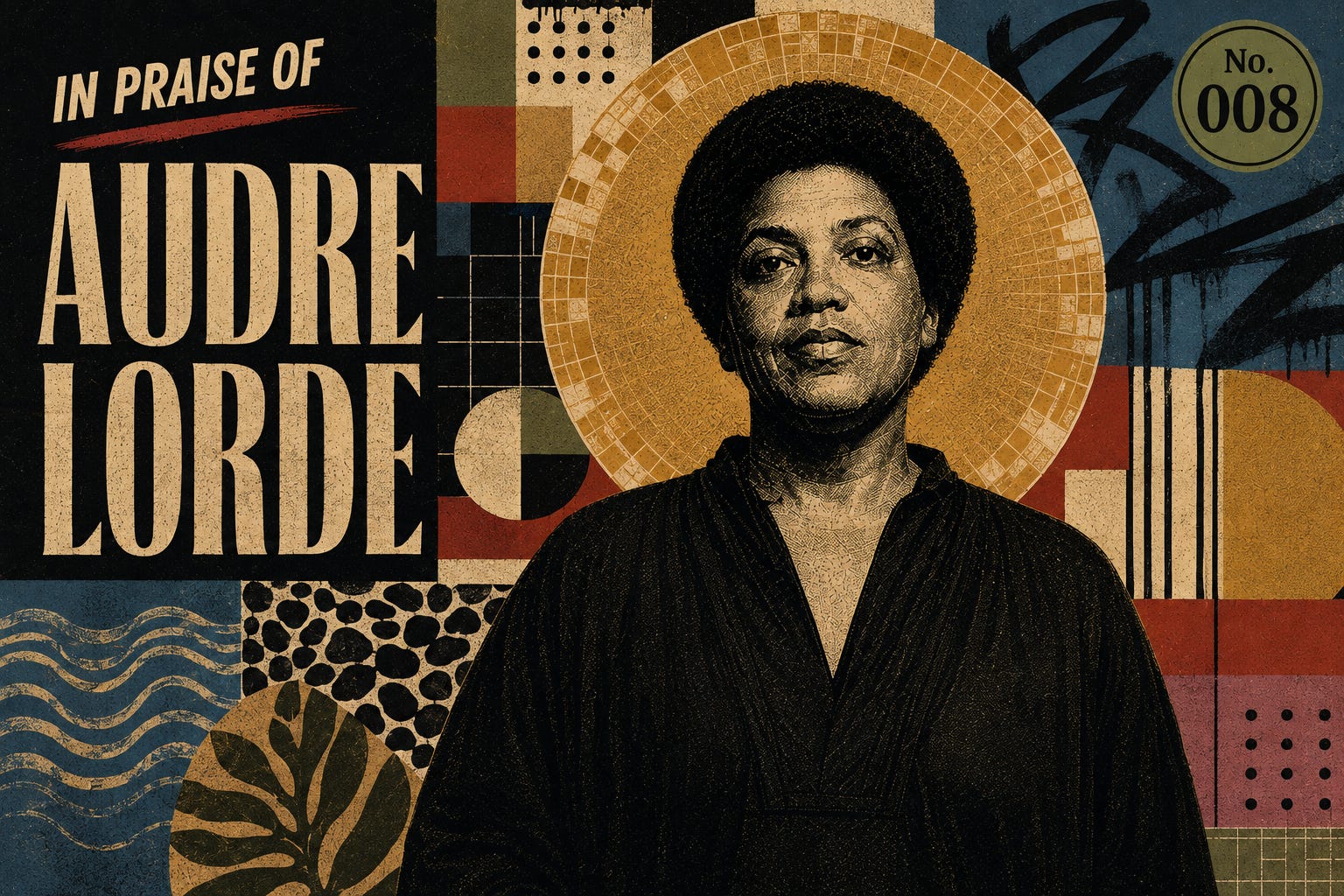
I first read Audre Lorde as a freshman at Ohio State, in an upper-division Queer Literature class I had petitioned to get into. I don’t remember now what argument I made for admitting me. I do remember the sensation of entering a room where everyone seemed to have read more than I had, knew words I didn’t know, and possessed some map of queer culture that I was only beginning to discover. Somewhere on that syllabus was Audre Lorde.
There are writers you encounter at exactly the moment you have acquired the language necessary to understand them. And then there are writers who give you the language. Lorde was the second kind.
Which is fitting, because Audre Lorde began on the other side of that exchange.
As a child, when someone asked how she was feeling, she sometimes answered by reciting a poem she had memorized. Before she was giving language to people like me, she was borrowing it from poets herself. Eventually she encountered feelings for which she couldn’t find a poem, so she wrote one. Poetry, before it became vocation or politics or literature, gave her somewhere to put an experience that otherwise had no words.
If you’ve never read Audre Lorde, this is a good place to begin. Born in Harlem in 1934 to Caribbean immigrant parents, Lorde became one of the most influential American poets and essayists of the twentieth century, writing about Blackness, lesbian desire, motherhood, anger, illness, racism and feminism—and, more importantly, about what happens when several of those things occupy the same body at the same time. She famously described herself as “Black, lesbian, mother, warrior, poet,” refusing to choose one noun that would explain all the others.
She had been altering language since childhood. Born Audrey Geraldine Lorde, she dropped the y from Audrey because she preferred the symmetry of Audre Lorde, two names ending in e. There was no manifesto behind it. She simply looked at the name she had been given and preferred another spelling.
It is tempting to make too much of a child’s aesthetic decision. It is also difficult, knowing what came later, not to notice it.
At fifteen, Lorde submitted a poem to her high school literary magazine. They rejected it as inappropriate. She sent it to Seventeen instead, and they published it. She later became a librarian, earning a master’s degree in library science from Columbia and working in New York schools before poetry became the center of her professional life. Her first collection, The First Cities, appeared in 1968, followed by books including Cables to Rage, Coal and The Black Unicorn.
Lorde’s poems don’t treat words as transparent containers for meaning. Words have bodies. They glitter, clot, cut, lodge in the throat. They are dug from somewhere.
In Coal, Lorde opens with the grammatically strange declaration, “I / Is the total black.” The expected verb collapses. The I isn’t simply describing Blackness; it enters it, becomes material. Coal lies underground under tremendous pressure, carbon capable of becoming diamond, and Lorde turns that geological pressure into a way of thinking about language. Some words emerge crystalline. Others arrive wounded or snarled. One comes out like an “ill-pulled tooth.” Language in Lorde is rarely clean. Getting something from the darkness inside the self into the world can hurt.
She once described poetry as the means by which we give names to ideas that remain “nameless and formless” until the poem brings them forward. That may be the key to reading her. Lorde trusted feeling before it had been tidied into argument. Something could be known in the body before the mind possessed the vocabulary to explain it. Poetry was the passage between those states: feeling acquiring shape, rhythm, breath, and finally a name.
Her 1978 collection The Black Unicorn widens that vocabulary through African mythology, female divinities, ancestry, motherhood and lesbian desire. The unicorn itself is not the delicate white creature wandering through European tapestries. Lorde’s is Black and restless, impatient with captivity. Rather than searching the Western tradition for a symbol that might approximately contain her, Lorde makes a symbolic world in which she can appear whole.
This is also what makes “A Litany for Survival” so enduring. The poem addresses those who live “at the shoreline,” people for whom safety has always been provisional. Fear accompanies every possibility: when there is food, the fear of hunger; when there is love, the fear of losing it; when there is speech, the fear that nobody will listen. Silence offers no refuge either.
Lorde does not promise fearlessness. She gives fear a language and then speaks from inside it.
By the time I encountered her in that college classroom, Lorde had been dead only a few years, although to an eighteen-year-old this placed her somewhere in the vast geological epoch known as The Past. I didn’t yet understand how much of the vocabulary surrounding me had been fought for by writers like her. Words that seemed simply to exist had histories. Somebody had needed them before there was a name for what they meant.
In 1982, Lorde made that process the subject of an entire book. Zami: A New Spelling of My Name contains childhood, racism, work, friendship, sex, migration, her mother’s Caribbean history and the community of women Lorde encountered as a young lesbian in New York. “Autobiography” couldn’t quite hold it, so Lorde called the book a biomythography. Biography mingles with history, memory and myth. Scholarship has consequently read Zami as a form of life-writing that searches for a home partly by creating a literary form capable of containing the life being written.
And then there is that subtitle: A New Spelling of My Name.
Once the revision had been Audrey to Audre, one letter removed because the new arrangement pleased her eye. Now Lorde imagined spelling a name with things other than letters. Audre Lorde is spelled by her mother and her lovers, Harlem and the Caribbean, racism and friendship, kitchens and bedrooms, other women’s bodies and stories. The borders around autobiography become porous. Other people have left fingerprints all over the self.
Even her body would eventually require another vocabulary.
Lorde was diagnosed with breast cancer in 1978 and underwent a mastectomy. In The Cancer Journals, published two years later, she writes from inside an experience for which medicine already had plenty of terminology. Diagnosis. Patient. Surgery. Recovery. Yet clinical language could describe what had been removed without describing what the removal meant.
Lorde was especially furious about the expectation that women who had undergone mastectomies should wear prosthetic breasts, restoring the appearance of an unchanged body. Conceal the absence and survivors disappear from one another. Lorde wanted the evidence visible. Her later illness writing continued this habit of taking familiar metaphors of disease and stretching or challenging them until they could accommodate the experience she was actually living.
The body becomes another text she refuses to let somebody else correct.
That insistence eventually crossed an ocean. Beginning in the 1980s, Lorde spent significant periods teaching in West Berlin, where her relationships with Black German women helped catalyze an emerging Afro-German movement. Here the question of naming escaped the individual altogether. Language could allow people who had experienced themselves as isolated exceptions to recognize a shared history. A word could become a meeting place.
Near the end of her life, after years of living with cancer, another name was bestowed upon Lorde during a ceremony in St. Croix: Gamba Adisa. Jewelle Gomez records its meaning as “Warrior—She who makes her meaning known.”
The phrase feels almost too perfectly written.
Not because Lorde arranged her life into a neat literary metaphor. She spent too much of her career distrusting neat categories for that. But consider the distance traveled. A little girl cannot always explain how she feels, so she borrows poems. When the poem she needs doesn’t exist, she writes it. Audrey becomes Audre. Feelings become poems. Autobiography becomes biomythography. A life becomes Zami. Illness becomes The Cancer Journals. Experiences without names acquire them.
And finally, she becomes She Who Makes Her Meaning Known.
Audre Lorde died in 1992 at fifty-eight. Since then, countless people have found themselves doing exactly what she did as a child. They encounter something they cannot quite articulate—anger, fear, difference, desire, illness, survival—and go looking for words somebody else has already arranged correctly. They find a Lorde poem, an essay, a passage from Zami, perhaps even one of those quotations passed from stranger to stranger until the source has nearly disappeared.
Here. This is what I mean.
I was one of them, sitting in a college classroom I had petitioned to enter, beginning to understand that there was an entire queer literary history I had never been taught.
Audre Lorde began her life borrowing the language of poets because she needed words for herself. Somewhere along the way, she became one of the poets we borrow language from.
Comments
Nothing yet. Say the first thing.
Sign in to join the conversation.