
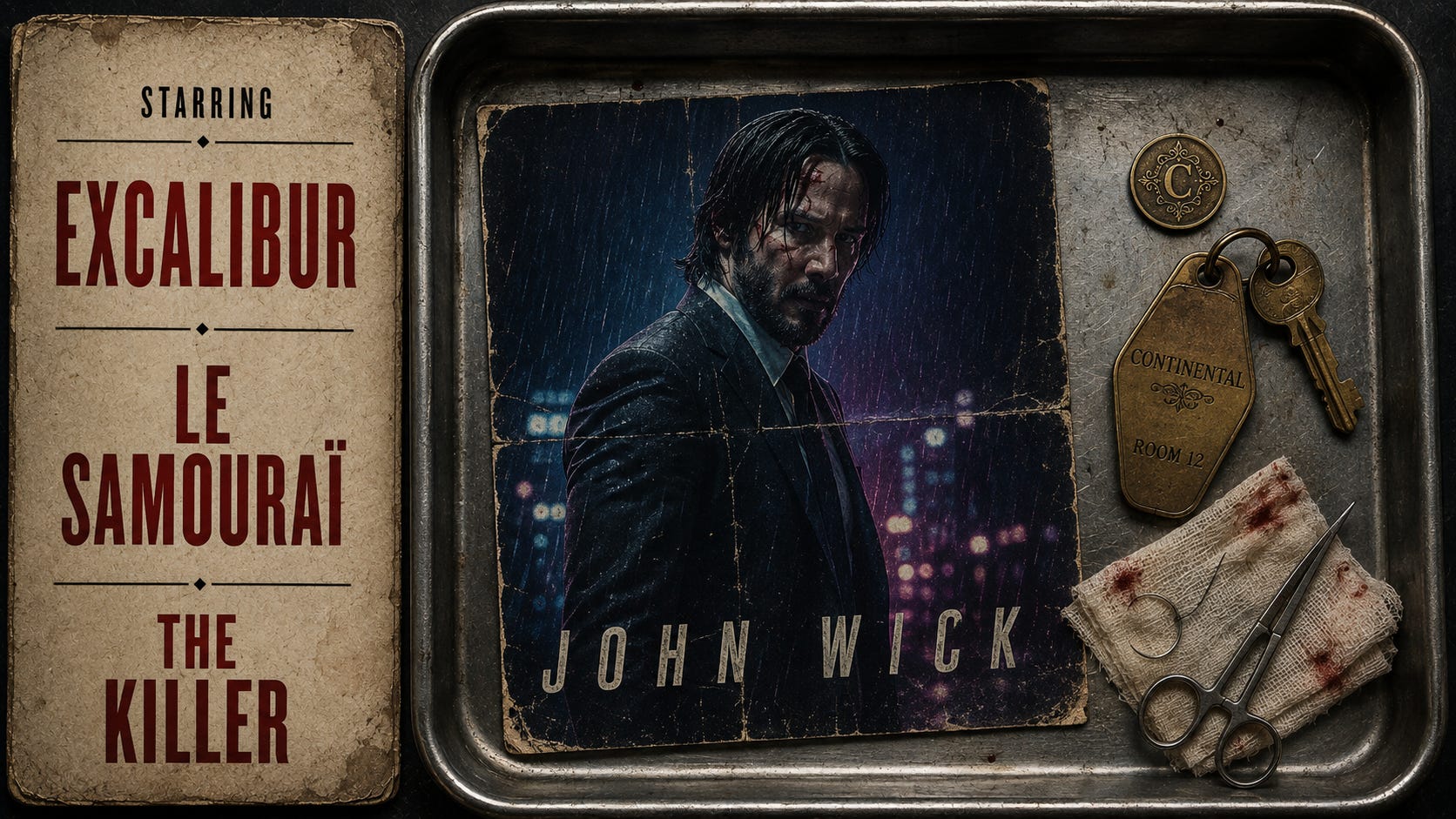
John Wick is a movie about a man avenging his puppy in roughly the same sense that Excalibur is a movie about a man pulling a sword out of a rock.
Both descriptions are technically accurate. Neither explains why anyone cares.
A quick refresher, because John Wick came out in 2014 and you probably remember the dog better than the plot: Keanu Reeves plays John Wick, a legendary assassin who left organized crime to marry Helen. When the film begins, Helen has just died of cancer. Before her death, she arranged for a puppy named Daisy to be delivered to John so he would have something to love after she was gone.
Then a spoiled young gangster breaks into John’s house, steals his beloved Mustang, and kills Daisy.
Unfortunately, the kid has no idea whose dog he just killed.
Cut John Wick open and that’s where things get interesting. Beneath the revenge movie is something much older: a medieval romance wearing a tailored suit.
Skeleton: Excalibur (1981)
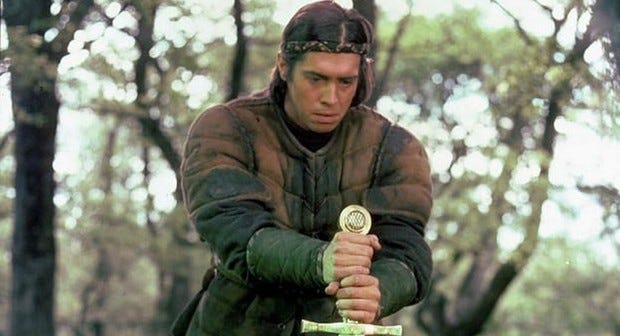
After stealing John’s car, the young gangster, Iosef, takes it to a chop shop. The owner, Aurelio, recognizes it immediately and punches him in the face rather than touch it.
Iosef doesn’t understand why.
His father does.
Iosef is the son of Viggo Tarasov, the Russian crime boss John once worked for. When Viggo learns what his son has done—and, more importantly, who he did it to—his response is one syllable:
“Oh.”
That’s the moment John Wick changes registers. Until then, we’ve been watching a crime thriller about a grieving widower. Suddenly we’re hearing a legend.
Viggo explains that John wasn’t merely one of his assassins. He was the man sent to kill the people you couldn’t kill. Years earlier, when John wanted to leave the criminal world for Helen, Viggo gave him an impossible final assignment. John completed it anyway. The bodies he left behind helped build Viggo’s criminal empire.
Iosef thought he robbed some middle-aged guy at a gas station. He has actually awakened the monster his father’s generation tells stories about.
The movie even gives John a folkloric nickname, Baba Yaga. The Russian mythology is mangled—Baba Yaga isn’t really the “Boogeyman” the movie claims—but accuracy isn’t the point. John has become larger than an individual man. His reputation precedes him.
Arthur works the same way. The king becomes larger than the man because stories have accumulated around him.
And when John Wick begins, John has already abdicated.
He left his kingdom for Helen. He exchanged the legendary assassin for an ordinary identity: husband, house, car, grief. Daisy is Helen’s final attempt to keep that life going after her death.
So when Iosef kills the puppy, he isn’t simply killing something John loves. He kills the future Helen left him.
John goes into the basement.
His old weapons aren’t sitting conveniently in a gun safe. He sealed them inside a case and buried them beneath concrete. Leaving the assassin world required an actual burial. Now he takes a sledgehammer to the floor.
The future has been killed. John excavates the past.
Excalibur understands this kind of object. Arthur’s sword isn’t simply a weapon; it’s the material form of an identity. To take it up is to become the king again. John doesn’t go shopping for new guns. He retrieves the weapons he buried when he stopped being John Wick.
The old king has drawn the sword.
Heart: Le Samouraï (1967)
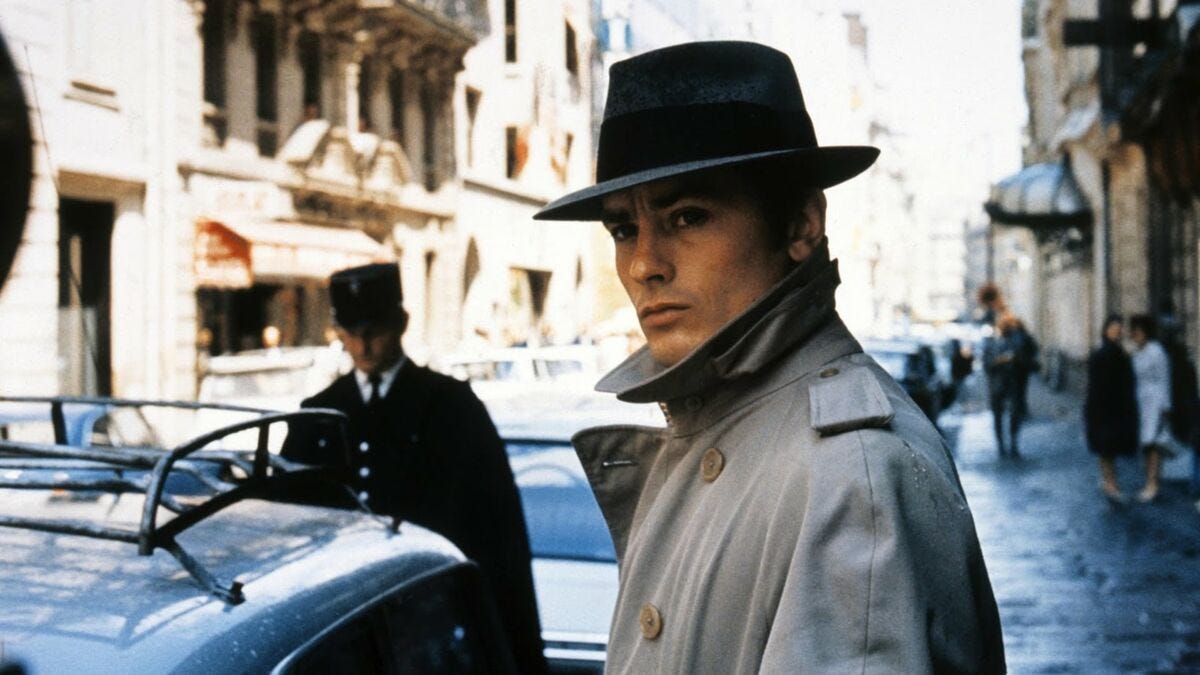
If Excalibur explains why John Wick feels mythic, Jean-Pierre Melville’s Le Samouraï explains why he feels lonely.
Chad Stahelski has cited Melville’s 1967 film as an influence. Alain Delon plays Jef Costello, a Parisian contract killer who has reduced existence to ritual. He dresses precisely, prepares methodically, speaks only when necessary. His apartment barely looks inhabited. Killing hasn’t interrupted his life. Killing has become the structure of his life.
John is built from the same emptiness.
Once John returns to the criminal underworld, something disturbing happens: he fits.
People recognize him. Doors open. A bartender knows what he drinks. Winston, the urbane manager of the Continental—a hotel that serves as neutral territory for professional assassins—knows his history. When John needs dead bodies removed from his house, he knows exactly whom to call.
The assassin world recognizes John more completely than ordinary life does.
That’s the melancholy underneath the wish fulfillment. John hasn’t returned to a world that no longer fits him. He’s returned to one that fits him perfectly.
Le Samouraï supplies the unsettling possibility at the heart of John Wick: supreme competence can itself be tragic. Helen gave John another way to exist. Without her, the frightening question isn’t whether he can become the legendary assassin again.
It’s whether he ever stopped being him.
Skin: The Killer (1989)
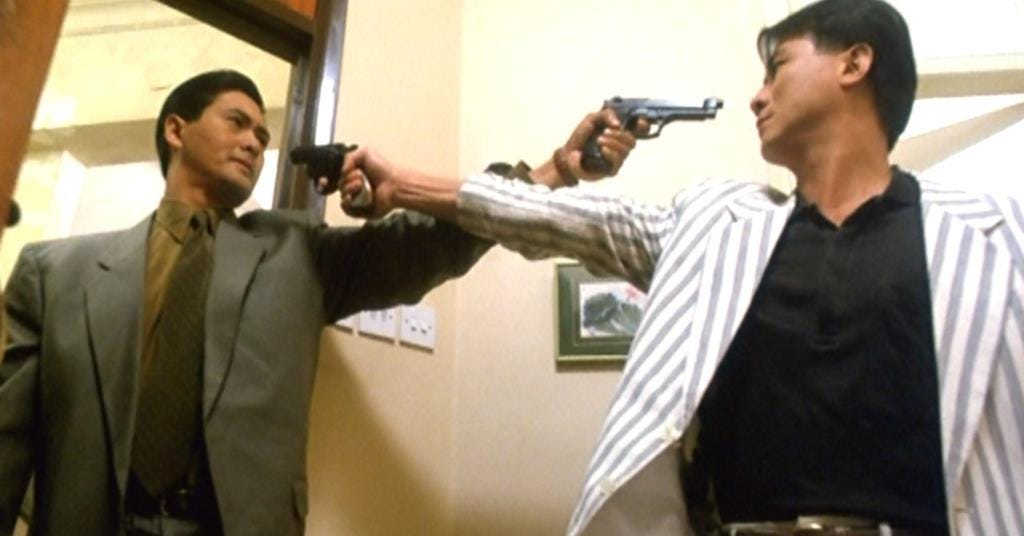
Then John Woo makes the whole thing beautiful.
Stahelski has also acknowledged Woo as an influence, and The Killer gives John Wick its physical vocabulary: violence as choreography.
The film arrived after years in which Hollywood action frequently chopped fights into close-ups, rapid editing, and shaking cameras. Stahelski, himself a former stunt performer, goes in the other direction.
The body is the special effect.
John shoots, grapples, throws, reloads, and shoots again while the camera stays far enough away for us to understand what his body is doing. The nightclub sequence becomes less a collection of kills than a constantly changing physical problem that John—and Reeves—has to solve.
Woo had already discovered how close gunplay could come to dance. Stahelski loses the doves and operatic romanticism and substitutes neon, concrete, tailored suits, and electronic music. The central pleasure survives: violence becomes expressive.
Keanu Reeves brings something else. Film theorist Richard Dyer argues that stars arrive carrying meanings accumulated across their previous roles and public lives. By 2014, Reeves carried two seemingly contradictory images: the extraordinary physical body of Point Break, Speed, and The Matrix, and the melancholy, solitary figure crystallized by the “Sad Keanu” meme.
John Wick needs both.
The body remembers Neo. The face remembers Sad Keanu.
Genre Vacancy
Something curious happens as the series continues: John Wick begins checking out of the genre it arrived in.
The original can still pass for a revenge thriller with hints of a strange secret society. The Continental hotel, its mysterious gold coins, and its rule forbidding violence on hotel grounds are mostly background texture.
The sequels decide the background is more interesting than the foreground.
Chapter 2 expands this underworld into an international hierarchy of blood oaths, powerful families, and the High Table. Parabellum turns John’s exile into something closer to a martial-arts quest, complete with ordeals, masters, sanctuaries, and warrior castes. By Chapter 4, the series moves freely through the Western, samurai film, wuxia, anime, and epic.
I think of this as genre shift: a franchise keeps its characters and iconography while the genre underneath them changes.
Even the action shifts. Stahelski has cited Buster Keaton, Harold Lloyd, Fred Astaire, and Gene Kelly alongside martial-arts filmmakers. By Chapter 4, fights start resembling production numbers. Introduce a space—the Arc de Triomphe, an abandoned building, a monumental staircase—and exhaust every possible physical variation upon it.
The body that began in The Killer has wandered into a musical.
But when a franchise checks out of one genre, it can leave a vacancy behind.
The first John Wick had itself checked into one. It arrived at a moment when Hollywood had largely moved away from the particular pleasures of legible physical action, practical choreography, and the hypercompetent professional. As Wick became increasingly mythic and spectacular, that earlier appetite didn’t disappear.
Nobody, written by John Wick screenwriter Derek Kolstad, moved neatly into the room Wick was leaving behind: domestic setting, underestimated middle-aged man, concealed violent past, sudden eruption of terrifying competence.
Maybe genres work less like filing systems than hotels. Franchises check in, redecorate, knock down a few walls, and eventually move on. The room doesn’t disappear.
Someone else takes the key.
Thanks for reading Andy Might! This post is public so feel free to share it.
Comments
Nothing yet. Say the first thing.
Sign in to join the conversation.