
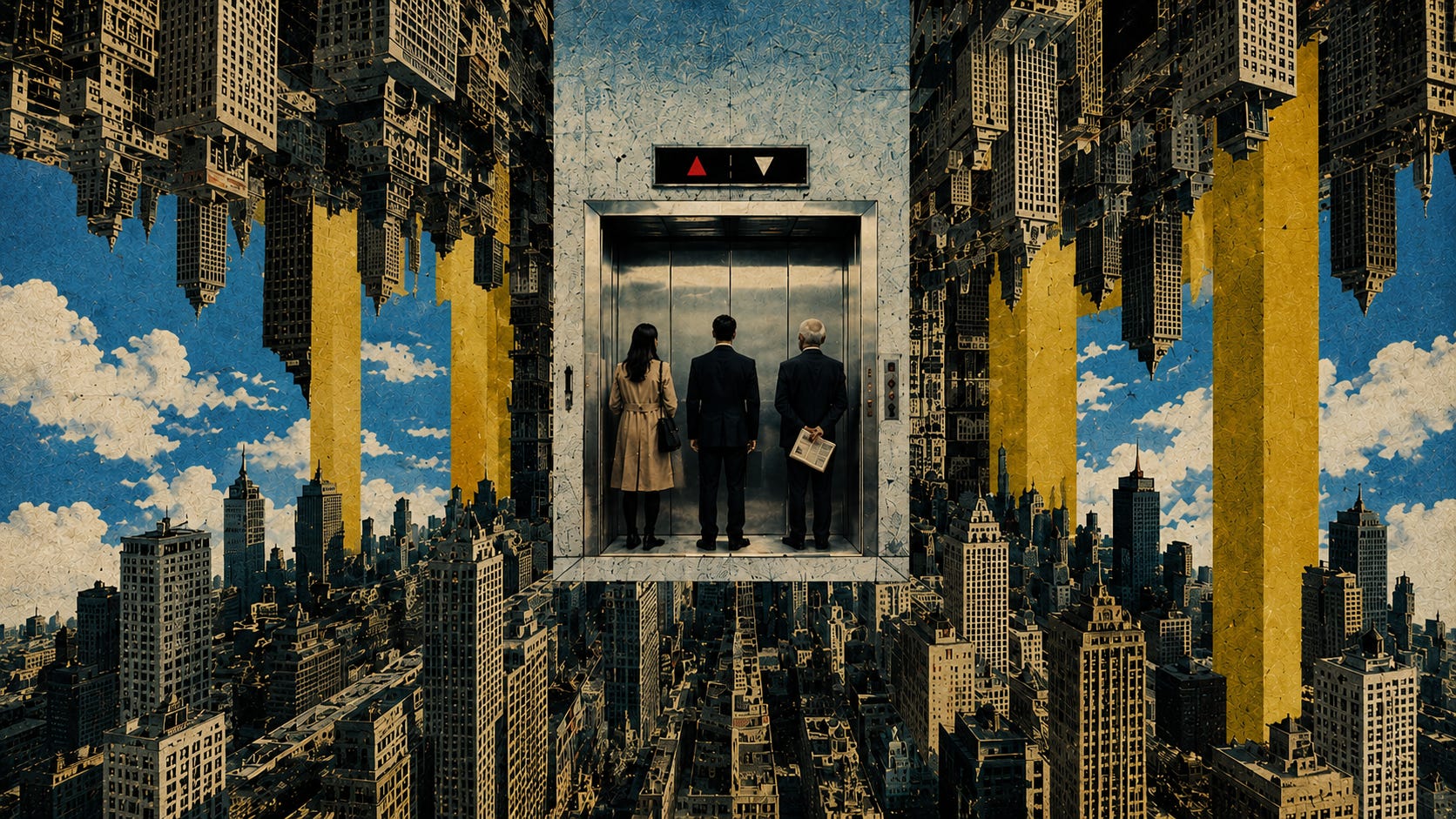
The button lights up and that’s it, that’s the whole transaction, you pressed it and now you’re just a request in a queue you can’t see. Somewhere above you cables and algorithms are already deciding things. You don’t get to check your work like you would with almost anything else in a day. No refresh. No second tap that does anything. You already did your part and it was small and now you’re standing here being obsolete in real time.
Stairs never do this to you. Stairs make you keep paying, floor by floor, so you always know what your effort bought you. There’s an honesty in that you mostly ignore in favor of the button.
Someone else arrives at the doors. Doesn’t look at you. Looks at the numbers instead, the way everyone does — six, four, seven again because somebody upstairs called it before you did. There’s a flicker of something almost like defeat in that, absurd as it is. Nobody’s racing you. And yet.
Third person now. A little congregation in front of a door none of you can open yourselves. Somewhere in here you think, for half a second, about Gaston Bachelard’s idea that a house has an attic and a cellar — one where the mind stays rational, one where the older fears actually live — and feel a little embarrassed about it, because a skyscraper doesn’t have a cellar. Every floor is attic. Nothing underneath you but daylight and clean geometry, stacked as high as the elevator is willing to take you.
You don’t think in sentences that clean in the hallway, obviously. You think about it later, writing this down. In the hallway you just think: the stairs would probably be faster. Every time. And every time you don’t take them, because you already pressed the button, and there’s a debt in that somehow. Having asked the building for something, you don’t get to walk out on the request.
The doors open. That small, briefly sacred rule everyone still obeys — the ones inside leave first, and you all shuffle half a step back, a courtesy nobody remembers agreeing to. Someone’s shoulder brushes yours. You get in.
Louis XV gets in with you.
Not the whole story of him, just a flash — Versailles, 1743, a chair on ropes, a mistress upstairs, a king who would rather build a private box than be seen taking the stairs to her. His little flying chair had doors before almost anything we’d recognize as an elevator did, and the doors weren’t really about safety. They were about discretion.
He rides with you for a floor or two.
Someone else gets on. Everyone rearranges into the same careful geometry, facing forward, a small temporary society that already knows it’s going to dissolve. Nobody knows where to put their hands. A phone comes out, held more than read. Two people who would never voluntarily stand this close to one another become intensely interested in the illuminated numbers over the door.
Near the buttons there’s a little framed certificate. A name, a date, a permit number. Some inspector you’ll never meet who’s been quietly riding in every elevator you’ve ever taken. You have no idea who this person is or what they checked or how carefully they checked it, but you’re currently trusting their signature with your body.
The numbers climb. Six, nine, twelve.
Louis XV is gone.
Before elevators, the shape of a building was almost upside down. The top floor could be the worst address there was — heat rose, and so did the stairs, and whoever had the least leverage ended up living closest to the sky. Servants. Students. Then the elevator separated ascent from climbing, and eventually the same height became the thing everyone wanted. The penthouse. The view. Privacy above the city.
Nothing about the height changed. Only who could afford not to climb it.
But the elevator did something stranger than make the top floor expensive. It changed how much city could fit on a piece of ground. Once people no longer had to climb every foot they rose, buildings could stop behaving like enlarged houses and start behaving like cities stood on end. Hundreds, then thousands of people could arrive at the same address every morning and disappear onto different floors, occupying rooms stacked directly above people doing completely different things.
Human beings spent most of history moving across the surface of the earth. Now you can work thirty stories above it and be irritated that getting there took forty seconds.
Someone gets off at nine. You can’t remember whether that was the person who came in with you.
There’s a mirror in the corner, slightly convex — a safety feature, not a vanity one. Built to catch a blind spot. You check yourself in it anyway. Dressed to Kill.
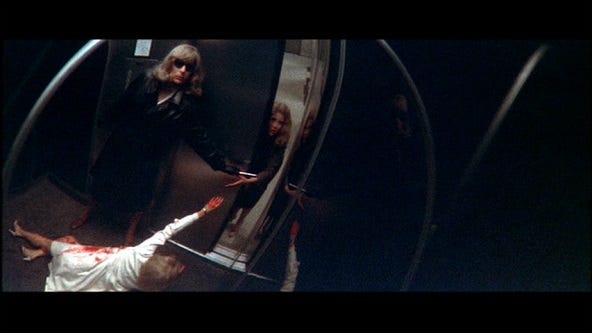
Brian De Palma’s elevator murder. Angie Dickinson entering the car and discovering someone already inside, the doors closing, the razor, the witness arriving too late. What sticks is the mirror: the killer caught in reflection, the audience seeing before it understands what it has seen. Blood on the buttons, those ordinary illuminated numbers you’d touch without thinking.
Which is maybe why elevators are so good at this.
A car looks like a vehicle. A train looks like a vehicle. An elevator looks like a room. Carpet. Lighting. Mirror. Walls. Then the doors close and the room changes addresses. Your eyes say you’re standing still while your inner ear knows perfectly well that you’re moving. Beneath your shoes is a shaft, and beneath that more shaft, and you’re trusting cables you can’t see, brakes you’ve never inspected and the signature of a stranger in a little frame.
The inspector is still there.
And somewhere in all this Kubrick arrives, because of course he does. He doesn’t even need the elevator car. Just the doors at the Overlook Hotel and what comes pouring through them in The Shining. Bachelard can keep his cellar. The dread finds a way upstairs anyway.
The Cecil Hotel tries to get on. Elisa Lam, alone in that elevator in Los Angeles, the footage everyone watched. You don’t let her. Some thoughts don’t belong to you just because they arrive.
You’re aware this is a lot for a forty-second ride.
Usually you kill these thoughts before they get through the doors.
You reach for your phone.
Forty seconds is apparently long enough to require filling now. A headline, a message, a photograph, anything you chose yourself rather than whatever was about to wander in. The doors close before it gets the chance.
But this time you leave the phone in your pocket.
And Steven Tyler gets in.
Love in an Elevator. Of course. Living it up when I’m going down.
You didn’t invite him. You’re humming before you notice you’re humming, some switch flipping the second a thought gets too heavy to carry in a box this size. Bachelard, class hierarchy, Angie Dickinson bleeding onto the buttons, a vertical city suspended above the earth, the abyss underneath your shoes — and now Steven Tyler, scarves and cheekbones and all.
There’s something almost merciful about how stupid the interruption is. No dread survives contact with Aerosmith.
You let him stay.
Someone gets off at twelve. Another person steps backward to make room. For a few seconds there are four of you again, close enough to touch and carefully pretending not to notice one another. Nobody speaks. The new person checks the numbers. You check them too, even though you know exactly where you’re going.
The little certificate stays bolted to the wall.
Your floor lights up.
The doors open and someone’s already stepping on before you’re fully off — that small breach of etiquette that never stops mildly irritating anyone. You turn sideways to get past them and step into a hallway indistinguishable from every other hallway in the building.
By now Bachelard is gone. De Palma too. You don’t remember when either of them left.
You’re still humming Aerosmith.
Of course Steven Tyler is the one who stays.
You walk toward your desk with him, quietly, while behind you the doors close and the elevator goes back to being nobody’s in particular, already descending toward someone else who pressed a button and is standing somewhere below, waiting for whatever arrives.
Comments
Nothing yet. Say the first thing.
Sign in to join the conversation.