
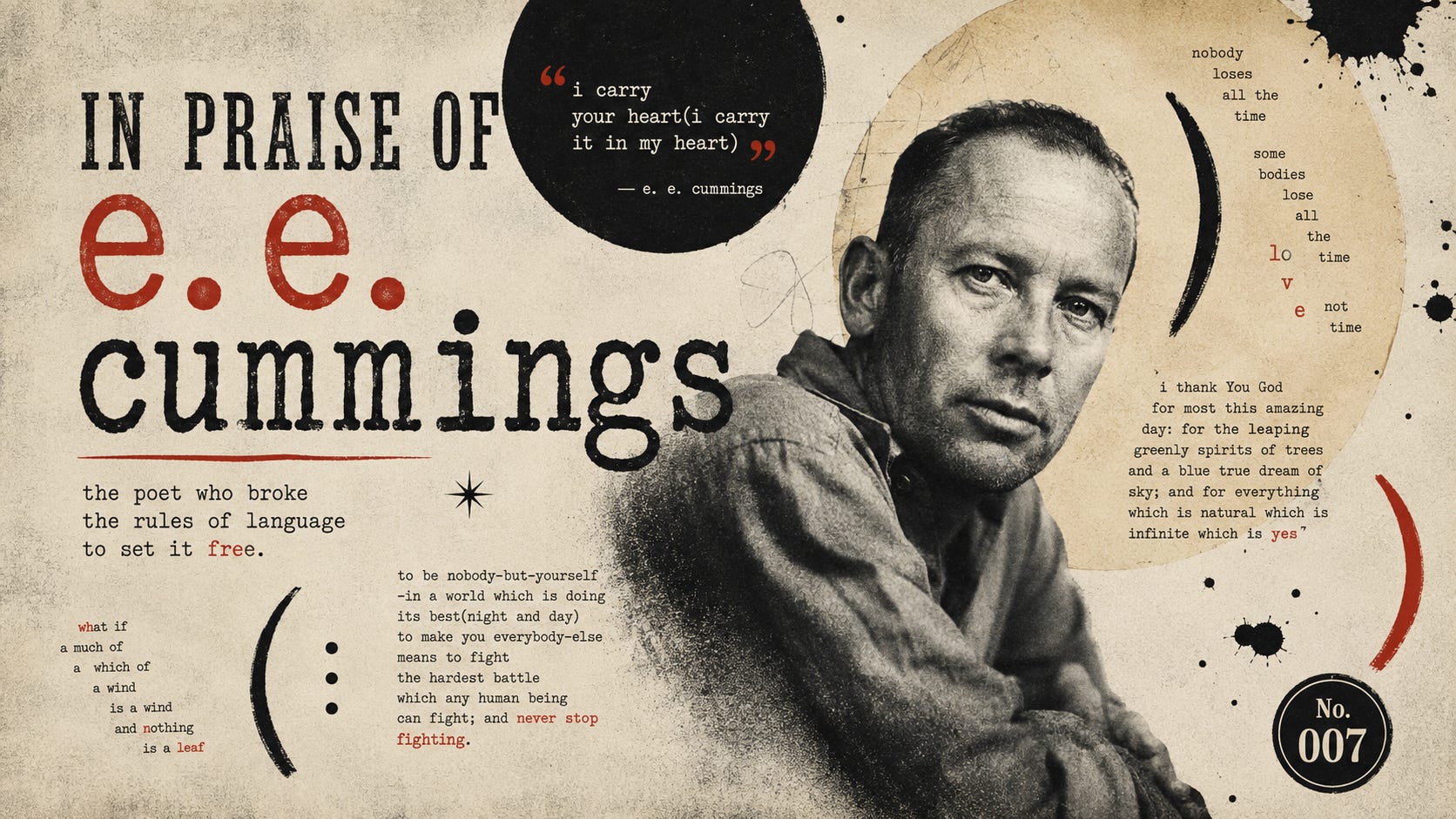
For most people, Cummings is the lowercase poet. The one who forgot where punctuation belonged. The poet whose work escaped into wedding invitations, coffee mugs, and Instagram captions until his radicalism became almost invisible.
It is a peculiar fate.
A writer who spent his career dismantling convention is now remembered as decorative.
His poems are often described as experimental.
I don’t think that’s quite right.
Experiments are trying to discover something.
Cummings already knew.
Language had become too obedient.
Words arrived alreadyuniformed, marching shoulder-to-shoulder toward conclusions they had been taught to reach. Nouns remained politely nounish. Verbs kept respectable hours. Parentheses(when permitted at all) stood quietly in the corner waiting to explain themselves.
Cummings smiled.
& quietly unlocked the cages.
Suddenly language became birdbusy.
Words tumbledintoeachother. Verbs nouned. Adjectives wandered off(with astonishinggoodmanners) to become weather. Parentheses(those marvelous little side-doors through which almostthoughts become actuallyalive) interrupted the interruption of another interruption. A sentence forgot it was a sentence and became a becoming.
Reading him can feel almost ridiculous.
Until it doesn’t.
You realize your eyes have slowed.
You are no longer reading through language.
You are reading language.
Every letter matters.
Every space.
Every tiny, apparently accidental collision between two words that had previously been introduced only under proper grammatical supervision.
The page becomes choreography.
Your eye leaps.
hesitates
returns
discovers that meaning has been waiting(not ahead of you but besideyou) all along.
People sometimes accuse him of making poetry difficult.
I think he made reading honest.
We skim because prose usually permits skimming. We consume because language has become frictionless. Cummings quietly places a pebble in the shoe of English. Suddenly every step announces itself.
His rebellion wasn’t simply typographical.
It was philosophical.
He distrusted anything that claimed to be inevitable.
Governments.
Wars.
Respectability.
The smug certainty of people who confuse rules with truth.
Having served as an ambulance driver during the First World War and later imprisoned by the French on suspicion of espionage, he understood how quickly institutions translate living people into paperwork.
Perhaps that is why his poems are so stubbornly alive.
Not alive in the sentimental sense.
Alive in the unrulysquirming stillbecoming notyetfinished sense.
His love poems remain among the greatest ever written because they never confuse love with ownership.
Love, for Cummings, is attention.
The kind of attention that notices the impossible curve of a smile before inventing a grammar capable of holding it.
The kind that suspects two people standing together are already creating a language no dictionary could anticipate.
For queer readers, there is another quiet gift.
Not because Cummings was writing queer poetry.
Because he demonstrates that form itself can refuse obedience.
Every generation inherits rules that insist they are simply reality.
This is how poems should look.
This is how sentences should move.
This is how love should sound.
Cummings answers with an irrepressible little parenthesis(why not?) and the whole structure suddenly wobbles.
Not enough to collapse.
Just enough for sunlight to get in.
Fashion dates.
Innovation becomes history.
But freedom, once discovered, has an inconvenient habit of remaining possible.
A century later, Cummings still whispers that English is far larger(and far less well-behaved) than we have allowed ourselves to imagine.
There are poets who leave us with beautiful lines.
Cummings leaves us with a beautiful suspicion.
That language itself has been pretending to be smaller than it really is.
Thanks for reading Andy Might! This post is public so feel free to share it.
Comments
Nothing yet. Say the first thing.
Sign in to join the conversation.