
Ireland’s best hotels don’t just assign you a room. They stage little acts of national identity. Their public spaces function as theaters for history, memory, weather, class, storytelling, and ritual — places where guests are absorbed into the Irish way of inhabiting the world.
Traveling across Ireland recently, I was struck by how differently hotels interpreted the task: an aristocratic estate outside Dublin, a polished city salon in Dublin, and a boutique property at the edge of the North Atlantic in Portrush—a seaside Ulster town where Irish tall tales blow in sideways with the rain. They’re all worth a look if you’re headed there.
Carton House
At Carton House, A Fairmont Managed Resort (the official title) the ritual begins with distance. It’s not physical miles — it sits barely forty minutes from Dublin Airport — but psychological.
You leave behind clogged ring roads (don’t get me started on Dublin’s airport) and flyovers to enter the old Anglo-Irish imagination: tree-lined drives, gravel crunching beneath tires, amd a Georgian symmetry trying very hard to convince you life is an artful balance between grace and beauty.
And the Fairmont folks pull it off in a very 21st Century way.
Carton House was once the seat of the Fitzgeralds, the Dukes of Leinster, perhaps the grandest aristocratic family the Irish ever produced besides the Boston Kennedys. Today the estate, like so many, has become a luxury hotel and golf resort, but what makes it fascinating is the way Carton House still holds on to its older self.
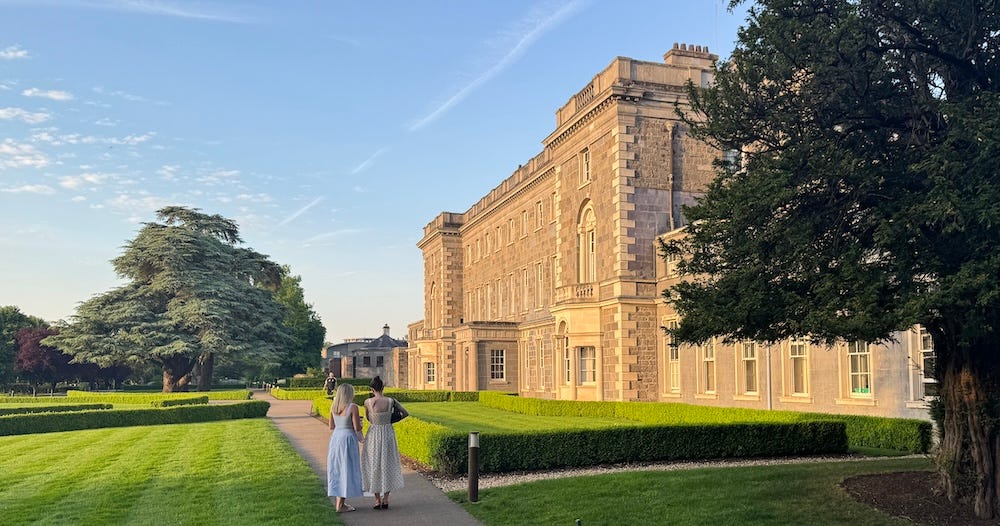
Hotel staff glide rather than hustle. Seated in the lobby, a glass of water appears before you quite realize you wanted it. The hostess at Kathleen’s Kitchen remembers you warmly from the night before. Its historic first floor rooms encourage lingering instead of scrolling. The sommelier’s office is the old butchery. There’s a whisky bar in the library. Even golf here feels less athletic pursuit than continuation of some inherited social code embroidered by Greg Norman.
The estate’s greatest ritual, though, may simply be its stately slowness. You arrive exhausted from friction — airports, text pings, the ambient shriek of modern life — and Carton responds by insisting on rhythm rather than rush. This is echoed in the furnishings in its 169 rooms and suites. Then long walks along the River Rye. A dram after dinner. Conversations you can tread as comfortably as the oak floorboards beneath your feet past rooms seemingly designed for reading nineteenth-century novels while rain taps against old windows. The place sells luxury, certainly, but also the belief that life should move gently across the landscape.
The Westbury
Dublin is one of two cities I know, the other being New Orleans, where storytelling operates as social currency. The 205-room Westbury, where the narrative is elevated to artistry, understands its there to put on a show.
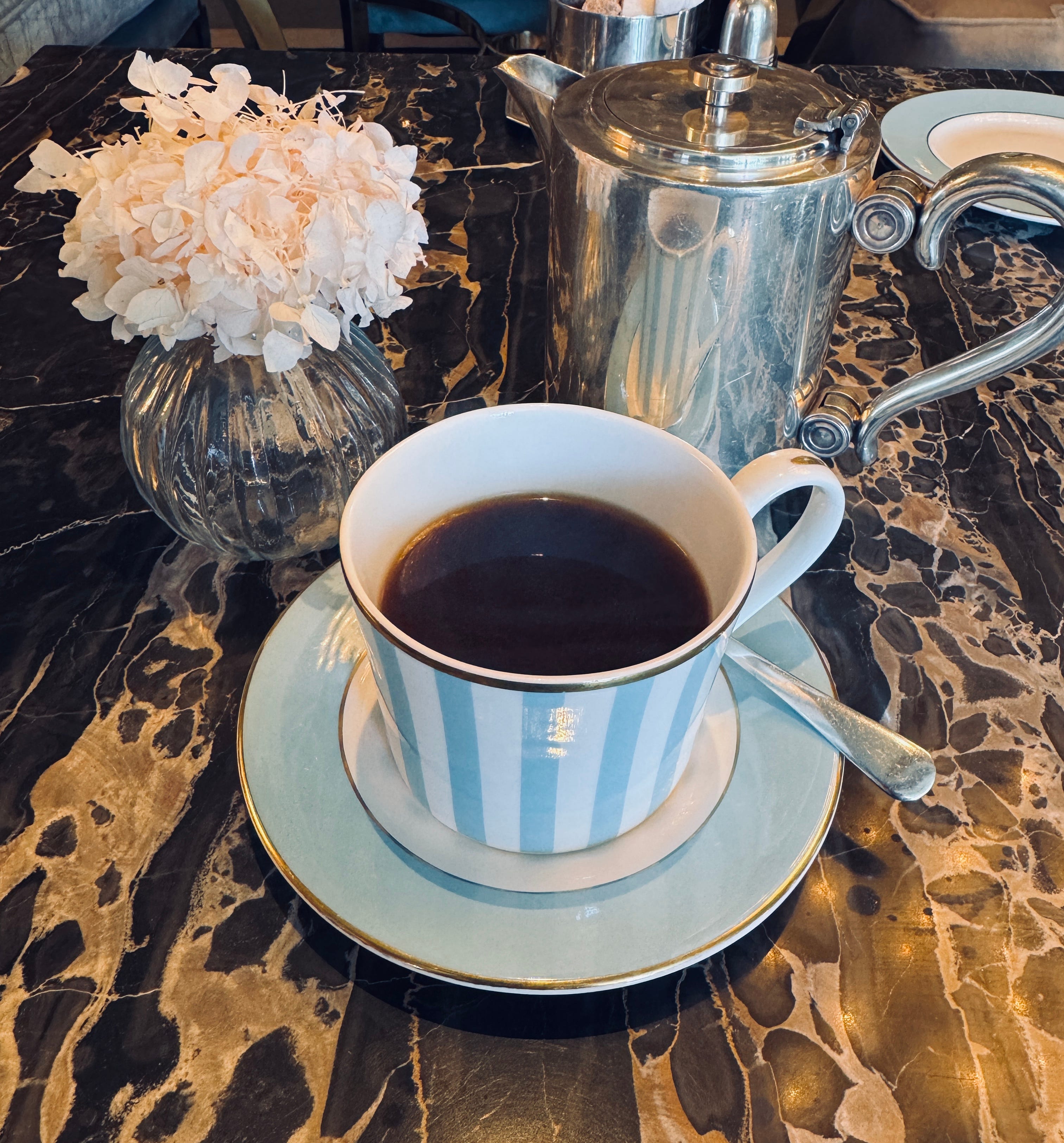
Its famous Gallery — the hotel’s grand drawing-room-like lobby overlooking the Grafton Street hurly burly— may be one of the great people-watching stages in Europe. Fashionable Dubliners and rich Texans slide in for afternoon tea. Older couples linger over champagne. Shoppers who need more of a recovery from their retail expeditions, beeline to The Sidecar, the hotel’s Art Deco bar for cocktails and oysters. All of it is polished to a gleam, but Irish hospitality never mistakes formality for stiffness.
At The Westbury, conversation seems less an activity than one’s civic duty. You feel it in the easy chatter between strangers, in bartenders who know precisely when to become conversationalists and when to dematerialize, in waitstaff who possess the timing of stage actors. James Joyce's famous phrase—"here comes everybody"—still feels like the hotel’s unofficial motto. Even its luxury feels democratic in an Irish way. The Westbury’s room rate may be dear, but its wit remains available to everyone.
The hotel also acts as a kind of urban neutral zone between old Dublin and the aggressively global city now pearling around it. Step outside and tech wealth, retail chains and modern tourism loudly roam the streets. Step back inside and the lighting softens, voices lower and the flowers artfully arranged. At the Westbury Dublin regains its older cadence. Not nostalgia exactly — it’s something more strategic. Call it preservation through performance. And I say bravo to it.
The Marcus Portrush
Portrush is a town on Ulster’s northern Antrim Coast. It’s a small resort town of 6,150 souls, where Ireland stops being so rational and returns itself to the myths and legends of its past. That’s the perfect place for a hotel like the Marcus. The light changes by the minute. The stories expand with whiskey. It’s a place shaped by fishermen, storms, ferries, and a maritime culture layered atop deeper Celtic mythologies.
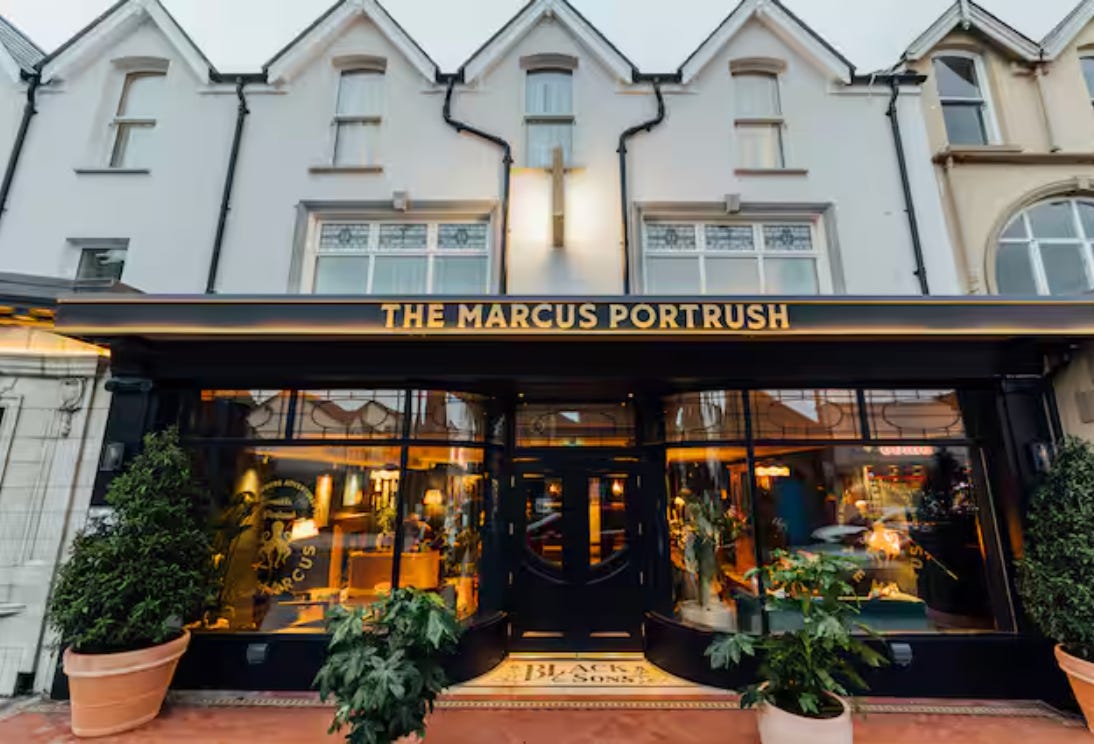
Unlike the dignified composure of Carton House, the 80-room Marcus leans into the Atlantic’s windblown drama and the legendary Giant’s Causeway, a mind-boggling volcanic landscape where geology and folklore got permanently entangled. Part of Hilton’s Tapestry Collection, the hotel preserved Victorian features like its intricate floor mosaics, and a decorative tiled façade. Inside, the whimsical and bold contemporary design elements draw direct inspiration from the surrounding North Atlantic coastline. Think octopus graphics and a Guinness or two settling darkly at the bar. Pull up a seat and the bartender offers up a free glass of wine and generously encourages you to take a larger pour. Bring up the Causeway, Northern Ireleands only UNESCO World Heritage site, and someone inevitably retells the story of Finn McCool for the thousandth time as though it might still be literally true. And perhaps in some emotional sense it is.
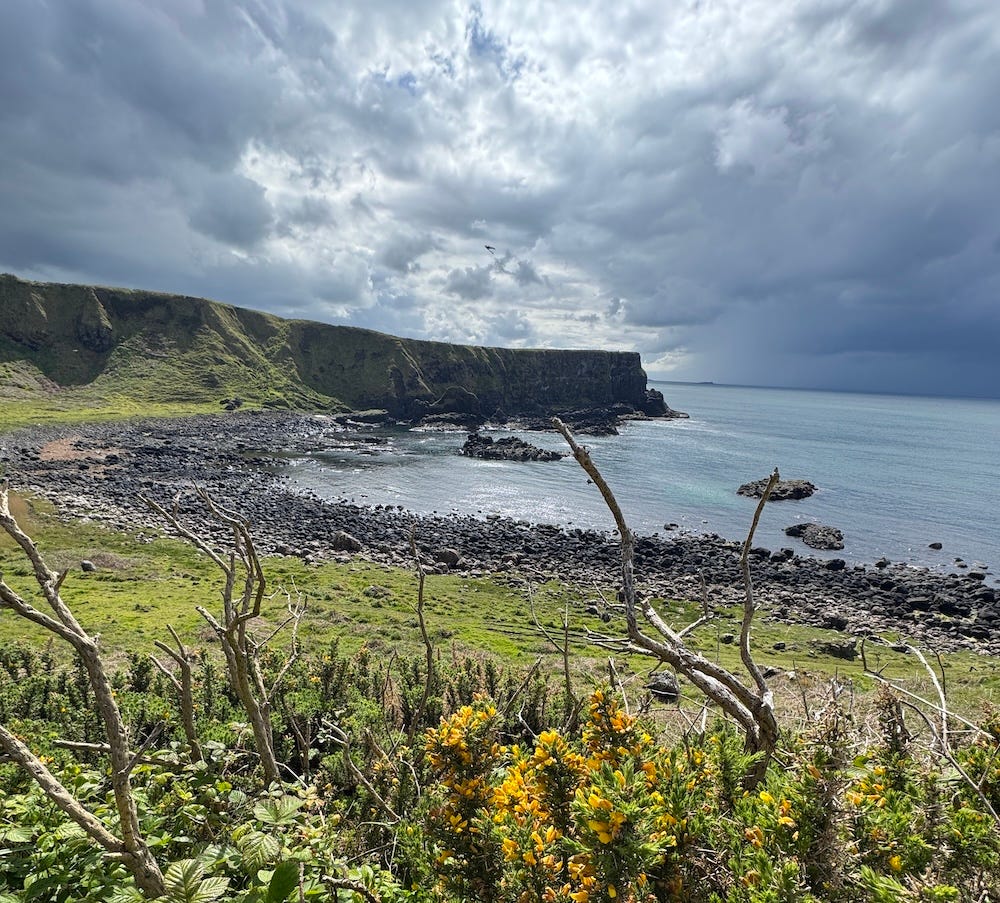
According to ancient lore the basalt columns are not merely rock formations but the work of Finn McCool — or Fionn mac Cumhaill — the giant warrior said to have built the Causeway as a bridge to Scotland. Walking over he came across a Scottish giant, because, of course they had one, too. This Caledonian galoot named Benandonner chased the terrified Finn back to Ireland where his fast-thinking wife got him out of that particular pickle by disguising him as a giant baby. Benandonner, thinking if the baby were this big, his father must be even larger, returns to Scotland. A woman saves a man’s bacon once again.
The local conveying this story did so in a factual manner, as if all this had happened yesterday. In Ireland, myth rarely stays confined to museums. It leaks into weather reports, pubs, and hotel bars. Mr. McCool might have tried hiding out at the Marcus to escape the Scottish giant. If there was a bed big enough for him.
Ireland remains one of the few places where hospitality still functions partly as storytelling. The best Irish properties do not merely pamper their guests; they induct them into the ongoing narrative. At Carton House, the story is order and inheritance. The Westbury gives you conversation and a Dublin showcase. The Marcus is stormy weather and the old tall tales. None of these hotels could exist quite the same way anywhere else and it’s why I think the experience of them matters.
In an era when luxury hotels increasingly resemble one another — same veined Calacatta marble bathrooms, same beige palettes on the walls, same wellness vocabulary — Ireland’s best hotels still feel rooted in their home turf. Not perfect. Not frictionless, but alive with Irish character. Stay in any one of them. You won’t be bored.
If this is your first visit to Lost in Place, you might also enjoy these other Irish stories:
I’ll be writing up more hotels in upcoming posts. If you’re curious, please subscribe.
###
Field Notes
Hotels:
Carton House, A Fairmont Managed Hotel. One of Ireland’s great country estates, Carton House occupies 1,100 acres just west of Dublin. Once home to the Dukes of Leinster, the restored Palladian mansion combines grand historic interiors with two championship golf courses, extensive walking trails, a spa, and one of Ireland’s finest afternoon tea traditions. Address: Carton Demesne, Maynooth, Co. Kildare; Tele: +353 1 505 2000 Rates: From about €300 per night.
The Westbury. Just off Grafton Street, The Westbury has long been one of Dublin’s grand hotels and remains a gathering place for artists, writers, politicians, and theatergoers. Its central location places Trinity College, St. Stephen’s Green, Temple Bar, and Dublin’s best shopping and restaurants within an easy walk. Address: Balfe Street; Tele: +353 1 646 3300 Rates: From about €375 per night.
The Marcus, Tapestry Collection by Hilton. Housed in a restored Victorian landmark in the center of Portrush, The Marcus is an excellent base for exploring Northern Ireland’s Causeway Coast, including the Giant’s Causeway, Dunluce Castle, and Royal Portrush Golf Club. Opened in 2025, it blends contemporary comfort with easy access to one of Ireland’s most storied landscapes.Address: 67–71 Main Street, Portrush, Northern Ireland; Phone: +44 28 7082 3500; Rates: From about £170 per night.
Sites:
The Causeway is a UNESCO World Heritage Site and the only one in Northern Ireland.
###
.
Comments
Nothing yet. Say the first thing.
Sign in to join the conversation.