
NOTE: A while back I included Lecce in “Here Not There,” my book on unconventional travel destinations. Today interest in the city is at full boil. Some thoughts on what that might mean.
Blame the Milanese.
Researching my National Geographic book in the fall of 2022, I was invited to dinner at an outdoor restaurant on the Via Umberto near the Basilica di Santa Croce and Lecce’s old Jewish quarter, the Giudecca. Lecce, if you don’t know, is a small city located in Puglia, the stiletto heel of the Italian boot. I was eating with a group from Milan: A newscaster. An academic. A sprinkle of bankers. Lovely people, the Milanese. They admire beauty, but they also know when it’s undervalued. When the conversation transitioned from politics to real estate, I discovered my dinner companions, every last elegant cashmere-wearing one of them, were long on Lecce. Snapping up neglected apartments and centuries-old homes, restoring them one limestone block at a time.
I remember thinking: If Milan has discovered Lecce, the Americans cannot be far behind.
We weren’t.
Fashionable destinations travel a familiar road. First come the artists. Then the gays. Then the architects. Then the design magazines. Then the boutique hotels. Conde Nast Traveler. Finally, Ryanair flights. Lecce hit that highway with remarkable speed. 0 to 60 in two years.
By 2024, Puglia was welcoming six million visitors a year—10.6 percent more than the year before—and Lecce had topped one million overnight stays for the first time.
I admit to mixed feelings. Discovery isn’t entirely bad. Places deserve investment. Bereft buildings deserve new life. The young deserve reasons to stay rather than leave. Tourism, when done thoughtfully, can rescue craftsmanship, restore neighborhoods, and keep historic cities alive instead of turning them into museums.
Still, every place has a moment when discovery changes from a compliment into capitalism.
Lecce got there sooner than I knew.
The city always possessed the ingredients modern travelers crave. It is walkable. Beautiful without trying too hard. Warm for much of the year. Close to two seas. Surrounded by olive groves, vineyards, and the old fortified masserie have become some of rural Italy’s most coveted hotels.
Unlike Florence or Venice, Lecce never seemed exhausted by its own popularity, and its beauty rewards patience not bucket lists.
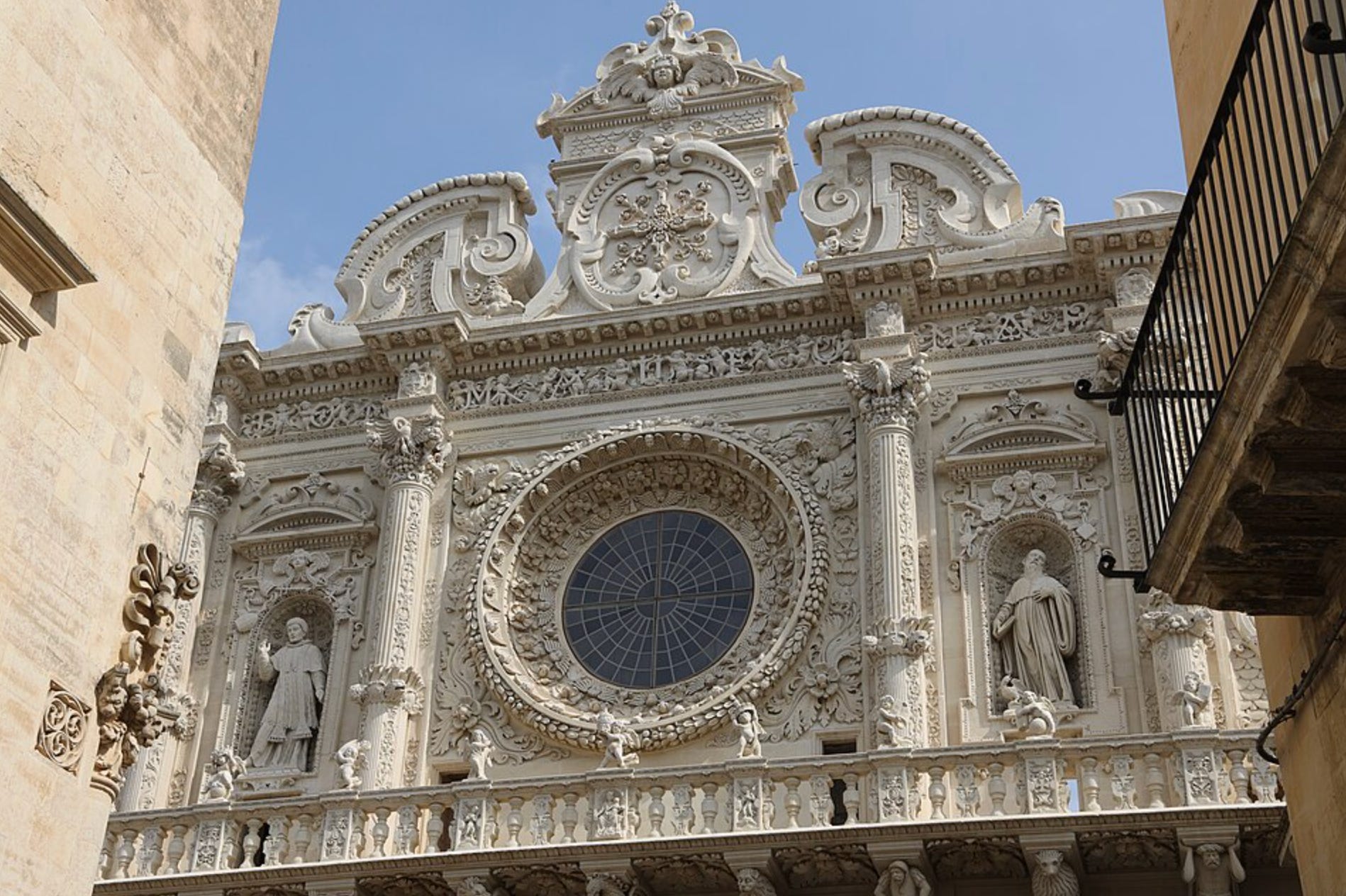
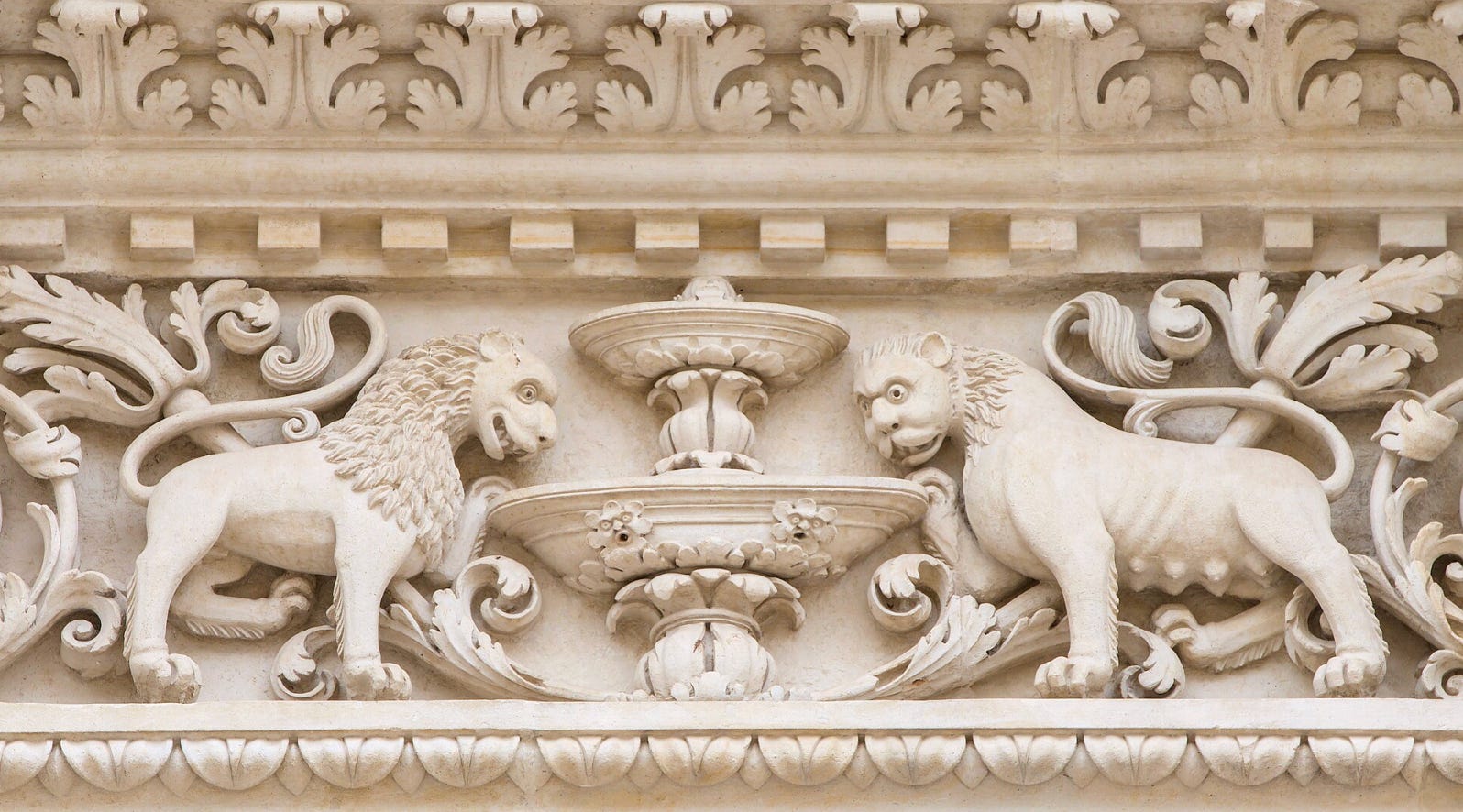
The locals call their honey-colored limestone pietra leccese. Soft enough to carve almost like wood, it gave generations of sculptors permission to indulge themselves. Boy, did they. The city’s Baroque architecture feels theatrical. The ochre slabs erupt with cherubs, fruit, flowers, saints, monsters, and impossible curls of stone. The façade of Santa Croce doesn’t merely decorate the building; it sings to you. It’s the Bad Bunny of churches. You may not understand the lyrics, but you’re riveted by the performance.
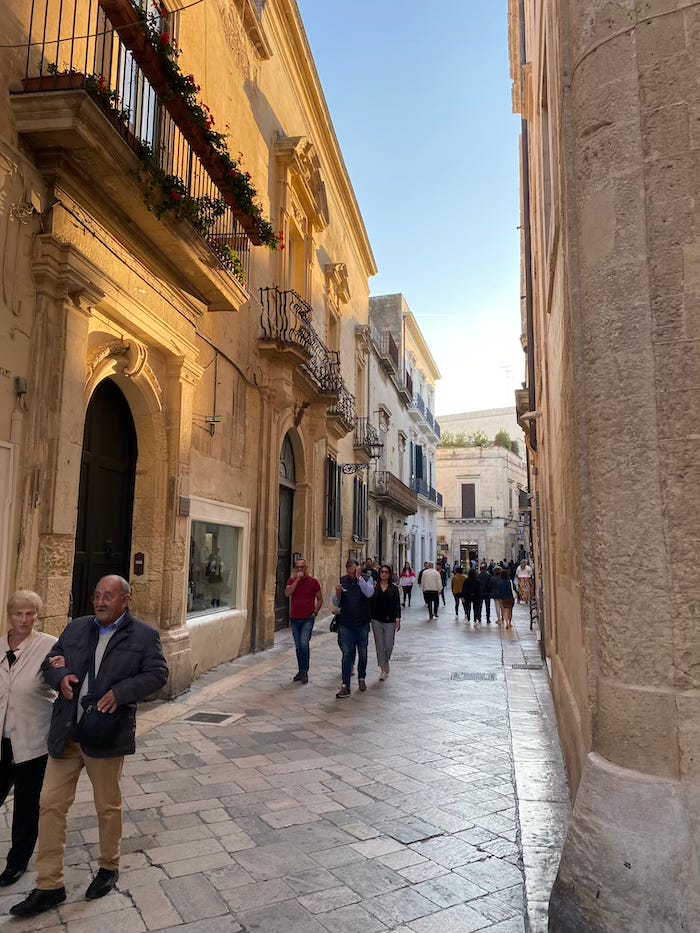
The street life’s no slouch, either.
Each evening, families emerge for the passeggiata, or evening stroll. Teenagers orbit the piazzas. Elderly couples reclaim familiar benches. Everyone eats gelato. Nobody appears to be in much of a hurry, which is perhaps Lecce’s greatest luxury. It’s a rhythm with deep roots.
Lecce has reinvented itself throughout history. Messapians settled here before the Romans absorbed it into their empire. A Roman amphitheater still lies partially exposed in the heart of town, overlooking my AirBnb and a reminder that spectators have been gathering here for nearly 2000 years. Byzantines, Normans, Swabians, Angevins, and Spaniards all left their mark. During the sixteenth and seventeenth centuries, as Spain fortified this eastern edge of its empire against Ottoman expansion, wealthy bishops, merchants, and noble families transformed Lecce into one of Europe’s great Baroque cities. Even the Jewish quarter tells a longer story—one of prosperity, expulsion, forgetting, and gradual remembrance. Few Italian cities carry so many historical layers.
Maybe that’s why Lecce never seemed eager to advertise itself. For years, it felt content being itself. Until now.
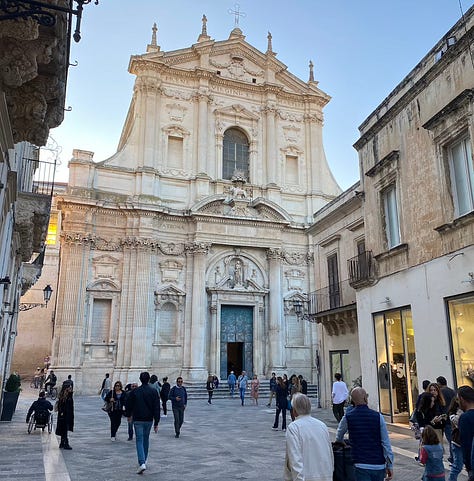

The word is out.
In 2025, visitor arrivals to Puglia climbed another 13 percent, with foreign tourism surging 25 percent. And this year, I bet, it’s higher still. Overseas home buyers’ inquiries have surged. Americans, once content with Tuscany and the Amalfi Coast, increasingly look elsewhere for authenticity—the funny thing being that authenticity has a habit of retreating once enough English speakers arrive looking for it.
I’ve watched this happen before. In Tulum. In Marfa. A place grows famous for not being famous and the qualities that drew people are eroded by the ensuing torrent of travelers.
No city remains frozen in amber, nor should it. Cities are living things. They deserve prosperity more than preservation for preservation’s sake. But they also deserve memory, I think.
The Lecce I hope survives isn’t simply a collection of Baroque façades. It’s the city where conversations linger over coffee until noon. Where elderly neighbors still know which family once lived behind which wooden door. Where craftsmen still carve the limestone. Where the evening promenade matters more than any tourist dollar.
Travel has always involved paradox. We search for places that feel undiscovered while participating in their discovery.
Perhaps the best we can do is arrive there humble pilgrims. Spend more time than money. Learn a few words. Walk don’t rush. Eat where families do. Respect that the city belongs first to the people who wake up there every morning to sweep their stoops, not to those of us lucky enough to borrow it for a few days.
Lecce’s quiet era is ending. The Milanese are there. The Americans are arriving. It was all probably inevitable.
I only hope that as the world falls in love with this remarkable city, it falls in love gently enough to respect it—and the traditions that made Lecce worth discovering in the first place.
What’s your opinion? Do you think Lecce’s “discovery” by Americans will be bad for the city?
Other ideas about travel:
###
No posts
Comments
Nothing yet. Say the first thing.
Sign in to join the conversation.