
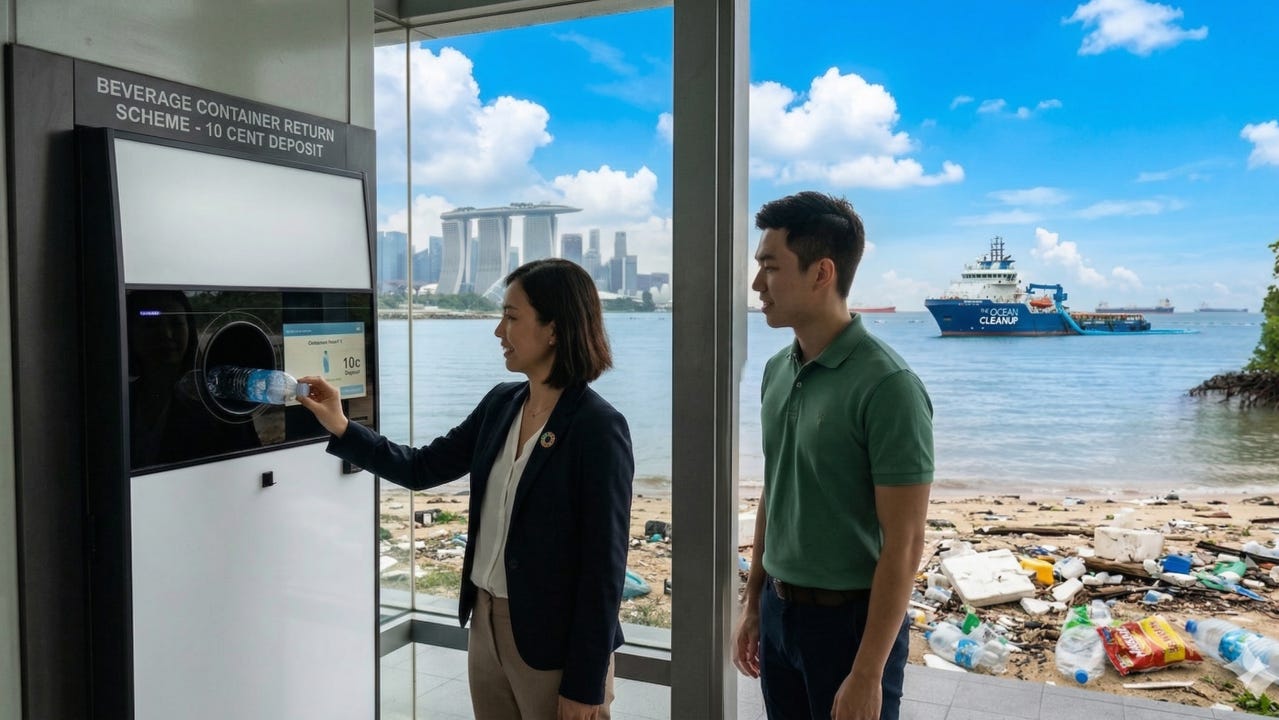
Two things are happening in Singapore today.
The first is almost bureaucratic. The Beverage Container Return Scheme goes live this morning — a ten-cent deposit on every plastic bottle and aluminium can sold on the island, refundable at reverse vending machines now installed across the city. Singapore’s first deposit return scheme. Years in the making. Finally real.
The second is anything but. This afternoon, at the Singapore Sustainability Academy, Boyan Slat — founder and CEO of The Ocean Cleanup — stands in front of a packed room and plays footage of 1.4 million kilograms of trash being pulled from a single river in Guatemala. In two hours. Everything in that footage would have ended up in the Caribbean.
I’m in the room, representing the Sustainable Procurement Pledge. And the timing of these two things falling on the same day feels less like coincidence and more like a systems diagram drawing itself.
The data is striking in its concentration.
Using AI-powered cameras mounted on bridges across hundreds of rivers, Slat’s team built the first global model of where plastic actually enters the ocean. What they found was a Pareto distribution so steep it almost looks like an error: one percent of the world’s rivers carries roughly eighty percent of the plastic flowing into the sea.
Most of those rivers run through coastal cities in middle-income countries. Places where consumption has outpaced the infrastructure to manage what gets consumed.
Slat puts it simply: people now have enough wealth to buy a lot of things wrapped in plastic, but governments can’t yet keep up with the growth of all this waste.
That framing matters. This isn’t a story about careless people. It’s a story about a gap — between the speed at which consumption scales and the speed at which waste management develops. And that gap has a geography. It’s concentrated heavily in Southeast Asia.
The OECD’s recent Regional Plastics Outlook confirms what anyone working in this region already senses: ASEAN Plus Three contributes over a third of global plastic leakage. Indonesia, the Philippines, Vietnam, Thailand, and Malaysia together account for roughly thirty percent of the world’s marine plastic pollution. Within ASEAN, more than half of waste generated goes uncollected. Less than a quarter gets recycled.
These aren’t distant statistics for anyone running a hotel or tourism operation in this region. They describe the operating environment.
I’ve been diving in the same spots across Southeast Asia for over a decade now. The changes aren’t subtle.
Coral that was vibrant five or six years ago is bleached. Reefs that used to hum with life are emptier each year. I’ve picked plastic off beaches more times than I can count — sometimes on the same beaches being marketed as pristine.
A few years ago, we took our toddler for a swim off one of the islands in the Riau Archipelago — the kind of place you go precisely because it feels untouched. We came out of the water slicked in oil. Not an industrial spill. Just the ambient reality of a waterway sitting between two of the busiest shipping lanes in the world.
You don’t forget carrying your kid out of the water and realising the place you chose for its beauty is slowly being poisoned.
Then came last June. A collision at Pasir Panjang Terminal sent 400 tonnes of fuel oil into the waters off Singapore’s southern coast. Sentosa’s beaches went black. Three months to clean up. 800 personnel, 2,300 volunteers, 3,750 tonnes of debris. Oil-soaked kingfishers. Dead fish. Sea snakes washed up on shore.
More recently, the algal blooms along the coast of South Australia — different ocean, different stressors, same underlying pattern.
Environmental assets under accumulating pressure. And every one of them connected directly to someone’s livelihood.
Here’s where the systems picture gets harder to look at.
Ocean plastic pollution isn’t static. Climate change is making it worse.
More intense rainfall — the kind Southeast Asia is increasingly experiencing — means more surface runoff. More runoff means more waste washed off streets, out of informal dumps, and down rivers into the sea. The same monsoon dynamics that make this region lush and productive are becoming the conveyor belt for plastic into the ocean.
Slat describes what he calls “flash events” in Guatemala — avalanches of trash that come down the river after heavy rain, up to five times a week during the wet season. One event can carry over a million kilograms. That volume is a function of two things: the accumulated waste on land, and the intensity of the water that mobilises it.
As rainfall intensifies, as flooding gets more frequent, as coastal storms push further inland — the rate of leakage increases. Even if consumption stays flat.
This is the compounding effect that most plastic conversations miss. The problem isn’t just what we produce. It’s what gets flushed into the water when the weather turns.
For small island developing states — many of which sit downstream of these rivers and currents — this is close to existential. Their economies are built on the health of their marine environments. Tourism, fisheries, the broader blue economy. These aren’t diversified revenue streams. They are the economy. When the water quality goes, livelihoods follow.
“Be very rigid and uncompromising when it comes to the end goal, but be very flexible about how you get there.” — Boyan Slat
What strikes me most about Slat’s presentation isn’t the technology — though the interceptors are impressive. It’s his clarity about where his work sits in the system. He doesn’t frame river interception as a permanent solution. He calls it a bridging strategy. Buying time while the slower, harder work of fixing waste management upstream catches up.
That’s systems thinking in practice. Not either/or. Not cleanup versus prevention. Both, in sequence, with honesty about what each can and cannot do.
And this is exactly where Singapore’s BCRS enters the picture — not as a simple win, but as an experiment in whether a wealthy, well-governed city-state can actually change the behaviour of its residents at the point of disposal.
The BCRS is an upstream intervention. It doesn’t clean the ocean. It prevents leakage before it starts — by turning every beverage container into something with retrievable value.
But it’s worth being honest about what’s involved. Robin Hicks, writing in Boiling Frog this week, does the maths that most of the cheerful launch coverage skips. Today, 1,070 reverse vending machines go into service across Singapore. Each weighs about 400 kilograms. Each costs roughly S$15,000. That’s 800 tonnes of steel and polycarbonate deployed at a cost of around S$30 million — before a single bottle comes back.
Within a year, the target is 2,000 machines.
The scheme aims to recover 16,000 tonnes of plastic and metal annually by 2029, targeting an eighty percent return rate on the billion-plus drink containers consumed in Singapore each year. Deposit return schemes in mature markets routinely hit those numbers. But Singapore is not starting from a position of strength. The city’s domestic recycling rate sits at just eleven percent — a historically low figure. The existing blue bin system, designed for convenience, has produced high contamination and low recovery. Most of what goes in gets incinerated.
The BCRS is an attempt to break that pattern. But as Lionel Dorai of Zero Waste SG has pointed out, returning a container takes more effort than throwing it away — and in a system built around centralised waste collection, that shift isn’t automatic.
(The scheme itself took years to arrive. Announced in 2020. Delayed to 2024. Pushed again to 2026. That timeline is frustrating. But it also reflects something real about the complexity of building waste infrastructure: the logistics of collection and sorting, the industry adaptation required from producers and retailers, the consumer education needed to make the habit stick, and the political will to sustain all of it through years of incremental progress.)
So the BCRS isn’t just a policy. It’s a test. A test of whether consistent education, clear messaging, and accessible infrastructure can shift behaviour in a population that has never had a deposit return system before. If participation is strong, it works. If not, as Hicks observes, the scheme risks becoming an expensive network of underused metal and plastic bins — collecting the materials they were built from.
Both are necessary. Neither alone is enough. And neither works without the public.
One thread runs through nearly every question this afternoon: who pays, who operates, and who governs?
Slat is candid about this. In Jakarta, a single planning meeting can involve forty people from ten different authorities. River jurisdiction, public works, municipal waste, national environment — the institutional tangle is real. His team has learned to hire locally, work both national and municipal levels at once, and design projects that create jobs for the communities they serve.
This isn’t charity. It’s architecture.
Local fishing communities operate the interceptors in the afternoon. Women in remote villages sort the waste. Over a thousand people are employed through the network of local contractors — people whose livelihoods now depend on keeping the system running.
“There’s something beautiful about taking stewardship of your own backyard,” Slat says.
He’s right. And this is where public-private partnership stops being a buzzword and becomes the practical mechanism for getting infrastructure built, permits issued, waste streams managed, and accountability distributed across the people who actually live with the problem.
The BCRS itself is a public-private construct: government-mandated, operated by the licensed scheme operator BCRS Ltd, with TOMRA supplying the reverse vending network. The Audacious Project’s $121 million commitment to The Ocean Cleanup’s 30 Cities program shows philanthropic capital is flowing. But Slat makes an important point: most of that money came from American donors. For a problem concentrated in Southeast Asia, local ownership matters.
And behind all of it — behind the interceptors, the deposit machines, the sorting centres — sits a supply chain question that doesn’t get enough attention. Where does the collected material go? What recycling infrastructure exists to process it? Who pays for the logistics of moving contaminated, mixed-quality waste from collection point to second life?
These are procurement and supply chain questions. And in my experience, they’re the ones most likely to determine whether a circular system actually closes the loop or just moves the problem one step further down the chain.
If you operate a hotel, a resort, or any tourism business dependent on coastal and marine health in this region — and honestly, which one isn’t — this isn’t an environmental sidebar. It’s commercial reality.
Healthy oceans support the food web that supplies your kitchen. Clean beaches are the product your guests are paying for. Functioning coral reefs drive the dive tourism that fills rooms in island destinations. When those assets degrade, the value proposition degrades with them.
(Yes, value also means money.)
Slat describes a shift in how The Ocean Cleanup measures success — from outputs to outcomes. Not tonnage collected, but ecosystem recovery. In cities where interceptors have been running long enough, they’re now doing five-year baseline studies on coral reefs, mangroves, seagrass beds, and local communities. The goal is to quantify the ecosystem service value that returns when the plastic stops flowing.
For hospitality, that’s the business case. Not the cost of your recycling programme or your sustainability report. The measurable value of the environmental assets your operation depends on. Reefs, water quality, fisheries productivity, scenic beauty — these have dollar figures attached. And they’re going in the wrong direction.
Hotels also play a role that’s easy to overlook. They bring people together. The fireside chat I’m at today is hosted at CDL’s Singapore Sustainability Academy — and the room holds philanthropists, operators, sustainability leaders, investors. The exact combination needed to mobilise capital toward infrastructure and innovation. In small island developing states, where a single resort can be the largest employer and the primary interface between visitors and the local environment, that convening power is even more concentrated.
Hotels aren’t just affected by these systems. They can be nodes within them.
Standing in this room today, watching Slat present the 30 Cities map — Jakarta, Manila, Cebu, Denpasar, Bangkok, Kuala Lumpur, Mumbai, and more — the concentration of targets in Southeast Asia is impossible to miss. Two thirds of the cities are in this region.
A few kilometres away, the first reverse vending machines are accepting their first bottles.
One intervention catches what has already escaped. The other prevents escape in the first place. Between them sits the harder, slower work: building waste management infrastructure, shifting producer responsibility upstream, developing the recycling and logistics systems that give recovered materials a second life, educating consumers who have never been asked to do this before, and creating the policy frameworks that make all of it durable.
And underneath all of it, the climate system is accelerating the flow.
I keep coming back to a question that isn’t really about plastic at all: how do we build the infrastructure we need at the speed the problem demands? Not just physical infrastructure — pipes, machines, sorting centres — but institutional infrastructure. The agreements. The governance. The funding mechanisms. The cross-border cooperation that this region, with its shared waterways and interconnected economies, so clearly needs.
The gap between the bottle and the beach isn’t a technology gap. It’s an infrastructure and governance gap. And for this region — where the rivers flow fastest, where the economies depend most on healthy water, and where the climate risks are compounding — closing that gap isn’t an environmental aspiration.
It’s an economic imperative.
Boyan Slat started The Ocean Cleanup when he was eighteen, driven by a scuba diving trip where he saw more plastic bags than fish. Over a decade later, his organisation has collected more than fifteen million kilograms of plastic and is cleaning an area of ocean the size of a football field every five seconds. His determination is remarkable. But what I admire most is his honesty about what his work can and cannot do — and his insistence that the real goal is to make his own organisation unnecessary.
That kind of thinking deserves more than admiration. It deserves infrastructure.
— Andrew
#RegenerativeHospitality #SystemsThinking #OceanPlastic #SustainableTourism #ClimateResilience
Andrew Cameron is the founder of ENZYME, a Singapore-based advisory working at the intersection of regenerative hospitality, food systems, and sustainable procurement across Asia-Pacific.
Comments
Nothing yet. Say the first thing.
Sign in to join the conversation.