

I’ll be honest. I’ve always been more of a hot cross bun person.
If you’re ever in Adelaide — and specifically in Bowden — there’s a place called The Lost Loaf, now at Plant 3 on Fourth Street. They do what I think are the best hot cross buns in Australia. Sourdough base, 36-hour ferment, real fruit, no added sugar. The kind of thing where you eat one and understand why someone would build a bakery around it.
But Easter is Easter. And whether your household runs on buns or chocolate, there’s a good chance you’ve had the same conversation this year that most families seem to be having: the eggs are smaller, and they cost more.
You’re not imagining it.
CHOICE, Australia’s consumer watchdog, has been tracking this for three years now. The numbers are striking.
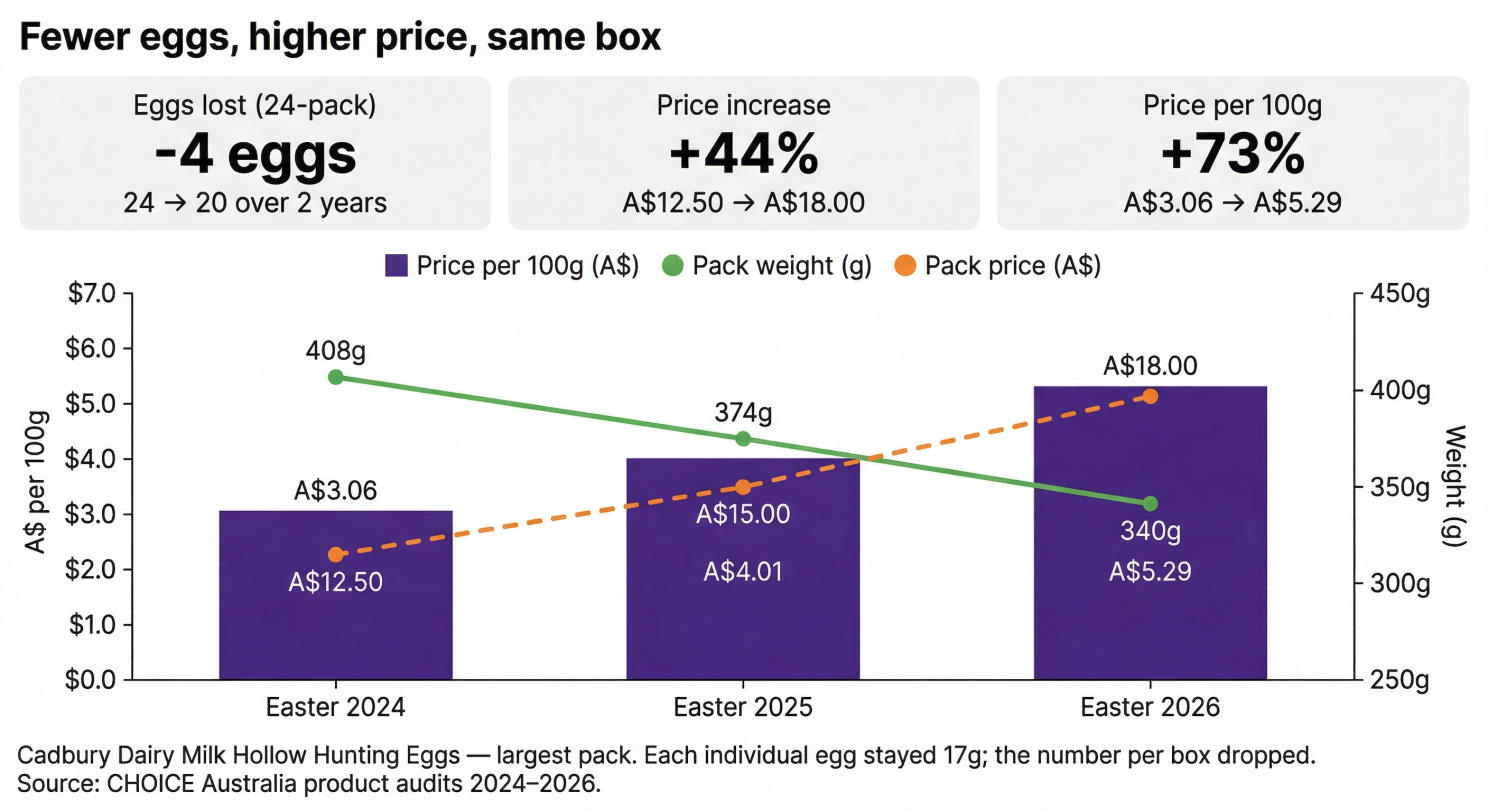
Take Cadbury’s hollow hunting eggs — the ones parents buy for backyard Easter egg hunts. In 2024, the largest box held 24 eggs at 408 grams for A$12.50. By 2025, it was 22 eggs, 374 grams, A$15. This year? Twenty eggs, 340 grams, A$18.
Same product name. Same shelf position. Same brand. But 73% more expensive per 100 grams over two years.
It’s not just Cadbury. Nestlé’s KitKat mini eggs went from 110g to 90g while staying at $3.99. Aldi’s hot cross buns lost 20 grams per pack with no price cut. In the UK, Which? found Ferrero Rocher Easter eggs jumping from £10 to £15, Maltesers eggs from £8 to £13 — flat weight, pure price inflation.
The industry has a polite name for this: pack-architecture management. The incentive is to stay below key shelf-price thresholds — the A$15 mark, the £10 mark — by shrinking the product rather than visibly raising the price. Consumers notice a price jump on the tag. They’re less likely to notice two fewer eggs in the box.
It works. Until someone counts.
The obvious headline is cocoa.
And the cocoa story is genuinely dramatic. In February 2023, global cocoa traded at around US$2,600 per tonne. By February 2024, it had more than doubled to US$5,600. By early 2025, it was closing in on US$10,000. In December 2024, futures hit an all-time high above US$12,000.
Then the correction came. By early 2026, prices had fallen back below US$4,000 — roughly 70% off the peak.
So cocoa crashed. But did your Easter eggs get cheaper?
No. CHOICE found prices still rising this Easter, even as the underlying commodity fell. Mondelēz, Cadbury’s parent company, confirmed it buys cocoa well in advance and that commodity price shifts won’t immediately change what you see on the shelf.
This is where the story gets more interesting than a simple commodity spike. Cocoa is just one input. Easter eggs also carry the cost of sugar, milk powder, energy, packaging, transport, labour, and retail margins. When all of those were rising simultaneously — and when cocoa was rising fastest — manufacturers adjusted their pack architecture. Now that cocoa has eased, the adjustments have stuck.
Prices rarely come back down the way they went up.
“We have learned that certain price points are very important, and so we have adjusted already to put our products at the right price point.” — Dirk Van de Put, CEO, Mondelēz International
Here is where most Easter chocolate coverage stops. Cocoa went up, eggs got smaller, consumers got frustrated. End of story.
But the system beneath that price spike hasn’t gone away. And it tells you something important about how global supply chains actually work — and fail.
Côte d’Ivoire and Ghana together produce around 60% of the world’s cocoa. That concentration means the global chocolate industry depends on the health of farms in a narrow band of tropical West Africa. And those farms are under compounding pressure.
The trees are ageing. Most cocoa trees in the region are 25 to 40 years old, well past peak productivity. Replanting rates are low because new trees take three to four years to start yielding and longer to reach full output. Farmers living on thin margins don’t have the capital or the time horizon to replant at scale.
Disease is spreading. Cocoa swollen shoot virus has affected significant portions of Ghana’s cocoa belt. Black pod disease compounds the problem. Yields per hectare have been falling for years — many smallholders now harvest 300 to 400 kilograms per hectare, against an agronomic potential of 800 to 1,000.
Deforestation continues. For decades, production growth in this region came from clearing forest to plant new land, not from improving productivity on existing farms. That model is now largely exhausted. Côte d’Ivoire’s humid primary forest area has declined by 28% according to Global Forest Watch. The EU Deforestation Regulation, taking full effect from December 2026, will add traceability and compliance costs to every tonne of cocoa entering European supply chains.
And underneath all of this: farmer incomes remain far below what is needed for a decent livelihood. Fairtrade’s living-income benchmark for a cocoa household of seven in Côte d’Ivoire is approximately €6,700 per year. The gap between that benchmark and actual household income is substantial. Low incomes drive under-investment in farms, reliance on family labour including child labour, and expansion into forest frontiers. A major NORC study estimated 1.56 million children engaged in child labour in cocoa production across Côte d’Ivoire and Ghana, with 1.48 million exposed to hazardous work.
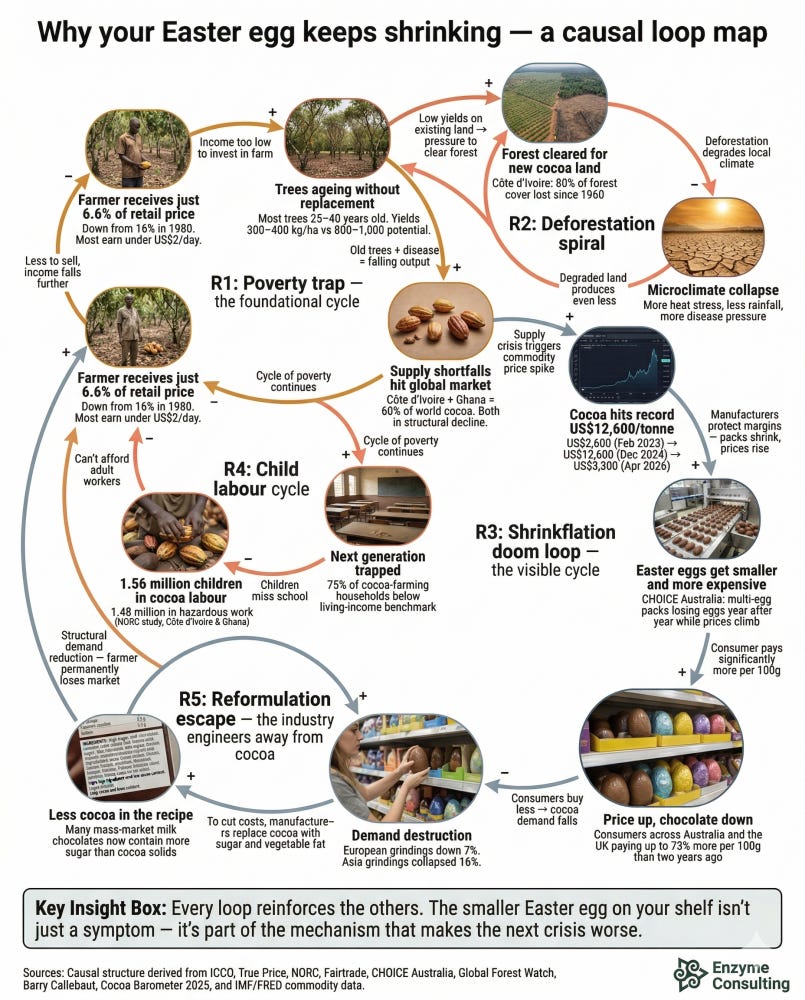
These are not separate problems. They are the same system. Ageing trees, low incomes, deforestation, disease, child labour — each one reinforces the others. And together, they produced the supply shock that made your Easter egg smaller.
Here’s a number worth sitting with.
True-cost accounting studies — the kind that attempt to price in social and environmental externalities alongside the market price — estimate that the unpriced costs of cocoa cultivation run between €5.75 and €9.91 per kilogram of cocoa beans. The farmgate price in Côte d’Ivoire when those studies were conducted? About €1.35 per kilogram.
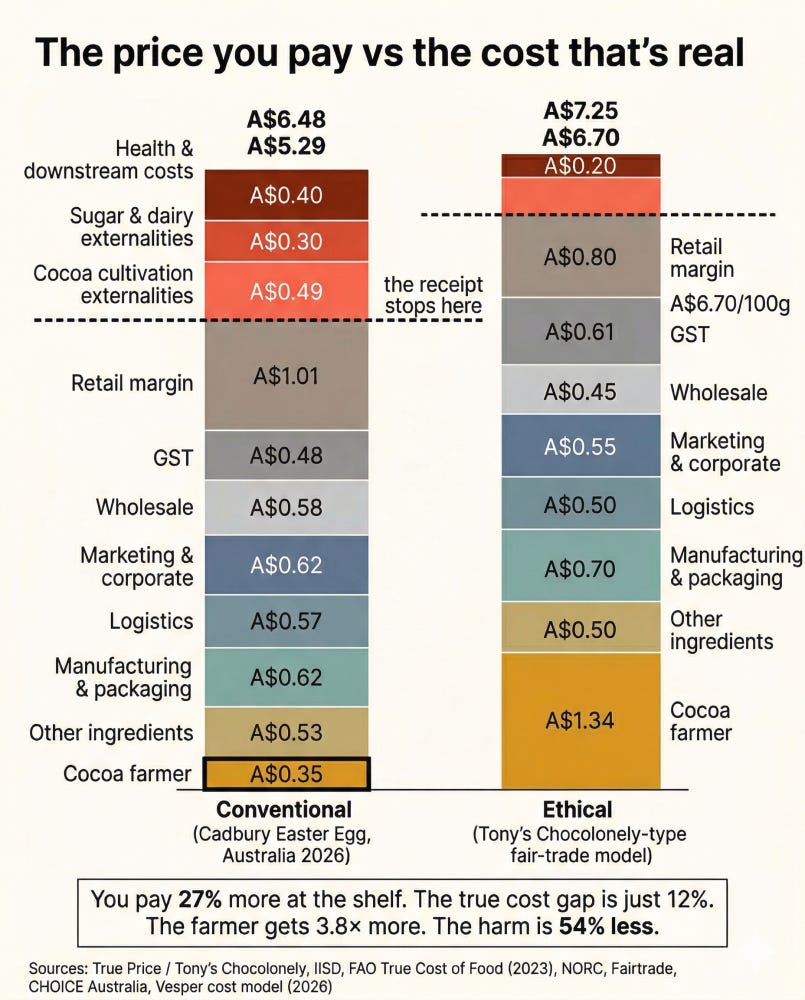
The external costs were four to seven times the price farmers received.
For a milk chocolate Easter egg — typically around 30% cocoa content — that translates to an additional €0.12 to €0.40 per 100 grams that doesn’t appear on any receipt. Deforestation. Soil degradation. Child labour remediation. Living-income gaps. Carbon emissions. Biodiversity loss.
These costs exist. They are being paid — by farming communities, by forests, by children, by future productivity. They’re just not being paid at the checkout.
And increasingly, they will be. The EU Deforestation Regulation. Corporate due diligence requirements. Traceability mandates. Certification costs. These are mechanisms by which externalised costs get internalised — slowly, unevenly, but directionally. Every one of them adds to the cost of producing chocolate. And every one of them is responding to the same underlying reality: a supply chain that has been running on subsidised destruction.
Meanwhile, the demand side has its own response. And it’s not pretty.
When cocoa prices spiked, the world’s largest processors didn’t just raise prices. They used less cocoa. European grinding volumes dropped over 7% year-on-year. In Asia, grindings collapsed by 16%. Manufacturers reformulated — more sugar, more vegetable fat, less actual chocolate.
Barry Callebaut, the world’s largest cocoa processor, reported volume declines and explicitly linked weaker demand to high prices. The company has also invested in cocoa-free chocolate alternatives and AI-supported recipe development. That’s not a short-term hedge. That’s an industry building optionality into a future where cocoa may be structurally more expensive, less available, or both.
The practical effect at the shelf: your Easter egg likely contains less cocoa than it did three years ago, weighs less, and costs more. The chocolate industry has responded to a supply crisis not by fixing the supply chain, but by engineering around it.
There’s a logic to that. But it’s worth being clear about what it means. The farmers whose livelihoods depend on cocoa demand are now facing a market that is actively trying to need less of what they grow. High prices should, in theory, attract investment in production. In practice, the demand side is retreating faster than the supply side can respond.
I spend a lot of my working life thinking about procurement and supply chains in hospitality and tourism. And the cocoa-to-Easter-egg chain is one of the clearest illustrations I’ve seen of something that applies far more broadly.
Most of us interact with supply chains at the point of purchase. The price tag. The shelf. The menu. We see the output. We don’t see the system.
But behind every price is a cost stack. And behind every cost stack is a set of conditions — ecological, social, economic, regulatory — that are either being maintained or degraded. When they’re being maintained, the supply chain is resilient. When they’re being degraded, the supply chain produces what looks like a good deal right up until it doesn’t.
The cocoa market just showed us what happens when that degradation catches up. Decades of under-investment in trees, in soils, in farmer livelihoods, in forest protection — all of that deferred maintenance accumulated until a few bad seasons tipped the system into crisis. And the consumers at the end of the chain experienced it as: my Easter egg got smaller.
For anyone working in hospitality, food systems, or tourism — industries built on supply chains that depend on healthy ecosystems, fair labour conditions, and functioning agricultural systems — this is a case study worth paying attention to. Not because you’re buying cocoa (though some of you are). But because the pattern repeats.
Seafood. Coffee. Palm oil. Cotton. Vanilla. The specifics differ but the architecture is the same: concentrated production in vulnerable geographies, externalised social and environmental costs, long biological response times, and a retail layer that manages perception rather than addressing the underlying system.
Sustainable procurement isn’t about choosing the right label. It’s about understanding the conditions that produce what you’re buying — and whether those conditions are being maintained or consumed.
Tomorrow morning, millions of families will sit down to Easter breakfast. There will be eggs on the table — fewer and smaller than last year, but still there. Kids won’t care about cocoa futures or living-income benchmarks. They’ll care about chocolate.
And that’s fine. This is not a guilt piece. Easter should be enjoyed.
But if you’ve made it this far, you now know something about the system behind the foil. That the egg on your table connects to a tree in Côte d’Ivoire that might be 35 years old and declining in yield. To a farmer earning less than what’s needed to invest in that tree’s replacement. To a forest that was cleared to plant it. To a child who may have helped harvest it. To a commodity price that spiked and crashed while the shelf price only went one direction. To a manufacturer that responded by putting less cocoa in the recipe and fewer eggs in the box.
None of this is inevitable. Every link in that chain is a decision. And decisions can change.
So enjoy your Easter. I’ll be reaching for the hot cross buns.
If you want the best ones in Australia, you know where to find them. The Lost Loaf, Plant 3, Fourth Street, Bowden, Adelaide. Tell Emma I sent you.
Happy Easter.
— Andrew
Andrew Cameron is the founder of Enzyme Consulting, a Singapore-based advisory practice working at the intersection of regenerative hospitality, systems thinking, and sustainable procurement. He is a representative of the Sustainable Procurement Pledge.
Andrew Cameron is the founder of ENZYME, a Singapore-based advisory working at the intersection of regenerative hospitality, food systems, and sustainable procurement across Asia-Pacific.
Comments
Nothing yet. Say the first thing.
Sign in to join the conversation.