
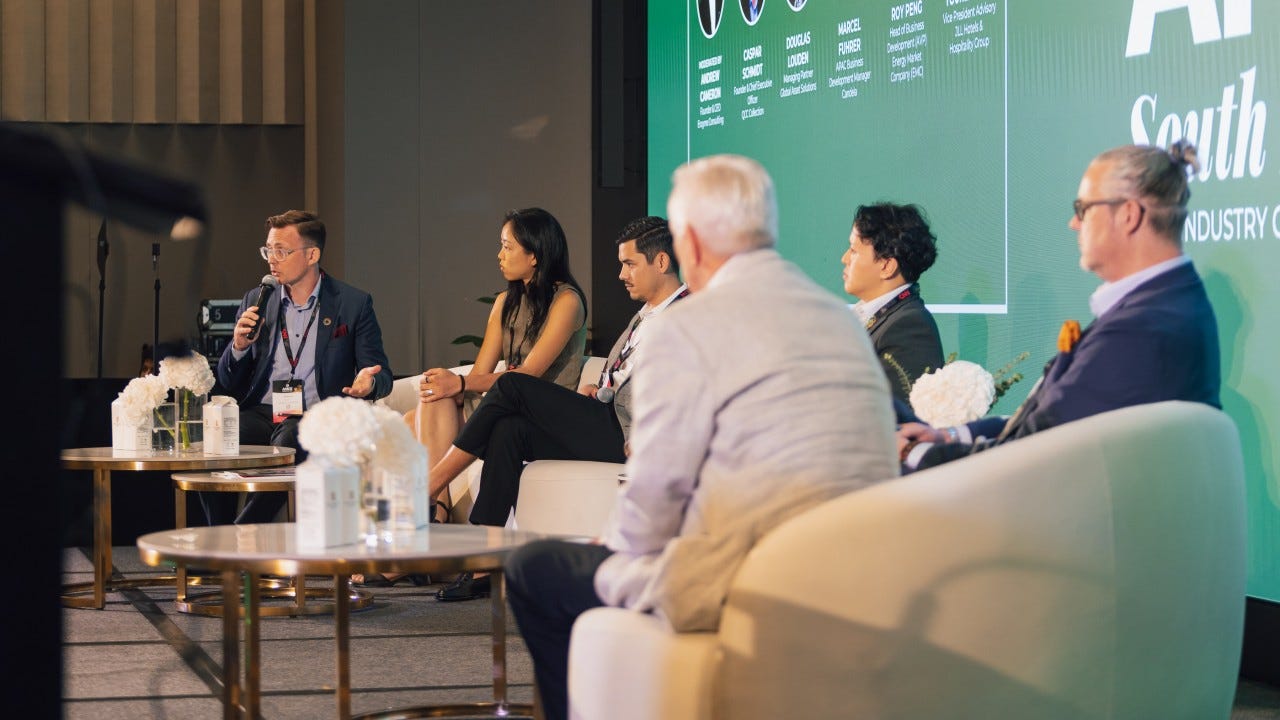
Last Tuesday, on the morning of 10 March, six hundred hotel executives, designers, investors, and technologists gathered in the Pacific Ballroom of the Pan Pacific Singapore for the opening of AHICE South East Asia 2026. Outside, the city was doing what it does best, functioning with immaculate efficiency while quietly repositioning itself for whatever comes next. Four weeks earlier, Prime Minister Lawrence Wong had made himself chair of a new National AI Council, announced 400 per cent tax deductions on artificial intelligence investment, and pledged free premium AI tools for any citizen who completes approved training.
Singapore has a crystal clear approach to pivoting in this new geopolitical, technological and economic climate, and it has already started to implement.
Inside the ballroom, however, the mood was a little harder to read for understandable reasons.
The delegates represented an industry caught between extraordinary momentum, Asia-Pacific’s hotel construction pipeline had just hit a record 2,323 projects, and a growing awareness that the ground beneath all that momentum was shifting the globe in ways that no single strategy could address.
A few topics that were recurrent and front of mind:
The Middle East conflict has limited readiness to travel and pushed oil above $100 a barrel, impacting supply chain, operating costs and energy strategy.
Singapore’s own Minister for Sustainability and Environment, Grace Fu had designated 2026 the Year of Climate Adaptation, with up to $100 billion earmarked for resilience spending for the increasing impacts of heat, food, water and rising sea levels.
Anthropic had published a study five days earlier exposing a chasm between what artificial intelligence can theoretically do and what anyone is deploying. How it impacts current and future jobs.
The same three markets kept surfacing as exciting development opportunities in the region: Vietnam, Thailand, the Philippines.
Across the two days I moderated four of the panels, spanning design, sustainability, guest technology, and AI. James Gregory Wilkinson, Renita Collins and the AHICE Global Hotel Industry Conferences team had built a programme that, intentionally or not, forced these conversations into proximity with one another. What emerged was not a set of separate insights about separate topics. It was a single argument, assembled in pieces by dozens of speakers who may not have realised they were making it together.
I’ll do my best with distilling this:
The hotel is no longer a building with rooms. It is becoming an operating system, integrating energy, connectivity, wellness, community, and experience into a single coherent architecture. And the operators, designers, and investors who grasp this will define the next era of the industry. Those who continue to treat technology, sustainability, design, and guest experience as separate departments will not.
I’m sure I’ll refine this over time. Maybe some nice diagrams and frameworks.
Where the friction lives
The AHICE programme opened with Design Inn, a symposium co-hosted by Katherine Cameron and Ivan Sunde that brought architects, operators and designers into conversation about what spaces need to do differently. The discussion that I have reflected on the most since, led by Bobby Carey of Studio Ryecroft: how do you create multiple touchpoints of wonder within a property, and connect meaningfully with locals as well as in-house guests?
The question matters because it sets up the central tension the rest of the conference would explore. Great hotel design has always been about emotional resonance, the quality of light and sound, the weight, height and texture of objects, the way a lobby makes you feel simultaneously welcomed, free and relaxed. But those qualities now depend, to a degree that would have seemed absurd a decade ago, to planning your tech stack.
Effective use of technology allows more physical space for designers to utilise, as well as more insights on guests to create tailored experiences.
When Daniel Mourad of Canary Technologies mapped the guest journey the following morning at the INN Tech summit, his description was methodical: discovery, booking, pre-arrival registration, payment authorisation, identity capture, arrival, in-stay, departure.
The friction, he observed, lives at the handoffs, the seams between stages where guests repeat information, switch channels, or encounter processes designed for the hotel’s convenience rather than their own. A frictionless journey means the guest never repeats information and interactions happen on their preferred channel, and the reality is we should have the ambition to create door-to-door experiences, that streamlines logistics and customs as well.
One passport and profile upload, fine-tuned driverless car pick-ups, remembered at arrival.
No lines, no waiting, no repetition.
The practical implication is that this physical and experience design vision requires the technology to function, and increasingly so. Alexandre Schappo of Lightera described the infrastructure this demands: passive optical LAN using fibre-to-the-room, installed once, with active electronics upgraded as demand grows. The material is invisible. Its absence is not.
Michael Benikos of Vingcard and ASSA ABLOY Group extended this into a world where the guest’s device becomes a single credential, room, lift, pool, gym, payment, drawing on what cruise lines have been doing for years. Carnival’s Medallion wearable releases the cabin door on approach, triggers personalised offers, tracks guest movement (including where your kids are). The lesson from these enclosed ecosystems is not that hotels should replicate them wholesale, but that guests who have experienced seamless orchestration will increasingly notice its absence on land.
Eric Wong of Infor offered the clearest articulation of where all this leads. He told a personal story about how his wife sprained her ankle at one property and was surprised with a welcome gift to support the injury at a competing property. No algorithm required. Opportunities for unreasonable hospitality and stories that are shared far more than what can be tracked with an NPS and survey.
The question remains, of course, is whether the industry will appropriately use the time this emerging technology frees up to deepen those human moments, or simply automate and cut headcount, and leave more shallow experiences.
The tinkerers and the brief
At the Design Inn AI panel, which I moderated with Matt Marshall of Cundall, James Robertson of VUCA VUCA DESIGN, and Simon McDonald of Avalon Collective, the conversation moved quickly past the familiar anxieties. Marshall, who described himself as deep down the AI rabbit hole with no intention of surfacing, framed it crisply:
AI bridges the gap between creating and making. The making can now happen fast, but you still have to create in the first place. If technical perfection is cheap, taste becomes extraordinarily expensive.
McDonald walked the audience through an eighteen-month journey from Midjourney, beautiful imagery through Google’s Nano Banana and Flux to node-based platforms like Weavy AI and ComfyUI.
The shift was significant.
Rather than typing prompts into a chatbot and hoping for the best, designers are now building visual workflows: chaining system prompts, style references, structural cues, and material inputs into repeatable production lines. The brief is the prompt. Sometimes highly specific, with structural references for minimum deviation. Sometimes deliberately loose, allowing the model to generate variations within creative constraints. “AI isn’t replacing traditional references,” McDonald said. “It’s expanding them.”
The invisible guest and the visible answer
Dhiraj Tulsiani of Cendyn laid it out during the AI and emerging technology panel. Guests are no longer only typing queries into Google. They are asking LLMs to recommend hotels, plan itineraries, and compare options. This is not a refinement of search engine optimisation. It is a different activity.
Traditional SEO is about appearing for a click.
Generative engine optimisation (GEO) is about appearing in an answer.
And the techniques that work are fundamentally different.
Research from Princeton and Georgia Tech found that GEO strategies can increase content visibility in AI-generated responses by up to 40 per cent. For hotels, the implication is direct: the words you use to describe your property are how AI discovers and represents you. If a hotel’s website reads like a brochure, vague adjectives, stock photography, no specific detail about what makes the experience distinctive, the AI model will fill the gap with someone else’s description. Or, more likely, with an OTA listing.
Tulsiani’s warning deserves attention beyond the technology community. As AI-generated overviews consume a larger share of trip-planning queries, the hotels that invest in precise, expert-level content about their niche strengths, family programming, culinary heritage, wellness credentials, sustainability practices, will be visible to a new generation of travellers.
Those that do not will become invisible.
The arithmetic of resilience
The sustainability panel, held on the first afternoon, produced the conference’s most candid exchanges.
YouRee Park of JLL opened with a bracing assessment.
Geopolitics, protectionist, inward-looking, deal-based, is creating a headwind for sustainability agendas that are inherently collective and long-term. Sustainability conversations with hotel owners have significantly decreased. What remains is heavily skewed toward energy savings with a clear financial return: a five-to-seven year payback period, or less for ageing buildings dependent on diesel and gas. Private equity firms are integrating sustainability opportunities as a post-acquisition value-creation strategy. The framing has shifted from environmental obligation to asset management.
That being, enviro-social capital connected to a property is an asset, and has measurable value, and benefits for protecting and restoring.
Douglas Louden of Global Asset Solutions was blunt about the industry’s credibility. A sign in a guest room asking about linen reuse does not constitute a sustainability strategy. But he also made one of the most compelling economic cases for ecosystem preservation I have heard at a hotel conference.
Adam Mogelonsky’s keynote on longevity science and hospitality brought the cohort question into its most commercially charged territory. What happens if we all live to 100-150? What happens with our approach to providing services and experiences? Will there be a generational wealth transfer, or will it be retained over a longer period?
This convergence of longevity medicine with luxury hotel programming is creating an entirely new category, one that requires partnerships across gym, spa, room technology, and clinical diagnostics, as well as complimentary elevated sustainability and F&B programming.
Southeast Asia is positioning aggressively. Properties where guests sync wearable health data to clinic dashboards for post-departure coaching are no longer speculative. They exist, and they command the highest margins in the industry.
For an ageing global population that is simultaneously wealthier, more health-literate, and more technologically capable than any prior generation, this is not a niche. It is a frontier.
Technology. Wellness. Design. Sustainability. Experience. Luxury.
One system
So, the technology serves the design. The design enables the experience. The experience justifies the premium. The premium funds the resilience. The resilience protects the asset. And the asset exists within a community, an ecosystem, and a set of global forces that it continually exchanges resources with.
The operators, designers, and investors who understand this as one interconnected system are already making different decisions. They are installing fibre, not copper. They are sizing electrical infrastructure for robotics that have not yet arrived. They are writing website content for AI models, not just search engines. They are valuing coral reefs alongside concrete seawalls. They are hiring designers for taste and judgment, then handing them tools that amplify both.
Those who continue to treat technology as IT’s problem, sustainability as marketing’s problem, design as the architect’s problem, and guest experience as operations’ problem will find that the integration is happening anyway, at the level of the guest, who experiences all of it as one thing.
Six hundred people spent two days in a ballroom in Singapore working through these questions. The conversations spilled into the lobbies, the coffee queues, the evening events and there was no single revelation. There was something much more useful: a pattern becoming visible.
The hotel is becoming a multi-disciplinary operating system. The only question left is who will write the code.
I know I’m excited.
Andrew Cameron is the founder of ENZYME, a Singapore-based advisory specialising in regenerative systems for hospitality and tourism. He serves as Global Co-Chair of the AHICE INN Tech Advisory Board.
Comments
Nothing yet. Say the first thing.
Sign in to join the conversation.