
This week’s Preview is going out in four parts for length reasons. Here is Part II, covering the Westminster by-election in Arbroath and Broughty Ferry.
Arbroath and Broughty Ferry
House of Commons; caused by the resignation of Scottish National Party MP Stephen Gethins.
Our second Scottish National Party defence of the week occurs in the ground zero for Scottish nationalism. The date is 6th April 1320, the scene is the abbey at Aberbrothock on the east coast of Scotland. King Robert the Bruce is still fighting the English invaders under Edward II, and he needs to keep his friends outwith Scotland on side. Which is a problem, because the world’s most powerful political figure is an elderly man who wants the war to end and is prepared to make dire threats to the leader of the smaller country in order to bring peace about. (Nothing like that could happen today, of course.) And 76-year-old Pope John XXII has recently made good on that threat by excommunicating King Robert.
In response to this, the Scottish Parliament met at Aberbrothock and put together three letters to be sent to the Pope in Avignon: one from Robert himself, one from the bishops, and one from the nobles. The last letter has survived. Composed (probably) by Abbot Bernard of Kilwinning and written in Latin, as was normal for learned people of the day, the Declaration of Arbroath made the case that Scotland was a proud, independent kingdom which occupied not only the literal but also the moral high ground. It asserted that the English had committed atrocities and their attacks on Scotland were unjust. There was also a hint that Scotland, if supported, might help out the Holy Father in a war which he wanted to wage against Muslim states in the Middle East. (Nothing like that could happen today, of course.)
And there needed to be a defence of King Robert’s previous behaviour in coming to the Scottish throne by deposing King John Balliol and then murdering John Comyn III, so the Declaration included text to the effect that the independence of Scotland was the prerogative of the Scottish people and that Balliol had broken his contract with them by failing to defend the country against the English. This was probably not intended as a statement of popular sovereignty, which did not exist in the mediaeval period when European politics was a literal game of thrones. We can’t be sure what influence this argument had on John XXII, but the Declaration of Arbroath as a whole found favour: Robert the Bruce’s excommunication was lifted.
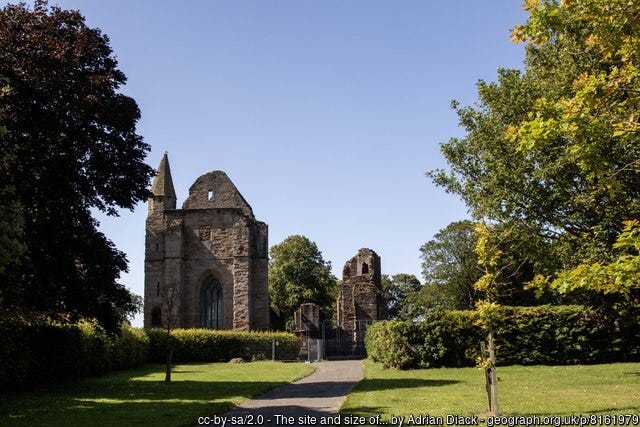
Arbroath Abbey now lies in ruins, but the town itself continues to thrive. Arbroath - or Aberbrothock, as it was once known - has been a royal burgh since 1599. The former Town House on the High Street which was home to the burgh council still has legal significance: by law, genuine Arbroath Smokies can only be produced within an 8-kilometre radius of the Town House. Smokies, which originated in the tiny fishing village of Auchmithie to the east of Arbroath, are salted haddock cooked over a very hot and smoky fire, and there are several firms in the harbour area which still produce this local delicacy. The town’s economy was traditionally based on the harbour, together with textiles: there were a number of jute mills here, and Arbroath was once a major manufacturer of sailcloth.
Jute, together with jam and journalism, were the traditional industries of the city of Dundee further along the coast. The profits from the jute mills accrued to a number of “jute barons”, who showed off their wealth by building massive houses in the fishing village of Broughty Ferry not far to the east of Dundee. By the turn of the 20th century, Broughty Ferry ranked among the richest suburbs in Europe. It became an independent burgh in 1864, and maintained that status until it was annexed by Dundee in 1913. Despite the name, the ferry (which connected the town with Tayport, on the Fife side of the Firth of Tay) no longer runs: its business was taken long ago by the Tay Bridges to the west.
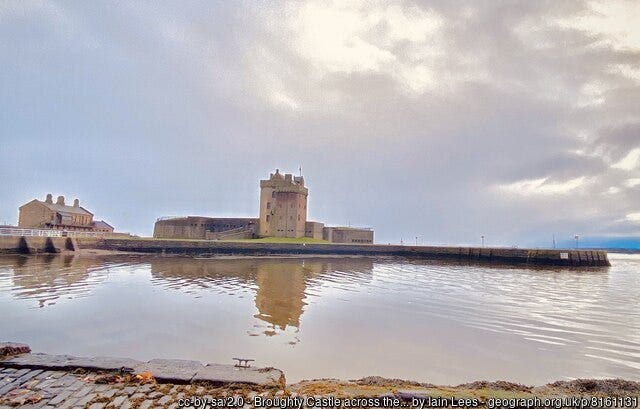
In between Arbroath and Broughty Ferry we find this constituency’s third town. Carnoustie is another old burgh based on the textile industry, but there is another side to its economy: tourism, particularly that generated by the sport of golf. Carnoustie Golf Links is one of the courses on the Open Championship rota and it has hosted the tournament eight times, most recently in 2018 when Francesco Molinari was the winner. The course is noted for its difficulty, and the events of the 1999 Open Championship - when the French golfer Jean van de Velde notoriously blew a three-shot lead on the final hole, and subsequently lost a playoff to local favourite Paul Lawrie - still live long in the memory.
Golf is not yet on the Commonwealth Games programme, but Carnoustie was nonetheless involved in the 2014 Glasgow Commonwealth Games in which it hosted the shooting events. These were held at the Barry Buddon training area, a Ministry of Defence rifle range which occupies most of the extensive system of sand dunes between Carnoustie and Monifieth. The military also have a presence at Arbroath, which hosts the Condor training area for the Royal Marines.
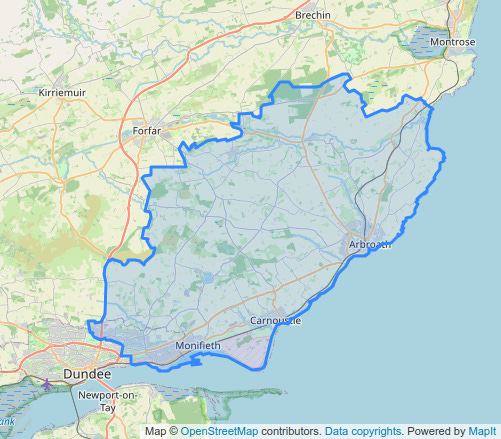
All of these towns are linked together by the A92 dual carriageway and by the railway line from Dundee to Aberdeen. Arbroath is the main railhead for the area, with express trains to England as well as the usual ScotRail services; the Aberdeen portion of the Highland Sleeper to and from London calls both there and at Carnoustie. Broughty Ferry is recognised by ScotRail as Scotland’s oldest railway station still in operation, having opened in October 1838. Many of the intermediate stops are sparsely served, and Golf Street and Barry Links stations (which lie to the west of Carnoustie) see just three trains a day and regularly feature near the top of the annual list of the UK’s least-used railway stations.
The towns and the large rural hinterland within the Arbroath and Broughty Ferry constituency were all within the traditional county of Angus, which takes its name from an 8th-century king of the Picts. But the county of Angus wasn’t always called that. The name dates in law from the Local Government (Scotland) Act 1947, which consolidated Scottish local government law of the time; the county council had previously resolved to use the name Angus in 1928. Before then, the county of Angus - and the parliamentary seat based on it, which went back at least as far the Union of 1707 - was known as Forfarshire. The First Reform Act of 1832 took the Forfarshire towns of Arbroath, Brechin, Forfar and Montrose out of the Forfarshire seat: those four burghs, plus the Kincardineshire burgh of Inverbervie, then formed the disconnected Montrose Burghs constituency.
The Montrose Burghs was a strongly Liberal constituency almost throughout its existence, and the Conservatives rarely even contested it. MPs of some strain of Liberalism held the seat continuously from 1859 to 1930. In fact, in the 1885 general election - held on a reformed and expanded franchise - the Liberal vote here was so strong that the top two candidates in the final reckoning were a Liberal and an Independent Liberal. The official Liberal John Shiress Will, a barrister, was the winner with a shade under 50% of the vote, and he was easily re-elected in 1886, 1892 and 1895 against opposition from the Liberal Unionists.
In 1896 John Shiress Will resigned his seat in the House of Commons to allow a return to the Commons for John Morley, a former Cabinet minister who had served in the third and fourth Gladstone administrations as Chief Secretary for Ireland until he lost his seat in Newcastle upon Tyne at the 1895 general election. Morley increased the Liberal majority at the resulting Montrose Burghs by-election of 22nd February 1895, and in time he was back on the Cabinet frontline: when the Liberals returned to power in 1905 he became India secretary. In between, Morley was one of the first 12 people appointed to the Order of Merit on its creation in 1902. The Order of Merit is, of course, unique in the British honours system in that it is awarded for merit.
When Asquith came to power in 1908, he kept Morley in post as India secretary but elevated him to the House of Lords, as the first and only Viscount Morley of Blackburn. The resulting Montrose Burghs by-election of 12th May 1908 was won by Robert Harcourt, the son of the former Liberal Party leader Sir William Harcourt, who had previously worked in the Foreign Office and in journalism; second place in that by-election went to an Independent Labour Party candidate.
The more rural Forfarshire seat - which at this time took in Carnoustie and the fast-growing Broughty Ferry - was also Liberal-inclined during the period 1885 to 1918. It had been held since an 1872 by-election by James Barclay, a large landowner and farmer in the county who was living proof of the old adage that where there’s muck there’s brass: he was a manure merchant. He won his fourth term of office very easily in 1885, but when the Liberal Party split a year later over the issue of Irish home rule Barclay joined the breakaway Liberal Unionists. He was narrowly re-elected on that ticket in 1886 with a majority of 407 votes, before losing his seat back to the official Liberals by 866 votes in 1892.
The winning Liberal candidate on that occasion was John Rigby, a noted lawyer who was making a return to the Commons after some years away: he had represented Wisbech from 1885 to 1886. Gladstone immediately appointed Rigby to the frontbench as Solicitor General for England and Wales, with a knighthood to go with it: this meant he had to seek re-election to the Commons, and nobody opposed him in the resulting Forfarshire by-election of 24th August 1892. Sir John Rigby’s legal career then blossomed: in 1894 he was promoted to Attorney General, and later that year he resigned from the Commons to become a Court of Appeal judge.
The resulting Forfarshire by-election of 17th November 1894 saw a poor choice of candidate from the defending Liberals, who selected London-based stockbroker Henry Robson over a well-known local candidate. This created an opening for the Conservative candidate Charles Ramsay, who was the youngest son of the 12th Earl of Dalhousie and had inherited a large amount of land in the county. In an upset result, Ramsay gained the seat with a majority of 286 votes; the large agricultural labourers’ vote in Forfarshire was thought to have been decisive in this result.
For the 1895 general election the Forfarshire Liberals reversed their mistake and selected the well-known local candidate who had been passed over for the 1894 by-election. Martin White, who defeated Ramsay by 441 votes, was a Dundee businessman whose wealth enabled him to pursue his interests. As well as politics, White was a skilled player of the pipe organ; he funded academic work in the relatively new discipline of sociology; and he installed Scotland’s first domestic hydropower plant to power his baronial castle at Balruddery, north-west of Dundee.
White resigned his seat in the Commons in November 1896 in rather murky circumstances. Officially, he fell out with his constituency party after a story falsely reporting his resignation had appeared in the Dundee Advertiser. The backstory was that he had been having an affair for some time with a woman called Helen Grant and had got her pregnant, and she was suing him for breaching a promise to marry her. They eventually settled the case out of court without the public or the press noticing.
The resulting Forfarshire by-election of 30th January 1897 provided a route back into the Commons for John Sinclair, a former Army officer who had served in the Gordon relief expedition in Sudan in the 1880s. Sinclair had previously been the Liberal MP for Dunbartonshire from 1892 until he lost his seat in 1895, and he had been a London county councillor before that. In the 1897 Forfarshire by-election he defeated the Conservatives’ Charles Ramsay by 458 votes, with no swing at all from the 1895 result. Ramsay then went off to the Yukon Territory to look for gold in the Klondike gold rush, presumably without success: he was back for another go in the 1900 general election, but narrowly lost to Sinclair again.
John Sinclair had worked closely in Parliament with the Liberal leader Sir Henry Campbell-Bannerman, and when the Liberals came to power in 1905 Campbell-Bannerman appointed him to the Cabinet as Scottish Secretary. Sinclair used this position to push through a number of reforms, including allowing women to stand in Scottish local government elections for the first time: in November 1907 Lavinia Malcolm became Scotland’s first female councillor in Dollar, Clackmannanshire.
In 1909 Sinclair was promoted to the House of Lords, taking the hereditary title of Lord Pentland; he then left these shores in 1912 to become Governor of Madras. The resulting Forfarshire by-election of 27th February 1909 pitted two lawyers against each other, with the Conservatives’ Robert Blackburn (who would go on to become a Court of Session judge) being easily defeated by the new Liberal candidate James Falconer. Falconer went on to be easily re-elected in both 1910 elections.
Once the First World War was over the the Forfarshire constituency was reduced in size at the 1918 general election, reflecting that Broughty Ferry had by now been annexed by Dundee. This might have been important in the Unionist gain of Forfarshire that year by William Shaw, a stockbroker who had served in the Royal Army Service Corps during the war; there were also rumours that Shaw had received the coalition government’s coupon, although this was not in fact the case.
James Falconer got his seat back in 1922 and round 3 of Falconer v Shaw was also a Liberal win in 1923. But when Falconer lost his seat for the second time in 1924 that pretty much ended the Liberal challenge in Forfarshire. The 1924 election here was a big win for the Unionist candidate Sir Harry Hope, a farmer and agriculturalist who had previously sat for Buteshire from January 1910 to 1918 and then for West Stirlingshire from 1918 to 1922. Hope retired at the 1931 election and William Shaw then returned as the MP for Forfarshire, winning in 1931 and 1935 with large majorities.
William Shaw finally retired from the Commons in 1945 and passed the Forfarshire seat on to the new Unionist candidate Simon Ramsay, who had served in the Black Watch during the Second World War: he fought in the Allied invasion of Sicily and won the Military Cross. Ramsay spent much of the 1945-50 Parliament as a Conservative whip. He retired from the Commons in 1950, shortly before he inherited the title of Earl of Dalhousie from his brother.
Meanwhile the Dundee constituency, which included Broughty Ferry from 1918, was a two-seat borough during this period. In 1918 it easily re-elected its incumbent MPs, Labour’s Alexander Wilkie and the National Liberal candidate Winston Churchill. Yes, that Winston Churchill: at this point he was Minister of Munitions and he was in the National Liberal faction associated with the Prime Minister David Lloyd George. Churchill had received the Coalition government’s coupon, and both Churchill and Wilkie were endorsed by the Dundee branch of the Unionist Party which had stood down in their favour. In the 1918-22 Parliament Churchill returned to the Cabinet, first as War and Air Secretary, then as Colonial Secretary from 1921.
Winston Churchill leaves our story in 1922, when the Dundee constituency returned a unique combination of candidates. Top of the poll was Edwin Scrymgeour, the only MP ever elected for the single-issue Scottish Prohibition Party; while the Labour seat was retained by E D Morel, a journalist who had spent most of his career exposing human rights abuses in the Belgian Congo. Churchill finished in fourth place, behind his National Liberal running-mate David Macdonald, and lost his seat. Morel suffered a fatal heart attack in 1924, and the resulting Dundee by-election of 22nd December 1924 was held for Labour by former MP Tom Johnston who had lost his seat in West Stirlingshire at the previous general election. In 1929 Johnston went back to West Stirlingshire, and Dundee’s Labour seat was retained by solicitor and Edinburgh councillor Michael Marcus.
Marcus and Edwin Scrymgeour were both ejected by the voters of Dundee in the 1931 National Government landslide. Again Dundee split its two seats, but this time between the Liberals and the Unionists. The Liberal MP was a very young Dingle Foot, who had recently been called to the bar and who joined his father Isaac Foot (re-elected for Bodmin) in the Commons; the Unionist MP was Florence Horsburgh MBE (as she was then) who became Dundee’s first ever female politician, as no women had ever been elected to the city council before then. Horsburgh subsequently became the first MP ever to be interviewed for television, in 1936.
The unusual double act of Foot and Horsburgh represented Dundee until 1945, when they lost their seats to Labour who won both of Dundee’s seats in that year for the first time. Top of the poll here in 1945 was Thomas Cook, a Lanarkshire man who had got into politics via the co-operative movement; his running-mate was John Strachey, a journalist who had previously served as MP for Birmingham Aston in the 1929-31 Parliament and who had been closely associated at that time with Oswald Mosley, before Mosley went fascist. Strachey had spent much of the war in the RAF as a public relations officer, and he immediately joined the government ranks as under-secretary of state for war; in 1946 he took on the difficult task of Minister for Food in those years of rationing.
The Montrose Burghs constituency was rather more settled in terms of its MPs during the inter-war years, but the fact that all of them were elected on a ticket with the word “Liberal” in it masks a rather hard swing to the right. Robert Harcourt stood down in 1918 and his seat was easily retained by new Liberal candidate and newspaperman John Sturrock. Sturrock was re-elected rather more narrowly in 1922 and 1923, contesting the first of those elections on the National Liberal ticket.
In 1924 John Sturrock stood down and was replaced as Liberal MP for Montrose Burghs by Sir Robert Hutchison, who had come to politics from a glittering career as an Army officer which went all the way back to the Boer War: Hutchison retired from the Army in 1923 with the rank of major-general and a DSO, and he was mentioned in despatches six times. He then went straight into politics as MP for the Kirkcaldy Burghs in 1922, but lost that seat in 1923 to Labour’s Tom Kennedy; the Montrose Burghs proved to be a safer berth. For most of his time as MP here Hutchison was in the whips office, serving from 1926 to 1930 as Liberal chief whip. He then defected to the National Liberals, the breakaway Liberal group which supported the National Government in 1931, and he was re-elected that year on their ticket.
Sir Robert Hutchison was elevated to the peerage in 1932, as the first and only Lord Hutchison of Montrose. The resulting Montrose Burghs by-election of 28th June 1932 was contested by the former Kirkcaldy Burghs Labour MP Tom Kennedy, who came close to winning but ultimately lost by 933 votes to the new Liberal National candidate Charles Kerr, who was very much in the same mould as Hutchison. Kerr was a former Horse Guards officer with a DSO and a Military Cross to his name, and he ended up as the National Liberals’ chief whip.
Charles Kerr was was elevated to the peerage in 1940, as the first Lord Teviot, and the resulting Montrose Burghs by-election of 5th July 1940 was won without a contest (thanks to the wartime political truce) by the new National Liberal candidate John Maclay, who had been selected to stand for the party here in the 1939 or 1940 general election that never took place. Maclay had been on the winning Cambridge team in the 1927 Boat Race, defeating Sir Douglas Thomson who we met in the Aberdeen South Preview above. He was safely re-elected in 1945 and spent most of the 1945-50 Parliament leading the National Liberal group in the Commons.
There were major boundary changes here in 1950, as the two-seat burgh of Dundee was divided into two single-seat constituencies and the Montrose Burghs constituency was abolished. Broughty Ferry was now located within the single-member constituency of Dundee East, while Arbroath, Carnoustie and Monifieth became part of the new seat of South Angus - reflecting the county’s name change from Forfarshire. This seat pattern remained little changed from 1950 until 2005, although the rural seat was renamed as East Angus in 1983, before becoming simply Angus in 1997.
These two constituencies had very different political persuasions, reflecting their urban and rural natures. The urban Dundee East seat started off by re-electing Labour’s Thomas Cook in 1950 and 1951 with relatively narrow majorities over the National Liberal candidate. Which posed a potential problem in 1952, when Cook died in a car crash on the road between Dundee and Arbroath: the car which he was driving left the road, hit a tree, went over a low wall and ended up in a field. Cook, who was 43 years old, was killed instantly.
The resulting Dundee East by-election of 17th July 1952 marked the entry to elections here of the Scottish National Party, although their candidate Donald Stewart (who would later serve for many years as the MP for the Western Isles) finished in third place with 7.5% and lost his deposit. The poll proved to be a comfortable win for the new Labour candidate George Thomson, who held the seat with an increased majority over the National Liberals.
This set up a long political career for George Thomson, who was brought up in Monifieth just outside the constituency and had been educated at Broughty Ferry. Thomson had left school at 16 to join the Dundee publishers DC Thomson (no relation) and briefly served as editor of The Dandy when he was 18, before joining the Royal Air Force in 1940. He was unable to fly due to sight problems and spent the Second World War as ground crew in Fighter Command; after the war he went back to journalism and became editor of the Scottish socialist newspaper Forward.
George Thomson’s 1952 by-election majority of 8,126 proved to be his best result in Dundee East and the seat went back to marginal status thereafter, but he was ultimately elected for six terms of office: the National Liberals were in second place until 1964, after which they merged with the Conservatives. In 1966 Thomson made it into Harold Wilson’s Cabinet as Chancellor of the Duchy of Lancaster; ultimately he had four Cabinet roles between 1966 to 1970, including serving as the last Commonwealth secretary before the Commonwealth Office was merged with the Foreign Office in 1968.
In 1973 the United Kingdom joined the European Economic Community, and George Thomson left the Commons to serve as one of the UK’s two representatives on the European Commission: he took the regional policy portfolio under president François-Xavier Ortoli. The resulting Dundee East by-election of 1st March 1973 changed the game of Dundee politics with an unexpectedly strong showing for the Scottish National Party, who surged into second place and came within 1,200 votes of winning. The Conservatives’ William Fitzgerald, who was the Lord Provost of Dundee, finished third with 25%; the SNP’s Gordon Wilson, a solicitor who had once controlled a pirate radio station, polled 30%; and the winner on just 33% of the vote was the Labour candidate George Machin. Machin was an Englishman from Sheffield who had risen to the Commons through the trade union movement, and his victory speech after the declaration was disrupted by hecklers with chants of “go back to Yorkshire”.
Fifty-two weeks later Labour’s Machin and the SNP’s Gordon Wilson faced off again in the snap general election of February 1974. By this point, as mentioned in the Aberdeen South Preview, the North Sea oil industry was starting to get going in earnest, and Wilson - who had by now become depute leader of the SNP - had a coined a pithy slogan to convert this geological good fortune into Nationalist votes: “It’s Scotland’s Oil”. It worked, and Wilson defeated Machin in Dundee East by 2,966 votes to become one of seven Scottish National Party MPs in the House of Commons - the party’s first big electoral breakthrough.
This boom was followed by bust, and in 1979 the SNP held just two seats: Donald Stewart in the Western Isles, and Gordon Wilson in Dundee East. Wilson may well have been helped in that year by another controversial selection by the Dundee East branch of Labour: they went for the Red Clydeside union leader Jimmy Reid, who had been a Communist candidate in both 1974 general elections and didn’t have the length of party membership which was normally expected for Labour parliamentary candidates at the time. Wilson defeated Reid by 2,519 votes, and later that year he was elected as leader of the Scottish National Party - a post which he would hold until 1990, when Alex Salmond took over for the first time.
By that point Gordon Wilson was out of the Commons, as he had lost his seat back to Labour in 1987. This set up John McAllion, who defeated Wilson by 1,015 votes, for a similarly long tenure in Dundee East. McAllion had been the convenor of Tayside regional council before his election, and he had worked as a teacher before going into politics. He went on to be re-elected in 1992 and 1997.
John McAllion was a supporter of home rule for Scotland, and when the Scottish Parliament was re-established in 1999 he became the first MSP for Dundee East. McAllion then stood down from Westminster at the 2001 general election, and he passed his seat on to Labour MP Iain Luke. Like McAllion, Luke had come up from local politics: he was a Dundee city councillor before entering the Commons.
As stated, during the period from 1950 to 2005 Arbroath, Carnoustie and the rural parts of the modern Arbroath and Broughty Ferry seat were included in various constituencies with the name “Angus” in the title. The first of these was South Angus, which in the 1950s was a safe seat for the National Liberals’ James Duncan. Duncan was making a return to Parliament, having previously represented the London seat of Kensington North from 1931 until he lost his seat in 1945. He was made a baronet in 1957.
Sir James Duncan retired at the 1964 general election and passed South Angus on to Jock Bruce-Gardyne, who was from a family with extensive landholdings in the area. There is still a Gardyne Castle in this seat, a privately-owned tower house not far from the village of Friockheim.
Bruce-Gardyne continued to enjoy large majorities right up until October 1974, when he was swept away in a landslide gain for the SNP. This was the start of the long political career of Andrew Welsh, a Glasgow schoolteacher who had just turned 30. Welsh defeated Bruce-Gardyne by 1,824 votes in October 1974. For the 1979 general election Bruce-Gardyne found a safer berth south of the Border in Knutsford, and the Conservatives selected Peter Fraser who defeated Welsh by the even narrower margin of 963 votes.
Peter Fraser had been born in Zambia and came to Scotland at the age of 12, after the Prime Minister Anthony Eden had pulled strings to get Fraser a scholarship to Loretto School in Musselburgh. Fraser made his career in the law, and in 1982 he was appointed to the post of Solicitor General for Scotland and received the title of QC to go with it.
The 1983 boundary changes redrew Fraser’s constituency as East Angus, moving Forfar out of the seat and Brechin and Montrose in. The new seat was considerably more Conservative than the old Angus South, and had it not been for the redistribution Peter Fraser would probably have lost his seat back to the SNP’s Andrew Welsh in 1983. As it was, the third and final round of Fraser v Welsh in 1987 was a win for Welsh, who returned to the Commons after eight years away. In the interim Welsh had served as provost of Angus and as leader of Angus district council.
Andrew Welsh never lost an election again after that, whether in East Angus or in the Angus seat that replaced it in the 1997 redistribution. As with John McAllion in neighbouring Dundee East, Welsh was elected to the Scottish Parliament in 1999 and stood down from Westminster in 2001, successfully passing the seat on to his party colleague - in this case, Mike Weir. Weir, who had been the SNP candidate for Aberdeen South in 1987, was a solicitor and an Angus councillor before his election to the House of Commons.
The advent of the Scottish Parliament, and the subsequent reduction in the number of Scotland’s parliamentary seats to match, forced a major redistribution here in 2005. The two Dundee constituencies expanded outwards into their rural hinterlands, with Dundee East gaining Monifieth and Carnoustie from the Angus constituency. This made the Dundee East seat less urban, and that might well have made the difference in the 2005 general election when the Scottish National Party’s Stewart Hosie gained Dundee East from Labour’s Iain Luke. Hosie, who had worked for many years in IT before his election, had previously finished as runner-up here in 2001.
Stewart Hosie would go on to hold Dundee East for 19 years, and for much of that time he was one of the SNP’s most high-profile figures. In 2014 he became the party’s deputy leader, succeeding Nicola Sturgeon after she ascended to the top job. Hosie didn’t seek re-election to that position in 2016 following media scrutiny over his private life: he had had an affair with a Westminster journalist, which had led to the breakup of his marriage to Shona Robison - who, awkwardly, was the SNP MSP for the corresponding Holyrood seat of Dundee City East. Hosie and Robison subsequently divorced, and he married said Westminster journalist.
The heavily-redrawn Angus constituency turned in close results between the SNP and the Conservatives in 2005 and 2010, with Mike Weir holding his seat on both occasions. But he eventually went down to defeat in the good Conservative year of 2017, when the Angus seat returned the Conservative candidate Kirstene Hair who overturned a majority of over 11,000 votes. Hair, who had been the party’s Holyrood candidate for Angus South in 2016, was - like George Thomson who we met earlier - a former employee of the DC Thomson publishing empire.
The Scottish Conservatives went backwards in 2019, and Kirstene Hair proved to be a one-term MP. She lost her seat back to the SNP, a result which brought Dave Doogan into the House of Commons. Doogan had given up a job as an MoD aircraft engineer in order to enter politics, and he had sat on Perth and Kinross council for seven years before he won the Angus constituency. He quickly made it to the party’s frontbench, being appointed as the SNP’s Westminster spokesman on agriculture and rural affairs within a month of the election. Following the 2024 redistribution Doogan was re-elected for the successor seat of Angus and Perthshire Glens, and last month he took over from the departing Stephen Flynn as the leader of the SNP’s Westminster group - a group which is much smaller now than it was when Doogan was first elected in 2019.
The Arbroath and Broughty Ferry constituency was created for the 2024 general election, essentially as the successor to Dundee East. Compared to the old seat, the east end of Dundee moved out and was replaced by Arbroath and its hinterland. The seat continues to cover a series of peripheral Dundee estates, mostly in the city’s North East ward, as well as affluent Broughty Ferry.
Stewart Hosie retired at the 2024 election, and the SNP managed to hold his former seat - no mean achievement in an election where Labour ran rampant across the Central Belt and SNP seats fell like ninepins. The Labour charge fell 859 votes short here, with Stephen Gethins of the SNP winning on 35% of the vote to 33% for Labour and 16% for the Conservatives.
Stephen Gethins had been an MP before, representing North East Fife from 2015 to 2019. His time there included being on the right side of one of the closest Westminster election results of modern times: in the 2017 general election he was re-elected with 13,743 votes to 13,741 for the Liberal Democrat candidate, a majority of two votes after three recounts. He had been the only SNP MP to lose his seat in 2019. Before entering politics Gethins had been working on embedding peace and democracy in the Caucasus and the Balkans; after his 2019 defeat he joined the ranks of academia, becoming a professor of practice in international relations at St Andrews.
The Angus wards of this seat have the distinction of being part of an SNP-held constituency at all seven Holyrood elections to date. Andrew Welsh held the Angus Holyrood constituency until he retired in 2011; at this point his seat was broken up in boundary changes with Arbroath, Carnoustie and so on transferring into a recreated Angus South constituency. This was won in 2011 by Graeme Dey, yet another journalist from the DC Thomson stable, who served for 15 years and was a Scottish Government junior minister for much of the period from 2018 to 2026; his final portfolio was minister for Parliamentary business, which he still held up to his retirement from Holyrood this year. Angus South was left unchanged in this year’s Scottish Parliament redistribution, and it was held for the SNP by Lloyd Melville who is an Angus councillor: he represents Monifieth and Sidlaw ward, and he is entitled to remain as a councillor until his term expires next year. Melville won Angus South last month with 42% of the vote, against 21% for the Conservatives and 18% for Reform UK; vote shares here in the North East Scotland regional ballot, with a wider choice of parties, were 32% for the SNP, 19% for the Conservatives, 18% for Reform UK, and 10% each for the Scottish Greens and Labour.
Meanwhile the Dundee portion of the Arbroath and Broughty Ferry constituency is nearly all in the Dundee City East Holyrood constituency (a small corner is in Dundee City West). Dundee City East has been in SNP hands since 2003, when Shona Robison gained the predecessor seat of Dundee East from Labour’s John McAllion. Robison, who had been a regional MSP for North East Scotland in the first Holyrood term, was a regular fixture of the Scottish Government for much of the last 20 years: she made it to Cabinet level in 2014 with the sprawling portfolio of the Glasgow Commonwealth Games, sport, equalities and pensioners’ rights, and her career peaked in 2023-24 when she was Humza Yousaf’s deputy as First Minister of Scotland. Robison was still the Scottish cabinet secretary for finance when she retired from Holyrood in 2026 after six full terms of office.
Stephen Gethins won the 2026 SNP nomination for Dundee City East to succeed Robison, and he was easily elected in May with 49% of the vote against 18% for Labour and 16% for Reform UK, whose candidate Mark Simpson was elected to Holyrood at the top of the Reform UK list for North East Scotland. The regional vote here gave 35% to the SNP, 16% each to Labour and Reform UK, and 14% to the Scottish Greens. There is no exemption from the double-jobbing rules for Gethins, and he was obliged to resign from Westminster upon his election to the Scottish Parliament.
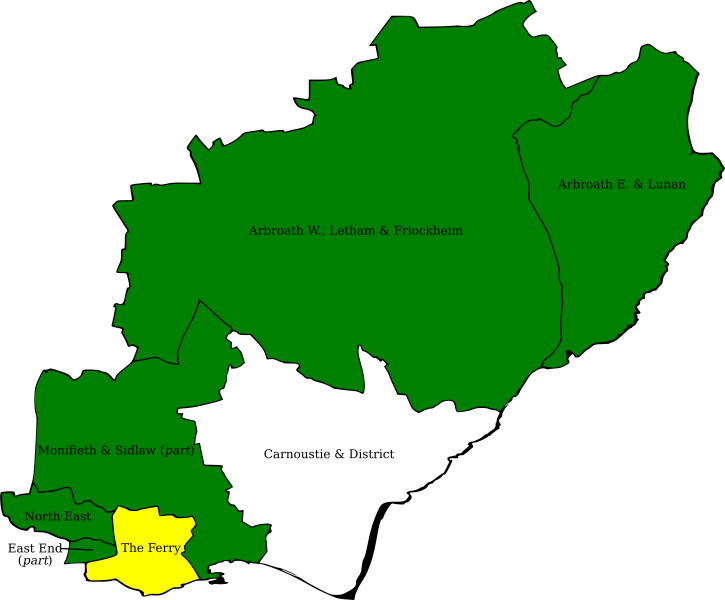
The ward and constituency boundaries here don’t match up, which is not uncommon in Scotland where the use of PR for local government results in wards of 3 or 4 councillors with relatively large headcounts. If we take as a best fit for this seat the four Angus wards wholly or partly in the constituency plus the Dundee wards of The Ferry and North East, then first preference votes here in 2022 were 30% for the SNP, 28% for Labour who didn’t stand in Carnoustie and District ward, 18% for the Conservatives and 10% for the Liberal Democrats (the vast majority of which came out of The Ferry ward covering Broughty Ferry, where they topped the poll). Councillor totals for the four Angus wards in the seat were six SNP, four independents, three Conservatives and one Labour, while the two Dundee wards returned three SNP councillors, two Labour and one each for the Conservatives and Lib Dems. The independent Angus councillor for Arbroath West, Letham and Friockheim ward resigned in 2024, and the resulting by-election was gained by the Conservatives.
The Scottish National Party have only ever had to defend two Westminster by-elections, both of them in the 2019-24 Parliament, and they have a 50% retention rate to date. Holding this seat and Aberdeen South would increase that to 75%. The one previous SNP by-election hold was Airdrie and Shotts in 2021, which was for the same reason as these two: the incumbent Westminster MP had gone to Holyrood.
Defending for the SNP is Lara Bird, a qualified barrister from Broughty Ferry who is currently studying for a PhD at King’s College London. Bird is also an experienced long-distance runner, and she completed this year’s London Marathon in a time of 3 hours, 12 minutes and 58 seconds to raise funds for the RNLI. She is a first-time election candidate.
The Labour candidate this time is Heather Doran, who works for Dundee University and is an Angus councillor for Monifieth and District ward. In May Doran was the Labour candidate for Angus South, and she was in second place on the party’s list for North East Scotland.
Also straight back on the campaign trail is the Conservative candidate Jack Cruickshanks, who won the 2024 Angus council by-election in Arbroath West, Letham and Friockheim ward; he was then a 24-year-old student reading financial economics at Dundee University. In May Cruickshanks was the Conservative candidate for Dundee City East and he was in an unwinnable eighth place on the party’s list for North East Scotland.
Fourth place here in 2024 went to Reform UK who polled 8.6%; their candidate this time is Bill Reid, who contested Angus South in May and was ranked in ninth and last place on the Reform UK list for North East Scotland. Last time round the Lib Dems polled 5.1% and saved their deposit by 43 votes; their candidate is Tanvir Ahmad, who stood in Dundee City East in May and was placed third on their North East Scotland list. In 2024 Arbroath and Broughty Ferry also had candidates from Alba and a pro-independence group called Sovereignty, both of whom lost their deposits; Alba are now defunct and Sovereignty are not standing again.
Nobody else has come forward so this by-election has a field of just five candidates, the shortest ballot paper for a Westminster by-election since West Tyrone in 2018. But if you want weird and wonderful candidates, you’ll be well catered for in the final part of this week’s Parliamentary Special as we head south of the Border...
Holyrood constituencies: Angus South (Angus wards), Dundee City East (most of the Dundee wards), Dundee City West (part of North East ward west of the A90 road)
Angus council wards: Arbroath East and Lunan; Arbroath West, Letham and Friockheim; Carnoustie and District; Monifieth and Sidlaw (part: east of A90 road)
Dundee council wards: The Ferry, North East, East End (part)
ONS Travel to Work Area: Dundee (most of constituency), Arbroath and Montrose (eastern end)
Postcode districts: DD4, DD5, DD7, DD8, DD9, DD10, DD11
Tanvir Ahmad (LD)
Lara Bird (SNP)
Jack Cruickshanks (C)
Heather Doran (Lab)
Bill Reid (RUK)
May 2024 result SNP 15581 Lab 14722 C 6841 RUK 3800 LD 2249 Alba 693 Sovereignty 231
Forward to Part III of this week’s Previews - Makerfield
If you enjoyed these previews, there are many more like them - going back to 2016 - in the Andrew’s Previews books, which are available to buy now (link). You can also support future previews by becoming a paid subscriber to this blog - which will also you get you early access to the Previews.
Andrew Teale
Comments
Nothing yet. Say the first thing.
Sign in to join the conversation.