
There are eighteen elections taking place on 18th June 2026, of which four (for a total of seven seats) are polls which were postponed from 7th May after a candidate died during the election campaign; eleven are ordinary by-elections, some of which deal with matters arising from May’s local elections; and three are Parliamentary Specials, one of which might have an impact far larger than the usual filling of a casual vacancy. But we’re not going to start with that one. This week’s Preview is being split into four parts, with the three Parliamentary Specials first and then a final part for the undercard. In fulfilment of Andrew’s Previews’ promise to cover all the right votes, but not necessarily in the right order, for Part I this week let’s go north of the Border:
House of Commons; caused by the resignation of Scottish National Party MP Stephen Flynn.
In 1969, British Petroleum were drilling for gas in the North Sea, about 135 miles east of Aberdeen. Gas was already being exploited in British and Dutch waters of the North Sea to the south, and BP wanted to test a theory that the gas field extended further north. Their geologists were astonished when the well struck oil.
This original discovery is now the Montrose oil field, and it is still going strong. Over the next few years many more oilfields were discovered under the harsh waters of the North Sea - Forties, Brent, Piper and so on - and the oil shocks of 1973 and 1979 made it commercially viable to develop them. To this day the Brent oilfield gives its name to the Brent Crude price for North Sea oil, although Brent itself is now exhausted and buying a barrel of Brent Crude will instead give you a blend of crude oil from other British and Norwegian fields.
North Sea oilfields in British waters were developed by private enterprise, and their extraction turned the old city of Aberdeen into an economic boom town, the Oil Capital of Europe. Aberdeen has the largest and busiest seaport in north-east Scotland, and its airport is the main base for helicopters serving the oil rigs.
But Aberdeen goes back a long way. The Port of Aberdeen has been here since at least 1136 when David I gave the city a royal charter, and Aberdeen had a flourishing fishing and shipbuilding industry for centuries. Aberdeen harbour is still the embarkation point for the main ferry service to Shetland, with overnight sailings departing for Lerwick every evening.
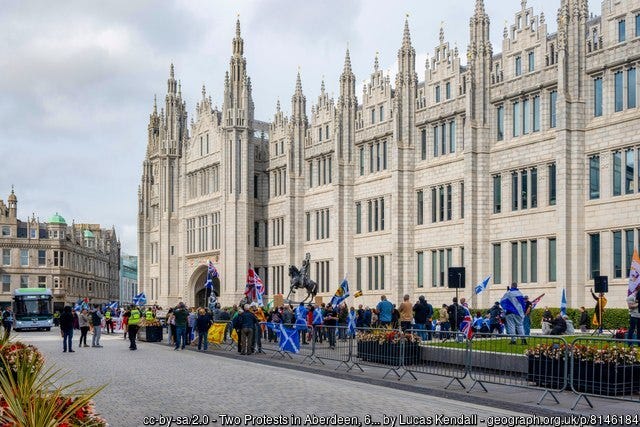
The nearby city centre is filled with 19th and 20th century buildings in grey granite, and Marischal College is the second-largest granite building in the world after the Escorial Palace in Madrid. The building is now occupied by the city council, but Marischal College was originally home to a university founded in 1593: it merged with King’s College in 1860 to form the modern Aberdeen University.
Aberdeen’s second, more modern university is Robert Gordon which obtained its university status in 1992: its main campus is a few miles up the river Dee at Garthdee. The eponymous Robert Gordon had graduated from Marischal College before making his fortune as a merchant in the Baltic city of Danzig (modern-day Gdańsk), and on his death in 1731 he left his fortune to found a private school in the city from which the university eventually spun off. Two current MPs were pupils of the original Robert Gordon’s College, including the former Labour Party chairman Dame Anneliese Dodds and the present Aberdeen North SNP MP Kirsty Blackman.
The city of Aberdeen was promoted from one MP to two by the Third Reform Act in 1885, and the Aberdeen South constituency has existed ever since then. It has been subject to frequent boundary changes over the years, and only the areas of Ferryhill, Broomhill, Ashley and Seafield have been in the Aberdeen South constituency continuously since 1885. One major factor in boundary-drawing here over the decades has been the River Dee, which was the boundary between Aberdeenshire and Kincardineshire. The Torry district, despite being not far to the south of Aberdeen city centre, was once in a different county.
So, as originally drawn, the Aberdeen South constituency of 1885 to 1950 (with minor boundary changes in 1918) lay entirely to the north of the Dee. It was centred on the city’s West End, with the eastern boundary being the arrow-straight George Street. In other words, this was Aberdeen’s middle-class seat - and the comparison to Aberdeen North, which has only voted Conservative once in its similarly long history (in 1935) is stark. Some of what are now the built-up western suburbs of the city such as Hazlehead, Airyhall and Garthdee were still open space at this time, and they had not yet been incorporated into Aberdeen: these areas were part of the seat of West Aberdeenshire until 1918 and Central Aberdeenshire thereafter. In 1885 the Kincardineshire parts of the present Aberdeen South - Kincorth, Torry and Cove - were part of the Kincardineshire constituency; in 1918 Torry was transferred to Aberdeen North, while Kincorth and Cove moved into a new seat of Kincardine and Aberdeenshire West.
In this form Aberdeen South was a safe Liberal seat from 1885 to 1918, including in the 1886 general election when the seat was uncontested. For most of this period its MP was James Bryce, a noted scholar of history and law who held the Regius Chair of Civil Law at Oxford University from 1870 to 1893; in 1876 he was one of the first people since Noah to reach the summit of Mount Ararat. He had entered politics in 1880 as a Liberal MP for the Tower Hamlets constituency, transferring here in 1885 as a result of the boundary changes.
In 1892 Bryce joined Gladstone’s Cabinet as Chancellor of the Duchy of Lancaster, which under the rules of the time meant that he had to seek re-election to the House of Commons in a by-election: at the resulting first Aberdeen South by-election of 23rd August 1892 he was returned unopposed. Bryce subsequently served as president of the Board of Trade from 1894 until the Liberal government was defeated in 1895; when the Liberals returned to power under Campbell-Bannerman in 1905, Bryce rejoined the Cabinet as chief secretary for Ireland.
James Bryce resigned from the Commons in 1907 to become British ambassador to the USA, with the British government of the time feeling that a high-profile political figure was needed to deal with the Yanks rather than the usual senior diplomat - a course of action which has been tried again in recent years with a rather less satisfactory outcome. The resulting second Aberdeen South by-election of 20th February 1907 was a much closer affair than previous elections here thanks to the intervention of the future TUC general secretary Fred Bramley as the candidate of the Aberdeen Labour Representation Committee. The Conservatives’ Ronald McNeill, a barrister who had previously edited the London evening newspaper St James’s Gazette and was also contributing to the Encyclopædia Britannica at the time, eventually lost by 367 votes to the new Liberal candidate George Esslemont. A rematch in January 1910 saw Esslemont increase his majority to 2,316; McNeill’s subsequent government career (he was Chancellor of the Duchy of Lancaster from 1927 to 1929) came from seats elsewhere.
George Esslemont resigned from the Commons in 1917, a few months before his early death at the age of 57. The resulting third Aberdeen South by-election of 3rd April 1917 was not contested by the Conservatives thanks to the wartime electoral truce, but that didn’t stop the Liberals bickering over their candidate. They eventually settled on Sir John Fleming, a timber businessman who had been Lord Provost of Aberdeen in 1898-1902 and was the first holder of that title to act as Lord-Lieutenant of Aberdeen when the city was made a county of itself. Sir John was a younger brother of Robert Fleming, who went into merchant banking and became an extremely wealthy man, and he was a great-uncle of the author Ian Fleming. He won the by-election easily against competition from two independent candidates: second place went to James Watson, a chemistry professor at Anderson’s College in Glasgow who had previously been associated with the Independent Labour Party, while the women’s suffrage campaigner Frederick Pethick-Lawrence (who was very briefly Leader of the Opposition during the Second World War coalition government) performed very badly on a platform of “peace by negotiation”.
With peace won instead through the surrender of Germany, the 1918 general election marked a step-change in Aberdeen South’s politics. Sir John Fleming stood for re-election, but he didn’t get the coalition government’s coupon which instead went to the Unionist candidate Frederick Thomson. Thomson was a barrister from the Leith family which had founded the Ben Line shipping company, which is still in operation today as a shipping agency based in Singapore; he had fought in the First World War in Egypt and in Salonika, where he had been severely wounded. He defeated Fleming by over 7,000 votes, with independent James Watson standing again and saving his deposit.
Frederick Thomson went on to successfully navigate the turbulent political years of the 1920s as the Unionist MP for what quickly became a safe seat, particularly after Labour took over second place in Aberdeen South in 1922. In April 1923 he was appointed as Solicitor General for Scotland and got the title of KC to go with it, but from 1924 onwards he was a Conservative whip. In 1929 Thomson was created a baronet.
Sir Frederick Thomson, 1st Baronet, died in 1935 at the age of 59. For the resulting fourth Aberdeen South by-election of 21st May 1935 the Unionists selected his son Sir Douglas Thomson, 2nd Baronet, as their defending candidate, and he romped to victory by almost a 2 to 1 margin over Labour’s Joseph Duncan who was secretary of the Scottish Farm Servants’ Union. Douglas Thomson had previously rowed for Oxford in the 1926 and 1927 Boat Races, finishing on the losing side on both occasions.
The Unionist majority over Labour here was cut to 1,816 votes by the Attlee landslide of 1945, so when Sir Douglas Thomson resigned the following year the fifth Aberdeen South by-election, scheduled for 26th November 1946, proved to be a close contest. The Labour challenger was Arthur Irvine, a barrister who had made several previous attempts to get into Parliament: he would eventually win a by-election in Liverpool the following year and serve as Solicitor General in the second Wilson government. The Unionist defence was led by Aberdeen South’s first female candidate. Priscilla Grant was only 31 but she was already a widow after her first husband, Grenadier Guards officer Sir Arthur Grant, had been killed in action in 1944. Lady Grant had stood in Aberdeen North in the 1945 general election and got nowhere; but Aberdeen South proved to be a much easier proposition, and Grant defeated Irvine by 3,839 votes.
In 1948 Priscilla Grant remarried. Her second husband was Johnnie Buchan, who was the son of the author John Buchan and had inherited the title of Lord Tweedsmuir - and a seat in the House of Lords - from him. Lady Tweedsmuir went on to have a long parliamentary career, which included winning what was dubbed the “Battle of the Housewives” in 1955: in a rare all-female candidate list, that year her Labour opponent was a young Judith Hart. Her tenure in Aberdeen South also took in an expansion of the seat in 1950, when boundary changes brought Torry, Kincorth and some new western suburbs of Aberdeen into the seat while moving most of the city centre into Aberdeen North.
Priscilla and Johnnie Buchan unwittingly had a part in setting up one of the most bizarre political stories of the post-war era - an attempted abduction of the Prime Minister Sir Alec Douglas-Home. In April 1964 Douglas-Home was staying at the Buchans’ house in Aberdeenshire while attending a Scottish Unionist conference, and he was followed home by a group of Aberdeen University students who knocked on the door. The Prime Minister was alone in the house at the time - the Tweedsmuirs’ house didn’t have room for his bodyguard to stay - so he answered the door himself, at which point the students told him that they intended to kidnap him. After playing for time by asking for ten minutes to pack a bag, Douglas-Home eventually bought the students off by giving them some of the Buchans’ beer, posing for photographs and joking about the forthcoming general election. The whole thing was hushed up at the time to avoid ruining the PM’s bodyguard’s career, and the story didn’t come to light until 2008 when Lord Hailsham’s diaries were published; the plot’s ringleader Sandy Carle, who was chair of the Aberdeen student union’s charity committee, went on to a career as a solicitor.
It took one of the titans of Scottish political history to finally lever Priscilla Buchan out of office. Donald Dewar, who ended his career as the inaugural First Minister of Scotland from 1999 until his death the following year, had first contested Aberdeen South in the 1964 general election just after he had finished his law degree at Glasgow University. He cut Lady Tweedsmuir’s majority to 3,898 votes on that occasion, and Dewar - then aged 29 - finished the job in the 1966 Wilson landslide to become the first Labour MP for Aberdeen South with a majority of 1,799.
This small majority proved to be a false start for Donald Dewar’s parliamentary career: he held Aberdeen South for only one term and didn’t get back into the Commons until 1978. In the 1970 general election Aberdeen South reverted to the Conservatives, with Iain Sproat defeating Dewar by 1,089 votes. Sproat would go on to win four terms of office here, often on knife-edge majorities: his re-elections in October 1974 and 1979 (when the Labour candidate was future Greenock MP Norman Godman) were both with under 1,000 votes.
The 1983 redistribution saw major changes to the Aberdeen South constituency. In came the city centre and Pittodrie from Aberdeen North; out went the suburbs of Kincorth and Garthdee, which were transferred into a rural seat called Kincardine and Deeside. The BBC/ITN estimates were that this reduced the Conservative majority in Aberdeen South from 772 votes to 541. Iain Sproat decided to do the chicken run and he sought re-election in Roxburgh and Berwickshire, which proved to be a disastrous decision for him: not only did Sproat lose in his new seat, but Aberdeen South returned the new Conservative candidate. Gerry Malone was elected to Parliament at his fifth attempt with an increased Conservative majority of 3,581 votes thanks to an even vote split between Labour and the SDP. Malone’s four previous failed candidates had including losing the 1982 Glasgow Hillhead by-election to Roy Jenkins. (Sproat, meanwhile, did not return to the Commons until 1992 when he was elected for Harwich.)
Gerry Malone was appointed to the Whips office in 1986 towards the end of what proved to be his only term as MP for Aberdeen South. In 1987 he lost his seat to Labour by 1,198 votes, and he subsequently turned up as MP for Winchester from 1992 to 1997. Malone lost his seat in Winchester in May 1997 by just two votes, went to the Election Court which voided the result for uncertainty and ordered a re-run, and he then lost the resulting Winchester by-election in November 1997 by 21,556 votes. The electorate tend not to like sore losers.
Malone’s successor as MP for Aberdeen South was Labour’s Frank Doran, a solicitor who only served one term in the seat after his election in 1987. In 1992 Aberdeen South was the only seat (excluding by-election regains) which the Conservatives gained from Labour against the national trend, with former teacher Raymond Robertson defeating Doran by 1,517 votes.
The 1997 redistribution reflected the oil boom and population growth in Aberdeen by granting three seats to the city for the first time. The new seat was Aberdeen Central, which took the city centre and the West End from Aberdeen South; it was projected to be a Labour seat, and Frank Doran successfully returned to the Commons there. In compensation Aberdeen South regained Garthdee and also extended up the Dee valley to take in the villages of Milltimber and Peterculter from the Kincardine and Deeside seat. That seat had been gained by the Liberal Democrats’ Nicol Stephen in a 1991 by-election before the Tories took it back in 1992, and partly because of this the Rallings and Thrasher estimates had the Lib Dems in second place in the redrawn Aberdeen South. Which is what happened in 1997 - except they were in second place behind Labour. The outgoing Conservative MP Raymond Robertson polled 26% and finished in third place; Nicol Stephen placed second with 28%, and the winner with 35% of the vote was Labour’s Anne Begg.
As in many other places across the UK, 1997 was a result which broke the mould in this seat. Dame Anne Begg, as she became in 2011, went on to win four terms of office as MP for Aberdeen South, becoming by far the longest-serving of the seat’s three Labour MPs to date. And Begg didn’t let her physical disability stop her from pursuing elected politics or her previous teaching career. She suffers from Gaucher’s disease, a genetic degenerative condition, and she has been a wheelchair user since 1984. We can see from elections to the Scottish Parliament that there was nothing inevitable about Begg’s wins: the Aberdeen South constituency there was represented by the Lib Dems’ Nicol Stephen from 1999 to 2011.
The establishment of the Scottish Parliament led to a redistribution of Scotland’s Westminster seats in 2005. Before devolution Scotland had been over-represented in the House of Commons, and the 2005 boundary changes brought the size of its constituencies into line with those in England by cutting the number of Scottish MPs from 72 to 59. This led to the abolition of the Aberdeen Central constituency after only eight years, and some of its territory returned to Aberdeen South.
It took the SNP landslide of 2015 to sweep Dame Anne Begg away. She was defeated in 2015 by the Scottish National Party’s Callum McCaig, who jumped from fourth place at the previous election to win the seat by over 7,000 votes. McCaig had started his political career early, being elected as an Aberdeen city councillor for Kincorth/Loirston ward in 2007 and then taking over as leader of the city council in 2011. He was 26 at the time.
McCaig resigned his seat on Aberdeen council after the election, and the resulting by-election was held by the SNP’s Stephen Flynn - who I described at the time as “McCaig’s parliamentary assistant” - with a massive 61% of the first-preference vote. But if Callum McCaig thought he was in for a long political career, he was wrong. The snap general election in June 2017 saw the Conservatives make gains in Scotland, and one of them was Aberdeen South. McCaig lost his seat to the Conservatives’ Ross Thomson by 4,752 votes. He is now the SNP’s chief executive, trying to pick up the shattered pieces left behind by the embezzlement conviction of the party’s long-serving former chief executive Peter Murrell.
Ross Thomson had also started his political career early. He first stood for election at the age of 19 as the Conservative candidate for Coatbridge and Chryston in the 2007 Holyrood elections, and in 2012 he was elected to Aberdeen city council as a councillor for Hazlehead/Ashley/Queens Cross ward. In 2016 Thomson was elected to the Scottish Parliament as a regional MSP for the North East region, and he stood down from Aberdeen council at the May 2017 election. He then resigned his Holyrood seat shortly afterwards upon being elected to Westminster.
During his time in Holyrood Ross Thomson was one of the few MSPs who supported a Leave vote in the 2016 EU membership referendum (which was ten years ago next week). He was a strong supporter of Brexit in a Parliament which was dominated by that single issue, and he supported Boris Johnson in the 2019 leadership election. But if Ross Thomson thought he was in for a long political career, he was wrong. His time at Westminster ended with his constituency party refusing to support him when allegations of sexual misconduct in Parliament’s Strangers Bar were made: this effectively forced Thomson into a last-minute retirement when the 2019 general election was called. Ross Thomson subsequently joined Reform UK and there was some speculation that he might be their candidate in this by-election, but the latest news is that he has flounced out of that party after failing to get their nomination for an Aberdeenshire council by-election in Peterhead next month.
The beneficiary of Ross Thomson’s fall from grace in December 2019 was the SNP’s Stephen Flynn, who as previously stated had been office manager for and had taken over the Aberdeen council seat vacated by Callum McCaig. He defeated the replacement Conservative candidate Douglas Lumsden, the co-leader of Aberdeen council, by 3,990 votes. Flynn then resigned his council seat in Kincorth/Nigg/Cove ward and a by-election to replace him was scheduled for May 2020, but this had to be called off as a result of the COVID-19 pandemic: his seat eventually remained vacant until November 2020, when the SNP easily held the rescheduled by-election.
Stephen Flynn took over in 2022 as leader of the SNP’s Westminster group, giving him the speaking rights afforded to the leader of the third-largest party in the Commons. In July 2024 Flynn lost those rights to the Lib Dem leader Sir Ed Davey but was still easily re-elected in his own seat, with a redrawn Aberdeen South constituency - now again including the city centre and Pittodrie - giving him 33% of the vote to 25% for Labour and 24% for the Conservatives. This was a numerical majority of 3,758 votes over Labour.
The relationship between Westminster and Holyrood constituencies was decoupled by the 2005 Westminster redistribution, and the former Aberdeen South Holyrood seat has taken a different turn. As stated above, it was held by the Lib Dems’ Nicol Stephen from 1999 until he retired in 2011. In that year the Holyrood seat was redrawn with the new name of Aberdeen South and North Kincardine, and it has had SNP representation since then. Maureen Watt (who is the daughter and mother of former SNP MPs) took the seat over in 2011 after five years as a regional MSP for North East Scotland. She passed it on in 2021 to Audrey Nicoll, who had won a November 2019 Aberdeen council by-election in Torry/Ferryhill ward; I described Nicoll then as “a part-time lecturer and retired police officer”. Her husband Alex is a former leader of the SNP group on Aberdeen council.
Nicoll stood down at last month’s Holyrood election and the SNP nomination in a renamed seat of Aberdeen Deeside and North Kincardine went to then-MP Stephen Flynn. Flynn was duly elected but fairly narrowly so, polling 34% against 31% for the former Scottish Conservative deputy leader Liam Kerr and 18% for Reform UK’s Duncan Massey; Kerr and Massey were both returned as regional MSPs for North East Scotland, at the top of their respective party lists. Under the terms of the Scotland Act 1998 as amended, once Stephen Flynn was elected to Holyrood he was obliged to resign his Westminster seat within 49 days or be disqualified from the Scottish Parliament.
The pro-independence majority in Holyrood is not a reflection of the votes which were cast last month, and is entirely due to the SNP’s overhang in the constituency seats. Aberdeen Deeside and North Kincardine is one seat where the Scottish Greens’ withdrawal from the constituency vote might have made a crucial difference, because the Conservatives carried that seat in the Scottish Parliament regional vote with 26%; the SNP had 25%, Reform UK 19% and Labour 9%. The 2,671 votes or 8% which went to the Greens in the regional vote is comfortably more than Stephen Flynn’s constituency vote majority of 1,244.
Mind, the Conservatives probably shouldn’t look on that result from Aberdeen Deeside and North Kincardine and conclude that they are about to win this Westminster by-election. This will be a tougher assignment for them. The Westminster seat does not include the North Kincardine ward of Aberdeenshire, where the Conservatives are strong, and it takes in large parts of the Aberdeen Central Holyrood seat where the Tories were fifth in the regional vote this year.
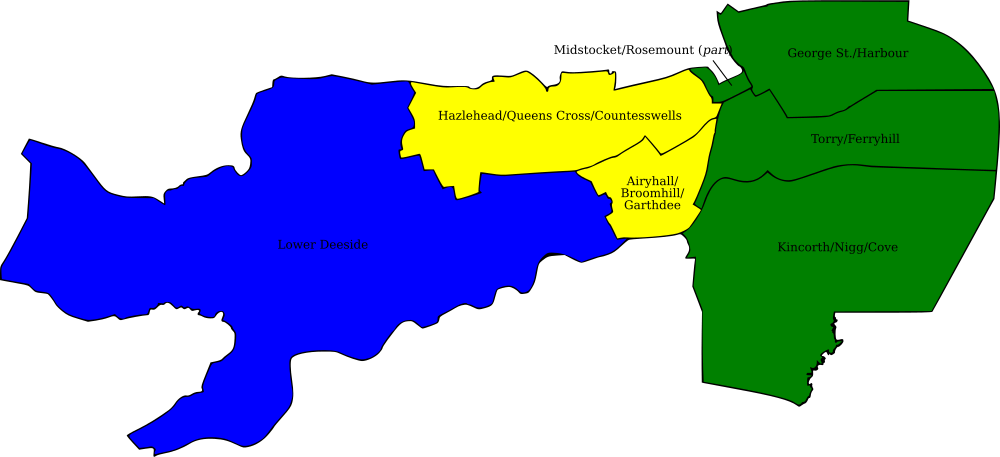
The last local elections in Scotland were back in May 2022. If we add together the votes cast then for the six wards wholly in this constituency, we see that the SNP topped the poll with 29% of the first preferences, the Conservatives polled 23%, the Lib Dems and Labour scored 16% each, and 10% of the votes were cast for independent candidates. This translated into eight SNP councillors, five Conservatives, four Labour, three Lib Dems and two independents. The Aberdeen South constituency also includes part of Midstocket/Rosemount ward, which the SNP carried in 2022. There is currently one vacant seat in the city-centre George St/Harbour ward where the Lib Dem councillor has resigned, and the Aberdeen returning officer had already scheduled a by-election to fill that seat for 25th June before Stephen Flynn’s resignation came through. Westminster elections and Scottish local elections can’t be combined because of the voter ID rules which apply to Westminster elections, so the electors of George St/Harbour ward will have to come back and do this all over again next week. And I’m going to have to write something different about the place.
Before then we have a Westminster by-election to deal with. Defending for the SNP from the bottom of the alphabetical ballot paper is Richard Thomson, who is hoping to return to elected politics after losing his Westminster seat in 2024. Thomson had represented the Gordon constituency in the 2019-24 Parliament, narrowly losing the successor seat of Gordon and Buchan to the Conservatives in 2024; before then he was an Aberdeenshire councillor from 2012 to 2020, representing Ellon and District ward and serving as leader of Aberdeenshire council from 2015 to 2017. Since 2024 Thomson had been working in public affairs. He had applied without success for the SNP nomination for Angus North and Mearns in the recent Holyrood election, but maybe this will be a consolation prize?
Starting in second place and hoping for more is the Labour candidate Nurul Ali, who is an Aberdeen city councillor for Bridge of Don ward (which is not part of this constituency). Ali was the Labour candidate for Gordon and Buchan in the 2024 Westminster election.
The Conservatives’ Douglas Lumsden is straight back on the campaign trail after securing re-election to the Scottish Parliament in May. Lumsden was previously the Conservative candidate for this seat in 2019; in 2021 he was elected as a North East Scotland regional MSP, and he retained that seat last month after narrowly missing out on a constituency seat in Aberdeenshire East.
Two other parties saved their deposits here in 2024. Reform UK, who finished fourth here in 2024 with 6.9%, have selected Jo Hart: she stood in May in the Aberdeenshire West constituency and was in fourth place on the Reform UK list for North East Scotland. The Lib Dems’ Mel Sullivan is also straight back on the campaign trail after her fourth-place finish in Aberdeen Deeside and North Kincardine last month, which is better than the fifth-place 6.3% the party managed in 2024. Sullivan, who was also ranked fourth on the Lib Dem list for North East Scotland, is an Aberdeenshire councillor for North Kincardine ward which borders this constituency. Of the three parties or candidates who lost their deposit here in 2024, one is back for another go: the Scottish Greens’ Jorg Shelton-Eckstein is hoping to improve on his party’s 3.5% and sixth place from two years ago. And one new party has entered the fray: David Ballantine, who gives an address in Edinburgh and was the Brexit Party candidate for Edinburgh South West in 2019, is standing on the ticket of the Alliance for Democracy and Freedom. He completes a ballot paper of seven candidates.
The list of polling stations for this by-election includes St Mary’s Cathedral (Roman Catholic), St Andrew’s Cathedral (Scottish Episcopal Church) and, for those whose religion is football, Pittodrie Stadium where electors from the Pittodrie North polling district are invited to cast their vote in the Sir Alex Ferguson Lounge. The returning officer has successfully managed to avoid this by-election clashing with Scotland’s World Cup games, and once the polls close the challenge will be on to see whether we can get a result earlier in the night than Haiti v Scotland last weekend. This is a Westminster by-election, so all voters are reminded to bring photo ID with them to the polling station.
This preview has been corrected to make clear that Alex Nicoll is no longer leader of the SNP group on Aberdeen council.
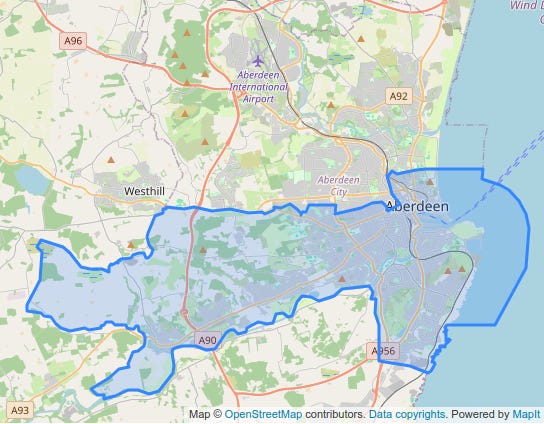
Aberdeen council wards: Airyhall/Broomhill/Garthdee, George St/Harbour, Hazlehead/Queens Cross/Countesswells, Kincorth/Nigg/Cove, Lower Deeside, Torry/Ferryhill, Midstocket/Rosemount (part)
ONS Travel to Work Area: Aberdeen
Postcode districts: AB10, AB11, AB12, AB13, AB14, AB15, AB24, AB25, AB31, AB32
Nurul Ali (Lab)
David Ballantine (Alliance for Democracy and Freedom)
Jo Hart (RUK)
Douglas Lumsden (C)
Jorg Shelton-Eckstein (Grn)
Mel Sullivan (LD)
Richard Thomson (SNP)
July 2024 result SNP 15213 Lab 11455 C 11300 RUK 3199 LD 2921 Grn 1609 Scottish Family Party 423 Ind 225
Forward to Part II of this week’s Previews
If you enjoyed these previews, there are many more like them - going back to 2016 - in the Andrew’s Previews books, which are available to buy now (link). You can also support future previews by becoming a paid subscriber to this blog - which will also you get you early access to the Previews.
Andrew Teale
No posts
Comments
Nothing yet. Say the first thing.
Sign in to join the conversation.