
This week’s Preview is going out in four parts for length reasons. Here is Part III, the Andrew’s Previews take on the much-anticipated Westminster by-election in Makerfield.
House of Commons; caused by the resignation of Labour MP Josh Simons.
A vintage recording there from the long-defunct Bickershaw Colliery Band, who enjoyed success in the 1930s and 1940s before folding in 1947. Bickershaw is a small village on the former Lancashire coalfield with one road in and one road out, where my sister once worked as a primary school teacher. One day she was teaching her class about the structure of the earth, with the core on the inside and the crust on the outside, at which point one bright lad piped up “you mean like a pie, Miss?”
Bickershaw and the other settlements in the Makerfield area fall within the cultural influence of Wigan, where rugby league is the main sport and the pie consumption is something to behold. In the days when Bury FC and Wigan Athletic were in the same division, the powers that be at Gigg Lane would quadruple the pie order when Wigan were the away team. Even the local takeaway app Wigan Eats has a drawing of a pie as its logo.
The Metropolitan Borough of Wigan also has a large geographic reach. In both area and population it’s comfortably in the top rank of the UK’s local government districts, but that’s not much of a reflection on Wigan itself. Wigan isn’t that big a place, and most of the borough’s population lives in small towns on the Lancashire coalfield.
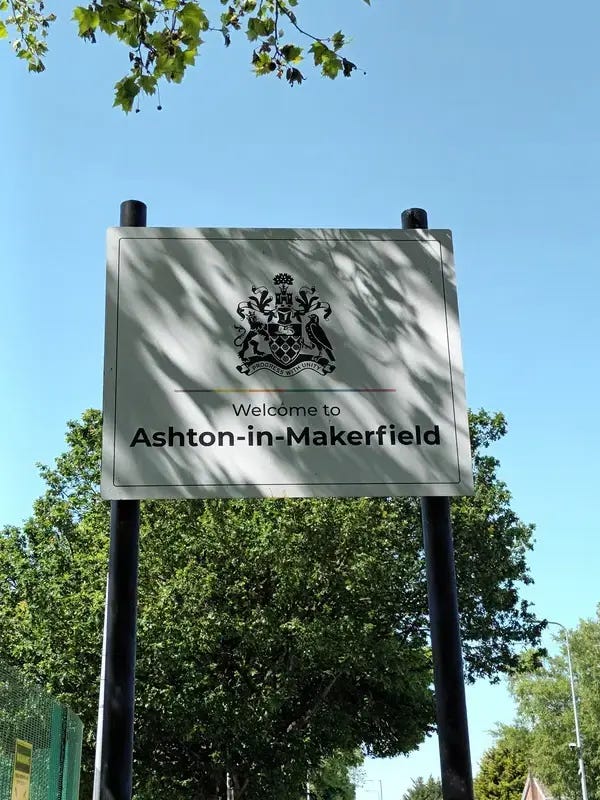
One of the largest of these towns is Ashton-in-Makerfield, a settlement of around 24,000 souls located on the M6 motorway to the south of Wigan. Its town centre is a bit of a mess at the moment thanks to regeneration works, but there are some handsome buildings here nonetheless. The town’s library is a Carnegie foundation from the early 20th century. The parish church, dedicated to St Thomas, dates from 1893 although there have been churches on the site since at least the 16th century: its graveyard contains a number of the 189 miners who were killed at the Wood Pit explosion in nearby Haydock in 1878.
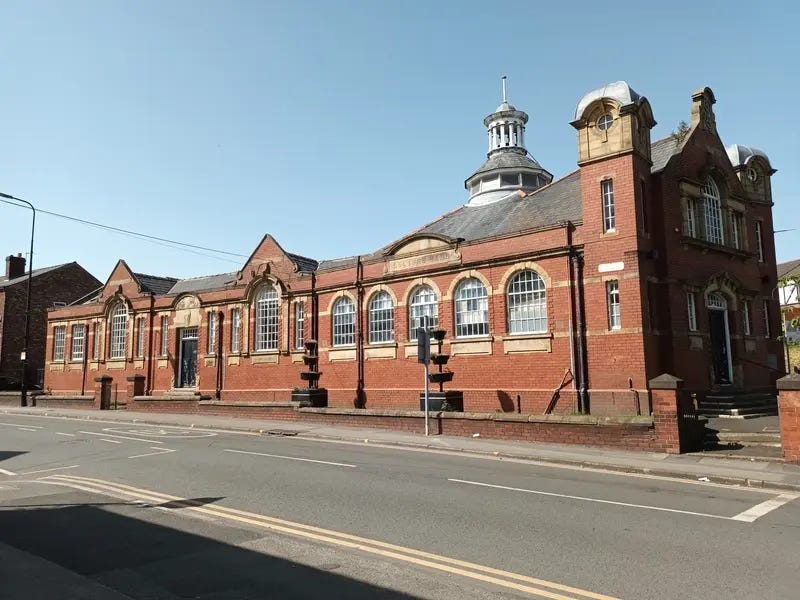
Although Ashton has long had a lock- and hinge-making industry, it’s coalmining that made the town. Ashton-in-Makerfield’s famous mineworkers include a number of MPs we shall come to later, together with the 1970s National Union of Mineworkers president Joe Gormley.
In recent years the town has honoured another of its famous sons by naming a street after him. William Keneally was originally from Wexford in Ireland, but when he was 4 his father retired from the Army and moved to Ashton-in-Makerfield to find work. After working down the pit for ten years from the age of 13, Keneally enlisted in the Army himself as a private with the 1st Battalion of the Lancashire Fusiliers. He was one of the Lancashire Fusiliers’ “six VCs before breakfast” who distinguished themselves with their bravery in the Gallipoli landings on 25th April 1915, securing W Beach (later renamed as Lancashire Landing) despite heavy fire from the Turkish defenders.
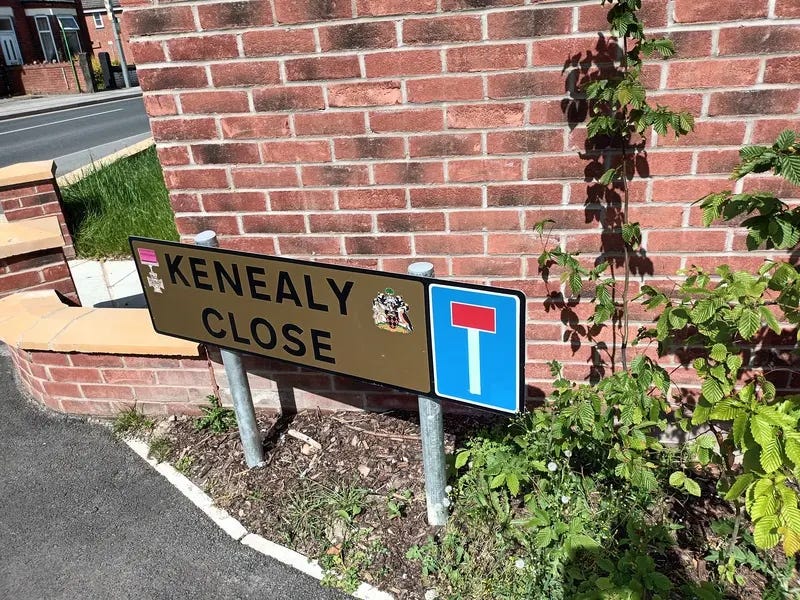
Private Keneally, as he was on that day, never made it back to Lancashire and his Victoria Cross was posthumous. He was killed on the Gallipoli peninsula two months later at the Battle of Gully Ravine, aged 29, after being promoted to lance-corporal and surviving the heavy fighting of three successive Battles of Krithia. The Commonwealth War Graves Commission have erected a headstone to him in Lancashire Landing Cemetery on the peninsula, but it has to be said that this was not their finest work. The gravestone not only gives an incorrect rank for William Keneally (lance-serjeant rather than lance-corporal) but also misspelt his surname as Kenealy. This official error has since found its way into a multitude of military histories and into the title of Keneally’s Wikipedia entry, so Wigan council’s street naming department can probably be forgiven for falling into the same trap. Ultimately there can be no greater tribute to your memory than to have your deeds remembered and your name misspelt.
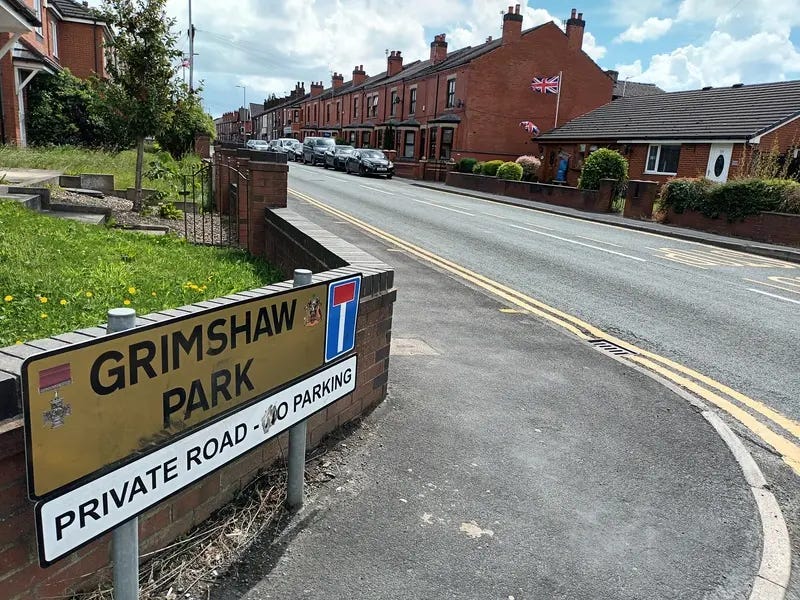
The same error has not been committed in the street in Abram named after John Elisha Grimshaw, the only one of the Six VCs who could reasonably be described as a Lancastrian. Grimshaw was born and bred in the tiny coalmining town of Abram. He worked as a carpenter in one of the town’s collieries before enlisting in the Lancashire Fusiliers. On the day of the Gallipoli landings he was a signaller with the job of maintaining communications between the shore at W Beach and the HQ on HMS Euryalus; that won Grimshaw a Distinguished Conduct Medal, which was subsequently upgraded to a Victoria Cross following some wrangling between the regiment and the War Office. Grimshaw lived to tell the tale, and he ultimately retired from the Army in 1934 as chief recruiting officer for East Anglia with the rank of lieutenant-colonel.
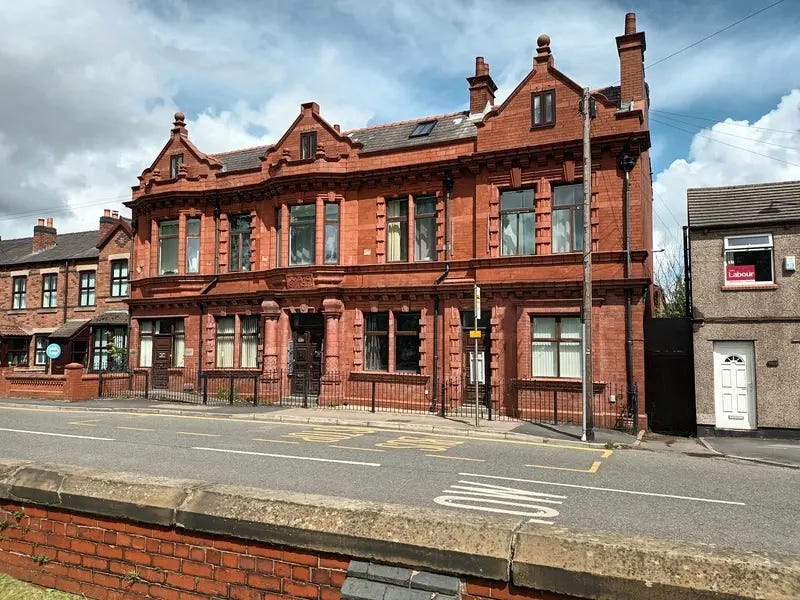
Despite its small size Abram was an independent town all the way up to the reorganisation of 1974. The red-brick council office building from 1903, which has now been converted into apartments, still stands on the main road opposite the parish church. In its graveyard we find a memorial to the victims of another pit disaster, the 1908 explosion at Maypole Colliery which killed 75 of Abram’s men and boys.
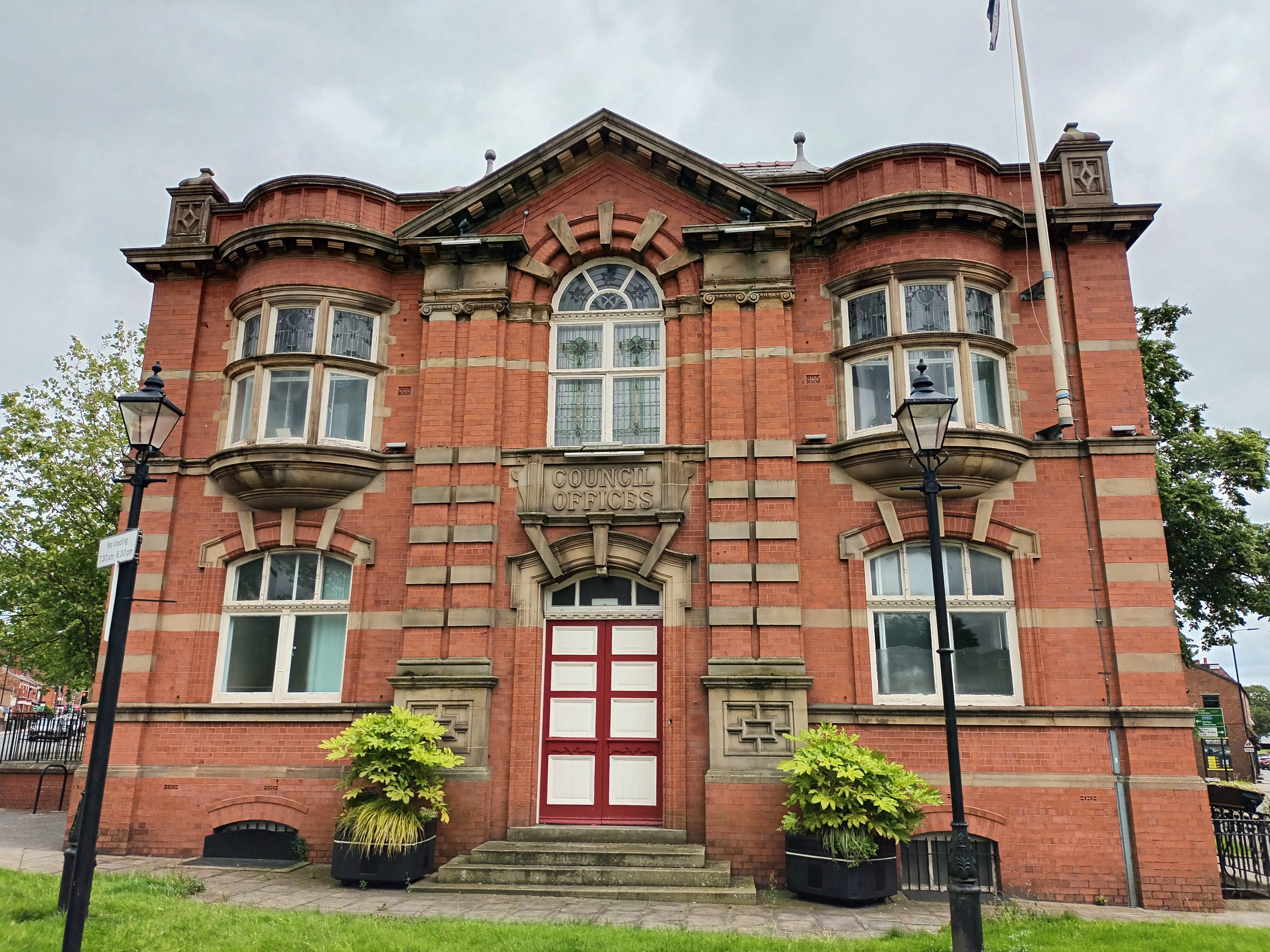
Another council building dating from 1903 is Hindley town hall, which is still in municipal use as offices for Wigan council. Hindley lies on the railway line from Manchester to Wigan, and the town centre has retained many of its Victorian buildings including a number of churches. On my research visit they had all come together for a church procession, led by a brass band.
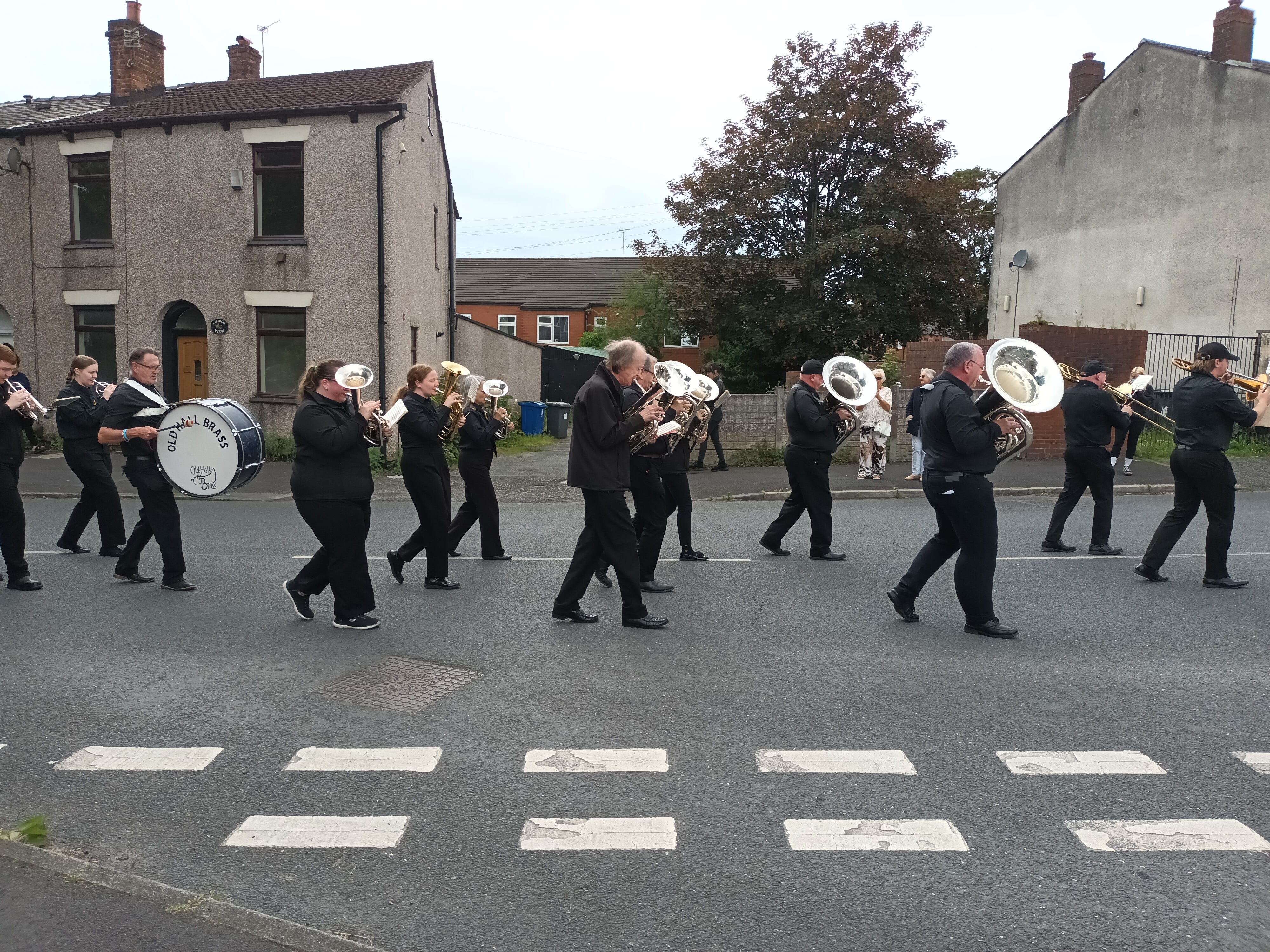
The oldest of Hindley’s churches is All Saints, which has been here since 1641 with the present building dating from 1766. This church is a regular booking for your columnist’s military band and it’s a genuine delight to play music here each year: the pews are always packed out and the atmosphere is great. We are next there on the evening of Saturday 26th September: put that date in your diary.
The road from Hindley towards Atherton passes through Hindley Green to reach a point identified on the map as “Dangerous Corner”, a name which promises more than it delivers. The road junction itself is not obviously more dangerous than any other T-junction. Meanwhile Corner Lane, the main road leading up to the junction from the west, is notable for its conspicuous lack of corners: it is the only part of the Roman road between Manchester and Wigan which is still in use as a road today.
Wigan is its own constituency, but the Makerfield seat includes some of its south-western suburbs. Most of this area is collected within the modern ward of Worsley Mesnes (pronounced “Mains”), which covers post-war council estates. This corner of what was once Lancashire has very high levels of residents who give their religion in the census as “Christian” - the highest Christian figure in this constituency is 70.9% for Winstanley ward, which is the 20th highest in England and Wales - so when the estates were developed there was a clear need to serve the spiritual needs of their new residents. One result of this was the construction of St Jude’s Catholic church, a striking building in the Brutalist style which was founded in 1964.
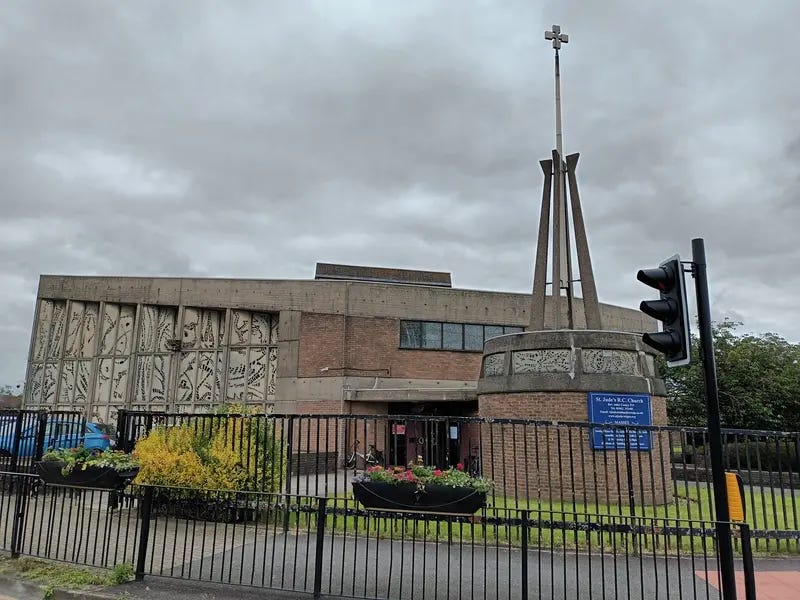
St Jude’s had to be built with unusually strong foundations to counter the effects of subsidence caused by the extensive coal mining. This has changed the landscape to the south of Wigan by the creation of “flashes”, which are land which has sunk so far thanks to the mining that the resulting depression has filled with water and turned into a lake. The largest of these in the area is Scotman’s Flash next to Worsley Mesnes, where Wigan council run a watersports centre. The Wigan Flashes as a whole now form a large nature reserve.
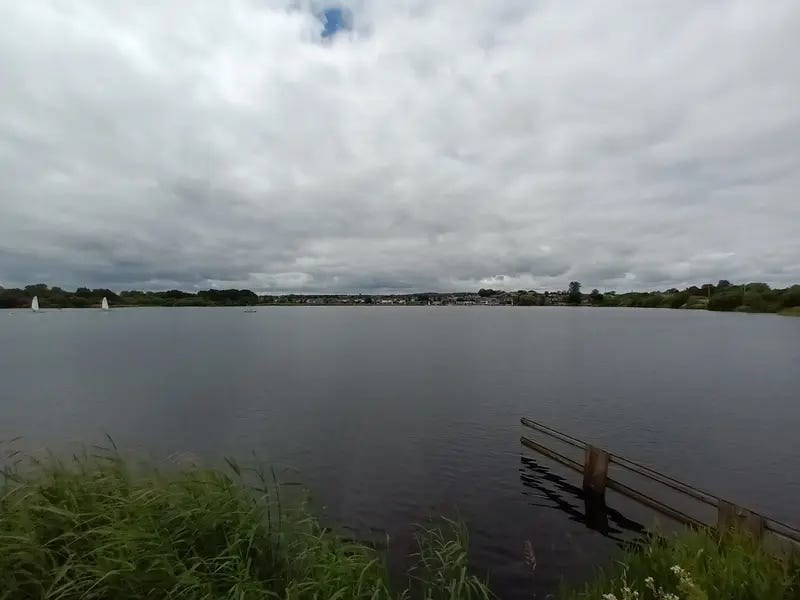
The middle-class area of this constituency is the town of Orrell to the west of Wigan, although this is not a middle-class area in the way that those who only know the Home Counties might think of one. This is the sort of area where they play rugby union. Sacrilege. The centre of Orrell is a road junction where we find Orrell Post, a stone pillar which dates back to the turnpike era. Neighbouring Winstanley, which is now an outer suburb of Wigan, is 92.4% owner-occupied - the highest figure for any ward in north-west England and ranking 5th of all the wards in England and Wales. Winstanley used to be part of an urban district with Billinge, which was partitioned between Greater Manchester and Merseyside at the 1974 reorganisation. Orrell and Winstanley are located next to the junction of the M6 and M58 motorways, providing commuting opportunities in several directions. This area is also home to Winstanley College, a very large sixth-form college which is noted for its academic success; this was where the members of the band The Verve first met each other.
The Makerfield constituency is not generally a seat of run-down council estates. While there is some deprivation - particularly in Abram, which is a very small and isolated town - many of Makerfield’s towns have relatively well-off areas and Orrell in particular is a middle-class enclave. The spoil heaps have been mostly landscaped, the mining subsidence has resulted in lakes teeming with wildlife, and the countryside is looking better than it has for a century. These might not be the most beautiful or the most prominent small towns, but the quality of life is good. There are far worse places to live.
Having said that, one difficulty here is transport. The creation of the Bee Network of buses resulted in a massive fare cut and increased services for the towns in Wigan borough, but the buses still have to use the same roads as everyone else. The railway network here is focused on Wigan: Orrell and Pemberton stations are on the Kirkby branch line which has no late evening or Sunday service, while Bryn - the station for Ashton-in-Makerfield - is on a line between Wigan and Liverpool with no service to Manchester. Apart from the M6 motorway, the road network here is little changed from the Victorian era with sizeable towns like Hindley still having all through traffic going straight through the town centre. For decades there has been talk of opening up the Makerfield area by building a link road from the M6 at Wigan eastwards towards Bolton, and the M58/M6 junction was laid out to allow the motorway to be extended eastwards. One small section of this road has finally been built in recent years to the south of Wigan, on an alignment which was once the Lancashire and Yorkshire Railway’s express route from Manchester to Liverpool, presumably in the hope of persuading central government that finishing the job would be worthwhile. My 2020 road atlas shows a westward extension of this road to meet the M6 as under construction, but this is not the case.
There has been a parliamentary constituency more or less corresponding to the modern Makerfield seat continuously since the redistribution of 1885. However, the name Makerfield only dates from 1983; for 98 years before then, the seat was named after a town which is now part of the Wigan constituency. That was Ince-in-Makerfield, which gave its name to the Ince parliamentary division that also contained Abram, Hindley, Orrell and Pemberton - but not originally Ashton-in-Makerfield, which until 1918 was part of the Newton constituency. The original Ince seat was in two parts, with the village of Haigh divided from the rest of the seat by the Wigan parliamentary borough.
With all this coalmining, the identity of the first MP for Ince may come as a surprise. The first and, to date, only Conservative MP for this area was Henry Blundell-Hollinshead-Blundell, who was from a family of major landowners in this corner of Lancashire. After education at Eton and Oxford, Blundell had had a distinguished military career which included service in both the Crimea and the Relief of Khartoum, in which he was one of the senior officers on the relieving force. He started 1885 half past monsoon on the banks of the River Nile, and ended it as the elected MP for Ince, defeating the Liberals in the 1885 general election by 546 votes. Blundell increased his majority the following year.
The 1892 general election saw Blundell defeated by a joint Liberal-Labour candidate who, to date, was the only Liberal MP for Ince. Sam Woods had started work in the local coalmines at the age of seven, and rose to become the first vice-president of the Miners’ Federation of Great Britain in 1889. He won Ince in 1892 by 4,579 votes to 4,352, a majority of 227; this was reversed in 1895 when Blundell returned to the Commons with a majority of 445. Woods subsequently won the 1897 Walthamstow by-election, but his time in the Commons was fairly short.
After being unopposed in 1900, Henry Blundell-Hollinshead-Blundell finally lost his seat in the 1906 Liberal landslide to another local coalminer. Stephen Walsh was an orphan from Liverpool who had started working in the Ashton-in-Makerfield coalmines at 13, and he had worked his way through all the grades of colliery life to become an official of the Lancashire and Cheshire Miners’ Federation. By 1910 he was described in the Times Guide to the House of Commons as “one of the ablest of the miners’ representatives in the House”. Following the 1906 election Walsh had attacked the idea that an MP needed an Oxbridge education, which must have stung Blundell. Mind, Walsh’s Tory opponent in the two 1910 elections was not Oxbridge-educated: Walter Greaves-Lord, who subsequently served for 13 years as MP for Norwood and then for five years as a High Court judge, was a graduate of what was then called University College, Liverpool.
Stephen Walsh went on to win seven terms as MP for Ince, his highest majority coming in 1918 when he polled 87% of the vote in a straight fight with a Socialist Labour candidate. That 1918 election also saw his constituency redrawn, with Hindley moving out into the Westhoughton constituency to be replaced by Ashton-in-Makerfield and Billinge to the south, and Standish and Shevington to the north of Wigan. Walsh had served in the wartime coalition government, and in December 1918 he was parliamentary secretary to the Local Government Board.
In 1922 Walsh was elected as vice-president of the Miners’ Federation of Great Britain. He was still in that position going into the 1923 general election when he was opposed by one of the first women to be a Conservative parliamentary candidate. Rachel Parsons had been elected to the London County Council the previous year as a Municipal Reform candidate for Finsbury, and she was an advocate for women’s employment rights and the founding president of the Women’s Engineering Society. Stephen Walsh defeated her by over 11,000 votes, and his reward for that was to enter Cabinet as Secretary of State for War in the first Macdonald government.
Stephen Walsh died in office in March 1929, aged 69. With a general election due later that year no by-election was held to replace him, and Gordon Macdonald took over as Labour MP for Ince in the 1929 general election. Macdonald was a Welshman who had gone down the pits in Ashton-in-Makerfield at 13 before winning a scholarship to Ruskin College, Oxford. At the time of his election he was a Miners’ Federation of Great Britain official and involved in the co-operative movement. He enjoyed a majority of nearly 17,000 votes that year, and wasn’t remotely challenged even in the Tory landslide of 1931.
Macdonald resigned from the Commons in 1942 to take up a post with the Ministry of Fuel and Power. He later served as the last Governor of Newfoundland, returning to Britain in 1949 to become Paymaster General (from the Lords) in the Attlee government.
The resulting Ince by-election of 20th October 1942 returned the Labour candidate Tom Brown unopposed, thanks to the wartime political truce. Brown was very much in the mould of Walsh and Macdonald before him as a mineworkers’ union figure; he had started in the pits at 12, he was vice-president of the Lancashire and Cheshire Miners’ Federation, and he had sat on Hindley urban district council since 1919 and twice served as chairman of the council. In a 22-year parliamentary career Brown saw off two future Conservative MPs: Robert Gascoyne-Cecil, later MP for Bournemouth West and after that the 6th Marquess of Salisbury, stood for Ince in 1945, while Walter Clegg (North Fylde 1966-83, Wyre 1983-7) was the Tory candidate in 1959. With his health failing, Tom Brown retired at the 1964 general election.
The 1950 redistribution had expanded the Ince constituency again. Standish and Shevington, to the north of Wigan, moved out into the Westhoughton constituency while the Ince seat expanded west to take in two small mining towns called Skelmersdale and Upholland. In 1961 Skelmersdale was designated as a New Town, which led to significant population growth: between the 1950 and 1979 general elections Ince’ electorate increased from 50,476 to 83,019. For the last 19 years of that period Ince was represented in Parliament by Labour’s Michael McGuire, an Irishman and branch secretary of the National Union of Mineworkers.
Following the local government reorganisation of 1974 the Ince constituency was divided between three counties. Skelmersdale and Upholland had remained in Lancashire; Billinge and Seneley Green had been transferred into Merseyside; and the rest of the seat became part of Greater Manchester. The 1983 redistribution transferred all those areas outside Greater Manchester out of the Ince constituency together with Ince itself, which moved into the Wigan seat. Accordingly a new name was needed, and “Makerfield” was chosen.
Michael McGuire continued in Parliament as MP for Makerfield for his seventh and, as turned out, his final term in the Commons. After failing to support the 1984-85 miners’ strike, he was deselected by his constituency party.
Makerfield Labour’s subsequent selection of Wigan councillor Ian McCartney broke the National Union of Mineworkers’ 80-year stranglehold on this constituency. Ian was the son of Hugh McCartney, who had served in the Commons from 1970 to 1987 as Labour MP for first East Dunbartonshire, then Central Dunbartonshire, and finally Clydebank and Milngavie. Aged 36 when he entered the Commons, McCartney junior had left school at 15 with no qualifications and had had a number of manual jobs. He was one of the shortest MPs, with a height of five feet and one inch.
McCartney ran John Prescott’s campaign for the Labour deputy leadership in 1994, and he went on to serve in government throughout the Blair administration. He piloted the Competition Act 1998 and a major employment rights package through Parliament as a junior trade minister, and was promoted to Cabinet in 2003 where he served for three years as Labour Party chairman and minister without portfolio.
Ian McCartney stood down in 2010 and was replaced as MP for Makerfield by Yvonne Fovargue, who had run the St Helens Citizens Advice Bureau for over 20 years. Fovargue had served on Warrington council for six years before her election to Parliament.
Yvonne Fovargue’s 14 years as MP for Makerfield coincided with Labour’s years in opposition, and while she held a number of junior shadow positions she never had the chance to make her mark on government other than an appointment in 2022 as a trade envoy to Libya and Tunisia. In the 2024 New Year Honours she was appointed CBE for political and public service.
Seven months later Yvonne Fovargue retired from the Commons and passed a slightly-redrawn Makerfield seat on to Josh Simons, who turned 30 within a month of his election. Simons had had a number of jobs since graduating from Cambridge, including working in Labour leader Jeremy Corbyn’s office and in the artificial intelligence division of Meta, the parent company of Facebook, Instagram, WhatsApp and so on. By 2024 he was running the Labour Together thinktank. Simons had been an unsuccessful candidate for Bury council in 2021, but his second election campaign had a better result: in July 2024 he was elected as MP for Makerfield with 45% of the vote, against 32% for Reform UK’s Robert Kenyon - the sixth-highest share of any Reform UK candidate that year - and 11% for the Conservatives’ Simon Finkelstein, a Labour majority of 5,399 votes.
John Simons joined the lowest rung of the government ladder a year after his election as parliamentary secretary for the Cabinet Office, covering for Satvir Kaur while she was on maternity leave. In January this year he was appointed to a more permanent government position at DSIT with responsibility for digital government. But at the start of March 2026 he resigned from both of his ministerial positions as the result of an obscure scandal from his Labour Together days involving a smear campaign against Sunday Times journalists.
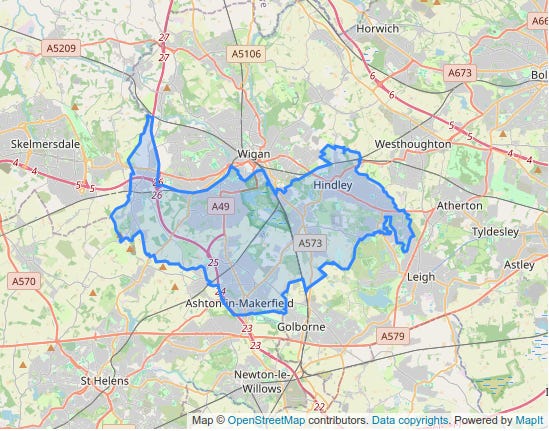
Meanwhile Reform UK were building on their already strong showing in the Makerfield constituency in July 2024. For what transpired at the next Wigan council elections in May 2026, have a look at the map:
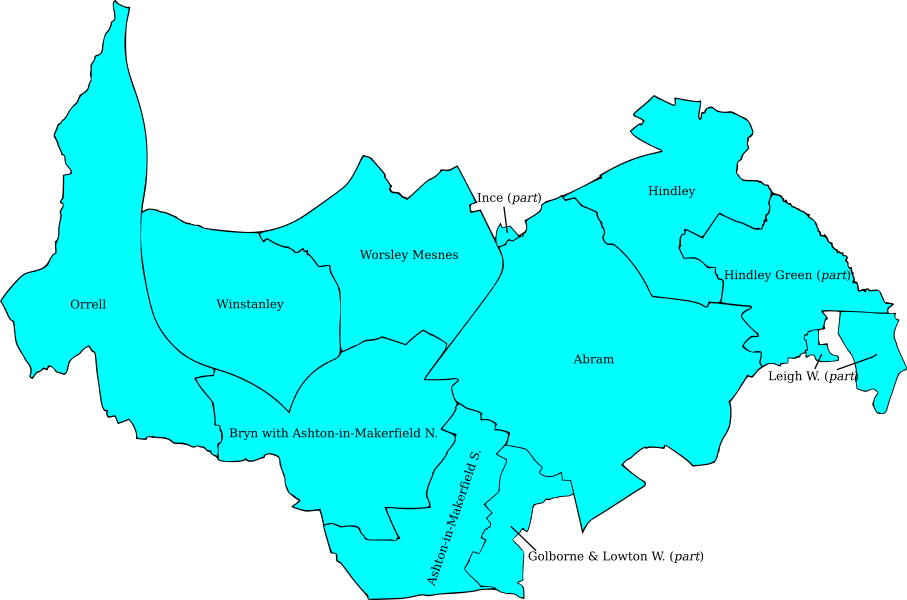
And this turquoise tide wasn’t just confined to the Makerfield constituency. Reform UK won 24 of the 25 seats up for election across the metropolitan borough of Wigan, with only Atherton North (won by an Independent Network candidate) getting away. Labour held 42 of the 50 seats not up for election so their council majority was secure despite the wipeout: Reform UK are now the largest opposition on Wigan council for many years with 25 seats, with the remaining 8 held by independent or Independent Network councillors. Across the seven wards wholly in the Makerfield constituency plus Hindley Green ward, almost all of which is in this constituency, Reform UK candidates polled 50% of the vote to 27% for Labour and 10% for the Green Party.
In the fallout from that Wigan council result, Josh Simons tendered his resignation as Labour MP for Makerfield. His reason for doing so was to provide a seat in Parliament for Andy Burnham, the elected mayor of Greater Manchester, who duly won the Labour nomination for this by-election.
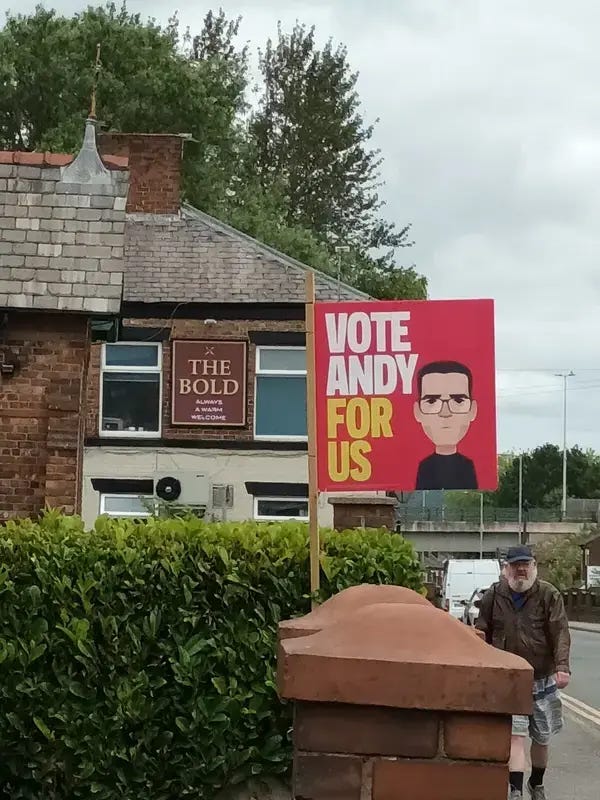
Andy Burnham has been in politics for a long time. He first entered Parliament in 2001 as the MP for the Leigh constituency to the south, which then included Hindley and Hindley Green, and he served in Cabinet throughout Gordon Brown’s premiership as chief secretary to the Treasury, culture secretary and finally health secretary. After leaving government Burnham stood for the Labour Party leadership in 2010 (finishing fourth) and 2015 (finishing second to Jeremy Corbyn).
Burnham remained on the Labour frontbench until 2016, when he left Corbyn’s shadow cabinet after securing the Labour nomination for the first election of Mayor of Greater Manchester - a post which, because it has police and crime commissioner powers, required him to leave the Commons at the 2017 general election. He was duly elected as Mayor in 2017, and re-elected for two further terms in 2021 and 2024, on each occasion with massive majorities. In the 2021 mayoral election Burnham topped the poll in every single ward in Greater Manchester, including the staunchest bastions of the middle classes, and in 2024 he repeated that trick in every ward except Oldham Werneth, finishing with a 63-10 lead over the Conservatives and a majority of over 350,000 votes. No other figure in the present Labour Party has anything like that level of popular support.
Burnham’s legacy as Mayor will be the Bee Network which brought Greater Manchester’s buses back into public ownership, and which in Wigan borough resulted in a massive bus fare cut. Since the Bee Network’s introduction in September 2022, after a long legal battle with the bus companies, single bus fares have been a flat £2, around half the level they were at previously.
If Andy Burnham wins this by-election and returns to the Commons, then he is widely expected to challenge Sir Keir Starmer for the Labour leadership and for the post of Prime Minister that would go with it. He would also be required to resign the Greater Manchester mayoralty and trigger a county-wide by-election for the post, which with an electorate of over 2 million would be the biggest by-election ever seen in the UK. Any such mayoral by-election would be held under the Supplementary Vote system, which has now been reintroduced for combined authority mayors following the passage in April of the English Devolution and Community Empowerment Act 2026.
Reform UK have reselected their candidate from 2024 Rob Kenyon, who has recently been elected to Wigan council for Bryn with Ashton-in-Makerfield North ward. He runs a plumbing and heating firm in the constituency, and he has previously served as a Royal Engineers reservist. Kenyon has attracted some negative attention during the campaign for his social media. He is one of two candidates to give an address in the constituency, the other being the Conservative candidate.
The Tories have indulged in a bit of nominative determinism by selecting Michael Winstanley, who has been on the local political scene for many years. Winstanley was a Wigan councillor for Orrell ward from 2000 to 2016, and he had the best Conservative score in this constituency in May’s local elections - 19% in his old Orrell ward. He was Mayor of Wigan in 2010-11, and he has stood several times for Parliament including a previous run at the Makerfield constituency all the way back in 1997. Winstanley is at the bottom of the ballot paper: being a W, he’s probably used to that.
Top of the ballot paper goes to the Lib Dems, who were fourth here with 6.8% in 2024. Their candidate Jake Austin has faced off against Andy Burnham before: he was the Lib Dem candidate in the 2024 Greater Manchester mayoral election. Austin is a Stockport councillor, representing Hazel Grove ward, and he is Stockport’s cabinet member for housing and the environment. The Green Party, who finished fifth and lost their deposit here last time with 4.4%, got into issues with their candidate selection after their original standard-bearer pulled out due to family caring responsibilities and/or antisemitic social media (delete to taste). They have ended up with Sarah Wakefield, who is on maternity leave from her job as a charity director and has recently been elected to Manchester city council for Deansgate ward in the city centre. Sixth and last place in Makerfield in 2024 went to the English Democrats, who have not returned.
This by-election has attracted the usual circus of people who are prepared to pay £500 for the chance to appear on television when the declaration comes through in the early hours of Friday morning. Count Binface, who needs no introduction, wants to cap the cost of a Wigan Kebab (for those not from the area, that’s a pie barm) at £2 and promises to “cut your taxes and raise everybody else’s”. I’ve heard worse economic policies. Dan Clarke, who was the Libertarian Party candidate in the Gorton and Denton by-election four months ago, is having another go here. Independent candidate John Dyer, who gives an address in Liverpool, was last seen on a ballot paper in the 2015 general election when he stood in Ellesmere Port and Neston. Ed Gemmell is a Buckinghamshire councillor (elected there as an independent in Hazlemere ward) who is standing for his own Climate Party. Paul Gould is an independent candidate who is opposed to Peak Cluster, a proposed carbon capture pipeline which would transport CO2 from Peak District cement factories to the Irish Sea via the Wirral. Howling Laud Hope of the Official Monster Raving Loony Party is back for the latest of his many, many election campaigns. Independent candidate Rob Pownall is an anti-hunting campaigner taking to the campaign trail in a fox costume; last month he stood for the Scottish Parliament in Edinburgh Central while dressed as a rather startled gannet, and there he scored rock all. There is a lot of online chatter over Rebecca Shepherd, a businesswoman from Wigan who is the first-ever election candidate for Restore Britain, a far-right group associated with the Great Yarmouth MP Rupert Lowe. And completing a list of 14 candidates is Peter Ward of Rejoin EU; see if you can guess what his signature policy is.
This by-election has also attracted the constituency pollsters in their droves, and at the time of writing five polls of Makerfield’s voters have been attempted. All of them have Labour’s Andy Burnham in the lead with vote shares of between 43% and 49%, with Reform UK’s Robert Kenyon in second place on 37% to 41% and the rest scattered; Labour leads range from 3 to 12 percentage points. For what it’s worth, on my research trips to the constituency all of the posters and stakeboards I have seen have been for those two.
The BBC have also pulled out all the stops. Two weeks ago Austin (LD), Burnham (Lab), Kenyon (RUK), Wakefield (Grn) and Winstanley (C) formed the panel for a special edition of the long-running debate programme Question Time recorded within the constituency at Winstanley College, and BBC1 will be covering the counts from Makerfield, Aberdeen, Arbroath and possibly the local by-elections as well (we can dream) with a by-election special programme - something which Auntie haven’t done for a very long time. Laura Kuenssberg will anchor live coverage from 23:10 until 04:00 or for however long it takes, while ITV are also broadcasting live into the small hours - with coverage of the World Cup match between Canada and Qatar from Vancouver. Quite whether the result in Makerfield will live up to that level of expectation remains to be seen - but when the returning officer takes the stage to read out the final scores, there will only be one winner. The course of the future might well turn on who that winner is.
Wigan wards: Abram, Ashton-in-Makerfield South, Bryn with Ashton-in-Makerfield North, Hindley, Hindley Green (almost all), Orrell, Winstanley, Worsley Mesnes, Golborne and Lowton West (small part), Leigh West (small part), Ince (very small part)
ONS Travel to Work Area: Warrington and Wigan
Postcode districts: WA3, WN2, WN3, WN4, WN5, WN7
Jake Austin (LD)
Count Binface (Count Binface Party)
Andy Burnham (Lab)
Dan Clarke (Libertarian)
John Dyer (Ind)
Ed Gemmell (Climate Party)
Paul Gould (Ind)
Howling Laud Hope (Loony)
Rob Kenyon (RUK)
Rob Pownall (Ind)
Rebecca Shepherd (Restore Britain)
Sarah Wakefield (Grn)
Peter Ward (Rejoin EU)
Michael Winstanley (C)
July 2024 result Lab 18202 RUK 12803 C 4379 LD 2735 Grn 1776 EDP 368
Forward to Part IV of the Previews - the Undercard
If you enjoyed these previews, there are many more like them - going back to 2016 - in the Andrew’s Previews books, which are available to buy now (link). You can also support future previews by becoming a paid subscriber to this blog - which will also you get you early access to the Previews.
Andrew Teale
No posts
Comments
Nothing yet. Say the first thing.
Sign in to join the conversation.