
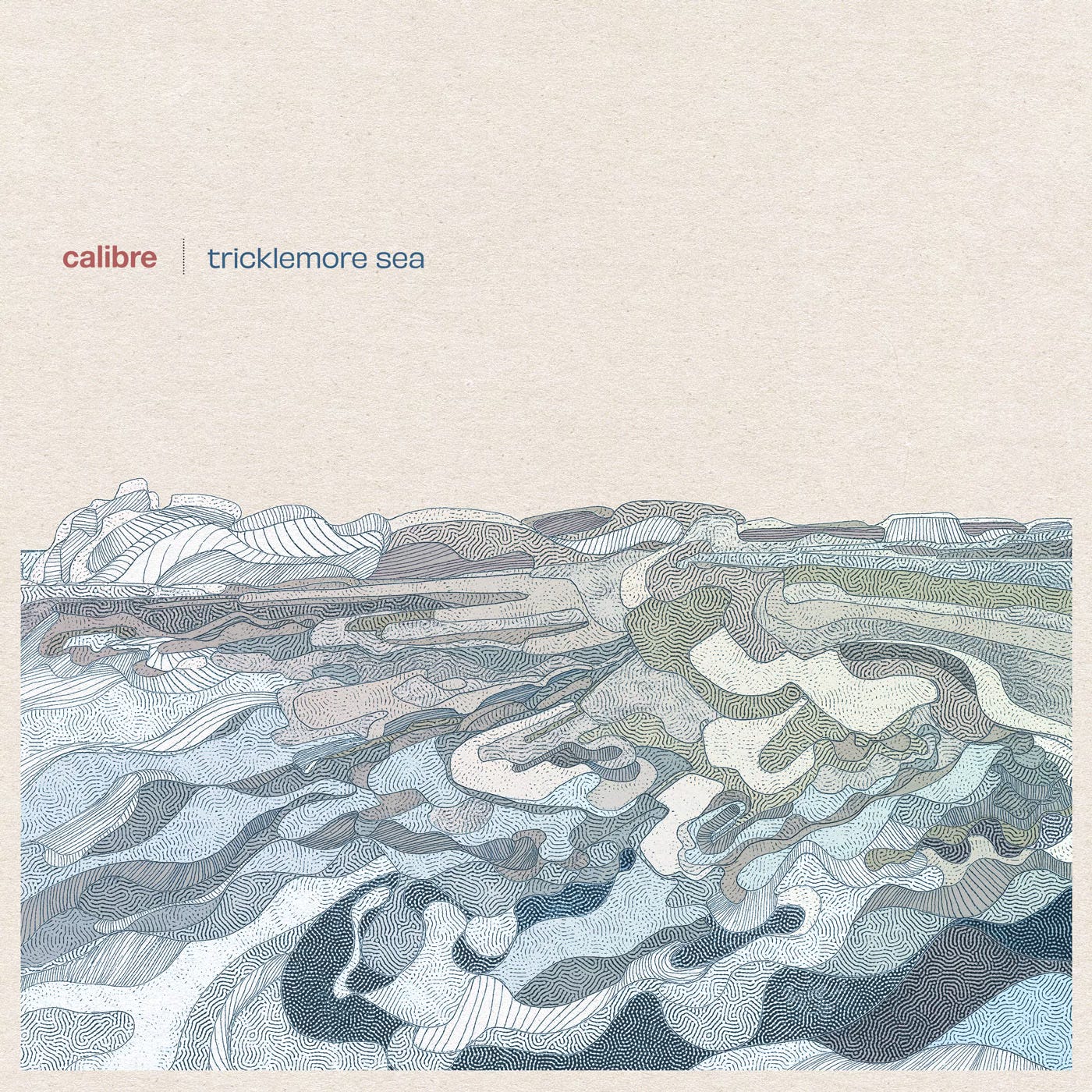
Dominick Martin is one of those rare artists whose body of work is its own world. That sounds like a cliché, but I think it’s almost literal. Put on his latest record, Tricklemore Sea, and you’re immediately in a defined space. It’s wide-open and melancholy, the grey skies and concrete landscape of urban Belfast contrasted with the gentle lapping of ocean waves. The drums and other instruments sound like they’re right in the room with you, more acoustic-feeling than electronic. He’s been making music that sounds exactly like this for over 30 years, which isn’t a dig. Whether he’s producing straight-up drum & bass, ghostly dub, or the downtempo ambient-not-ambient of this latest LP, Calibre always sounds like Calibre, with an elegant musicality that might come off a little frou-frou if it weren’t so deeply felt.
He’s not the flashiest or clubbiest drum & bass producer, instead focusing on a melancholy and melodic strain of dance music built around live instrumentation and an intimate aesthetic borrowed from bedroom pop. His voice often whispers or mutters in your ear, and when he sings, it usually sounds like a shy fella serenading themselves when no one else is around. He balances private moments with the extroverted nature you need when you actually DJ public places for a living.
Martin’s discography is vast and varied, with themed albums like 2019’s Planet Hearth (ambient) and 2021’s Feeling Normal (dubstep/garage) interrupting his usual steadily trickling lava flow of drum & bass records. On top of that, there’s the excellent Shelflife series, which collects gems from his archives for grab-bag collections that make most other drum & bass producers seem amateurish in comparison.
He’s one of those people who lives, breathes, and constantly makes music. His prolificacy is nearly a double-edged sword. A lot of his records do sound the same, but it’s hard to complain when it’s not only a singular sound, but such a pleasant one. Martin’s only imitator is himself, and he’s also (almost) his own only influence. One of the embarrassments of my early music writing career was randomly panning his beautiful 2010 LP Even If. To me, at the time, it just sounded like more of the same jazz-tinged drum & bass, gloomy and grouchy at that. But I listen back and now and wonder what the hell was wrong with me—I think I was just 20 years old with something to prove—because Even If has some of Martin’s best music, delivering on the promise that every record of his makes. It’s supple, sighing, intricately textured dance music that floats by with a breeze of cool air, somehow lighter than the kick drums that might otherwise weigh it down.
The latest Calibre record, Tricklemore Sea, is a downtempo effort that comes just a few months after They Want You, an album that confidently flexed all of Martin’s different dance music muscles. This one is his most vulnerable and revealing yet. It’s made mostly of softly brushed drums, speak-singing, and synth motifs that flicker and linger in the peripheries, the electronic music equivalent of candle lighting instead of incandescent bulbs. Tricklemore Sea is immersive and inviting, from the dusty piano-and-guitar duet that begins it with “Little Blend” to the overcast “Bit Broken,” where the drums merely pitter-patter and Martin sounds weary, like he’s finally putting his feet up for the day.
My favorite song on Tricklemore Sea is “Living In Your Head,” a mirage of looped synths, acoustic bass, and muttering, where Martin speaks of a “a fellow in his time / holding court, drinking wine.” His voice twists into a higher-pitched warble: “I’m in living in your head now,” the piano curling into a beautiful music box-like twinkle along with it. '“Living In Your Head” comes off a bit like a knowing self-portrait, a mournful acceptance of a newly wizened existence that reflects loss and the passage of time with a lived-in happiness, instead of regret. This maturity—sorry for using that cliché—is really what makes Tricklemore Sea special. It’s an artist channeling decades of their practice, a life spent making art, into one single piece of work that hints at past glories without resorting to nostalgia.
Tricklemore Sea a stunning record that I like even more because it’s so hushed, meek, a quietly profound way of dealing with aging in electronic music. I spoke with Martin over Zoom back in February to talk about the making of the album, the meaning of art itself, getting old, and living in Northern Ireland without electricity for months on end.
How’s it going?
I’m here in Belfast by myself, and I just had a house refurb. I’ve been waiting for a year to come back here, and now I’m trying to get used to the place being a little different than I’m used to.
So are you living in Belfast now?
I live here for the required amount of days, and then I’m traveling. And I also have a daughter in Berlin, so I spend a lot of time in Berlin. Now I can spend some time here. The place was sort of wrecked after Covid and didn’t have any proper electricity, and I lived here for years like that.
No electricity?
Yeah, and only one or two rooms. I didn’t have a working kitchen, and I lived like this for quite a while. To have it refurbed and have all this stuff working, it’s a luxury.
How did you live without a kitchen and only a little bit of electricity?
Well, I’d come back here and stay for a week, or as long as I could stand it, and I’d just have to improvise. The coffee place up the road knows me pretty well.
The new album feels almost pastoral, in a different way than some of the ambient work you’ve done, or the Shine A Light album.
I guess it’s the follow-up from Planet Hearth. I’ve always written this type of music. I have tapes here from ‘96 and ‘97. And when I listen to them, it’s like I can’t remember making the tunes, but it surprises me, because I made those tunes with guitar pedals, and without a computer. So when I started making music, it was really with whatever I could make it with. I’ve tried to create this area for myself where it feels a bit more boundaryless, a more naked presentation where the lack of a genre allows me to sort of not really care. There’s too much protocol.
This type of material allows me to explore the vocal stuff that I’ve been trying to do right from the start as well. So this is a really nice wagon for me. It seems to justify the singer-songwriter part of what I can do. It also allows me to be really abstract, or to catch people with melody. I don’t think I can write any type of music the way other people write it.
Were there any records or artists that were touchstones for the kind of music you wanted to make?
I don’t really do that. There’s probably stuff that influences me, but there’s just too many people, really. Early on I tried to copy other people, because when you start, everybody does that. But I’m trying to put myself into it as much as possible. So if it does sound like other people, it’s because we’re in a common area of making music.
I’m a record collector, and I’m a student of music. So I can’t deny the influences of all these things, but I don’t directly... It’s not like a well I’m drinking from.
Is the process for writing a record like Tricklemore Sea the same as when you write dance tracks?
I don’t premeditate anything. So it just depends how that first few seconds goes. I mean, I have ideas. The premeditation is almost like dreaming it into being, so it doesn’t have to have a physical connection to an idea that’s actually happening. I just work in the moment, and I can’t really explain how I do things. I start with something, and away I go.
I’ve got quite a bit of variety, so I can really go all over the place.
Do you write lyrics ahead of time, or are those kind of improvised based on the instrumental tracks you write?
The vocals are written over substrates, so then I can pluck them and then make them less abstract or more abstract, whatever way I want to go with it. I’ve always used my voice as layering, or sometimes as even some top end on a bassline or whatever. I can hum the note into existence. I can sing high, but I’m not a very confident singer. I couldn’t really do it in front of people. It’s always been done in secret.
Have you gotten better at singing over the years?
I think I’ve refined the ideas when I’m doing it. I have more of a... I guess I feel a bit more confident about it. I remember my mum said to me years ago, she said to me that she really loved the work that I’ve done with my voice because it sounded unique. So obviously, if you’re an artist and uniqueness is flashing somewhere, that’s where you want to go.
Tell me about your music-making regimen, because you release a lot of music and you make a lot of music.
I’m so frivolous about it, I couldn’t tell you. I don’t have writer’s block or anything. I don’t understand what that is. There’s always something in there that I can extract. It doesn’t mean it’s going to be very good, but there’s always something in there to roll with, when I’m happy, or sad, whatever. I think angry and sad are the better proposed positions to be in. But it’s hard to conjure up a certain type of emotion that’s required sometimes. It’s hit and miss. I don’t think I have too much of a structured approach to it because if I did, I might not make as much music.
It doesn’t make any sense.
So you’ve never had writer’s block or a struggle for inspiration?
No. Maybe now I might. I shouldn’t have said it.
When you’re making instrumental tracks that don’t have vocals or lyrics, what kind of feelings or situations are you drawing from?
I hope it’s all meaningful. But I’m really happy writing stuff that doesn’t have much meaning.
It just binds around a place. It’s involved in its own fun. But there’s other music that opens up the emotional pathways to different things. For me, that’s the memory of music. It still operates regardless of its genre or its time. I think anything that has a beauty to it can really transcend its time very easily.
I don’t really have a particular style that I’m trying to attain with it or anything. A lot of the time, it’s like everybody says: accidents are the best thing. The more opportunities you give an accident, the better possibilities you get.
Is beauty a really important thing for you with the music you make?
Sometimes. I like melancholic music. I like malaise. I think malaise is the real natural default of human experience.
Why? What do you mean?
We’re sort of born into a life. You’re born and you’re dying. There’s a tragedy to life. You sort of have to accept all of these things. There’s a melancholy to it. I guess my experience growing up in Belfast when I was a kid, meant I had a higher setting of melancholy than other people. The more sensitive you are as a human being can also lend itself to being more perceptive of these things.
Are you a sensitive person?
Definitely. I don’t like crowds. As you get older, I guess you realise some things about yourself, don’t you? I think you have to be a sensitive person to be artistic. I really do. It’s part of the perception of the world and yourself in it. A lot of people that make stuff that’s interesting don’t even think of themselves as artists. Or people who can write poetry, but they’re not poets. People can make music and they’re not musicians. There’s a lot to sift through, isn’t there?
Do you have a day job or do you live off your music?
I‘ve lived off my music for maybe 26 or 27 years. I don’t need a lot to live, though.
I don’t have a sports car. I don’t have fancy women or anything. I don’t have a massive drug habit. I have fairly basic demands in life. Just music and basic comfort, I’m happy.
So how do you spend your days then? What’s an average day look like for you?
Well, for the last month I’ve been dealing with builders. Meeting guys who know a lot more about doors and fridges and things than me. When I’m back in Berlin, I would generally start work around 10am. Go pick up my daughter around 1pm. Break, work again until night time.
That’s generally how I work. I also think it’s a good idea not to do anything at all. What Bukowski said: you should just stare at a wall for a couple of weeks. I take advice from people who’re prolific. It doesn’t matter what they do. I think that if you’re prolific producing things and creating things, you should be listened to. So I do that. I have days where I don’t do anything and days when I write.
Do you think being prolific is important? Because you release a lot of music.
I don’t think it’s important. I think the quality of what you do is important. I don’t know if I can attain those things. I think prolificacy is something that comes a bit easier. I’m more of a natural beast than someone that has to train and do it another way. And because if you’re training and constructing yourself and producing yourself as a businessman and this and that—which is what a lot of musicians do today—then there’s something that’s different about that, isn’t there?
So I don’t actually know that much. I’m trying to learn all the time. I don’t know if being prolific is a particularly good thing or a bad thing. It just puts you in a different place. I make a lot of music, for sure. I wonder sometimes if there’s something wrong with me. But it’s a medicine as well. For these last two months, I haven’t written any music, and I really feel it. I feel a wee bit mental and out of balance or something.
Is that mostly because of the house stuff?
No, it’s just the crescendo of things going on as opposed to life itself as a way—like it does for everybody. I had a gig in Belfast and a gig in Dublin. And both of them sort of felt different because of the lack of time with writing. I need to do something. Like, draw a picture. But this time off has also given me time to reflect.
I think for the last 20 odd years I’ve been just writing and writing and writing and I haven’t really stopped to look at it too much.
Is this the longest you’ve gone without writing new music since you started making music in the ‘90s?
I think so, yeah.
Do you think when you go back to making music that it’s going to feel different?
No. To me it’s the same thing as painting. It’s always the same thing. It’s just a tap right there.
You just have to find where to turn it on. I do think I work a bit slower now, and maybe some signs of premeditation are creeping into it.
Tell me a bit about your other creative outlets. I know you paint. Aside from that, is there anything else you do to express yourself or your hobbies?
Obviously I read a bit, and listening to music is how I study. I like to know how I fit into it. So I listen to other people’s music all the time and think, “Wow, I wish I could make music as good as that.” That’s how I feel about it.
Drawing and painting are my other main outlets. And maybe writing lyrics. Because I don’t really write poetry. You could call it poetry, but I have little abstract notions once in a while for the basis of ideas for songs rather than actual lyrics.
How long have you been painting for?
Since I was a child. That was where my mom wanted me to go to be an artist.
It’s the same thing with music. I can continually produce things. I think the actual name Tricklemore Sea, somebody asked me if it exists as a place, and I don’t know. It’s just a recognition of some feeling. The picture on the cover is a place in Kerry. It’s based on a river flowing into the sea. I sort of feel like this creatively, this is what all of us are trying to do.
We’ve got our own little rivers that eventually find their way to the sea. Having the distinction to find yourself and to be yourself is really important at the moment. Not being too afraid of doing something slightly different.
How would you describe your paintings to someone who doesn’t know about art?
How could I describe it? It’s the same thing with music. There’s no pre-plan. It’s just the first line determines where the next line goes and that’s it. All of my art has been done like this since I was a child. When I was in art school, I continued doing these paintings that I’ve been doing since when I was a kid. They wanted me to explain them and I just couldn’t. They just come from somewhere, they come flying out of me. Why do I need to know? I just make them. A lot of the time it’s just bullshit and people are trying to explain it. It’s a lot of bollocks in the end sometimes. I just have this thing that flows out of me naturally and I’m lucky enough to be able to do it. I wish I could explain it better.
Have you ever had any gallery shows? Do you have a parallel career in painting or is it mostly just private and for your albums?
I just do it for myself. It’s just another way of finding the medicine. I have had thoughts about doing that, but I don’t think I’d like to sell my work. If I was very poor and I got desperate and needed to feed myself, then yeah, sure. For artistic reasons I would love to do a gallery of all the work I’ve done because all of the album covers, except for maybe two or three, I’ve done the artwork for.
Why wouldn’t you want to sell it?
I want to give it to my daughter so she can possibly sell it. Maybe it’ll be worth more.
Do you see any parallels or commonalities between the way you paint and the way you make music?
It’s just a mind-emptying exercise. Which I think is similar to meditation and Zen Buddhism, of which I know nothing about. Zen Buddhism is seven seconds of silence in the mind, isn’t it? Something like that. I’m fucked man, I couldn’t be getting that.
But whenever you’re doing something creative it turns everything off. It reminds me of psychedelic mushrooms, when they did studies of activity in the brain and it turned up nothing. So I think that’s what’s good about it. I don’t have to think about anything. I don’t have to think about the world. I don’t have to think about who I am. I just can disappear into something and not be too bothered by my own presence.
As someone who releases so many records and so many different kinds of records, and you work in this flow state, how do you decide what’s going to be what?
Albums are not something that I build. They just occur whenever. And the material doesn’t have to be within the last year. It can be from 20 years ago, as long as it makes sense for that thing. So that means when people say “I don’t like your new material,” I can always say, “Well, it’s not new.”
It’s just a case of decisions and feelings. Whenever it’s an album project I live with the material differently because I listen to lineups and running orders and how the opening and ending feels, and I think that’s something maybe that doesn’t exist with some modern artists because they don’t have that entrapment with vinyl. But I’ve always been trapped, because I’m a vinyl collector, and my work eventually has to be on vinyl.
But the actual answer to how I form albums is just through the glut of material.
So the format of the album is very important to you?
Yeah. The tunes have to be speaking to one another and kind of have a vague relationship—it doesn’t have to be binding.
What do you mean by binding?
A lot of people bind their works together by time. I’m not. So it’s just about choosing things that fit, and generally I’ll have a lot of things to choose from.
What’s an example of an album that you love that you think fits perfectly well together? Not necessarily your favourite album but an album that is a great example of what you’re talking about.
Maybe Brian Eno’s Apollo: Atmospheres and Soundtracks. I think it’s because I first heard that when I was about 13. My brother’s mate’s dad had a really good record collection, with a lot of cool jazz and weird stuff. He brought this album over to me and I started walking the dog with it. It’s like a complete world that you walk into, because it’s devoted to the presentation of the Apollo Landings. But as a listening experience it has a congealing effect. My material, on the other hand, goes all over the joint, it doesn’t stay in that one place.
Your music from way back when sounds very similar to your music now. Has your setup changed much?
Those tapes I spoke about from ‘96, I made those with guitar pedals, a Bontempi keyboard, a drum machine inside the Bontempi keyboard, a bass guitar, cardboard drums, and baking trays. Then I evolved: I worked with another person for a short time who had an archive sampler and a computer, and then I moved into the box and that means everything I used was just software. I worked like that for a good 20 years, and then about three years ago I bought a console. For the first time in my life I actually had something really nice to work on and I think that is something that’s allowed me to look at stuff like Tricklemore Sea with a bit more confidence. It feels more alive for me.
Because I’m a drummer and a violinist, and I played the tin whistle when I was younger, I had a relationship with instruments. I understand percussion from a percussionist point of view so I guess all these things have an effect.
Why does having that new console give you more confidence?
I’m not technical. I hope you believe me—I really don’t know what I’m doing a lot of the time. So It’s more important to be conceptual, and then I end up with all this entanglement, which can be difficult. That’s the problem with making a lot of stuff: you have to figure it all out. It can be a real pain in the arse. But with the console, I feel like I can do anything. It’s an instrument in and of itself. It has two control voltage channels, which means you can affect everything with oscillators, everything that you use on the mixer. Other people know how to use it better than me, but I’m a feelings producer, I don’t really use mathematical approaches or technical approaches. This instrument appeals to my natural positioning.
One thing that always struck me about your music is that a lot of the instrumentation, like the drums and the keyboards, feels very in the room, like it’s in a physical space.
I’ve spent years sampling things. I sampled a piano down in Florence, Ireland years ago. I’d taken some mushrooms and a storm rolled in and I was on my own, and I just sat for hours playing in fear, but I recorded it all. I was just trying to keep the bad shit at bay. I’ve used those piano samples for years. I’ve always been of the opinion that you really don’t need that much. I can write a tune from the hum of a refrigerator. I can sing on the bus. It’s all music.
What about your drums?
I’ve got arthritis in my hands now so I can’t let the stick roll the same way. I don’t know whether you play any instruments, but with drums, there’s a real degree of subtlety once you learn how to play them properly. There’s lots of before and after the actual mathematical shots—that’s what gives you that little bit of funk, sort of accepting that you’re going to be off. The imperfection of percussion gets lost in electronic music—it’s difficult sometimes to remove the computer from it—but I think percussion is the basis of the universe. Everything’s about timing, and the universe itself operates through massive cycles that commit themselves to time, so I think percussion and rhythm is one of the most basic forms of communication. And not just for humans.
Are most of your drums sampled from your own playing, or is it a mix of things?
I’ve used sampled drums for years. I have a collection of my own stuff. Some of I didn’t know what the hell I was doing back then, I had to mic across a cymbal boom, so there’s a massive hum going all the way through them and it takes a lot of cleaning up. Recording drums is difficult, but I love playing them. It’s primal.
Drums are a bit like the bass. There’s an easy entry point but to start playing them in a way that makes you sound different is difficult.
What do you think your signature style is when you’re playing drums? What makes you sound like you?
Years ago I couldn’t play jazz but I would try to play toward it. It’s when you can’t quite make something perfect yourself, then whatever you make is going to sound like you, because you’re in a different place.
I feel like Tricklemore Sea has a more organic sound to it. Is there a story behind it?
There are always stories behind the work. Planet Hearth, I had a close friend who died. I don’t have many friends, so when I lose one it can have a deep emotional impact. Planet Hearth was written in Valentia, which is an island off the west coast of Ireland. I had a lot of time down there with that friend, so it’s all wound up in that. There’s a sense of loss with Planet Hearth, but with Tricklemore Sea it’s harder for me to say.
I think my default setting is melancholic. That’s what I want to hear myself. I don’t listen to happy music unless it’s reggae or ska. That’s as happy as I can get—maybe a bit of soul music but I generally like bluesier types of music. The whole fucking world has been full of shit for the last while. Jesus Christ, if you don’t have your own personal shit to take care of there’s plenty on the exterior. So there’s a translation of that experience in the work, I just can’t quantify it for people. I can’t tell you exactly how it is, and I don’t want to tell you the truth anyway.
Do you think the melancholy of your music—that kind of overcast feeling—comes up from growing up in Northern Ireland when you did?
Yeah. I was very sick as well. I was in a rough part of Belfast. So I got to see a lot of the guts of it. I knew a lot of people who were killed, and it obviously had an effect on me. I became an alcoholic when I was in my teens, I was already hitting the booze. I didn’t have the outlet that I have now, and I didn’t understand how art could keep me safe. I don’t really like to dwell on it in my work. I don’t sit there and go, “Oh yeah, I went through this shit, that’s the reason for this.”
I watched this thing with Miles Davis recently. He wasn’t the most pleasant of characters, and the interviewer was trying to extract the reason behind his talent being based in suffering. Miles was really pissed off at this because he was very well-off. He didn’t experience poverty or anything. So I don’t know. I can say that there’s a hell of a lot of it that is inspired by growing up in Northern Ireland, I guess.
Do you think there’s anything particularly Irish about your music?
I was initially going to say “I hope not.” There’s Irish music I like—Luke Kelly from the Dubliners, I think he’s one of the greatest vocalists in history. I like Lankum as well, they get a bit weirder, this kind of abstract ambient stuff. And Enya, for all of her horror, you can see why people like that stuff.
I’m very wary of trying to blend Irish music into my stuff. Once you start getting into any of it, it’s like, “I can hear the bodhrán coming.” I love Irish folk music as well. So I can’t diss Irish music, but I don’t try to make it part of my own music. If it’s there, it’s there. I’ve never thought about it too much.
You mentioned before not being sure where you fit in. I’m curious because you live off your music but you don’t really play the game in a way that a lot of other electronic music artists do. So… is it through record sales, or what?
No, I can make a living from DJing. I don’t really like it though because it’s disruptive. It can be a wonderful experience, but it’s sort of like heaven and hell. I remember when Covid came along I was like, thank god for that—no more airports for a while. I’m a sensitive guy. When I have to do something that annoys me, I don’t deal with it very well. I work for time, I don’t work for money. It’s really important to note the difference.
What does that mean?
I’ll do enough work to give me time. I don’t want to spend my time making money. If I can make some money when I work, that’s brilliant, but I don’t do it because of money—I do it for all these other reasons that I did when I was a kid, and I never made money from it then. If I wanted to go out there and just make money, I would do it but I don’t care about it. I don’t care what other people are doing. I just focus on what I’m doing.
I’ve got my world of observation, don’t get it twisted—I’m not sitting here with a bucket on my head. But I don’t engage with the extension of people’s egos. I know social media is more than that, I know it’s connecting the world, but I just tapped out of it and tried to survive without it and realised that I could really have a lot of shit to say, but I don’t want to say it at that moment.
No posts
Comments
Nothing yet. Say the first thing.
Sign in to join the conversation.