
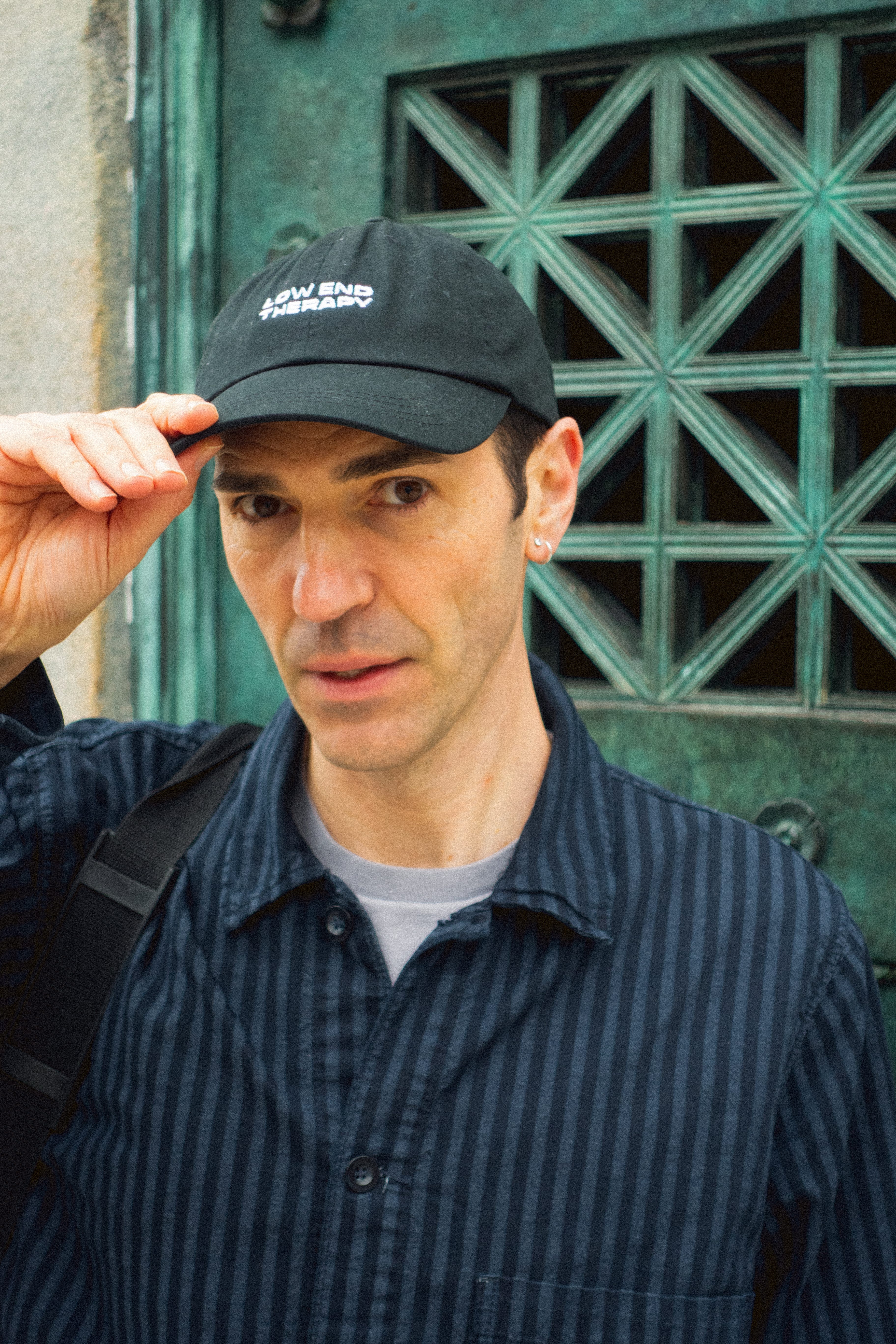
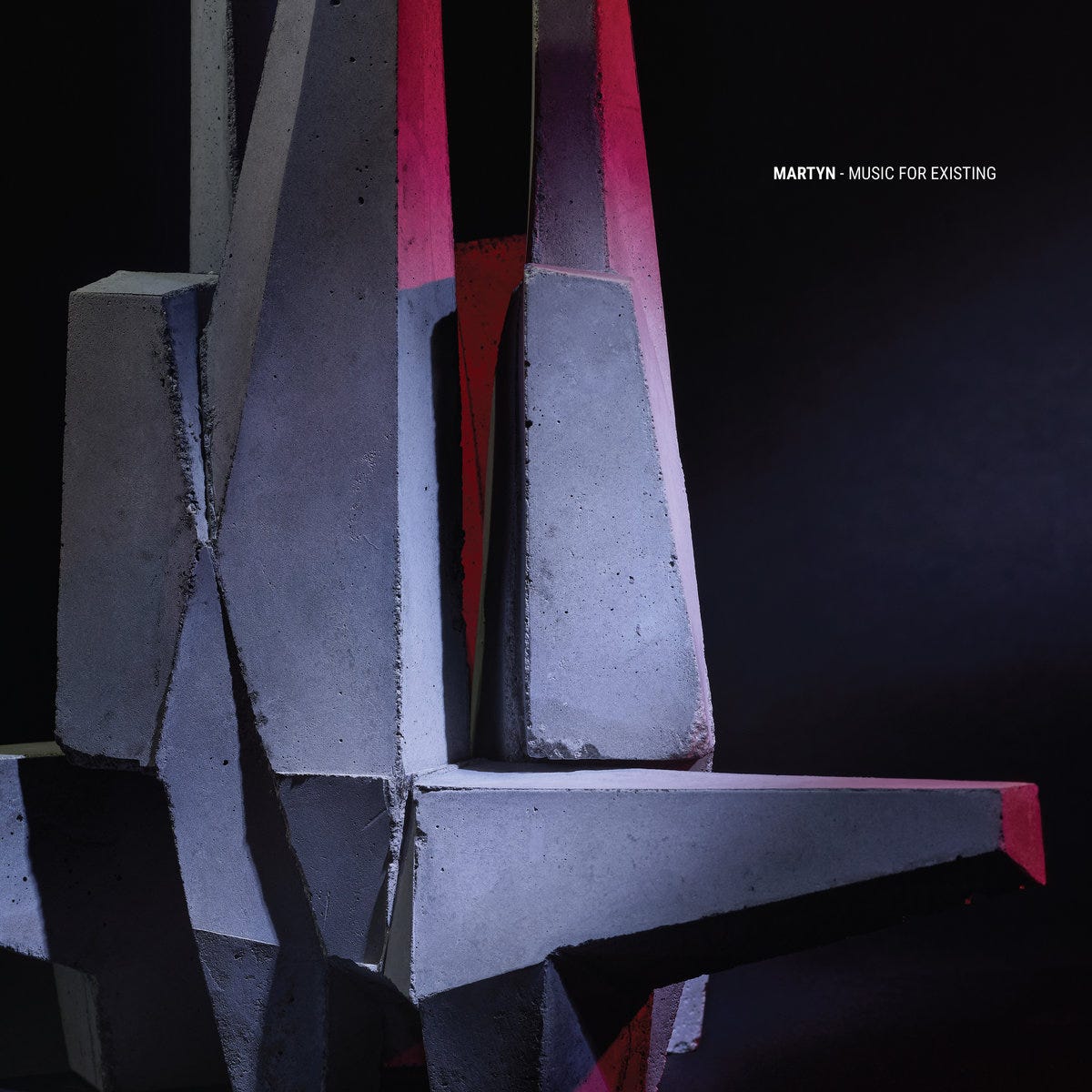
At one point in our chat a couple weeks ago, Martyn told me that he didn’t necessarily want to be one of those 60 year-old DJs still traveling around the world to play gigs. Which seemed funny to me, because in his early 50s, he’s just released what might be his best album.. The slower, steadier Music For Existing—his first LP since 2018’s convincingly clubby Voids—underlines the warm, soulful sensibility that made his music stand out from the get-go. The drums are lifelike and textured (he’s never used a drum machine), and the tracks are built from live jams with a cut-up method that evokes formative ‘90s records on labels like Ninja Tune and Mo’Wax. It sounds lived-in, thanks to the rough but elegant textures that have always been Martyn’s calling card, like an album jacket with a ring worn into it.
That’s not to say that Music For Existing is a throwback record. Sure, with its acoustic instrumentation and vaguely hip-hop style, it recalls classic Coldcut and DJ Shadow tracks. But it also features plenty of Martyn’s one-of-a-kind drum programming (like on “Heavy Sound”), some truly monstrous sounds—check out the mean-ass acoustic bass on “Phantom Jazz”—and flashes of the effortless UK hybridism that made him famous, like the slo-mo jungle of “Hypnotoxic Laser.”
Futureproofing is a reader-supported publication. To receive new posts and support my work, consider becoming a free or paid subscriber.
Martyn is one of those artists who has so many jams—instead of one big hit—that it’s easy to forget how important he was at the peak of the dubstep crossover. An outsider on all fronts, as a Dutchman living in the exurbs of Washington DC, he made some of dubstep’s most undeniable anthems before helping spearhead its shift into dusty house and techno, all while balancing the influence of the drum & bass that he started out making in the first place. His output has slowed down over the years, but now his energy is still making important waves in dance music, now as a teacher of younger artists, instead of a proprietor of can’t-miss dubplates.
His 3024 label has become an incubator for up-and-coming artists through a mentorship program teaches electronic music history, production skills, and how to navigate the industry. It’s in this position as an elder statesman that Martyn seems most comfortable, which explains why his new music sounds so fluid. Music For Existing is Martyn doing what he wants—after years of hosting a jazz show on NTS but only expressing those influences in the margins of his own music—without any pressure to have something to appease promoters with or reflect current club trends. He’s always been an uncommonly musical producer in the nebulous world of post-dubstep, and it’s lovely to hear him stretch out and explore that, with the help of musicians like Duval Timothy, Mark Cisneros, and Lucinda Chua.
Talking to him, I got the sense that he was perfectly content in his new role as the benevolent uncle of dance music, passing down wisdom without being didactic about it. For a guy who’s given even me unsolicited advice over the years, it’s a fitting role—maybe the one he was born to play.
The interview
The first thing I thought when I heard the album is that it sounds pretty old-school. How did it come about?
During the pandemic, a lot of musicians had time on their hands because they didn’t work. People were writing their ambient album or whatever. I didn’t really do that because from the beginning of the pandemic I started teaching and that quickly became my day job. For a while, I was much more invested in teaching about music than making it. I did little sketches here and there, but nothing substantial. I did put out a few collaborative EPs and some one-off tracks and remixes, but I never had the idea of writing an album. I was actually thinking that maybe I had already written my last album.
But for some reason, especially in the last year, all of these little sketches and ideas I had collected suddenly became a project. It became more concrete when I started bouncing these ideas to friends to see if they wanted to contribute something. It became a back-and-forth between me and a lot of other people and that started to turn into a record.
It was really about the collaborations, which was a much more interesting way of making music than I’m used to. I’ve been a bedroom producer, making music by myself, since day one. And I think I wasn’t inspired that much anymore by myself. It was way better to be a contributor to a whole rather than be responsible for every millisecond of a production.
Were you sending almost-finished tracks to other people?
Most of them were just loose sketches, one or two minutes. Sometimes it was based around a sample that I wrote some musical parts on top of. Then later on we would replace the sampled beats with real drums and other instruments. What I sent was usually rough around the edges. Some stuff had no beats whatsoever. And sometimes people would bounce back ideas and then those ideas turned into all new songs. It was quite loose. It wasn’t like, “Here’s a song. Can you play a solo on it? Can you do the drums?” It was more like, “Okay. Here’s an idea. Go into the studio, see what you come up with.”
Is there a theme or anything that ties these tracks together? Because it’s not really a dance music album. It’s something else.
I don’t think it would make sense for me to write another dance music album. I’ve done a bunch of them, and it’s weird because I guess people know me for a lot of my earlier work. The stuff I made in 2008. But it didn’t feel right to make an album of post-dubstep bangers, because I would be repeating myself and there’s a lot of other people at the moment that do really good stuff in that world. Why would they need me to do that?
As a musician, you always want to move forward and try new things. And for me anyway, the music that I listen to on a daily basis, what I do on NTS Radio, is mostly jazz. So it made more sense to make an album that follows that ethos of how music is made.
Where does the jazz influence come from?
I’ve been involved in jazz for a long time, mostly just collecting stuff. Around ten years ago I started to record jazz mixtapes for NTS, and that became a monthly show called Darkest Light. For me the idea behind the show is exploring new genres and styles, as I would pick up new records while traveling around the world for gigs. I think it’s always shown in my music, but maybe not as much as on this album. There was always jazz in my music. Even the way I produce, improvising ideas and resampling sounds, it’s kind of like a jazz approach. But now that I use acoustic instruments people all of a sudden think of it as jazz.
Some of it, especially the first track, reminds me of old Mo’Wax Records, DJ Shadow, etc.
It’s all sample and cut-up techniques. I guess a big influence for me is also Madlib, who did loads of hip-hop stuff, but he also did lots of jazzy stuff, like Yesterday’s New Quintet, their first album was really important to me way back when. There’s a throughline to the Brainfeeder stuff as well, people like Ras G.
You mentioned improvising. How does improvisation work when you’re making electronic music with a computer?
I think it’s the same as with acoustic instruments. You listen to something and while you’re listening you’re automatically responding and then that becomes a new pattern or a new groove that you can expand or build on. Most of the time the computer is just meant as a device to record rather than write music.
So are you recording long passages of improvisation and cutting it down?
Yeah. There’s a track called “Hypnotoxic Laser,” it’s like a drum & track and I use a modular with a granular sampler. I made all these different takes, like five or six minutes long, and then edited them down. And in that particular track, it was a single take of a sound that develops throughout the song. So it’s basically exactly the same as how you would play a horn.
You also said that you thought you were done making albums. Why?
Because I’m teaching about music a lot. With teaching you also transfer some sort of creative energy, talking about your music or the process, you approach it in such an analytical way that it almost becomes impossible to be creative yourself, at least without analyzing everything that you’re doing at the same time. When I was teaching so extensively it was much harder for me to be free and creative in the studio. And for a while, I was fulfilled by transferring my knowledge to other people and then seeing them make amazing music and sending it back to me. There’s a good exchange going on. I thought maybe my task in life now was just to teach and let other people have fun creating things.
But then, as I said, after a while all these sketches started to pile up and a project started to take shape.
How were you able to turn your analytic voice off while making it?
Collaborating helped. The one thing with collaborating is that you have to leave some of the creative process with them, so you don’t have full control over it. You’re more like a contributor. So that helped me turn off the analytical mode. But I’m also a Virgo, so I’m always going to have that analytical voice. That’s just part of the process.
It also helps to have a final goal. In this case, not making a dance music album. Because that allowed me to be a bit more free in the studio without having all these preconceived notions of what the results should sound like.
If you felt that you were a teacher and not a music producer anymore, that seems like a pretty profound shift in identity.
It feels great. Teaching is an underrated part of musicianship. If you look at jazz and classical music, most classical musicians are teachers and only a few of them are real performers that perform full-time. Most people that are trained in classical or jazz go on to become teachers rather than performing artists. But in electronic music it’s kind of the other way around. Everyone wants to be a performer, everyone wants to be a DJ or a live artist. There’s not a lot of people that also teach.
With the music maturing, you have a lot of artists with loads of experience who have been in the game for 30 years. They know something about music, right? I think maybe my generation, my peers, should be teaching the younger people something. That’s also how the mentoring program started. There’s a lot of educational material, but it’s tech focused. How to do things rather than how to be a musician. But yeah, it is maybe a profound change. It also has to do with how you conduct yourself as an artist. There are really successful 60 year-old DJs that do well and fly around the world, but I’m not sure I want to be one of those people. I also don’t want to just leave music. So this position of teaching stuff, pushing forward new ideas through different media—writing, radio, or just making more music—works for me.
Do you think having multiple streams of income—writing, teaching, making music, DJing—are important to making a living as an artist nowadays?
I didn’t start any of this to make money. And there’s no real income for me from writing, for example. But for me, every day is about creating something, and that can be a piece of music or it could be a piece of writing. Or painting, like I was doing for a while. I just need to create something, and however that surfaces is fine with me. Even within teaching, there’s a lot of creativity. You build these sessions, shape the subject matter, sort ideas. But yes, on a larger level, if you want to survive as a musician there has to be more than one source of income because there’s almost no one who can survive on one sole creative occupation at the moment.
When you’re mentoring and teaching these younger artists, especially artists who are trying to make dance music, does that come into it? How the industry works, and how to make money? Material conditions seem worse than ever for a lot of people.
I don’t know if it’s any worse than before. When I first started making music, there were barely any role models of people who made it into a career. Making music, DJing, producing, was never really something you would do as an occupation, unless you were a megastar.
Like Sasha or something.
Yeah, but that was not something I aspired to anyway. That wasn’t my kind of music, and I was just in it for the music. Maybe that ethos has gone a little bit, and more people are making music because they want it to be their job. In my teaching, I try to approach music as a way of life rather than as something that can eventually become your job. Then they can become artists, and whether or not they make money off of it is up to them. It’s so much more important that they become good artists first.
Most of my mentoring is about making people aware of what they can do in terms of inspiration and creativity, and then giving them the knowledge, and telling them about what I experienced when I started making music.
Did you have any mentors when you started out?
Not as many as I would have liked. And I think that goes for a lot of people from my generation—there were basically no examples, no role models of people who did anything similar to what I wanted to do and had turned it into something bigger. There were loads of people I learned stuff from, but only little bits here and there. Like there was a guy called Robert who was the local record store owner [in Eindhoven], and I learned so much from him just by going there every week, he constantly fed my appetite of trying out new music. So he was a mentor to me. But it’s not like someone sat me down and explained how everything works. People have more interesting resources nowadays.
How do you feel about dance music media in 2026? What do you read? I find music discovery via editorial much more difficult now.
Music discovery in general is just harder, regardless of whether there’s people writing about it. Because I don’t know where to look. But there’s also this myth that people have to be in the know about everything that happens. I think if you even have a limited scope of what happens in music, that’s fine. For example, I buy a lot of music on Bandcamp, and every time I do, I’m added to a mailing list. And then on Bandcamp Friday I get 400 emails and that’s loads of music right there. You don’t need to know everything that comes out, or listen to everything, unless that’s literally your job. And it’s not my job. I can just do whatever I want, which is great.
I think there’s a lot of interesting stuff happening, but it’s mostly outside of traditional media outlets. There are really great people on Substack, but there’s also a lot of shit on Substack to be honest. But people find their niche and do interesting stuff with it. There’s also loads of people that jump between music, fashion and food, a lot of cross-pollination happening. But even there are some DJs who use the mix format as a sort of journalism. I spoke to Beatrice M., who does these mixes of genres that sound like other genres, it’s basically music journalism. Or at least taking an anthropological approach to music. It’s a way of learning about music that you can’t just do in an article.
In the mentoring program, I do a series called “Listening To.” So it’s listening to UKG, to jazz, to dubstep. It’s my interpretation of how these styles developed and cross-pollinated. You can learn a lot by going through, say, 40 tracks in an hour, and building a narrative about the history of a scene. That’s really interesting to me, stuff that’s on the border of journalism and musicianship. It’s part creative, part documentary.
What else do you do in the mentorship program?
A lot of it is production focused, but less on the technical side and more how to approach certain problems. There’s a lot of feedback—people bring me music and we listen together and then provide feedback on how to improve it. We also prepare releases together, and there are several labels that have started within the mentoring program and spread through our discord or through collaborative sessions. There’s lots of little initiatives, it’s more like a framework, or a bigger community that’s growing around it, of people who are all just interested in making music.
I have these monthly sessions where I talk about topics that I find interesting. What does your scene look like, or the importance of a certain artist or label, or something more abstract, conversations about workflow and more technical stuff.
One thing you said earlier stuck with me—that you didn’t want to make an album full of bangers because that’s not what people need from you. So what do people need from you now?
I’m pretty happy with the role I play now. I feel a responsibility to share what I have with other people, and mentoring and teaching is very important to me. I also get a lot of reciprocal energy from that, because I’m seeing people do well with my guidance or transfer of knowledge. That’s the best part for me.
But also, I want to make music till I’m very old. And the music I make has to connect with who I am as a person, and I’m not 20 years old anymore. I shouldn’t be making 20 year-old music. That doesn’t mean my music now is boring and old, but I do think your personality and where you are in life should be reflected in the music. That’s also why all those people made ambient albums during the pandemic, because it was a time for contemplation and reflection.
Two years ago you put out the compilation Through Lines, and the new album also has a kind of retro vibe. Do you… suffer from nostalgia?
I don’t really see it as a retro album at all, because making it was a totally new process for me. Is something retro because you’ve heard the sounds before, even if it’s all new ideas?
I guess it’s in the ear of the beholder.
That’s not to say your opinion doesn’t count but… but there’s a lot of music right now that sounds very futuristic and very sound design-y, and is also super boring. Maybe “classic” is a better word. I never started making any music with the idea of taking a little bit of the ‘90s and the ‘00s or whatever. That’s not how the record came to be.
Nostalgia, well, teaching people who are usually much younger than me, sometimes half of my age, taught me as well. A lot of things I did in the ‘90s, and the way I approach problems, are very different from how people approach problems nowadays. Everything else in the world has changed around them. If I taught them how I made music in the ‘90s, that would be of no use to them. So it’s made me learn more about how things work in the present day and change the way I think about music. That way I can tell people how to do things right now, rather than talking about stuff back in the day, or saying they should only play vinyl.
I often ask artists who are, um, aging, about how they still keep up with music.
Well, I learn a lot about music from the young people I work with. And it’s kind of my job to listen to everything they make. But like I said before, I think if you keep your scope relatively small, you can still keep up with music pretty easily. I think it’s only when you widen your scope to everything—or even, say, the new electronic music playlist on Spotify or whatever—that you become overwhelmed very quickly, and maybe get depressed. Especially because there is just so much mediocre music out there. So it’s about keeping it relatively controlled and contained, rather than trying to listen to everything.
So what is your scope?
Well, there’s that 400-email Bandcamp Friday list. I also love listening to people’s collections on Bandcamp, which is basically like going to a record store and eyeing what the really cool person next to you is holding. You get influenced by what they’re buying. So I like finding weird curveballs like that through Bandcamp. Not to just get a flood of stuff, but to break away from it and find things that are ugly or confusing. That’s where real discovery happens.
Futureproofing is a reader-supported publication. To receive new posts and support my work, consider becoming a free or paid subscriber.
Comments
Nothing yet. Say the first thing.
Sign in to join the conversation.