
In March, the Senate did something disaster recovery advocates have wanted for fifteen years. Tucked inside the 21st Century ROAD to Housing Act was Section 501: a provision that would permanently authorize the Community Development Block Grant–Disaster Recovery program and stand up a dedicated Office of Disaster Management and Resiliency at HUD. The bill passed the Senate by an overwhelming margin, by a vote of 89–10. After three decades of running one of the country’s largest long-term recovery program using one-off authorizations and appropriations, Congress was close to putting it in statute.
Then the House took it out.
When the House passed its amended version of the Act—also on an overwhelmingly bipartisan 396–13 vote—the permanent CDBG-DR authorization was gone. At first the cut went unexplained…House Financial Services Chair French Hill's statement on the amendment talked about cutting barriers to construction and modernizing HUD programs, but said nothing about disaster recovery. The case came last week, however, at a June 10 subcommittee hearing on the program. Part of it was administrative. Hill pointed to a HUD Inspector General finding of more than $690 million in poorly documented spending, and Housing and Insurance Chair Mike Flood called the unauthorized program a "nightmare" for HUD and local governments. Part of it was philosophical. Representative John Rose argued that long-term recovery belongs at FEMA, not entrenched as a permanent program and bureaucracy inside HUD. "It is time to end the experiment," he said. Others, like Representative Monica De La Cruz, argued that the Senate's codification formula would shortchange rural counties.
I’ll be at the Natural Hazards Workshop this week, and speaking on the closing plenary panel. If you are there, be sure to say hello! Would love to meet some readers ‘in the wild.’
The bill is now back in the Senate’s hands, with Warren and House Ranking Member Maxine Waters both pushing for a conference committee to reconcile the two versions, and with the National Housing Conference and the National Low Income Housing Coalition both urging the Senate to put CDBG-DR back in.
If you are in the disaster recovery world, this might seem like déjà vu all over again. And you would be right. Congress has gotten painfully close to making CDBG-DR a permanent program multiple times now, only to pull up short in the final lap. In today’s post I wanted to recount the painful history of the DR program and efforts to make it permanent.
Besides being a litmus test for how long you’ve been working on recovery (once CDBG-DR starts rolling off the tongue, too long), CDBG-DR is one of the largest and most important federal programs to aid disaster survivors and disaster impacted communities. It is also routinely criticized for being too slow and too confusing. What explains a lot of the dysfunction is that CDBG-DR is not really a “program” at all…it is shorthand for supplemental appropriations that Congress routes through HUD’s regular Community Development Block Grant authority (which was created in 1974) and earmarked for disaster recovery. The standing CDBG program funds housing, infrastructure, and economic development for cities and states. CDBG-DR is what happens when Congress adds a disaster-specific appropriation onto that program.
That use of the CDBG authority for disaster recovery began in the early 1990s, with the first use in 1993, and stuck because the structure was useful. CDBG-DR money is flexible in ways almost no other federal resources are: grantees can spend it on housing reconstruction, infrastructure, economic revitalization, planning and mitigation, targeted to the “most impacted and distressed” areas of a federally declared disaster. It typically arrives after FEMA, insurance, and SBA loans and is intended to address unmet needs. By statute, 70 percent of the funds must benefit low- and moderate-income households, and DR has become a lifeline for households and communities where private resources and insurance dollars aren’t nearly enough to fuel recovery.
CDBG-DR has become the second-largest federal disaster recovery vehicle after FEMA’s relief programs, all while never becoming a permanent program. It isn't the only federal money that funds long-term rebuilding. FEMA Public Assistance restores public infrastructure and facilities, and SBA disaster loans help households and businesses. But Public Assistance is limited to public assets, and SBA offers loans that lower-income survivors often can't qualify for or repay. CDBG-DR often acts like a funder of last resort, i.e. the main source of flexible grant money for the unmet needs and is especially for low- and moderate-income households and communities who get left behind by other programs.
Since fiscal year 1993, Congress has appropriated more than $111 billion in CDBG-DR funds, according to the Congressional Research Service. Our friends at Carnegie’s Disaster Dollar Database have created the best public tool for tracking CDBG-DR appropriations and note that HUD has spent roughly $50 billion through CDBG-DR since 2015 alone. The size of those appropriations tracks the size of the disasters, and they arrive in big, irregular spikes. The largest by far followed the 2017 hurricane (Harvey, Irma, and Maria) for which Congress provided about $35 billion in CDBG-DR across three supplemental bills. Puerto Rico's share of that response (more than $20 billion) was the largest CDBG-DR allocation ever made to a single grantee. Earlier disasters received comparable amounts: roughly $16 billion for Hurricane Sandy in 2013 and $16.7 billion after Katrina, Rita, and Wilma in 2006. The most recent authorization was in January 2025, when HUD allocated $12 billion to 23 states and one territory for disasters in 2023 and 2024—part of the biggest single appropriation of long-term recovery funds ever made (a $110 billion disaster supplemental).
Because CDBG-DR is not permanently authorized, HUD cannot write standing regulations for it. Instead, each time Congress appropriates money, HUD has to publish a new set of rules through a Federal Register notice—deciding allocations, eligible activities, waivers, and requirements more or less from scratch. The Bipartisan Policy Center counts more than 80 notices since 2001.
There are many challenges associated with this improvisational approach to recovery spending, especially the time it takes. A study by my colleagues at the Urban Institute, commissioned by HUD, examined 88 grants from 2005 to 2015 and found that CDBG-DR housing recovery activities took 4.7 years to complete on average with wide variation driven partly by the fact that rules shift from disaster to disaster. Their first recommendation is the one almost everyone in this space has also made, that Congress should permanently authorize CDBG-DR in statute.
And it really is almost everyone. The list of organizations on record supporting permanent authorization is long and ideologically diverse:
The National Low Income Housing Coalition and its Disaster Housing Recovery Coalition, a network of hundreds of frontline organizations
The National League of Cities and the National Association of Counties
Even the federal government’s own watchdogs—the Government Accountability Office and HUD’s Office of Inspector General—have recommended that Congress codify the program.
So why hasn’t permanent authorization happened? Amazingly, frustratingly, it nearly has been and multiple times. Permanent authorization has passed a full chamber of Congress three separate times in the last seven years—the House once, the Senate twice—but never both chambers in the same Congress.
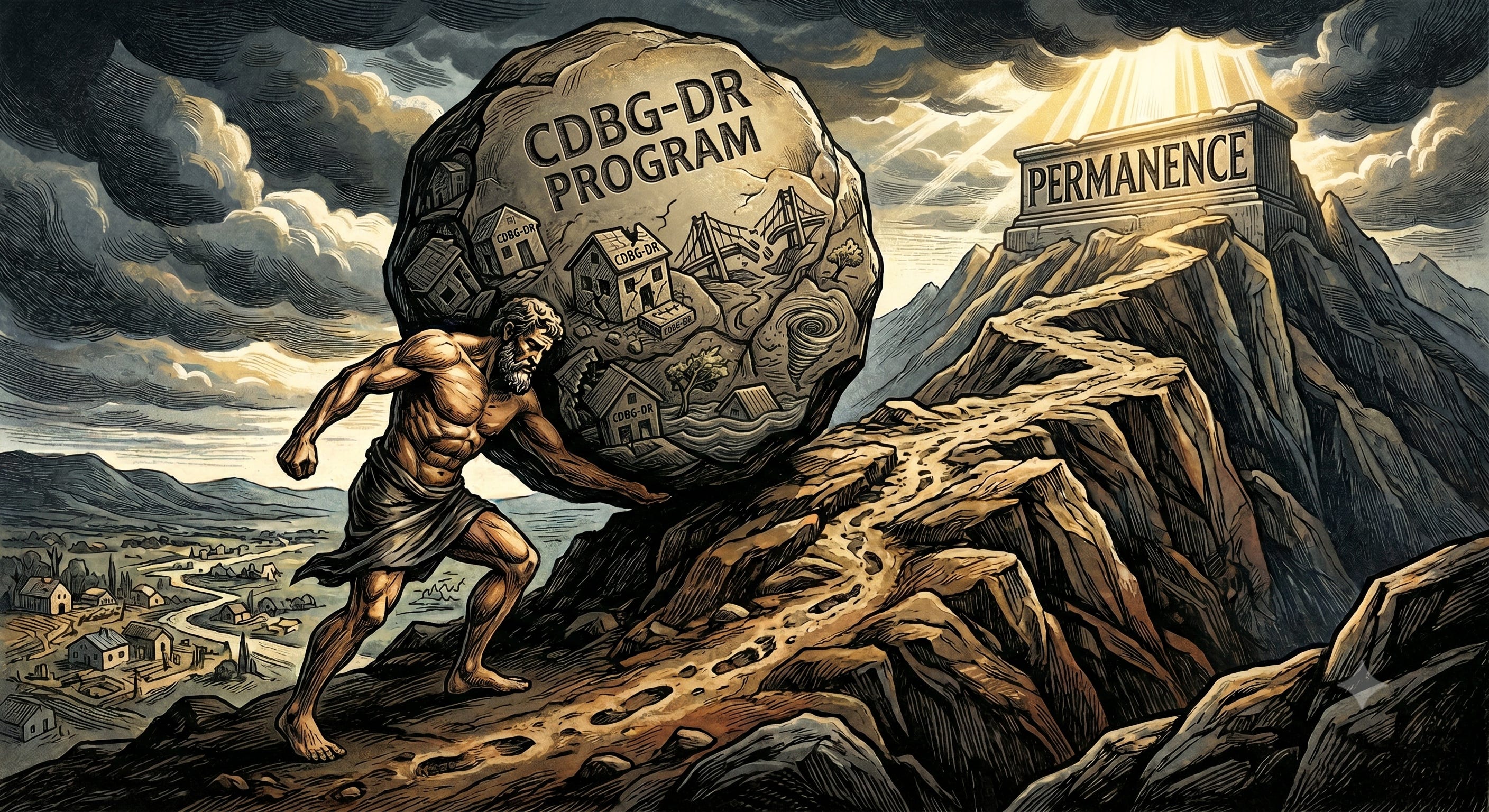
The main vehicle, in its various forms, has been the Reforming Disaster Recovery Act—a bipartisan bill that does roughly what Section 501 of the ROAD package does: codifies CDBG-DR in statute, lets HUD write standing regulations, locks in the low- and moderate-income emphasis, and creates a forward-facing recovery fund. Versions of the Act have been introduced in every Congress since the 115th:
November 2019 — the House passes authorization. Out of a March 2019 oversight hearing on the chaotic Harvey, Irma, and Maria recoveries, Representatives Al Green (D-TX) and Ann Wagner (R-MO) built the Reforming Disaster Recovery Act of 2019 (H.R. 3702). It cleared the Financial Services Committee unanimously and then passed the full House, 290–118, on November 18, 2019. The Senate companion (S. 2301) was referred to the Banking Committee and never moved.
2021 — the appropriations route. Senators Brian Schatz (D-HI) and Susan Collins (R-ME) reintroduced the bill (S. 2471), with Rep. Al Green carrying a House companion. That October, the Senate Appropriations Committee folded it into its FY2022 Transportation-HUD bill. The broader appropriations process collapsed into a continuing resolution and the provision didn’t survive.
2023 — stuck. Schatz and Collins reintroduced again (S. 1686), this time with twelve additional co-sponsors from both parties and Al Green carried the House version. It didn’t advance.
2025 — the Senate passes authorization. The reforms got absorbed into the larger ROAD to Housing Act (S. 2651), which Senate Banking reported unanimously. The Senate then folded the whole package into its FY2026 National Defense Authorization Act by voice vote. The House declined to put the housing package in its own NDAA—Chair French Hill fought its inclusion—and the final enacted NDAA dropped it entirely.
The ROAD to Housing Act bill is back with the Senate, who can swallow the House version as-is (likely killing permanent CDBG-DR for this Congress, given the upcoming elections) or push for a conference committee to put the provision back in. Warren and Waters want the conference, and industry and advocacy groups are pressing the Senate to restore the section. But House Republicans didn’t just quietly drop the provision. At the June 10 hearing, several of its Republican members began building a public case against it: that recovery should move to FEMA, that the program is run too loosely to enshrine, that the Senate’s formula needs work.
The Senate is expected to act later this summer. I’ll keep you updated.
AI Statement
I used Anthropic’s Claude to help research the Congressional vote histories on the CDBG-DR program, gather news stories about the recent ROAD to Housing Act moves, suggest edits to the draft blog post, and create the silly image for the post. I did not use AI to conceive or write the article.
Have questions or want to talk further? Contact me.
Comments
Nothing yet. Say the first thing.
Sign in to join the conversation.