
We called them digital natives. Their the digital generation, they just get technology or my kid knows how to use my phone better than I do. This is what many of us assumed 15 years ago when smart phones and social media started to encroach upon our daily lives. If kids were born knowing how to navigate technology, then we didn’t have to teach it. We could hand them the device and step back.
The researchers came for that idea years ago, and they were not gentle. Paul Kirschner and Pedro De Bruyckere published a takedown of the digital native myth that should be required reading for every school board: the evidence shows no generation of students who naturally understand technology simply because they grew up with it. What kids actually have is comfort — fast thumbs, no fear of the interface. What they don’t have, unless someone teaches it, is comprehension of what the technology is doing to them and for them. Comfort and comprehension look identical from across the room. They are not the same thing, and the gap between them is exactly where a generation got hurt.
The evidence of that gap is everywhere once you look. When the OECD tested fifteen-year-olds across dozens of countries on whether they could distinguish fact from opinion in what they read online, fewer than one in ten could do it reliably. These are the same students who can run three apps at once, who live on their phones, who look — from across the room — completely fluent. They could open everything. They could evaluate almost nothing. And we know where that ended: the 2023 Surgeon General’s advisory on social media and youth mental health, the anxiety and depression documented at population scale, the harm surfacing years after we missed our moment to teach. We mistook fluency of access for fluency of judgment, and our students paid the difference.
And with AI many of our students are already there. The students I have talked with about AI want to know how to use it effectively. They want the adults in the room to help guide them and not assume they are simply cheating. Common Sense Media found that roughly seven in ten teens have used generative AI — most without their parents knowing, and much of it without any adult ever teaching them what the tool is or how it fails. This is the social media pattern replaying in real time. Mass adoption by kids. Minimal awareness by adults. Zero instruction in between. We have seen this exact movie, and we know the ending, and we are watching it again with the sequel.
Ask that same confident-looking student whether the answer is right, or where it came from, or what the tool quietly got wrong, or whether they should have used it at all — and you find the same gap we found with social media. They don’t know that these systems generate plausible text rather than verified truth. They don’t know the machine will invent a source with a straight face. Access is not understanding. It never was.
The second pillar is a refusal: don’t assume fluency. Teach it. Deliberately, as curriculum, the way we would teach anything else that matters. This is not a fringe position — it’s where the serious institutions have already landed. UNESCO has published AI competency frameworks for students and teachers because it concluded that AI literacy is a teachable body of knowledge, not an ambient skill kids absorb. The AI4K12 initiative mapped out five big ideas about artificial intelligence that students can learn from kindergarten up — how machines perceive, how they learn, how they can be wrong, what they mean for society.
Whole countries are moving: Estonia, which treats digital education as national strategy, launched a program to put AI tools and — critically — AI instruction in front of secondary students and their teachers together, on the explicit logic that unguided exposure is the risk, and taught exposure is the remedy. The question is no longer whether AI fluency can be taught. It’s whether your school will be teaching it or leaving your students to teach themselves.
And teaching it has one non-negotiable condition — you have to put AI in front of students, not behind a curtain. You cannot build judgment about a tool you’ve hidden. A ban doesn’t produce careful users; it produces users who are careful only to not get caught, learning everything they know from each other in the dark. Remember what the New York City reversal admitted: the ban had been fear, not strategy — and during those months of prohibition, students didn’t stop using ChatGPT. They stopped using it where any adult could see them and coach them. Prohibition didn’t remove the tool from their lives. It removed the adult from the room.
I have argued this point many times over the last few years that if we do not teach these concepts in school, we defer the teaching or learning elsewhere. Some kids will be fine in this equation, but many will fall behind and fall into the same pattern as many did with social media guidance and guardrails.
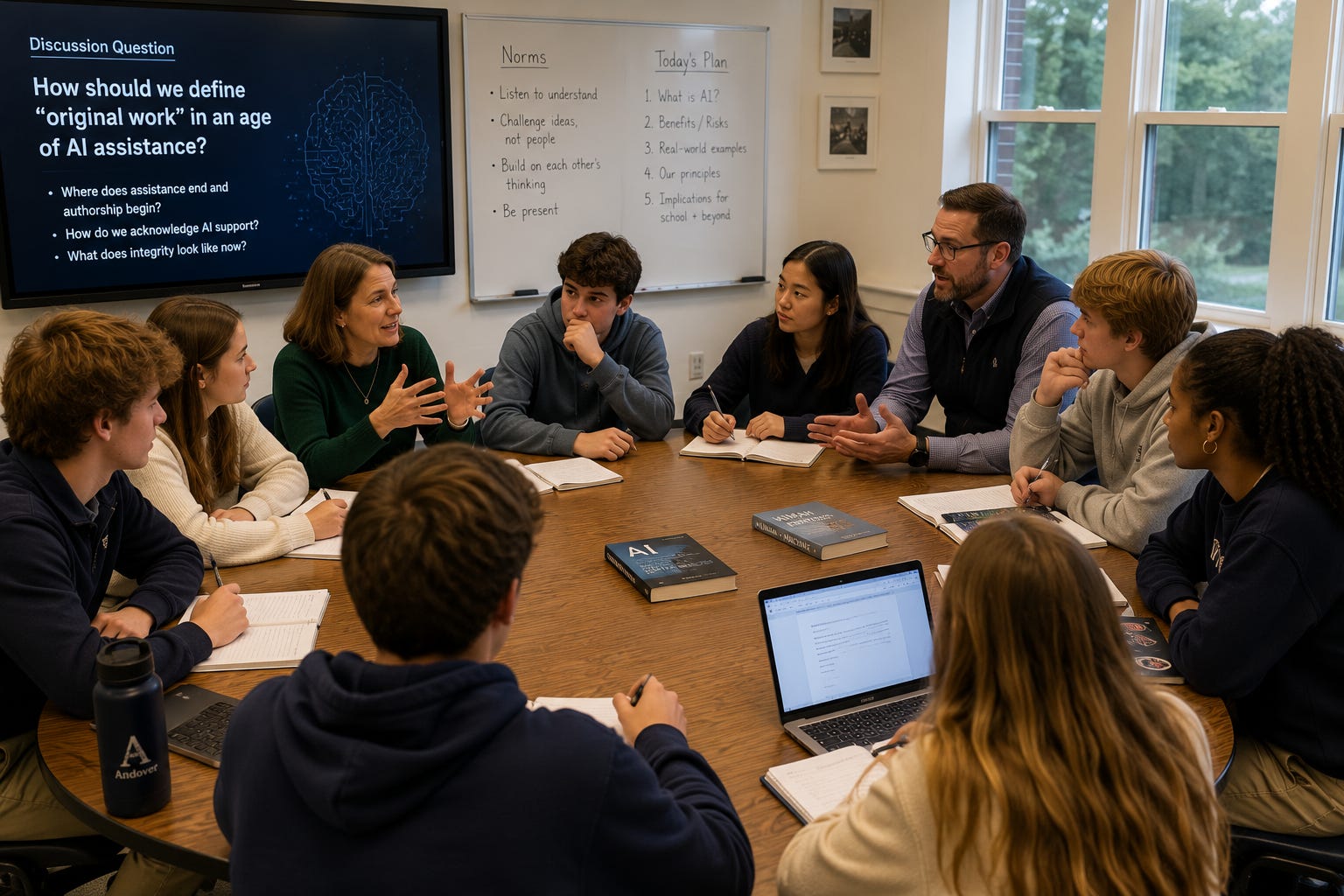
Teaching AI does not mean we are compromising our values. AI is not a very popular term among many kids and adults. Only a few months ago students were booing commencement speakers who mentioned AI in their speeches. But let’s not conflate that with the idea that prohibition of AI is good. We need to lean into these conversations with our students. You can teach about AI simply by using the Harkness method.
That’s it. What we don’t need to do is race to get another AI tool into our classrooms. The goal here is not to be first, but rather prepare our students to leave our schools prepared to use AI for good, challenge AI policy and governance, and dismiss it when it is not the right tool. I understand the instinct to protect. But hiding the tool doesn’t slow it down; it just guarantees that when students meet it — and they will, the moment they leave your building, if not the moment they get home tonight — they meet it with no one having taught them how to think. Protection that produces ignorance isn’t protection. It’s a delay for the same harm.
So here is the assignment inside this pillar. Audit the assumption first: ask your students, anonymously, how many are already using AI and for what. Invite your students to your AI council or committee to help inform and guide the way the school will approach AI. Leaving student voice out of this journey should not be an option. Then name AI fluency as a teaching responsibility — assigned to real courses, real grade levels, real people — rather than an assembly, a one-day workshop, or a paragraph in the handbook. An assumption is just a lesson nobody was assigned to teach.
Assume nothing. Teach the thing you think they already know. That is how you close the gap this time, instead of paying for it fifteen years from now.
This is the second of five pillars in the Human-First AI Framework. Access last week’s post here. AI TRANSPARENCY NOTE: How I use AI: The ideas, arguments, and judgments here are mine. I use Claude as a research and editing assistant — summarizing sources, pressure-testing arguments, and tightening drafts. Nothing is published that I haven't written, verified, and revised myself.
No posts
Comments
Nothing yet. Say the first thing.
Sign in to join the conversation.