
I’ve used AI nearly every day since November of 2022. I know what it’s good for. I know it isn’t always right. I know it can be annoyingly agreeable — it will tell me my bad idea is a great one if I let it. And I know the moments it has genuinely made my thinking sharper. I hold both of those truths at once, every time I open the tool. That’s what fluency actually is.
And I don’t just think about this as a consultant. I think about it as a dad. When my own kids and AI come up, I’m not trying to raise children who believe it’s magic, and I’m not trying to raise children who believe it’s poison. I want them to pick it up the way they’d pick up any powerful tool — knowing what it’s built for, what it’s bad at, and what it costs them when they hand it something they should have done themselves. That’s the standard in my house, and it’s the same standard I bring to every school I work with.
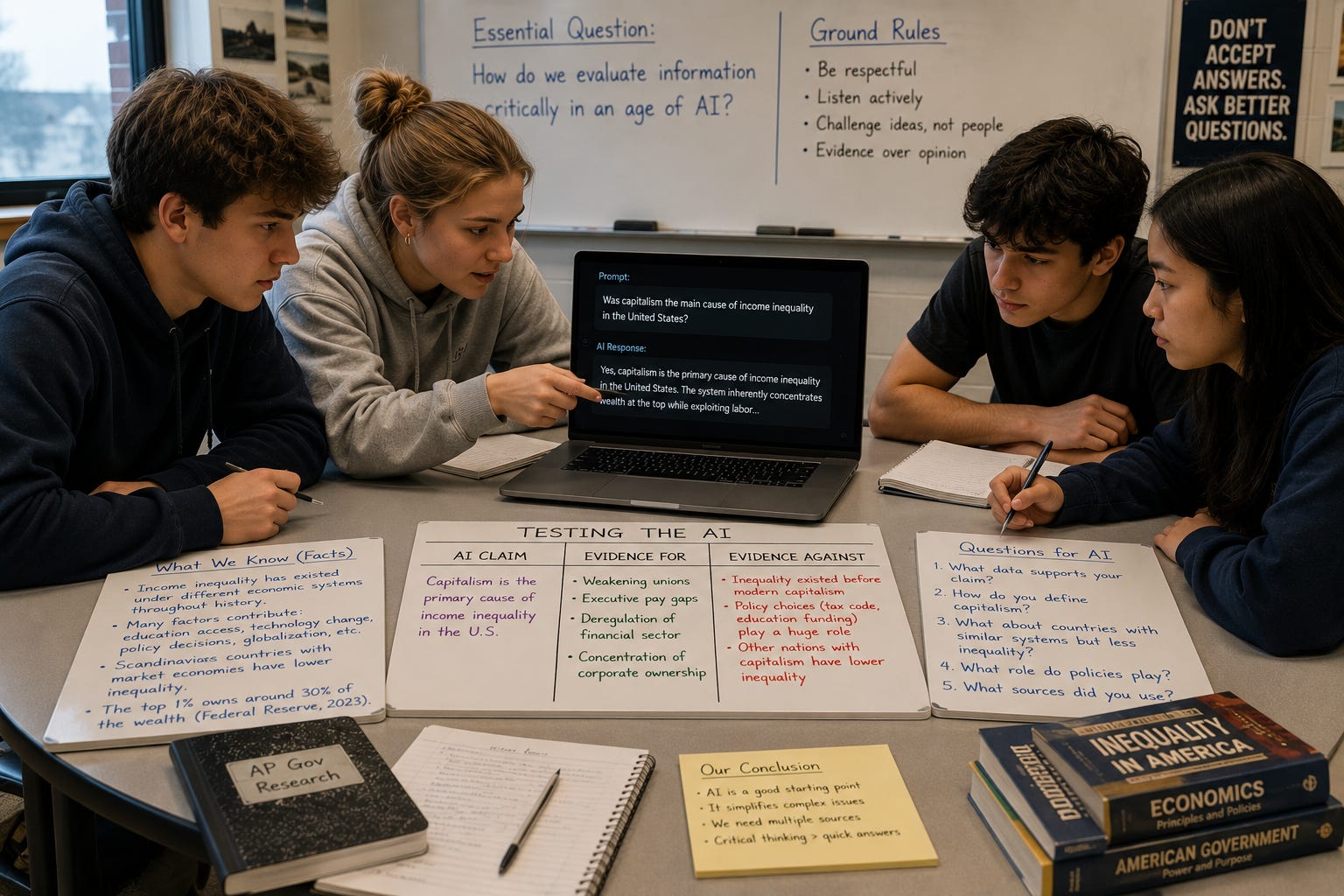
Most of our students hold only one truth. Some trust every answer — they paste without reading and treat the tool as an oracle. Others have been told it’s a cheat, a threat, a thing serious people avoid. The first student becomes a mark. The second gets left behind. Both were taught half the truth, and half the truth about AI isn’t caution — it’s malpractice.The third pillar refuses that half-education. Teach the power and the poverty of AI, both, at full strength, at the same time.
Start with the power, because it is real and our students deserve to see it. I’ve watched a kid use AI to turn a wrong PSAT answer into a personalized set of practice questions — a private tutor, for free, for a family that could never afford one. That is not a parlor trick, and the research is starting to say so at scale. A Harvard team built an AI tutor for an introductory physics course and ran a controlled comparison against the university’s well-designed active-learning classroom — and the students working with the AI tutor learned more, in less time, and reported being more engaged. Read that again: not more than a bad lecture. More than the good classroom.
Education has chased personalized, one-on-one tutoring for forty years, ever since Benjamin Bloom showed that individually tutored students dramatically outperform conventional classrooms — and we always concluded it was unaffordable. The PSAT student in my opening found the affordable version on his own phone. Scale that instinct across a graduating class and you get students using these tools to understand a hard concept three different ways until one lands, to pressure-test their own arguments, to reach toward problems as large as disease and climate that will need every mind we can prepare. If we only ever warn them away from AI, we snuff out that engine before it ever turns over.
Then show them the poverty, just as honestly — because the poverty is not a footnote, it is a load-bearing fact about how these systems work. AI is confidently wrong in ways that are hard to catch. It invents sources that do not exist, complete with plausible authors and page numbers; lawyers have been sanctioned in federal court for filing briefs full of cases an AI invented, which is worth telling students precisely because the people fooled were highly educated professionals. It carries the biases of the data it was trained on and hands them back with a straight face. And it is, as I’ve said before, annoyingly agreeable — researchers call this sycophancy, and it’s been documented across every major model: these systems will bend toward telling you what you want to hear, will tell you your bad idea is a great one, because agreement is what the training process rewards. A student who doesn’t know this will trust the tool exactly when they should push back on it.
If you want the single best piece of evidence that students need both halves, look at what happened when researchers gave hundreds of consultants at Boston Consulting Group access to GPT-4. On tasks that sat inside the AI’s capabilities, consultants using it performed dramatically better — faster, higher quality, across the board. But on a task deliberately designed to sit just outside what the AI could do well, the consultants using AI did worse than the ones working alone — because the tool sounded just as confident outside its competence as inside it, and they couldn’t tell the difference. The researchers called it the jagged frontier: AI’s abilities don’t fail gradually or predictably, they fall off a cliff mid-sentence, and the cliff is invisible unless you’ve been taught to look for it. Those were elite professionals with advanced degrees. Now picture a fourteen-year-old at the same frontier with no map. That is who we’re responsible for.
So what does teaching both halves look like in this coming school year? It looks like lessons where students use AI to genuinely accelerate something — and then, in the same unit, lessons engineered to make the tool fail in front of them. Have them fact-check an AI-written history paragraph against primary sources and count the confident errors. Have them ask it about something they know deeply — their town, their sport, their grandmother’s recipes — and watch it fake expertise. Have them push a mediocre thesis statement through it and notice how readily it applauds. A student who has personally caught the machine inventing a citation is inoculated in a way no warning assembly will ever achieve. The power lessons build capability. The poverty lessons build immunity. You need both running in the same classroom, or you’re producing either marks or skeptics.
Fluency is holding both of these truths in the same hand. Not swinging between hype and fear, but standing in the harder middle where a thing can be genuinely powerful and genuinely flawed at once. That middle is uncomfortable. It’s also where every mature relationship with a technology has to live — and it’s precisely the place the jagged frontier study proves even experts struggle to find on their own. So show them the ceiling and the floor of what this tool can do. A student who has seen both is the only kind who can use it well.
How I use AI: The ideas, arguments, and judgments here are mine. I use Claude as a research and editing assistant — summarizing sources, pressure-testing arguments, and tightening drafts. Nothing is published that I haven’t written, verified, and revised myself.
AI detectors are not foolproof. They flag false positives regularly, particularly on clear, structured prose. A scan result is an estimate, not a verdict — this statement is the more accurate account of how the piece was made.
No posts
Comments
Nothing yet. Say the first thing.
Sign in to join the conversation.