
A superintendent asked me last spring what the first step of an AI rollout should be. She expected me to name a tool, or a training, or a policy document. I told her the first step was a sentence — one her whole community could read. She looked disappointed. Everyone wants the tool.
But here is what I’ve watched happen in schools that skip this step. A teacher tries something with AI, a parent hears about it secondhand, and by the time the question reaches the principal’s office it has curdled into suspicion: why is my child using this, what happened to real learning, who decided this. The school scrambles to explain a decision it never actually articulated. It had reasons. It just never wrote them down.
If you want to see what that scramble looks like at scale, look at New York City. In January of 2023, weeks after ChatGPT launched, the nation’s largest school district banned it on school networks and devices. By May — four months later — the district reversed itself, and the chancellor said publicly what most bans never admit: the decision had been driven by fear, by knee-jerk caution, rather than by any considered belief about what students actually needed. Think about what those four months cost. Not just the instructional time. The credibility. Every parent and teacher in that system watched leadership announce a position, hold it briefly, and abandon it — which teaches a community that the district doesn’t actually know what it believes. That is the price of policy without a declared why. The rules changed twice; the belief was never stated once.
Now hold that against a district that did the opposite. Peninsula School District, outside Tacoma, Washington, spent time before generative AI hit the mainstream working out what it believed — and then published it. Their principles said, in plain language, that AI in their schools would be human-centered: teachers and students at the center of every decision, the technology in service of relationships and learning rather than the other way around. When ChatGPT arrived and districts everywhere were whipsawing between panic and paralysis, Peninsula didn’t have to scramble. The belief was already on the record. The community had already read it. New tools could be evaluated against a standard that existed before the tools did. That is what being early actually buys you — not a head start on software, but a head start on trust.
And trust is the real currency here, because the families you serve are already living this question at home without you. Common Sense Media’s research found that a large majority of teenagers have already used generative AI — and that most of their parents had no idea. The kids are using it. The parents don’t know. And in the silence where a school’s belief statement should be, families are left to assemble their own picture from headlines, group chats, and fear. When a school says nothing, it doesn’t create neutrality. It creates a vacuum, and vacuums fill with the loudest available anxiety.
There’s a cautionary tale on the other side, too — the district that skips the why and sprints straight to the purchase. Los Angeles Unified spent millions on a flashy AI chatbot, announced it with fanfare, and watched the vendor collapse within months, taking the tool down with it. The failure wasn’t really technological. It was sequential. A district that starts with what to buy instead of what it believes has no standard to buy against, and no story to tell its community when the product stumbles. The tool was the strategy. When the tool died, so did the strategy.
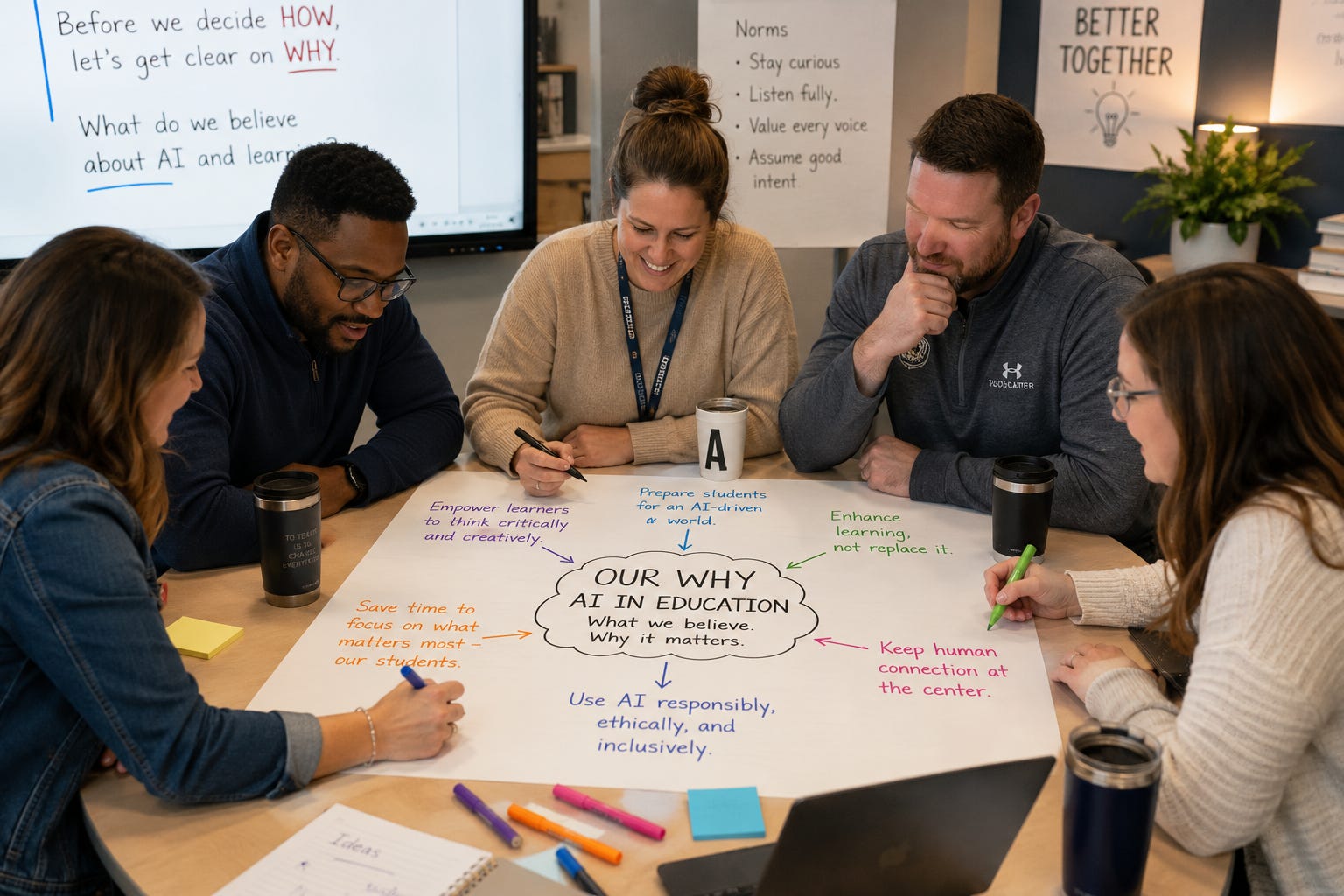
So the first pillar of a human-first approach is this: declare your why — not privately, in a leadership meeting, but publicly, in a statement your community can hold in their hands. This is what we believe about AI. This is why we are teaching it. This is why we are doing what we are doing.
The purpose underneath every other pillar is simple: we are preparing students to understand AI and stand on their own with it once they leave us. Not to master one particular app — the apps will be unrecognizable in five years anyway. To carry judgment into a world that will be saturated with these tools long after graduation. If that is the goal, the community deserves to hear it stated plainly, before the first lesson, not after the first complaint. This is the same case UNESCO has been making to education ministries worldwide: policy should start from a human-centered vision of what students need, not from the capabilities of whatever tool arrived this quarter. The international guidance and the local reality agree — purpose first, platform second.
A good statement of belief does something a policy cannot. A policy tells people what the rules are. A belief tells them why the rules exist — and a parent who understands the why will extend you grace when a lesson is imperfect, because they trust the direction. A parent who only ever sees the what will read every misstep as evidence you never had a plan. New York had rules. Peninsula had a belief. Only one of them held.
Here is what I’d tell any leadership team to do before September. Write the statement together — no more than a page, ideally a paragraph. Make it say what you believe about AI and children, not what you prohibit. Name the fear honestly; parents can smell a statement that pretends there’s nothing to worry about. Connect it to what your community already trusts about you — your mission, your values, the things you’d say about learning even if AI didn’t exist. Then share it everywhere: the website, the back-to-school letter, the first faculty meeting. Say it out loud until your teachers can say it without the paper.
Make it short enough to remember and honest enough to defend. Everything else in this framework is built on top of it — and none of it holds without it.
This is the first of five pillars in the Human-First AI Framework. Two free posts a week, every week. The thinking stays free — it always will.
Comments
Nothing yet. Say the first thing.
Sign in to join the conversation.