
In the previous three posts I talked about how frequently I use AI since it became available. Over the past few years I spent much of that time experimenting with it and testing it’s limits and it’s capacity. What I found in many instances is that I don’t always need it. Sometimes, in fact, it’s more cumbersome to use AI than to just navigate the problem I am working with at the moment. I apply the same logic to all the technology in my life. I don’t have a default on switch for all my devices. In some instances it makes sense to have my laptop or phone out, but in other cases, it’s better to actively listen and just let the conversation happen.
We’ve handed students the most powerful tool that’s ever entered a classroom, and we’re teaching them everything except that. How to prompt it. How to cite it. How not to get caught with it. Almost nobody is teaching the question that actually matters: when. When is a problem worth taking the tool off the shelf — and when is the struggle the entire point of the assignment?
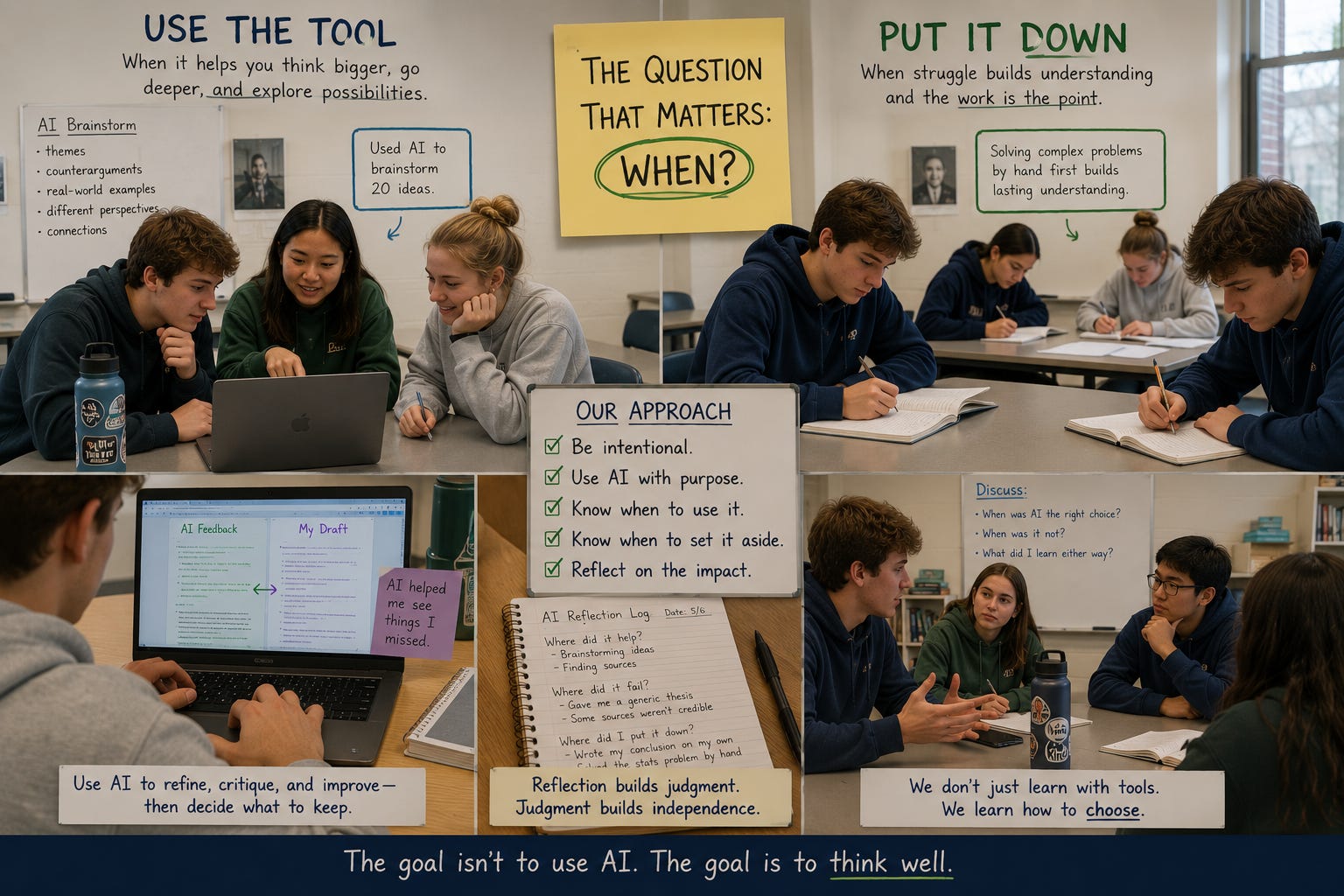
And this is what we want for all of our classrooms. Not only for AI use, but for screen use as well. Technology in our classrooms should enter our classrooms off. The default should never be on. We want to prepare our students to make intentional, purposeful choices on when it makes sense to grab the laptop and when the problem at hand would benefit from the use of AI.
Manu Kapur has spent two decades demonstrating what he calls productive failure: students who wrestle with a problem before being shown the solution learn the underlying concepts more deeply than students who are handed efficient instruction up front. The struggle isn’t an obstacle to the learning. The struggle is the learning. It’s the same reason Mueller and Oppenheimer found that students taking slower, effortful handwritten notes understood lectures more deeply than laptop note-takers transcribing every word — ease of capture came at the cost of processing. (Later replications have complicated the size of that effect, but the underlying principle — processing beats transcription — has held.) Friction, at the right moment, is not the enemy of thinking. It’s the price of it.
Now we have the first hard evidence of what happens when AI removes that friction wholesale. Researchers at the MIT Media Lab put EEG caps on students writing essays — some using ChatGPT, some using search, some using only their own minds — and the results should be posted in every faculty room. The students writing with the AI showed measurably weaker neural engagement than the students writing unassisted. They struggled to quote their own essays minutes after finishing them, and they reported the lowest ownership of what they’d produced. The researchers called it cognitive debt: the work got done, but the thinking that the work was supposed to build never happened, and the bill accrues quietly. Handing over the last ten feet of struggle doesn’t just change how the essay gets written. It changes whether anything was learned by writing it.
But before you conclude that the answer is to keep AI away from the work entirely, hold the MIT finding next to the Harvard one from the last pillar — the AI tutor whose students learned physics better than a well-run classroom. Both are true. AI that replaces the student’s thinking creates cognitive debt; AI that scaffolds the student’s thinking accelerates it. Same technology, opposite outcomes, and the difference isn’t the tool. It’s the judgment about when and how to reach for it. Which means the judgment is the curriculum. Not the prompting tricks, not the clever workarounds — the decision itself.
Here is the thing about judgment: you cannot lecture it into existence. You build it through practice and reflection, by putting students in real situations and asking them to make the call and defend it. Use AI to brainstorm twenty angles on an essay, then explain why you kept two and threw out eighteen. Draft alone first, then let the AI critique — and decide which critiques deserve to change your draft. Sometimes the assignment says: this one is by hand, because the point of this exercise is to build the muscle, and here’s why. Every one of those decisions is a repetition, and judgment is built the way any strength is — under load, over time. The simplest classroom tool I know is a three-question log a student fills out after any AI-assisted work: where did it help, where did it fail, and where did I put it down. Ten weeks of those logs will teach a student more about their own thinking than a semester of rules.
This is also the pillar that ends the cheating panic, quietly — and the panic deserves ending, because the data never supported it. When Stanford researchers surveyed high school students after ChatGPT’s arrival, the share admitting to cheating was essentially unchanged from the years before it existed. Students who cheat found ways long before AI; students with a reason to think mostly still choose to. The cheating problem was never really a technology problem — it’s an assignment-design and motivation problem wearing a technology costume. And when a student can articulate why they used AI here and refused it there, the conversation stops being about catching them and starts being about their reasoning. The tool stops being contraband and becomes a choice they’re accountable for. That is a far more honest place to stand, for them and for us.
Knowing when to take the tool off the shelf, and when to leave it there — teach that, and you’ve taught the thing that lasts long after any particular tool is obsolete.
How I use AI: The ideas, arguments, and judgments here are mine. I use Claude as a research and editing assistant — summarizing sources, pressure-testing arguments, and tightening drafts. Nothing is published that I haven’t written, verified, and revised myself.
AI detectors are not foolproof. They flag false positives regularly, particularly on clear, structured prose. A scan result is an estimate, not a verdict — this statement is the more accurate account of how the piece was made.
No posts
Comments
Nothing yet. Say the first thing.
Sign in to join the conversation.