
I refuse to accept a future where we just train our students to be professional “users”—people who rely on tools someone else built, follow policies they didn’t write, and focus on problems they didn’t choose. They end up competent and compliant, sure, but always stuck downstream from the real decisions. The fifth pillar is about changing that. We aren’t here to teach students how to use AI; we’re here to teach them how to shape it.
If that sounds aspirational, consider that young people are already doing it — just mostly outside our schools. Encode Justice, one of the most visible AI-accountability organizations in the country, was founded by a high school student and built into a global network of thousands of young people who research AI harms, testify to lawmakers, and push for guardrails on the technology they’ll inherit. They didn’t wait for a curriculum. The talent and the will were already there; what schools failed to provide, they built themselves. Every district should read that story two ways at once: as proof that students are capable of exactly this kind of agency, and as an indictment that they had to leave school to exercise it.
The same lesson sits inside the last technology cycle, on the darker side. When the reckoning over social media finally came — the 2023 Surgeon General’s advisory, the whistleblower documents, the lawsuits from hundreds of school districts — the most damning revelations came from inside knowledge that took a decade to surface. An entire generation lived inside systems engineered to hold their attention, and almost none of them had ever been taught to ask the engineering questions: who built this, how does it profit, why does the feed look like this and not some other way. They had opinions about the apps. They had no framework for interrogating them. That absence wasn’t the students’ failure. It was ours. We taught them to be users, and users is all they knew how to be while the harm compounded.
So this pillar means teaching students to see AI as something with authors, and authors make choices that can be questioned. Why was this tool built this way? Whose data trained it, and who was left out? When it produces a biased result, is that a glitch, or the system working exactly as designed? These aren’t rhetorical questions; they’re researchable ones, and the field keeps handing us teachable cases.
Facial recognition systems that misidentify darker-skinned faces at far higher rates documented by researchers like Joy Buolamwini, whose work started as a graduate project and ended up changing how major companies ship products. Hiring algorithms scrapped after they taught themselves to prefer male résumés. Every one of those stories is a unit waiting to be taught: a real system, a real harm, a real person who asked questions and forced a change. A student who studies them learns the most subversive fact about AI — that it is not weather. It is decisions, and decisions can be contested.
This is also about getting students to push back on policy, not just the products themselves. The rules governing AI in our schools, our states, our country—are being written right now, largely by people who won’t be living with the consequences as long as our students will. We need our graduates in those rooms. They should be able to look at a draft policy and say, ‘This harms people, and here’s why,’ or ‘This rule is lazy, and here’s a smarter way to do it.’
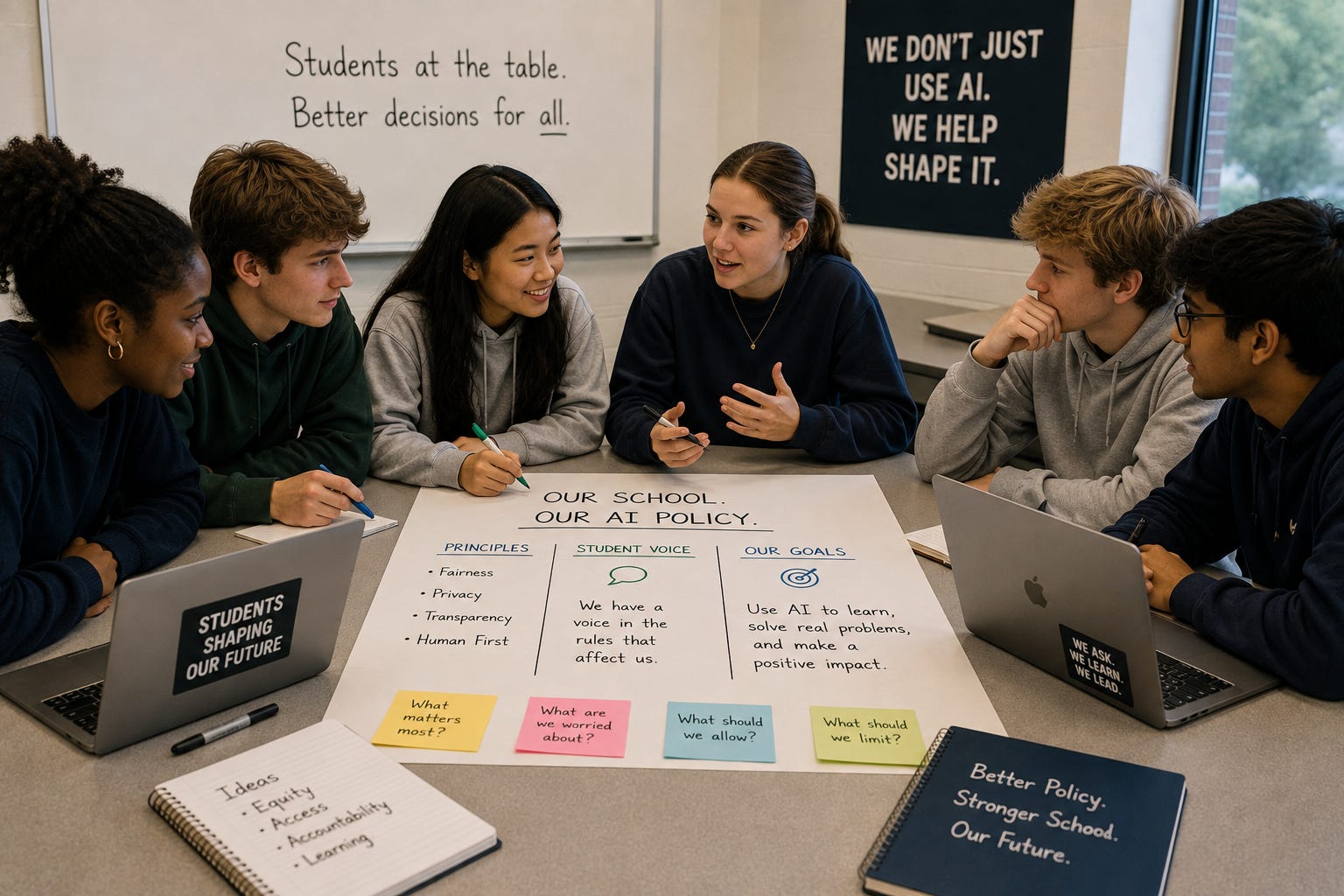
The single most powerful move a district can make costs zero dollars: put students on the committee that writes the AI policy they’ll actually live under. Districts that have already done this often through student advisory councils find that students are frequently more thoughtful about the risks than the adults. Why? Because they know how these tools are actually being used, not how we imagine they’re being used. When students help write the policy, it isn’t just better policy, it’s the fifth pillar in action.
This is also, quietly, the answer to the fear that AI makes students passive. It only does that if we let the whole education be about absorbing what the tool produces. Aim higher and the opposite happens: students who steer, who redirect these tools toward problems worth solving — disease, climate, the town’s actual issues — who treat AI as raw material for their own purposes rather than a finished authority to obey.
We assumed the last generation could navigate what we handed them, and we were wrong, and the bill came due on them. This time we can send students out not merely equipped to survive an AI-saturated world, but ready to shape it — to challenge its harms, question its policy, and bend the technology toward something better than what they inherited. That is what human-first has meant all along. Not humans protected from the machine. Humans in charge of it.
The human first AI framework can be found below. It is free to use and share with your school.
No posts
Comments
Nothing yet. Say the first thing.
Sign in to join the conversation.