
I was talking with a group of students recently and I asked them how they actually use AI. One boy raised his hand and told me that when he studies for the PSAT and gets a question wrong, he puts that question back into an AI tool and asks it to generate more like it — to challenge him on exactly the thing he missed, so he walks in more prepared. He had, without being taught, turned AI into a tutor.
I keep coming back to that moment, because a good tutor is something most families cannot afford. Private test prep sits behind a paywall that quietly sorts kids by income long before they ever sit for the exam. This student had reached past that wall with a tool already in his pocket and used it to support his own learning. Nobody assigned it. He recognized a problem that was genuinely worth using AI for, and he pulled the tool off the shelf.
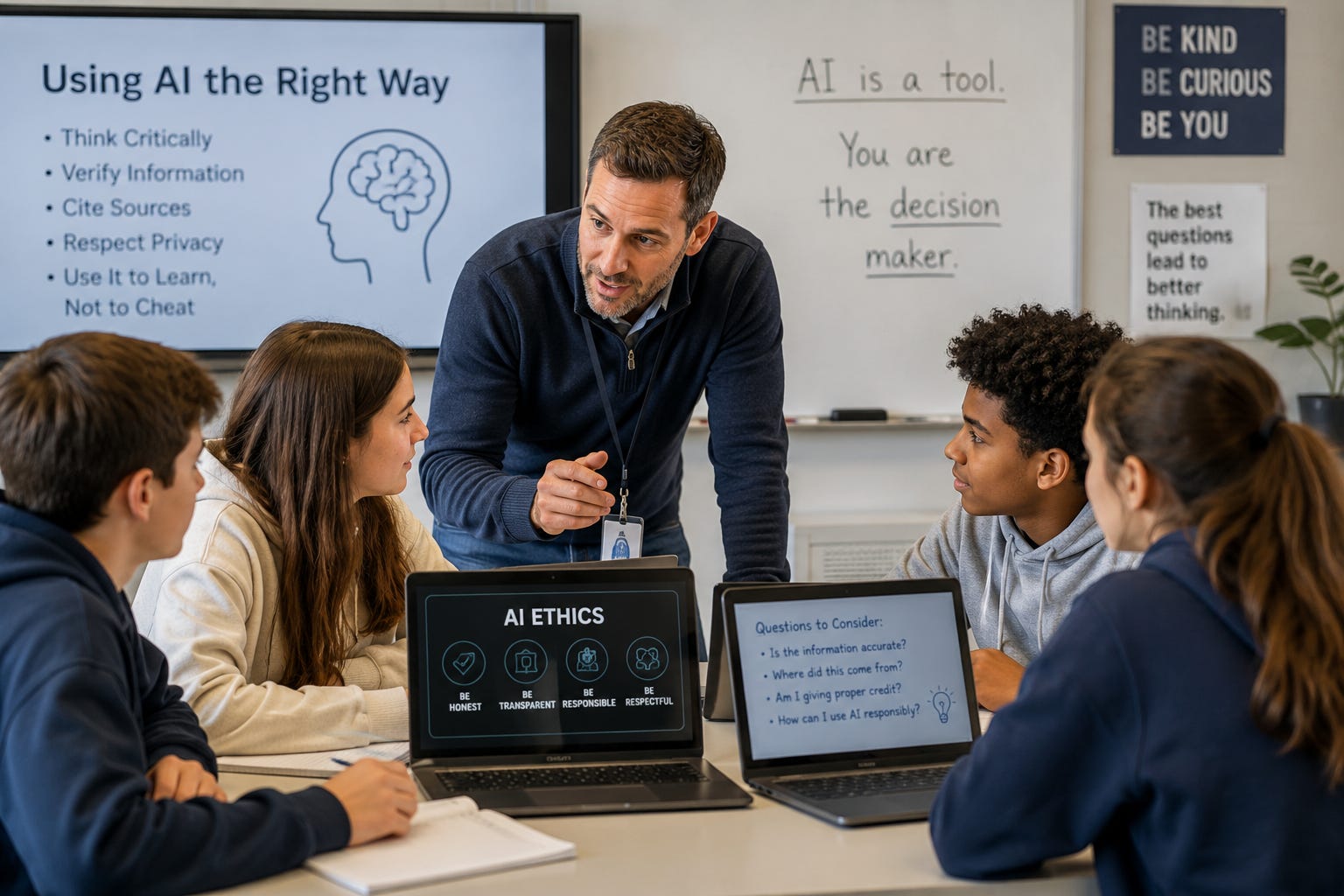
That is the whole argument in one raised hand. It reinforces the why for almost every school I know — the language will differ building to building, but the truth underneath doesn’t. And it shows the thing we so rarely teach: not just how to use AI, but when it is the right tool to reach for at all.
Right now, most schools are somewhere in the middle on AI. Some want to block it outright. Some are saying, cautiously, let’s try this and figure it out. Very few have decided what they actually believe. I understand the paralysis — the technology is moving faster than any policy cycle was built to handle. But I want to name what sitting in the middle is actually costing us, because we have been in this exact spot before, and we got it wrong.
Fifteen years ago, social media arrived in our students’ hands and we said almost nothing useful about it. We assumed they were tech-savvy — that because they could navigate an app, they could navigate its consequences. We didn’t teach them how an audience works, or how a feed is engineered to hold them, or what it does to a developing mind to perform for strangers all day. We handed them the most powerful social technology in human history and offered no instruction to go with it. We treated it as something happening to schools rather than something schools had a responsibility to teach.
We know how that story ended. It ended in the 2023 Surgeon General’s advisory on youth mental health — the anxiety, the depression, the documented harm that surfaced years after we missed our moment. That bill came due on our students, not on us.
AI is the same fork in the road. The difference is that this time, we are standing at it before the harm, not fifteen years after. That is a gift we did not get with social media, and I am not willing to waste it.
So here is my argument, and it is the opposite of both the block-it camp and the let’s-just-try-it camp. Schools need to lean into the AI conversation now — proactively, deliberately, with students at the center. Not because AI is harmless. It isn’t. But because our students are going to live and work inside a world with AI embedded in nearly everything they touch. They will use it. The only open question is whether they use it with judgment or without it — and judgment is the thing schools exist to build.
This is what I mean by a human-first approach to AI. It starts from the student, not the tool. It asks what a young person needs in order to stay in charge of their own thinking, and it builds backward from there. It teaches that AI is genuinely useful — that there are real ways it can support learning and help solve problems as large as curing a disease or building a more sustainable world — and it teaches, just as seriously, where AI is weak, wrong, and quietly manipulative. A student who sees only the power becomes a mark. A student who sees only the danger becomes a skeptic who gets left behind. Fluency is holding both.
And here is the distinction I care about most, the one we never taught with social media: knowing when to take the tool off the shelf. A fluent student doesn’t reach for AI reflexively. They recognize the moment a problem is genuinely worth using it for, and they recognize the moment their own mind is the better instrument. That judgment — when to use it, when to put it down, and why — is the entire game. If we ban AI from students, or hide it behind a curtain and never show them how it works, we will never spark the problem-solving that could one day come from them. You cannot build judgment about a tool you’ve kept in the dark.
We don’t get many second chances in education. We usually meet a new technology after it has already reshaped childhood, and we spend the next decade cleaning up. This time we are early. This time we can be proactive instead of reactive, human-first instead of tool-first, and for our students instead of merely about them.
Over the next few weeks I’m going to lay out exactly what that looks like: a human-first framework for bringing AI into a school, built on five pillars. It begins by declaring your why — not privately, but publicly, in a statement of belief you share with your community. It refuses to assume fluency, because that assumption is the mistake we already paid for once. It teaches both the power and the poverty of the tool. It builds the judgment to know when to use it and when to set it down. And it prepares students not just to use AI, but to push back on it — to challenge its harms, question its policy, and steer it toward problems worth solving. Underneath all of it sits transparency: policies shared plainly with parents, so trust is built on purpose rather than demanded in a crisis.
I’ll take each pillar one at a time in the posts to come, all summer, free. Consider this the summer reading that sets up your fall.
Because the goal was never to prepare our schools for AI. It was to prepare our students for the world — and that world is already here.
No posts
Comments
Nothing yet. Say the first thing.
Sign in to join the conversation.