
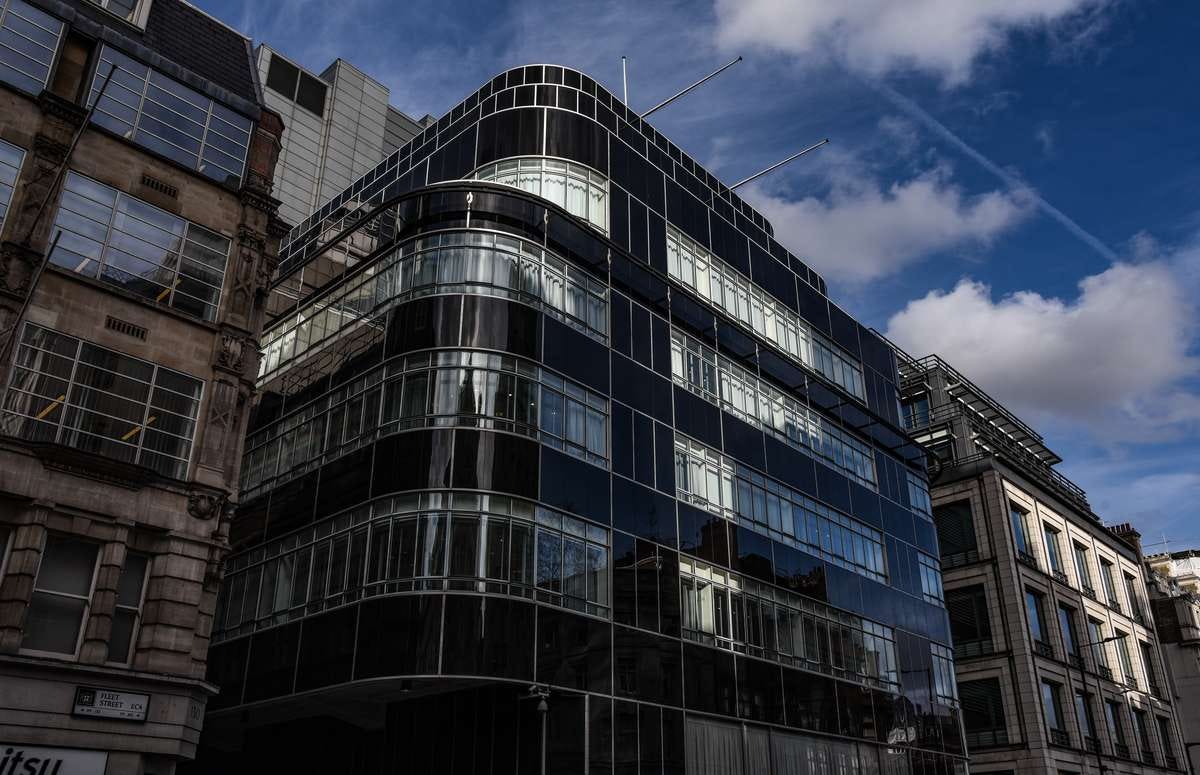
The Black Lubyanka, the nickname for the unusual black and chromium Art Deco building on Fleet Street, was for many years the home of Express Newspapers, publishers of the Daily and Sunday Express. New arrivals were always impressed by the imposing lobby with its silver-and-gold panels that stated ‘Empire’ and ‘Britain’, the magnificent pendant lamp and the unusual oval staircase. It was reminiscent of some of the more imposing office entrances in midtown Manhattan. The flamboyant grandeur of the lobby masked the easy callousness, vulgarity and raucous philistinism of the day-to-day workings of a daily and Sunday paper. Not to mention the culture of daytime drinking that, for some, made the impressive oval stairs difficult to navigate.
In this sub-Dickensian milieu, photographer Tony Armstrong-Jones was frequently seen in the cream, smoke-stained corridors, camera slung over his shoulder, hurrying to a briefing from the magazine’s picture editor. He was a regular if, at around 5 foot 7 inches, somewhat diminutive presence, cigarette in hand, twinkle in his blue eyes. Like photographers the world over, he was chatty, professionally charming, smiley but tough – able to use his elbows effectively in a media scrum.
Known for his versatility as a photographer, Tony had already established himself as a rising star of the social, fashion and theatre worlds by the time he met Margaret. Only five months older than her, he was born at home in Belgravia, central London, on 7 March 1930. His father Ronald was a barrister, his mother was Anne Messel, whose brother, Oliver, was the celebrated stage designer.
Growing up in the small village of Bontnewydd, North Wales, the teenage Tony contracted a serious case of polio, which confined him to a wheelchair for a long lonely year and left him with one leg shorter than the other. His experience toughened him and later informed his ground-breaking work on behalf of the disabled.
Like his father, he went to Eton but proved an indifferent scholar. ‘Maybe he is interested in some subject, but it isn’t a subject we teach here,’ said one end-of-term report. Nonetheless, he was admitted into Cambridge where, after failing his second-year exams, he turned to photography as a career, swapping a microscope given to him by his father for a camera.
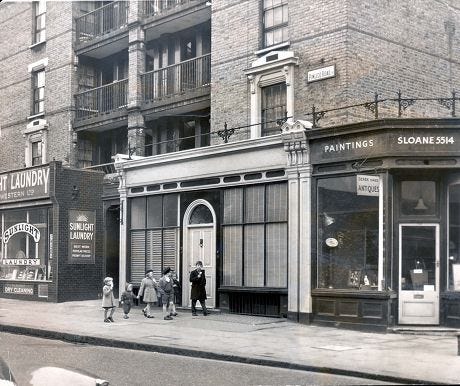
Thanks to the connections of his actress stepmother, Carol Coombe, he snagged a three-year apprenticeship with portrait photographer Henry ‘Baron’ Nahum, who was a friend of Prince Philip. After only six months, Tony set up his own studio in a former ironmonger’s shop at 20 Pimlico Road and hosted numerous parties for a mainly bohemian crowd.
While he started his career taking party pictures for glossy magazines like Tatler, Vogue and Queen, his reputation as a portrait photographer grew apace. In 1956 he was invited to take the twenty-first-birthday pictures of the Duke of Kent. The following year he photographed the Duke’s sister, Princess Alexandra, and soon afterwards he was commissioned to photograph the Queen and Philip together with Prince Charles and Princess Anne. His success rankled with rivals. The king of royal portraiture, Cecil Beaton, complained, ‘I don’t think A.A. Jones’ pictures are all that interesting, but his publicity value is terrific. It pays to be new in a field.’
On 20 February 1958 he was one of the guests at a dinner party in Chelsea organized by Lady Elizabeth Cavendish, Margaret’s lady-in-waiting. He and Margaret did not seem to have any obvious chemistry, though they were seated beside one another and shared an engaging conversation throughout the meal. Afterwards, the princess never once asked after the Society photographer. She had initially assumed he was gay, and her instincts weren’t far off, as it was later revealed that he was bisexual. They only met again because her long-time friend and sometime boyfriend the Honourable Dominic Elliot – the youngest son of the Earl of Minto and such a familiar figure in the ‘Margaret Set’ that she called him ‘Dom-Dom’ – asked the princess if she would sit for some new pictures for her twenty-ninth birthday. Elliot told her that he knew of this up-and-coming photographer who was perfect for the job.
Margaret trusted his judgement and agreed to pose for Armstrong-Jones. When she arrived at his studio, he somewhat cheekily – all the while making jokey asides, gossiping about mutual friends and relating tales about theatrical stars – asked the princess to change her clothes, jewellery, and then pose. Few men had ever treated her in this way and Margaret was used to calling the tune. She was intrigued, later recalling: ‘He understood my job and pushed me to do things. In a way he introduced me to a new world.’ Quite fortuitously, she had found a man, she said, who was ‘daring’ and different; someone who encouraged her rebellious, bohemian side.
The princess and the photographer had more in common than anyone thought. Like Margaret, Tony was a man of contradictions, as talented and charming as he was impetuous and unpredictable, and occasionally cruel. Lady Cavendish described him as having ‘a great zest for life’, adding, ‘he was great company and a brilliant mimic; always whizzing somewhere on his motorbike’. His good friend, designer Carl Toms, saw him as a modern eccentric determined to have his own way. This quality could ‘goad people to the brink of assassination only held back by a charm that could halt a ravening beast in its track’.
Margaret had learnt one painful lesson from the Townsend debacle: if she wanted to truly explore a romance, it had to remain secret. No more picking fluff off RAF uniforms. If the relationship started to go somewhere, only then would she tell her sister. Tony played along expertly, the secrecy of their encounters only serving to heighten their passion. Even close friends were kept out of the loop. In the autumn of 1958, when Lady Penn asked Tony for dinner, he accepted at first, only to back out when he learnt that Princess Margaret was attending too – he didn’t want to give away any clues to the rest of the party. A few weeks later, on 11 November 1958, Margaret insisted he attend a luncheon party at Clarence House. Even though they sat side by side, everyone thought he was the hired hand, the photographer, and thought nothing of his presence. It was the perfect cover.
The subterfuge they practised ensured that their romance had the excitement of a cheap spy novel. Margaret’s car would drop her off on a road near his Pimlico studio. Then, after checking that the coast was clear, she could sneak down the alley connected to the back entrance and into her lover’s arms. For once, she would dress as anonymously as possible: dark spectacles, tweed skirt, sweater and headscarf.
Aside from his Pimlico flat, there was another secret romantic hideaway where Tony and Margaret could meet unobserved. This was a ground-floor room in a former East End pub at 59 Rotherhithe Street, Bermondsey, overlooking the River Thames.
For Margaret these rendezvous offered her a glimpse into the world of the ordinary. She could eat shepherd’s pie cooked by Tony, drink cheap wine, even wash dishes in the sink. Just as she and her sister had always desired, she could be ‘normal’ – if only for a few fleeting hours. ‘It had the most marvellous view,’ she remembered nostalgically. ‘One walked into the room and there was the river straight in front. At high tide swans looked in. And because it was on a bend you looked towards the Tower and Tower Bridge with the dome of St. Paul’s behind them to the left, and the docks to the right.’
In the early days Tony knew how to strike the correct balance between daring and deference. He always made sure to address Princess Margaret as ‘Ma’am’, even as he enticed her into his unorthodox and nonconformist life. The ghost of her father hovered over the burgeoning relationship. Like George VI, Tony was fascinated by fashion, eagerly designing her dresses and dictating her overall look.
For the most part, though, it was a one-dimensional relationship. As one of Tony’s friends recalled: ‘What he had foremost in common with Princess Margaret could be put in three words: sex, sex, sex. Theirs was a terribly physical relationship, they couldn’t keep their hands off each other, even with other people present. He was very well made and obviously that had a lot to do with it.’
Comments
Nothing yet. Say the first thing.
Sign in to join the conversation.