
Perhaps the only thing David and Bertie shared completely was a keen interest in fashion. One was a flashy dresser who gravitated towards Fair Isle sweaters, two-tone shoes and turned-up trousers. The other dressed more conservatively and focused on the tailoring of a dress or a suit, spending hours with ateliers and cutters, sketching out designs, trying out new ideas for court dress, state occasions and even pantomime costumes.
Aside from that commonality, they were worlds apart in demeanour and temperament, one bred for the sunlight, the other for the shadows. One was more youthful and jaunty with smooth, rarely shaved skin, a slight build but an energetic gait and spirit. The other was frail, nervy, prone to irrational bursts of temper and suffered from a slew of debilitating ailments ranging from stomach problems to a serious stammer, non-stop blinking and twitches that caused his mouth to droop. One partied till dawn, seduced single – and married – women, and loathed his father. The other bowed down to his father’s bidding, settling into a sensible marriage and ‘a more rooted royal style’. Their father always lamented that one child ‘was heading down the wrong tracks’ while the other perpetuated the proper image of the monarchy, ‘a model of dreamlike domesticity’. Even Wallis Warfield Simpson, the American paramour of the Prince of Wales, noticed the polar temperaments of the two brothers: her lover ‘all enthusiasm and volubility … the Duke of York quiet, shy’.
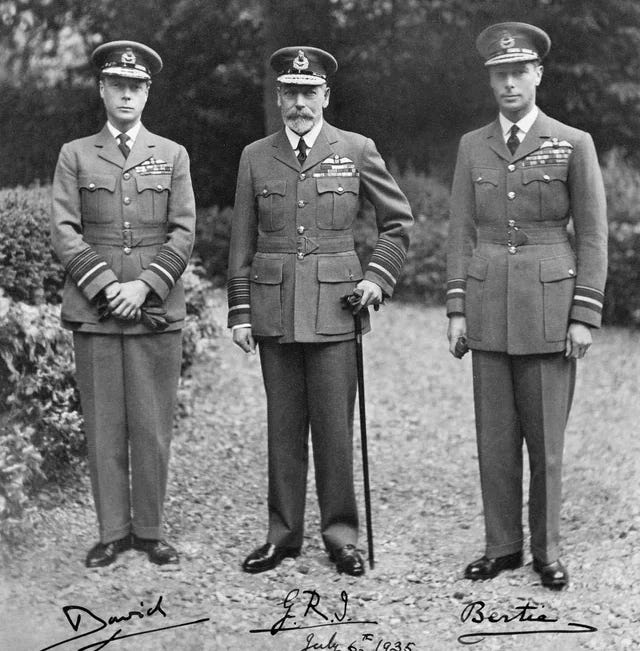
The choices made by these two brothers, David, the eldest son and heir to the Windsor dynasty, and Bertie, his younger sibling only eighteen months apart, would intimately shape the future of the House of Windsor and, in the process, profoundly alter the destiny of Bertie’s daughters, Elizabeth – Lilibet as she was known in the family – and Margaret. Their grandfather and the boys’ father, King George V, experienced an eerie foreboding about the future of his family even as he celebrated his Silver Jubilee in 1935. With his eldest son and heir, the Prince of Wales, now forty and no nearer marrying and securing the dynasty, the King stated sorrowfully: ‘After I am dead, the boy [the future Edward VIII] will ruin himself within 12 months. I pray to God my eldest son will never marry and have children, and that nothing will come between Bertie and Lilibet and the throne.’
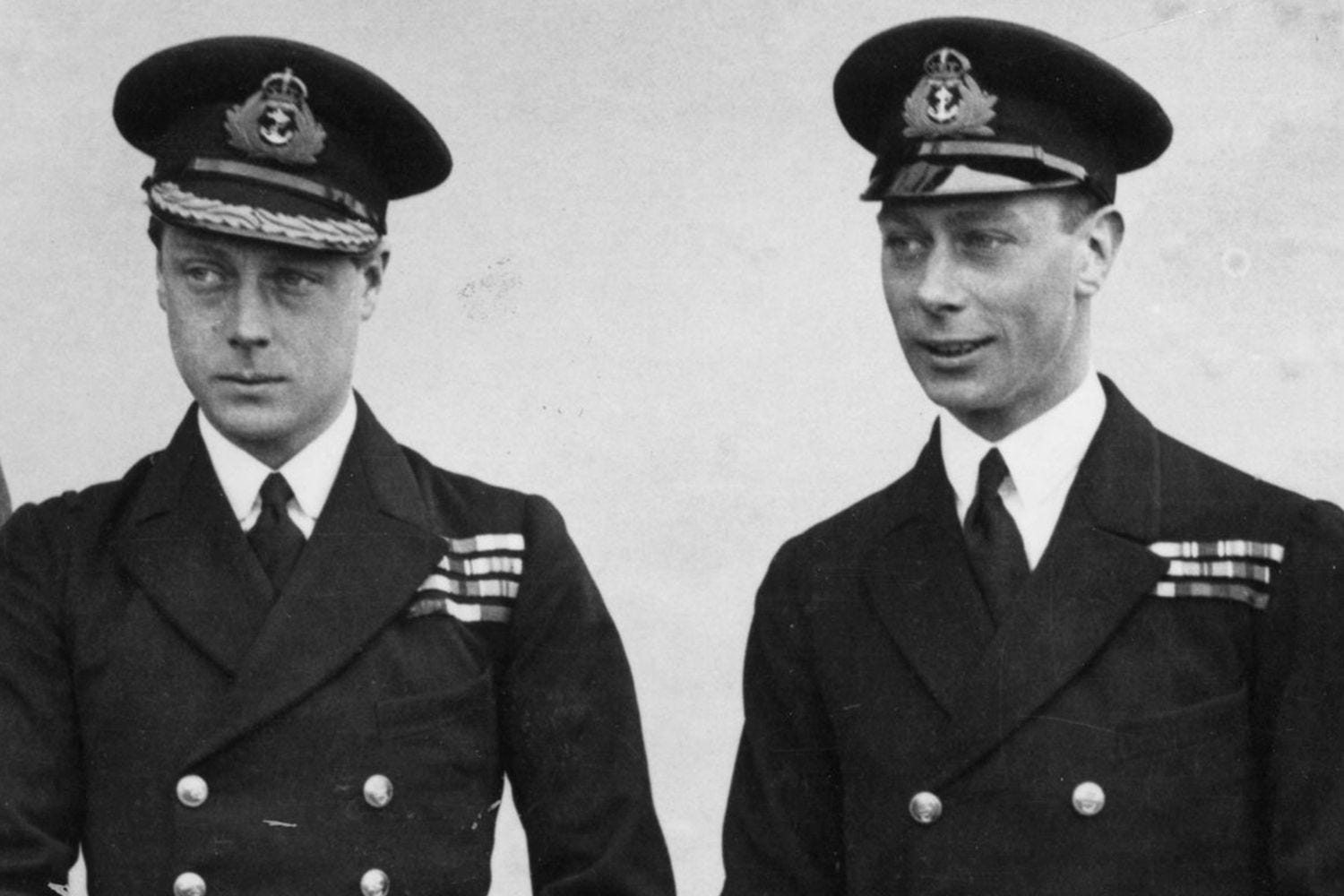
The King’s prayer would be answered. It was Edward VIII’s abdication to marry the twice-divorced American, Wallis Warfield Simpson, that would transform the lives of his brother and his brother’s daughters, changing the family dynamic for ever. Their uncle’s decision placed them firmly in the lifelong embrace of the monarchy, further shaping who they were and what they became.
As with David and Bertie, in the popular imagination, every generation of the House of Windsor is stalked by a shadow. The good versus the naughty royal. The rebellious extrovert versus the sensible introvert. William the straight shooter, Harry the wild child. Diana the demure, Fergie the roustabout. The sun and the moon. These stereotypes often mask as much as they reveal. And yet, each set of royal siblings – like all siblings – feeds off this asymmetry, occupying the psychic space left by the other.
As Princess Margaret told her friend, writer Gore Vidal: ‘When there are two sisters and one is the queen who must be the source of honour and all that is good, the other must be the focus of the most creative malice, the evil sister.’ Certainly her behaviour on occasion made her sister shine, Margaret easily slipping into the ‘black sheep’ stereotype. That reputation barely disturbed the ash on her ever-present cigarette holder. As she once remarked: ‘Disobedience is my joy.’
Margaret was sufficiently self-aware to be able to draw the subtle distinction between the media’s portrayal of her as someone jealous of the Queen’s position versus the more layered conflict of a young woman overshadowed by her older sister: ‘I have never suffered from “second daughter-itis”. But I did mind forever being cast as the “younger sister”.’ As a friend perceptively noted: ‘She sees herself as the king’s daughter rather than the queen’s sister.’ That is to say, part of the main royal family, not a subsidiary branch, which was the case after Elizabeth became queen. Margaret never indicated that she wanted to switch places with her sister, instead telling anyone who would listen that her role in life was to support her sister with the immense burden of her position. As she once remarked: ‘Isn’t it lucky that Lilibet is the eldest?’ While Margaret chafed at the restraints of royal life, Elizabeth dutifully embraced them.
The two sisters were contradictory and conflicted, butting heads over matters both small and monumental, but they also loved one another. This push-and-pull between affection and distance, deep love and primal jealousy, went to the heart of the private world that Elizabeth and Margaret shared.
Both sisters entered the world on the twenty-first day of the month. That, though, was the only similarity about their respective births.
Elizabeth was born on 21 April 1926 in Mayfair, London, to then Prince Albert, Duke of York and Elizabeth Bowes-Lyon. That year was proving a challenging one for Britain, as it teetered on the edge of industrial chaos and a historic general strike. By the time of her birth, strong public interest had already built up because her imminent arrival offered a diversion from the national crisis. A crowd milled outside 17 Bruton Street, when Elizabeth finally arrived via Caesarean section at 2.40 in the morning. In accordance with ancient tradition, Home Secretary Sir William Joynson-Hicks was present to witness the birth in order to prevent child swapping. Soon enough, the bonny, blue-eyed baby became a potent symbol of family, continuity and patriotism.
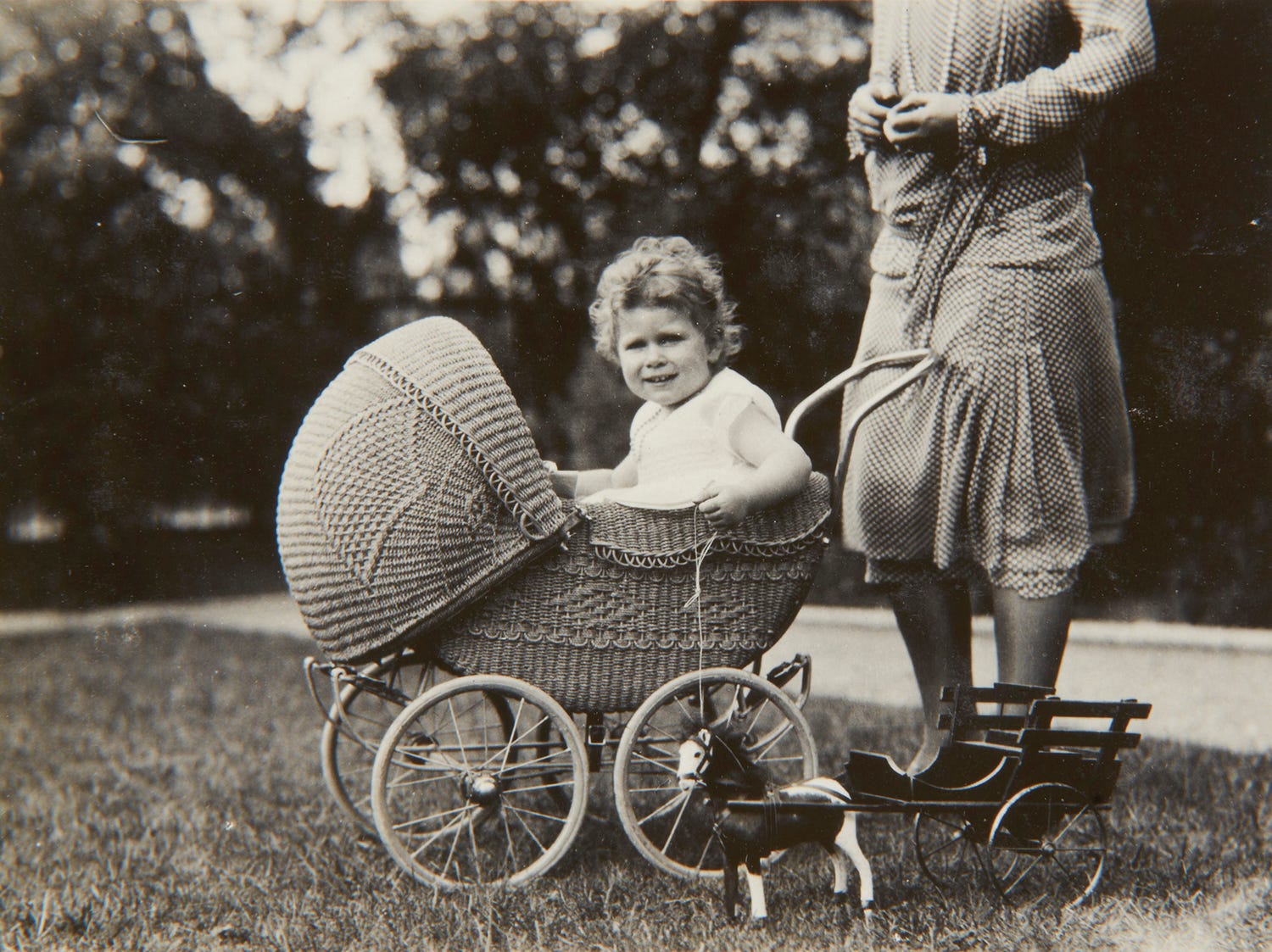
Just over a month later, on 29 May, she was christened Elizabeth Alexandra Mary in a ceremony at the private chapel at Buckingham Palace, the service being officiated over by Dr Cosmo Gordon Lang, the Archbishop of York. Such was the interest in the baby princess that excited onlookers broke through the police cordon outside the palace in an attempt to catch a glimpse of the famous infant. Her distinguished name implied her future destiny as queen – even though, under the 1701 Act of Settlement, she appeared unlikely to ascend the throne once Uncle David produced an heir. Still, everyone spoke as if she represented the country’s great promise, with one newspaper observing, ‘The possibility that in the little stranger to Bruton Street there may be a future Queen of Great Britain (perhaps even a second Queen Elizabeth) is sufficiently intriguing.’
The new baby catapulted her parents from a relatively quiet royal life to the front pages of newspapers and magazines. Weeks after her birth, the pavement outside the Yorks’ London residence was still thronged with so many fans that occasionally she had to be smuggled out of the back door in her pram for her daily airing. In time her mother became concerned about this surge of attention. She later wrote to her mother-in-law, Queen Mary: ‘It almost frightens me that the people should love her so much. I suppose that it is a good thing, and I hope that she will be worthy of it, poor little darling.’
This extraordinary amount of attention was not limited to the man and woman in the street. From the start, her irascible grandfather King George V doted on her. Stories soon circulated about how the angelic little girl had won the affections of the unbending Sovereign. Though he was notorious for intimidating his own children and senior staff, Elizabeth was the exception. The Archbishop of Canterbury recounted that on one occasion, the monarch, who was playing a horse, allowed his granddaughter to pull him around by his grey beard as he shuffled on his knees along the floor. ‘He was fond of his two grandsons, Princess Mary’s sons,’ recalled the Countess of Airlie, ‘but Lilibet always came first in his affections. He used to play with her – a thing I never saw him do with his own children – and loved to have her with him.’ He monitored her every small advance, sending a wireless message to his son and daughter-in-law, who were on board the Renown sailing to Australia, to inform them that his granddaughter had cut her first tooth. The King was enraptured by her. One Christmas at Sandringham, three-year-old Elizabeth was listening to the carol ‘While Shepherds Watched Their Flocks by Night’ when she noticed the lyric ‘to you and all mankind’. She innocently announced: ‘I know that old man kind. That’s you grandpapa. You’re old and you are very, very kind.’
Baby Elizabeth always listened attentively when Grandpa England stressed the virtues of decency, duty and hard work, values which were further reinforced by an inflexible Household regime and a dedicated team of staff in the nursery, including her nurse, Clara Knight, known as Alah; Margaret ‘Bobo’ MacDonald, a copper-haired Scotswoman; and later Bobo’s sister, Ruby. At the firm request of her grandmother, Queen Mary, Elizabeth was trained to be a model royal from the beginning. ‘Teach that child not to fidget!’ became her grandmother’s recurring demand. Alah painstakingly coached the three-year-old Elizabeth on the necessity of standing absolutely still, like a marble statue. Pockets were sewn in on all her dresses just to make sure. She learnt to answer a salute, wave her white-gloved hand from a balcony or open car, pose graciously for photographers, and control her bladder for hours. Later, she was taught the proper form of address for the Archbishop of Canterbury and the prime minister. If she performed to Alah’s exacting standards, she was rewarded with a biscuit. Misbehaviour would earn a slap across the back of her legs. Even by the standards of the day, her childhood was stifled and emotionally threadbare, the adults in her life encouraging a docile conformity.
As a toddler, Elizabeth learnt that she needed to act with grace, bow and curtsy to adults, and never lose her composure or act too familiarly towards anyone. Everything in her rigidly controlled life was run like clockwork, from breakfast at 7.30 a.m. to bedtime at 7.15 p.m. sharp. In short, she began life as a sheltered, privileged child, drilled in the need for self-discipline and respect for the demands of her position.
While there were obvious limitations in her regimented and rather repressed childhood, there were perks too, though some more obvious to adult sensibilities. Elizabeth would travel in limousines between the various royal castles, palaces and houses while carefully attended by a small army of butlers, footmen, maids and chauffeurs. At Christmas and on her birthday she was inundated with gifts, many sent by adoring members of the public, who themselves were of modest means. At age four, she acquired her first Shetland pony, Peggy, from her grandfather and began riding lessons soon after. Whenever she appeared in public, throngs of people would stop, smile, cheer and even wave flags. It was thus a childhood that alternated quickly between great attention and great isolation, and Elizabeth was raised as a small adult rather than as a child. Then, when she was just four years old, her position of ascendancy in the nursery came under challenge.
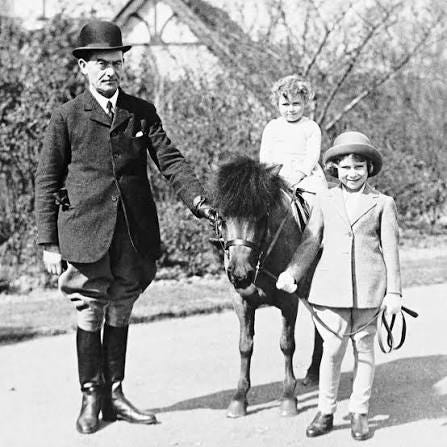
While Elizabeth was born in the centre of fashionable Mayfair in a comfortable town house at 17 Bruton Street, her sister arrived on 21 August 1930 during a violent thunderstorm in the family’s ‘haunted’ ancestral home, Glamis Castle, a storied Scottish pile that came complete with dark, winding corridors, steep stone steps, draughty bedrooms – and its own ‘monster’, said to be a disfigured creature hidden away in a secret room. Elizabeth had been a ‘wanted’ first child, but the duke and duchess had hoped for a boy as their second. They hadn’t even considered female names. Though the parents liked the sound of Ann Margaret, at the behest of Queen Mary they settled on naming the child Margaret Rose, as Margaret was the name of a Scottish queen.
On the morning after Margaret’s birth, Alah told Elizabeth a big surprise awaited her in her mother’s room. After touching her new-born sister’s hand, Elizabeth grew so excited that she grabbed the doctor, David Myles, and led him to the room, proclaiming: ‘Come and see my baby, my very own baby!’ She was so excited that she was found later in front of her toy cupboard. Beside her were a blue velvet frog, a woolly rabbit, a pair of prized dancing dolls, and several picture books, the excited infant announcing that she was getting things ready for the baby to play with.
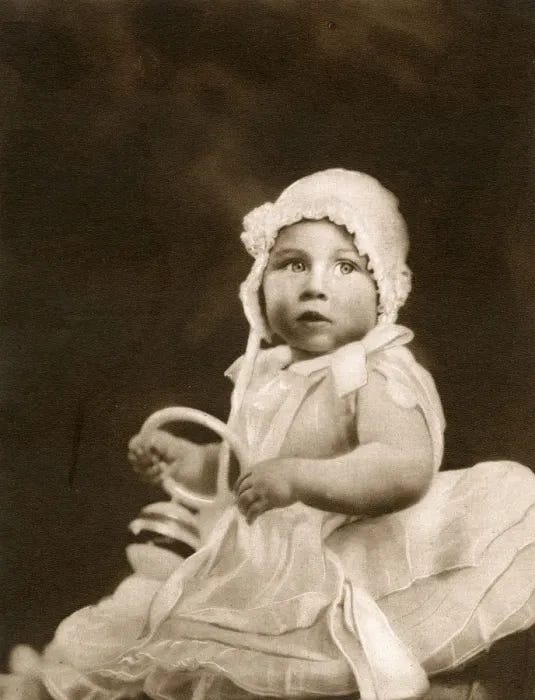
Such devotion was not merely a reaction to the immediate excitement of Margaret’s birth. At her christening on 30 October, she wore the same lace dress that her sister had done four years earlier. Gazing at her sister with adoration, Elizabeth whispered: ‘I shall call her Bud. You see she isn’t really a rose yet.’ Those words carried more significance than intended: Margaret Rose would always remain the bud, representing unfulfilled potential, someone restrained by convention and longing to burst forth.
Even though Margaret, Elizabeth and their mother would come to be called ‘The Three White Roses of York’, the truth was that only Elizabeth had been born a royal ‘rose’ in that she was ultimately destined to be the Queen.
The arrival of this second daughter focused the world’s attention even more closely on Elizabeth as the likely heir to the throne. A waxwork figure of her on her pony was installed at Madame Tussaud’s. Chocolates, dinnerware, tea towels and hospitals were named after her. Her face was emblazoned on a six-cent stamp in Newfoundland. A popular tune entitled ‘Nursery Suite’ and composed by Edward Elgar honoured her as well as her sister and mother. The Australian government named a piece of Antarctica ‘Princess Elizabeth Land’. Her doting father began comparing the young girl to the illustrious Queen Victoria. ‘From the first moment of talking,’ he told the writer Osbert Sitwell, ‘she showed so much character that it was impossible not to wonder that history would not repeat itself.’ For the baby Margaret, still too young to pronounce Elizabeth’s name correctly, her older sister was simply ‘Lilibet’.
Within just a few years in 1933, Lilibet confidently informed her younger sister: ‘I’m three and you’re four.’ Confused, Margaret responded: ‘No, you’re not. I’m three, you’re seven.’ The toddler had no idea that Elizabeth was referring to their positions in the line of succession. At seven, Elizabeth already had the throne on her mind, unlike her uncle and even her own father. She solemnly told her Scottish governess, Marion ‘Crawfie’ Crawford: ‘If I am ever Queen, I shall make a law that there must be no riding on Sundays. Horses should have a rest, too.’
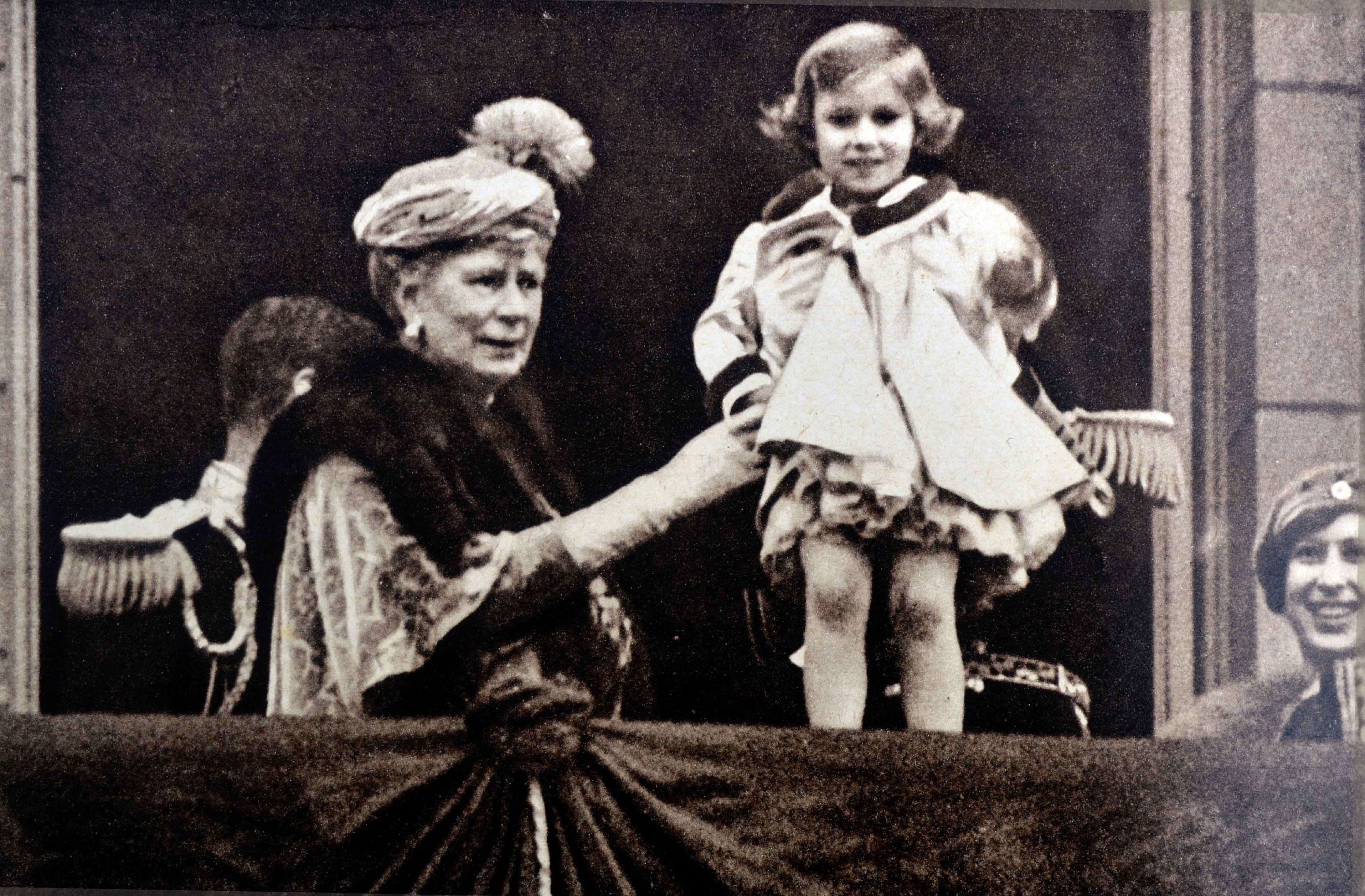
While Elizabeth was busy contemplating future edicts, rumours circulated that Margaret was deaf and dumb because the public was not allowed to see her. This annoyed King George so much that, when the royal family were standing on the balcony of Buckingham Palace after a royal wedding, he bent down and whisked her off her feet and stood her on the balustrade. Years later, Margaret told her confidant Christopher Warwick that she had no head for heights and found the whole experience ‘terrifying’. The King’s action, however, had the effect of dramatically dispelling the rumours.
Inside the family, it was apparent that Margaret was a beauty with an intriguing and wilful personality. Her mother proudly gushed to Cosmo Lang: ‘She has got large blue eyes and a will of iron, which is all the equipment that a lady needs! And as long as she can disguise her will, and use her eyes, then all will be well.’
From the beginning it was clear that Margaret was daddy’s little girl, despite not being as well behaved as her older sister. She would often sneak downstairs after lunch in the nursery, push ‘her small fat face’ round the dining room door, and climb on to her father’s knee to steal a sip of soda or spoonful of sugar. Crawfie, their governess, recalled: ‘She was a plaything. Warm and demonstrative, made to be cuddled and played with.’ She also displayed an early ability to play off one parent against the other. When she was four, she went up to her mother, looked at her affectionately, gave her a kiss and told her: ‘Mummy darling, I really do believe that I love Papa much more than I do you.’
Elizabeth wasted no time in keeping a watchful eye on her exuberant baby sister, viewing it as her solemn duty to protect Margaret from the outside world. On one occasion, when a buck-toothed chaplain came to visit and asked Elizabeth if he could see Margaret, her older sister replied: ‘No, I think your teeth would frighten her.’
Over the past 40 years, I’ve written bestselling books about Princess Diana, The Queen, Wallis Simpson, Meghan Markle and many others. You can find all of them to buy here.
No posts
Comments
Nothing yet. Say the first thing.
Sign in to join the conversation.