

Today’s Read Time: 9 minutes
This week we’re talkin’ the first negative jobs number, the American consumer we keep underestimating, an economy that take a punch, and homebuyers munching through housing inventory like hungry hungry hippos.
Let’s get into it.
(👇 .09% from this time last week, 30-yr mortgage) Mortgage News Daily
The Boring Company struck a deal to put a Music City Loop station at downtown’s JW Marriott. Announced August 1, the station will give the SoBro hotel direct access to the underground Tesla tunnel connecting BNA to downtown; two boring machines are already digging, a third arrives in September, and the company says more than 40 stations are in various stages of planning and design in Music City (Nashville Business Journal, The Boring Company).
A new round of U.S. tariffs takes effect August 19. The Section 338 package hits certain Canadian goods at 50%, Brazil at 25%, and roughly 60 other trading partners at 10–12%, including some goods previously covered under USMCA (Tax Foundation).
The Fed’s September path flipped in a single morning. After Friday’s jobs report, futures markets moved from pricing a likely September rate hike (~55% odds) to a hold as the base case, with hike odds falling to ~44% (CNBC).
⭐ Foo Fighters — Nissan Stadium, Saturday Aug 15. Stadium rock on the East Bank; the marquee show of the summer (Nashville Guru).
My Chemical Romance — Nissan Stadium, Thursday Aug 13. Two stadium shows in three days: a big week for downtown bars, hotels, and anyone who owns a short-term rental (Nashville Guru).
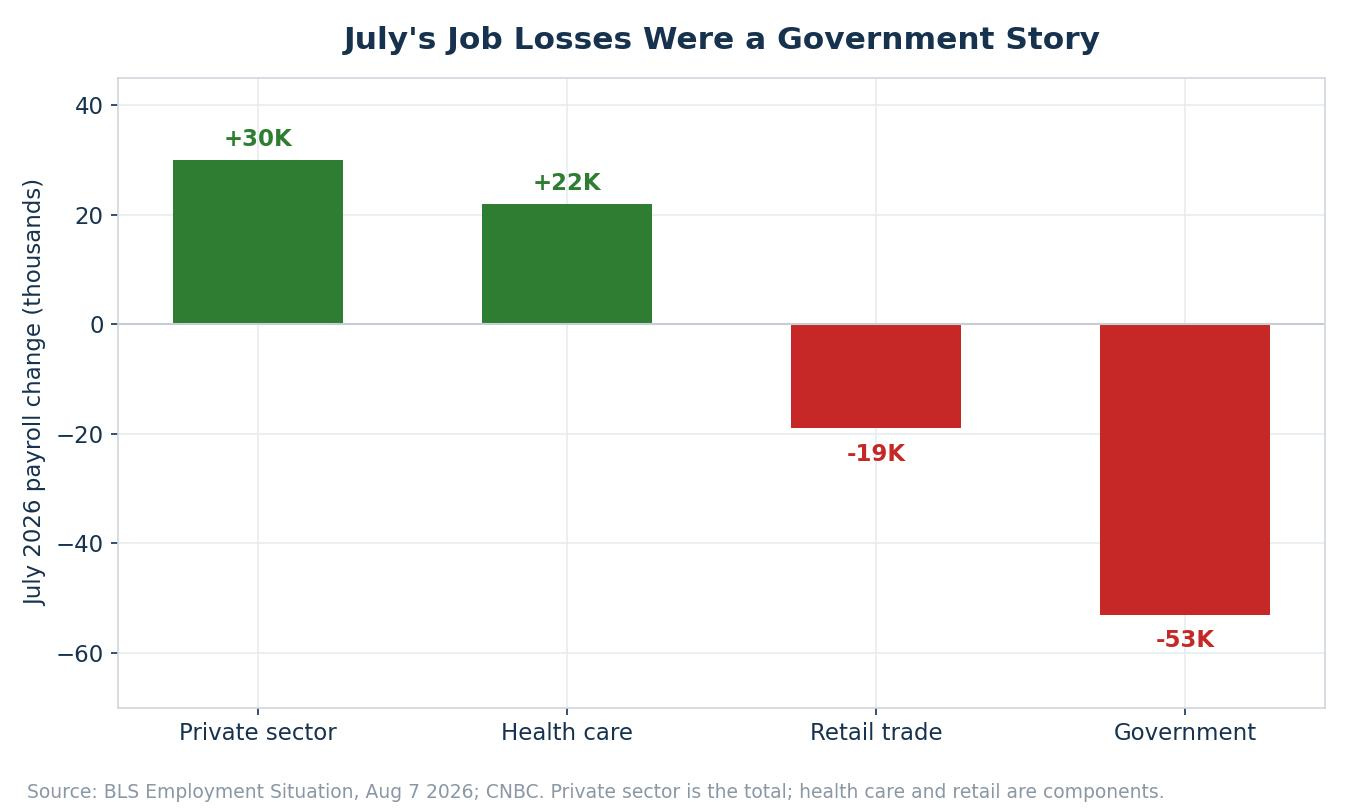
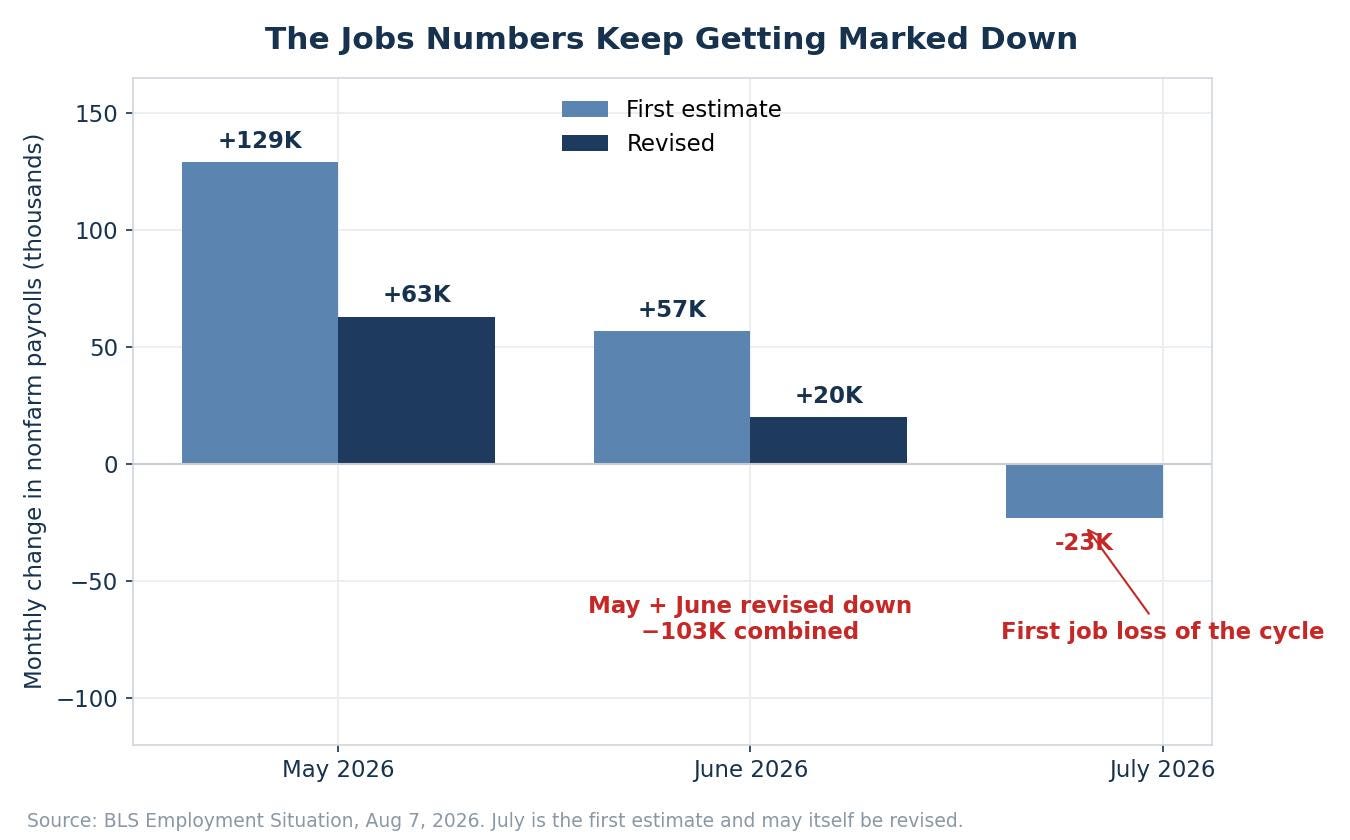
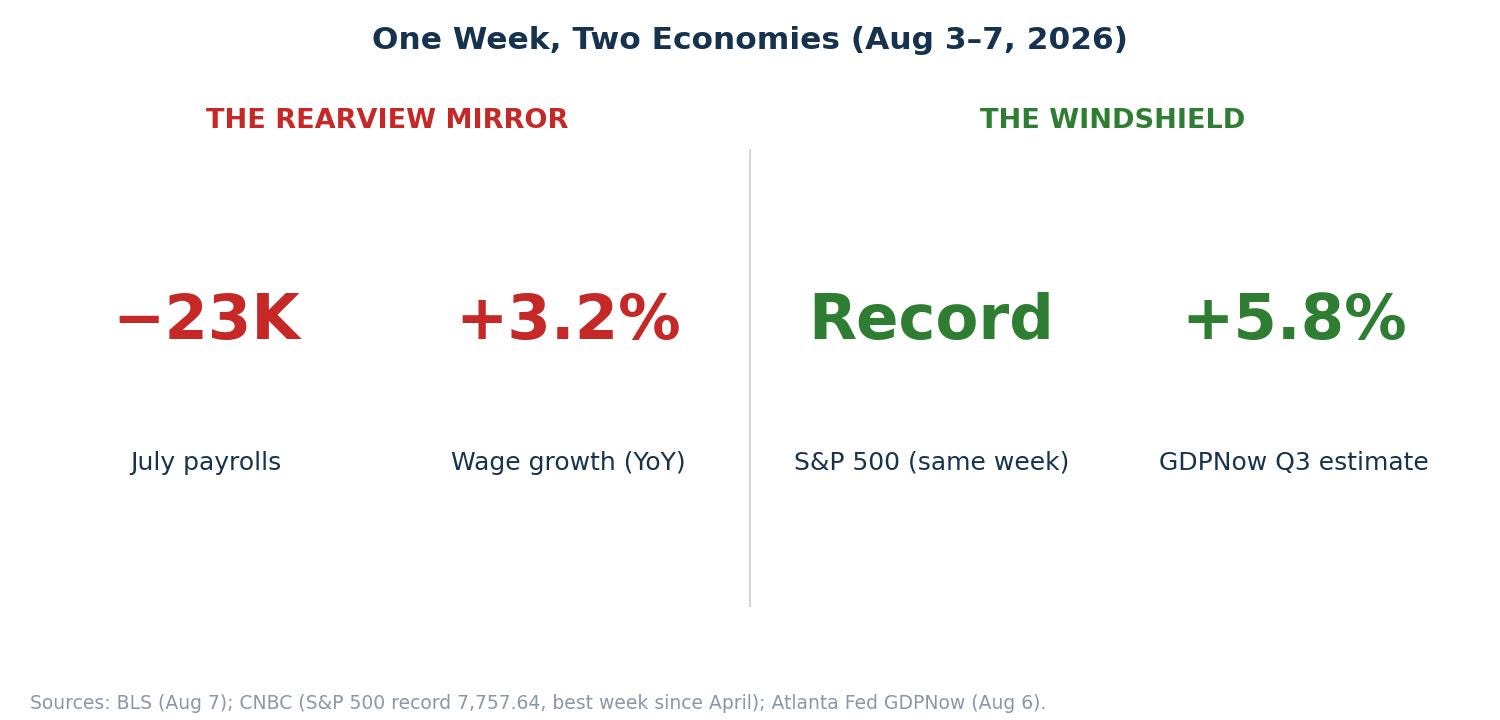
America lost 23,000 jobs in July: the first monthly decline of this cycle, vs expectations of an 83,000 gain (BLS, CNBC). But, before you cancel your weekend plans, let’s look inside the number.
The private sector added 30,000 jobs. Government shed 53,000, with public education alone down 50,000 (BLS). Health care added 22,000, retail lost 19,000. The “job loss” was, roughly speaking, a government story, not a business story.
The more significant insight for me was in the fine print: previous jobs reports that were revised lower.
May was marked down from +129,000 to +63,000. June went from +57,000 to +20,000. That’s 103,000 jobs that were reported, celebrated, and then quietly erased (BLS).
Quick Ad break: Groundfloor Bonds
9.5% Fixed. Your Money Back in Six Months

Why lock up your capital for years? For a limited time, accredited investors can earn a 9.5% fixed annualized return with the new Groundfloor Bond Note. Your investment has a defined six-month term, so you can earn a competitive fixed return while keeping your options open for whatever comes next. Capped at $10M. It won’t stay open long
Wage growth cooled to 3.2% year over year, the slowest since May 2021, and unemployment ticked down to 4.1%, though partly because the labor force shrank (BLS, CNBC). I covered the report-then-erase pattern in The Curious Case of the American Non-Worker a few weeks back, and this trend has worsened. The first jobs number released has a high estimate, only to be revised lower.
However, my rule: one month of data is noise. Two months in a row, we’re heating up, start paying attention. Three months, it means something, (per NBA Jam rules of course). July is one month of negative job growth, and a government-heavy (aka non-productive work) one at that.
The steelman: the potential bear case is more about the pattern than anything else. When revisions run persistently in one direction, the labor market is usually weaker than the headlines said in real time. Job gains have also narrowed to basically health care and not much else, and decelerating wages mean workers are losing bargaining power. If August and September also come in negative, that’s a trend, and I’ll change my tune and tell you so. But betting on a recession every time one number disappoints has been the single most expensive trade of this decade.
Careful of those who cry wolf.
Consumer sentiment hit a five-month high in July: the University of Michigan index rose 11.5% to 55.2, and year-ahead inflation expectations fell to 4.2% from 4.6% (Advisor Perspectives). Good news, right? Sure. But 55 is still miles below the long-run average of roughly 85. In fact, according to the survey, the American consumer has been ‘miserable’ for four straight years.
I suspect this is more an ideological/political feeling and not actually about the economy.
Frankly, I don’t put much weight on consumer surveys. And neither should you.
They measure moods, not money, and moods have been a lousy forecaster. Don’t take my word for it. Jerome Powell, when he was Fed Chair, said it plainly: “the link between sentiment data and consumer spending has been weak. It’s not been a strong link at all.” The Kansas City Fed studied 30 years of data and found that adding sentiment to a spending forecast changes almost nothing (KC Fed).
So ignore what consumers say. Watch what they do. And the people with the best view of what they do are the banks that process their paychecks and swipe their cards.
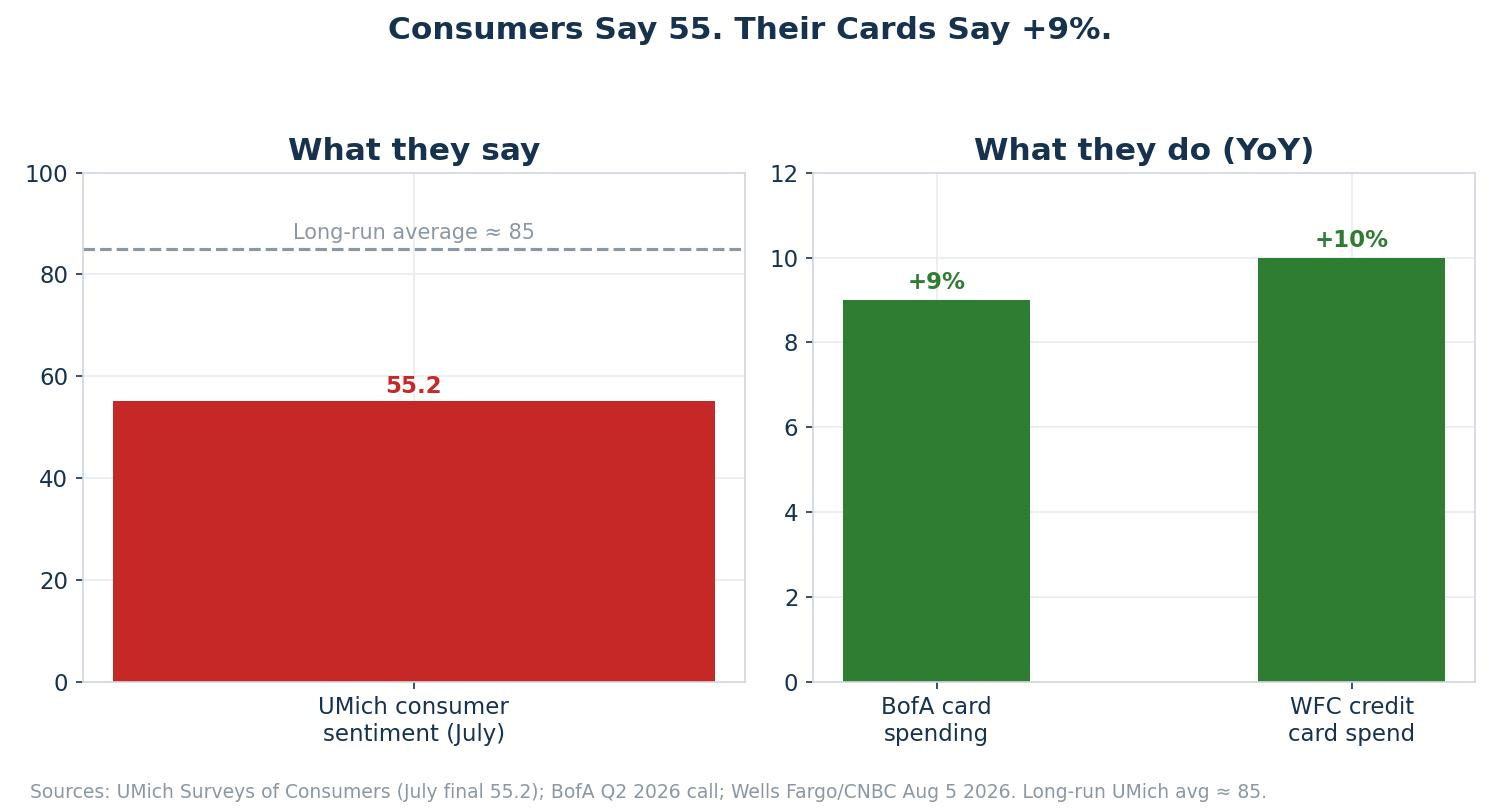
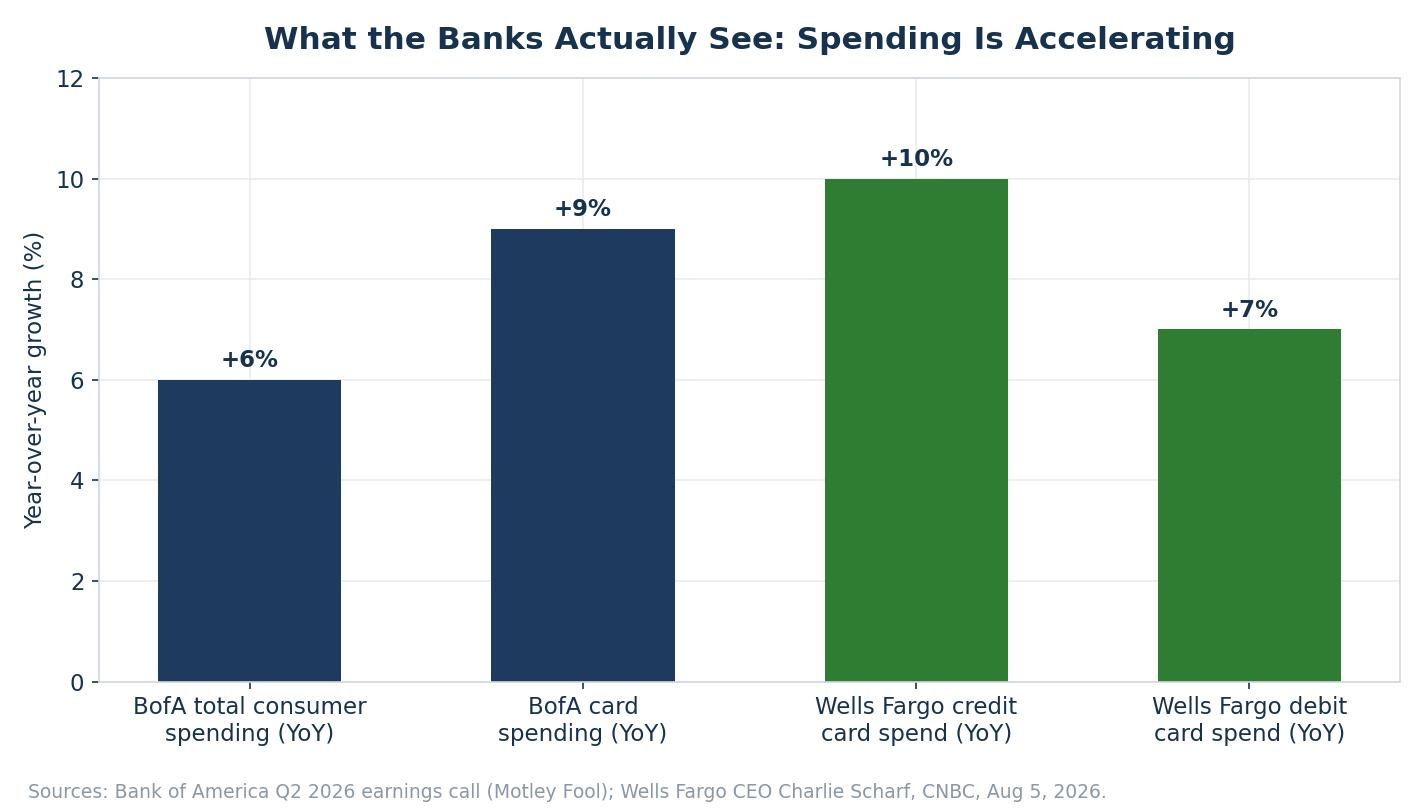
What the banks see. Bank of America CEO Brian Moynihan told analysts on the Q2 earnings call that consumer spending “picked up during the second quarter and now is running at 6%+ year over year,” up from 5% in the first half, with card spending up 9% to $266 billion. Consumers are “continuing to spend on discretionary items such as travel and entertainment,” the bank’s second-largest spending category (Yahoo Finance). And the credit side is the opposite of stressed: “Consumer credit quality remains strong,” with card charge-offs and delinquencies improving both year over year and quarter over quarter (BofA Q2 2026 call, transcript).
Wells Fargo CEO Charlie Scharf, on CNBC two weeks ago: “Our credit card spend is up 10%. Our debit card spend is up 7%.” And the detail that should end the doom-loop debate: “paychecks rising faster than inflation for our customer base,” with “delinquencies down, savings rates up.” About 70% of the spending increase came from mass-market customers, not the affluent (CNBC via 24/7 Wall St.).
Housing analyst Jay Parsons has been making the same point from the rental side: renters are in remarkably good shape. Market-rate renters are spending roughly 21–22% of income on rent, the lowest rent-to-income ratios since before COVID, because “wage growth has outrun rent growth for more than 40 consecutive months.” Renter delinquencies have been improving too (Forbes/Parsons, The Rent Roll, EP#96).
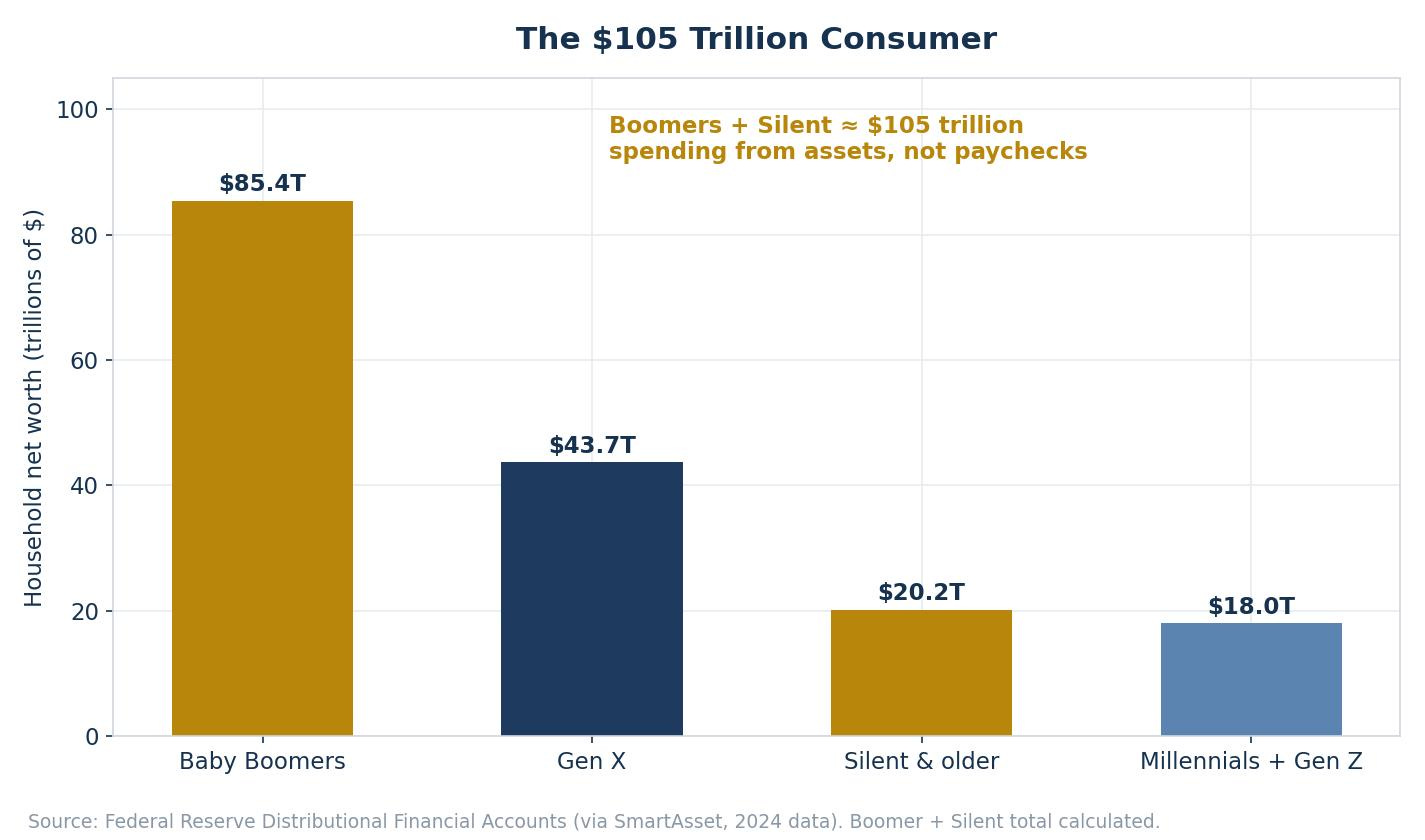
Where’s the K? The fashionable take says we have a “K-shaped” economy: the rich soaring, everyone else sinking. Ed Yardeni, the economist who called this decade the “Roaring 2020s” back when that sounded insane, pushed back hard on that narrative on The Compound and Friends this week with Josh Brown and Michael Batnick. His evidence starts with his own eyes: stores, malls, and restaurants are full, and try getting a cheap Knicks ticket. His deeper argument is generational. Retiring Baby Boomers and the Silent Generation sit on roughly $100 trillion in combined net worth, and they are spending it down from assets, not paychecks. Flat disposable-income growth misses them entirely: their income statement looks boring while their balance sheet buys the vacation (TCAF #254).
The Fed’s own data backs him up: Boomers hold about $85.4 trillion in net worth, the Silent Generation and older about $20.2 trillion. Call it $105 trillion between the two groups (what’s a few trillion amongst friends, eh?), roughly 63% of all U.S. household wealth (Federal Reserve Distributional Financial Accounts, via SmartAsset). Yardeni calls it a “G-shaped” (generational) economy, and he thinks it powers consumption, corporate earnings, and yes, the Roaring 2020s, through the end of the decade; he has floated S&P 10,000 by then (TCAF #254).
Surveys suck.
Is the economy…dare I say…bulletproof?
Despite the negative jobs news (again just a 1 month reading) the strongest stock market week of the year happened anyway: the S&P 500 closed Friday at a record 7,757, up 3.6% for its best week since April, with the Nasdaq up 5.2% and the Dow at a record too (CNBC).
One of these narratives is wrong, says the commentariat. The economy is decelerating, says the consensus.
I don’t think so. I think the economy is being underestimated, again, and the pattern is now six years long.
Consider what this economy has absorbed since 2020, a parade of grey swans (the cousins of black swans you can sort of see coming, and panic about anyway):
a global pandemic that shut the country down.
The fastest Fed hiking cycle in four decades.
A land war in Europe, and an energy shock.
Regional bank failures in 2023.
A yen carry-trade unwind that vaporized markets for a week.
Tariff wars, renegotiated twice.
And this spring, an actual shooting conflict with Iran that closed the Strait of Hormuz and sent crude toward $90, but not to $150.
Every single time, the recession calls followed within days. Every single time, the economy took the punch and kept walking.
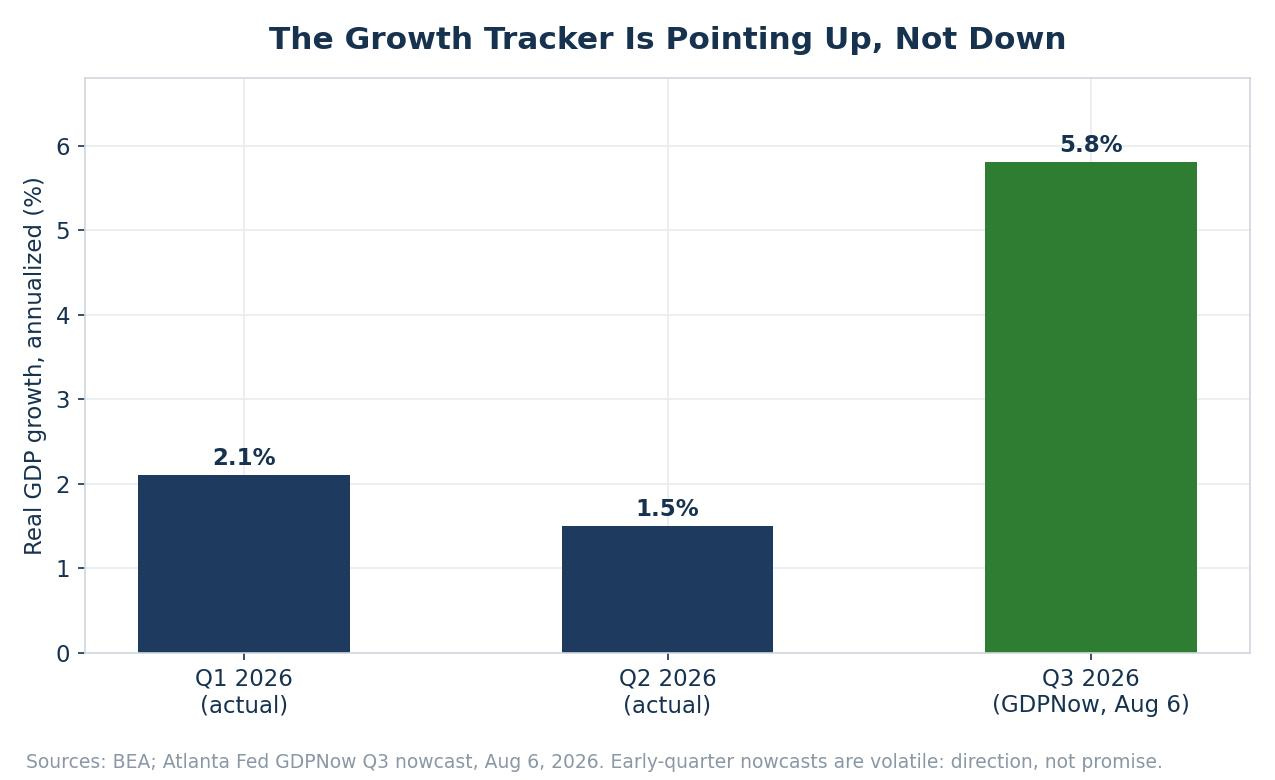
It appears to be doing it again. The rearview mirror says Q2 GDP grew a soft 1.5%. The windshield says the Atlanta Fed’s GDPNow tracker has third-quarter growth running near 5.8% as of August 6, with consumption strong and private investment surging (BEA, Atlanta Fed). Early-quarter nowcasts are volatile, direction not promise, but the direction is up, not down.
And inflation? Look at the trajectory before April: core CPI at 2.6%, core PCE in the low 3s, headline drifting down for months (BLS, BEA). What interrupted it wasn’t wages or demand: it was oil, spiking from about $69 to nearly $90 on the Iran conflict, and now round-tripping back to the high $70s as the war premium bleeds out (Trading Economics). Temporary, oil-driven, and unwinding: the argument I made in Inflation Reset still appears to be on track.
Meanwhile the jobs data has become so volatile, and so heavily revised, that the Fed can’t credibly tighten against it. You saw it in real time Friday: September hike odds collapsed from ~55% to ~44% within hours of the report (CNBC). A committee that was talking itself into a hike now has a negative payroll number and a −103K revision sitting on the table. Whatever your politics of monetary policy, the practical read for us is simple: financing costs appear more likely to drift down than up from here.
Robust is not the same as hot. I want to be precise: this economy is not running hot. Wage growth at 3.2% is not hot. A quarter of soft GDP is not hot. What it is, is durable: strong enough to absorb shock after shock without breaking, which is a more valuable trait than speed. Bulletproof beats fast.
Exhibit A: Housing
If you want proof the underlying economy is sturdier than the headlines, don’t look at the S&P. Look at the least affordable, most rate-punished corner of the economy: housing. It should be flat on the canvas. It isn’t.
Mortgage rates have been parked between roughly 6.6% and 6.9% since spring (Mortgage News Daily). That was supposed to be the demand-killer. Instead:
1)) Purchase applications have now been positive year over year for 25 straight weeks in 2026 (HousingWire).
2)) Weekly pending sales are running ahead of last year: 69,109 versus 68,413 in the same week (HousingWire).
3)) The inventory recovery is being eaten alive. A year ago, national active listings were growing 24.7% year over year and the “inventory is back” stories wrote themselves. As of July 31, that growth rate has collapsed to 2.1%, and total inventory still sits 9.1% below 2019 levels (ResiClub).
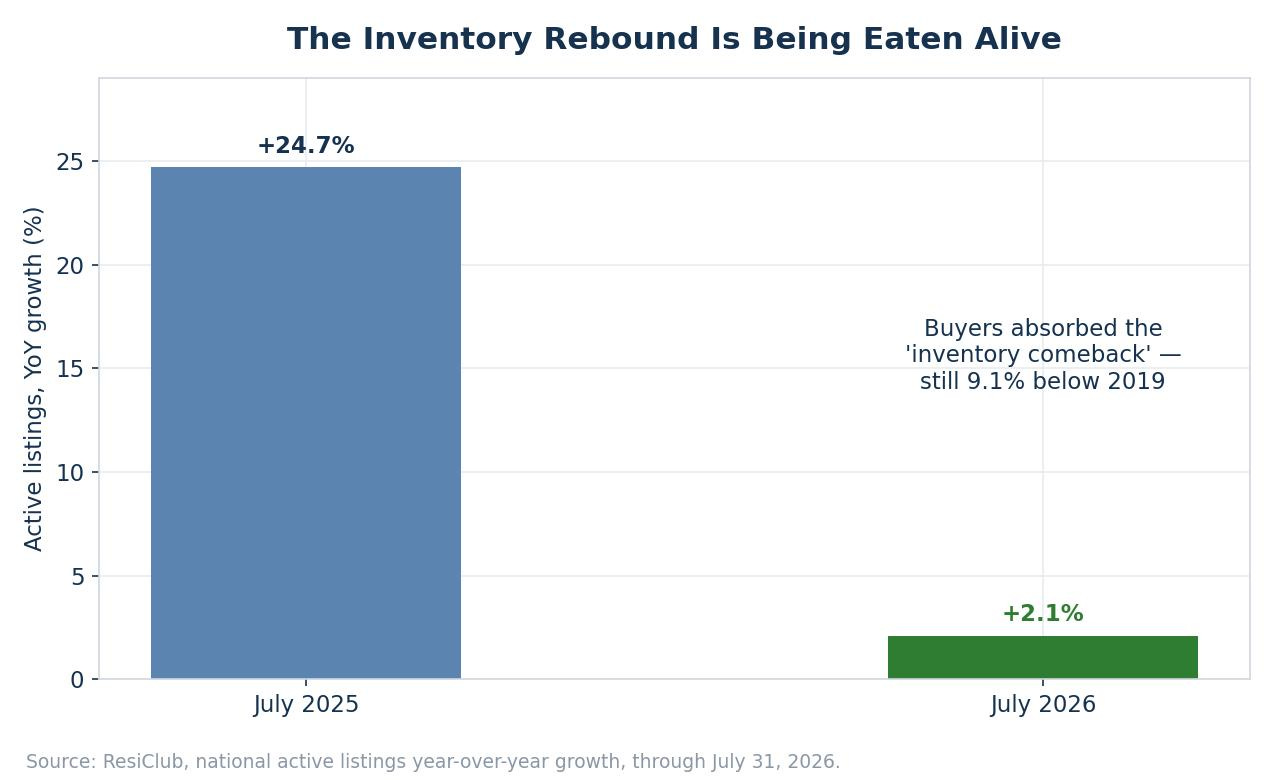
Picture the old Hungry Hungry Hippos game: every marble that rolls onto the board gets gobbled before it stops moving. That’s the American homebuyer right now, at 6.8% money. Sellers listed more homes this year (new listings are up), and buyers absorbed essentially all of it. I wrote in Revenge of the Seller’s Market that inventory was heading back toward scarcity, and last week in The Housing Market Is Frozen, Not Broken that volume, not price, was the frozen part. This is the sequel: the thaw is being bought as fast as it drips.
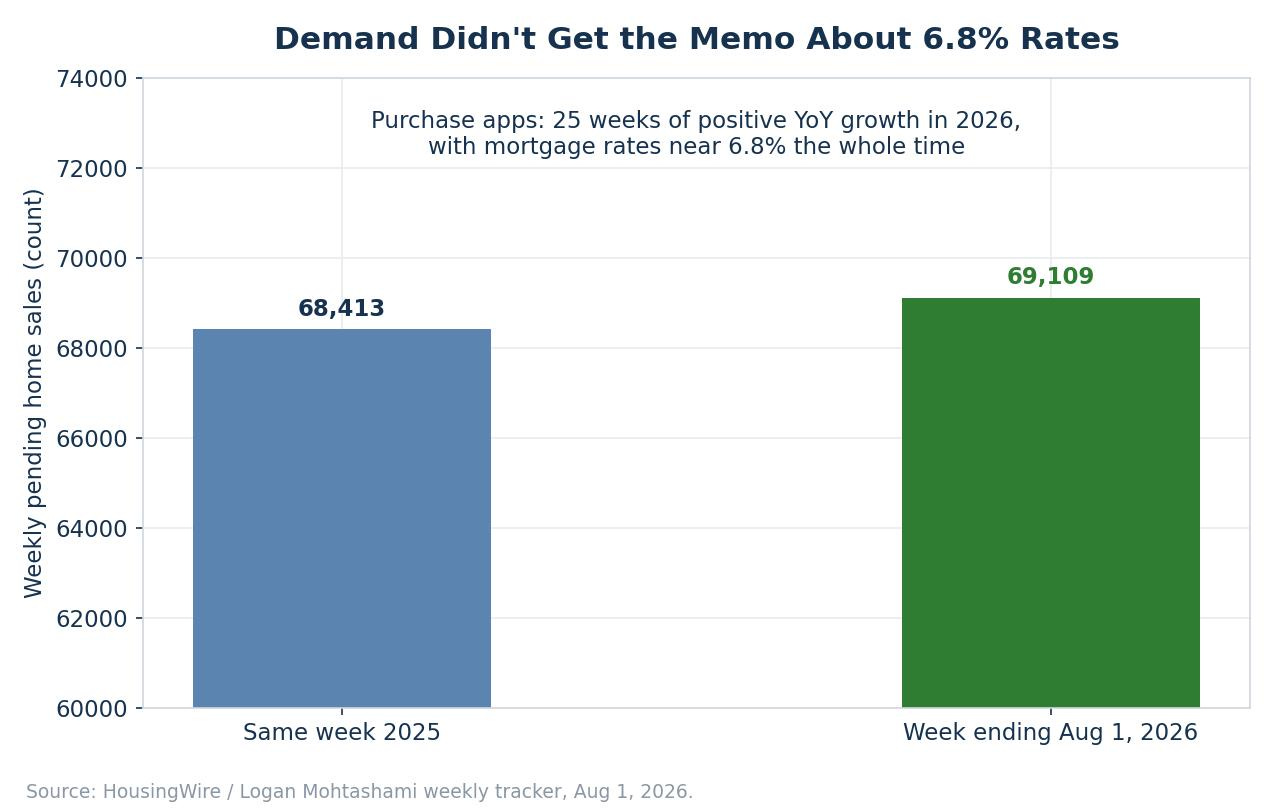
Logan Mohtashami, whose forward-looking weekly data leads closed sales by one to three months, put it two ways this summer: “Housing has weathered the 2026 storm of crazy headlines and inflation as well as it possibly can,” and “mortgage spreads being better in 2026 is the housing hero story of the year” (HousingWire, HousingWire).
Demand that holds through a hostile rate environment is pent-up demand, and pent-up demand is fuel. If financing costs drift toward 6% as the Fed’s hand gets stayed, the hippos don’t get less hungry. There will be more of them.
The steelman: the honest bear case has three legs. First, Mohtashami’s own caveat: “The longer we stay above 6.64%, the softer housing demand gets,” and the weekly pending edge over last year is thin, about 1% (calculated). Second, GDPNow’s early-quarter estimates are built on thin data and swing hard; 5.8% today could be 3% by September. Third, the growth that exists leans heavily on AI capital spending and asset-rich consumers, and both of those depend on markets staying at records. If equities correct 20% while payrolls come in negative for two more months, the bulletproof story takes real damage, and I’ll be the first to re-underwrite it. What I won’t do is call the fight against an opponent who’s still standing after six knockdown attempts.
What It Means for Investors
A durable-but-not-hot economy with sticky-scarce housing inventory is, in my humble opinion, close to ideal conditions for the patient landlord: enough growth to keep tenants employed and rents paid, not enough heat to reignite inflation and rates, and a for-sale market too tight to crash. While you wait for the obvious all-clear that never gets announced, the quiet engines keep turning: cash flow, loan paydown, tax benefits, appreciation, leverage. Those five engines are the whole architecture of my book on how real estate investors actually build wealth, and years like this one, boring on the surface, bulletproof underneath, are when they do their best compounding.
Quick Break: My Free DealLab Real Estate Calculator
Want help running numbers on your next deal (or an existing property you have)?
I built a free real estate deal analyzer, including an Advanced Mode for the pros.
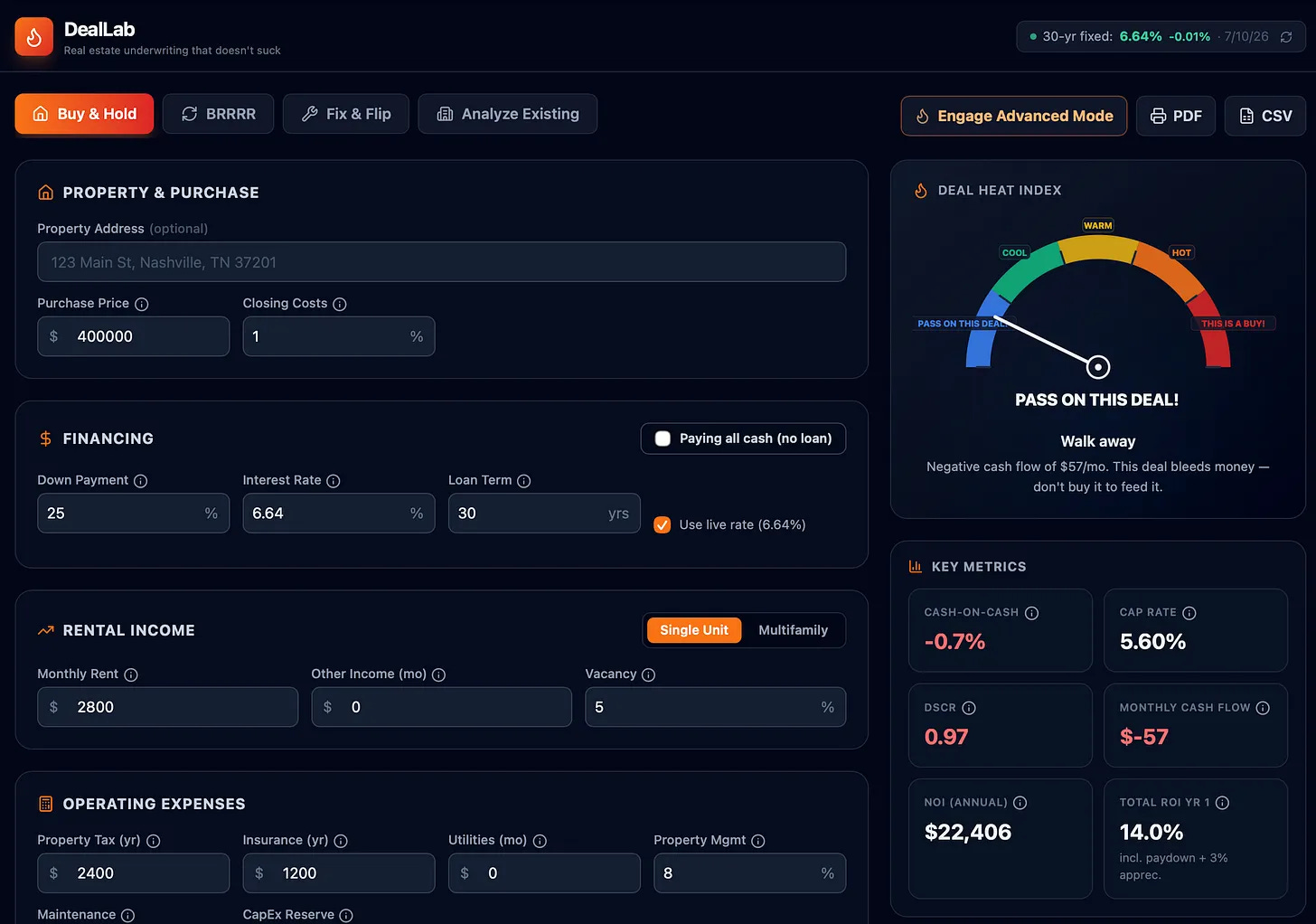
Bookmark it. It will come in handy.
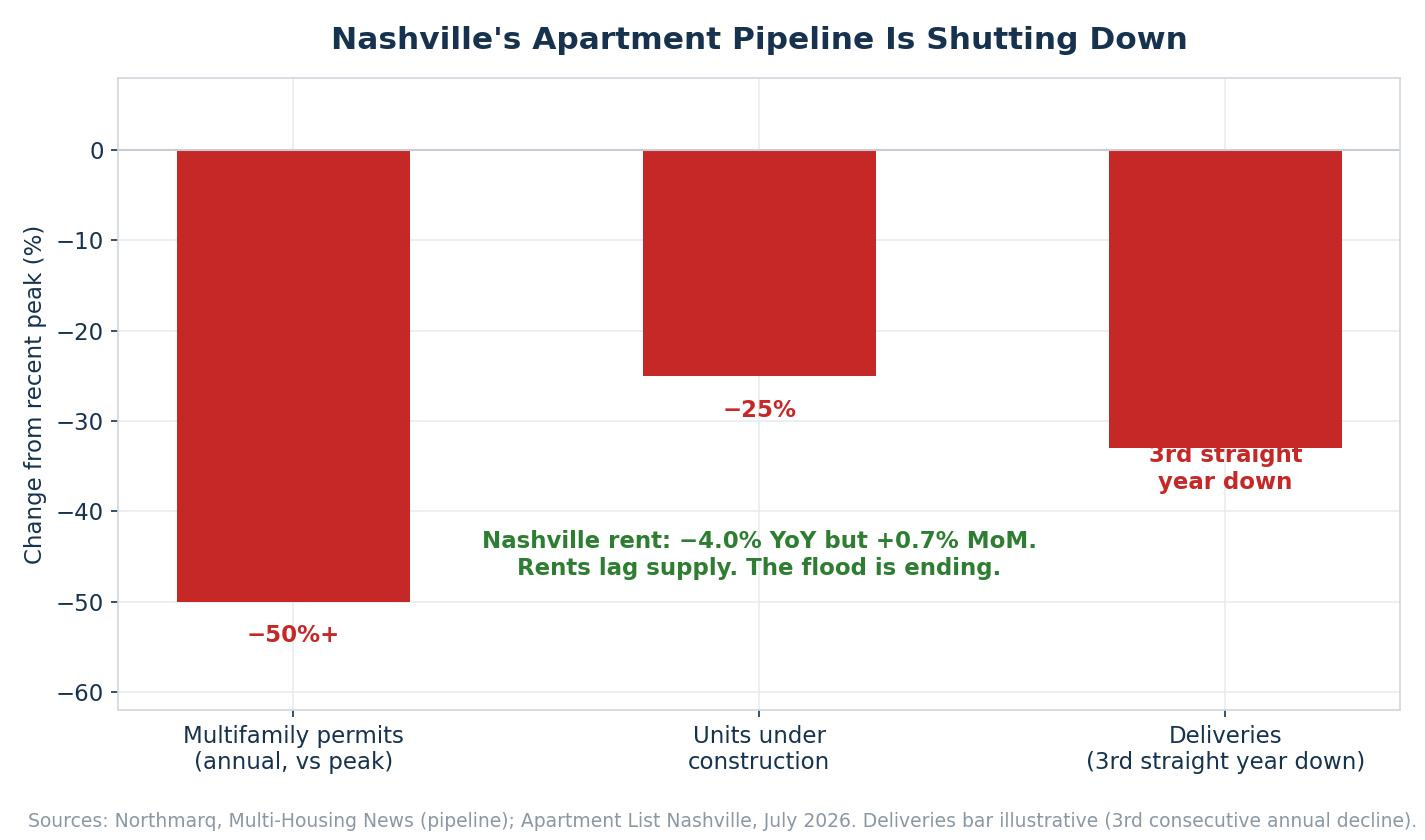
Nashville’s median rent sits at $1,358, still down 4.0% year over year, but up 0.7% on the month (Apartment List). The year-over-year number is the rearview mirror. The windshield is the pipeline, and the pipeline is shutting down.
Annual multifamily permits in the metro are down more than 50% from their peak. Units under construction are down about 25%. Deliveries are set to fall for the third straight year (Northmarq, Multi-Housing News). Rents lag supply, always. The discounting you see today is the echo of cranes that went up in 2022 and 2023. The cranes that aren’t going up in 2026 are tomorrow’s rent growth.
The national rental market is already showing us the movie. Apartment demand nationally has outrun new supply by roughly 100,000 units this year, occupancy is back to 95.5%, and Jay Parsons noted on his Rent Roll podcast that the apartment REITs reported improving rent growth, and rent growth momentum, on their Q2 earnings calls (Forbes, RealPage, The Rent Roll, EP#96). The Sun Belt, including Nashville, is the last region still discounting, because we built the most. That’s not a flaw in the thesis: that’s the sequencing. The markets that overbuilt hardest bottom last, and the operators who buy into the discount before the bottom is official are the ones who get the momentum.
My take: Nashville rents are about to reaccelerate, and our demand engines, the tourists, the tunnel-diggers, the corporate relocations I covered the other week in The $6.6 Billion Bet on Nashville, have not gone anywhere. Negative headline rent growth plus a collapsing supply pipeline is what a buying window looks like while it’s open.
Want to advertise to the more than 40,000 weekly readers of The Skeptical Investor? You can! Advertise with us; we can help you grow your business. Reach out.
Ok, back to business.
The old Hungarian-German speculator André Kostolany had a metaphor I think about every week like this one.
A man walks through the city with his dog. The dog runs ahead, doubles back, darts sideways after a pigeon, and covers five times the distance his owner does. But when they get home, they arrive together. The dog, Kostolany said, is the market. The man is the economy.
This was a week of dog.
Stocks sprinted to records. Jobs data darted the other way. Gold chased a pigeon. And every commentator with a microphone tried to divine the future from the zigzags.
Watch the man. He has walked through a pandemic, a war, an oil shock, a banking scare, and a tariff fight, and his pace has barely changed: consumers spending 6% more than last year, three-quarters of a trillion dollars swiped on two banks’ cards, renters healthier than they’ve been since 2019, and homebuyers absorbing every marble on the board at 6.8% money. That is not an economy decelerating toward recession. That appears to be an economy so durable that we’ve gotten bored of its resilience and gone looking for reasons to doubt it.
Skepticism, done right, points against the consensus, not the evidence. The consensus keeps predicting the man will collapse. The evidence says he’s still walking.
So the operator’s move this week is the same as it’s been all year: ignore the zigzags, underwrite the walk. Buy the discounts the doubters leave behind, in a city where the concrete is about to stop pouring.
In Kostolany’s words:
“The dog is the stock market. The man is the economy. In the end, they arrive together.”
Follow the man.
Until next time. Stay Curious. Stay Skeptical.
Herzliche Grüße,
-P.S. If this newsletter has been useful to you, the best gift you can give me is free: forward it to one person who’d benefit. I promise you 24 hours of good joo joo.
You can consult one-on-one on the phone with me, The Skeptical Investor!
Get professional advice from someone who actually owns, operates, and brokers real estate. Not just some partner in a fund making money off others.
Want to Grow? - Get clarity on how to grow your business or scale.
Stuck? - Get answers to your problem, let’s hop on the phone and figure it out.
No “guru” trying to sell you an expensive course. No BS. No fluff. Only results.
I’ll give you my frank, brutally honest advice. Book a call with me today.
It’s 2026. Be an owner.
Comments
Nothing yet. Say the first thing.
Sign in to join the conversation.