

Today’s Read Time: 20 minutes (totally worth it, we go deep).
This week we’re talkin’ data centers.
Just data centers (and real estate of course). No briefs, no detours. The most hated building in America may just quietly be the best economic development deal your town can land. The U.S. is lapping the world at building them, and almost everything you’ve heard about them is wrong. This is Industrial Revolution 2.0, and we’re going deep: the myths, the receipts, with real life examples, and exactly what it means for your rentals, your land, and your listings.
Let’s get into it.
(☝️ .02% from this time last week, 30-yr mortgage) Mortgage News Daily
American shoppers tapped the brakes — retail sales fell 0.6% in July, the steepest monthly drop since May 2025, led by a 2.2% slide in online spending and a 0.9% drop at gas stations as pump prices fell. Sales remain up 5.0% from a year ago. However, 1 month a trend does not make. (CNN, Aug 14)
Wholesale inflation is up and down: a tale of two energies — producer prices ran 4.7% over the past year, but July’s monthly reading was flat, held down almost entirely by a 5.7% collapse in wholesale gasoline prices. Oil is doing the disinflation work, expect this to remain volatile during the Middle East conflict. (BLS, Aug 13)
Wall Street just made AI infrastructure an asset class — Nvidia assembled six giants (Apollo, Blackstone, BlackRock, Brookfield, Goldman Sachs, KKR) to mobilize more than $500 billion for AI data centers and computing clusters. CEO Jensen Huang says “AI factories” can now be financed as productive infrastructure, like real estate or toll roads. This is a construction catalyst unlock. (CNBC, Aug 10)
⭐ Shakespeare in the Park (my favorite, a must see!) — The Bandshell at Centennial Park, opens Thursday Aug 20 and runs Thursdays–Sundays through Sept 20 (plus Labor Day Monday). This year: A Midsummer Night’s Dream. Free (suggested $20 donation), vendors at 5:15, pre-show concert at 6:00, curtain at 7:00. BYOB (bring your own blanket). (Nashville Shakespeare Festival)
Buddy Guy — Ryman Auditorium, Wednesday Aug 19. The last of the great blues men, on the best stage in America. (Ryman)
Meet Thomasina Minor, she teaches second grade at Start Elementary in Richland Parish, Louisiana.
She was sitting on her couch with her eight-month-old when she found out her end-of-year bonus was over $50,000.
Her word: “jaw-dropping” (Meta).
This is not a typo. Teachers in Richland Parish received bonuses up to $50,935 this year, 5x the normal bonus (GovTech). In a parish where teacher salaries run $29,504 to $52,335, that bonus is roughly a full year’s pay, landing on top of their salary.
What happened?
Meta is building its largest data center in history there, a $50+ billion campus called Hyperion.
Meta pays a 1% sales tax directly to the parish. A single one of those payments topped $22 million. The parish’s entire normal annual sales-tax haul was about $21 million (Shreveport-Bossier Advocate). One company, one year, more than doubled the town’s revenue.
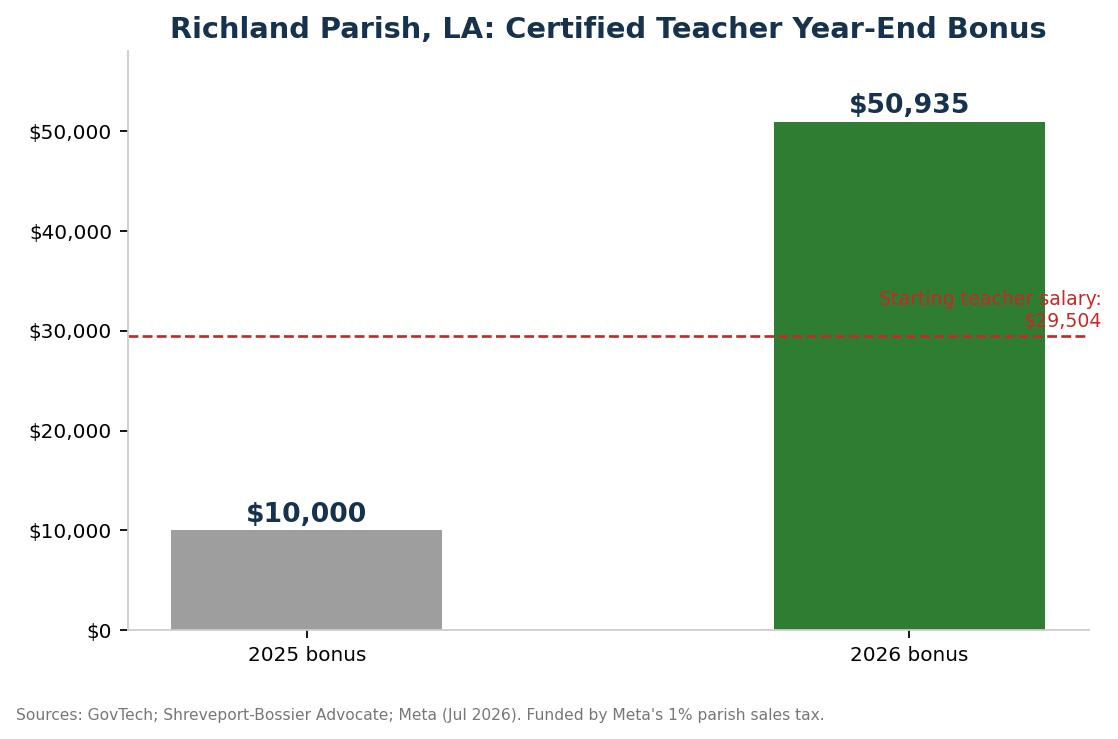
Superintendent Sheldon Jones, a 30-year veteran: “It’s life-altering for our teachers and their families... This year, for the first time in my 30-year career, every teacher we interviewed was fully certified. With bonuses like that, the best educators come to you.”
Mark Zuckerberg put the same story in his “The Future Is for Everyone” essay, and CNBC ran it on air last week (clip): teachers are now moving to Richland Parish from across the country, and the superintendent believes it may become one of the nation’s best school districts.
Is this the same type of building that towns/activist groups across America are fighting to keep out?
Yep.
Same warehouse, same servers, same humming chillers. One town gets $50,000 teacher checks. Another gets a lawsuit and a Facebook group called Stop The Data Center.
Unfortunately, misinformation about data centers is rampant on the internet and even the news (shocking I know).
Importantly: This is not political.
We are just talking facts here today. No politics.
And the difference is the deal town/cities/states make with data center operators.
Let’s take a further look.
Let’s talk scale.
Because most people, including most real estate investors and brokers, have no idea what’s being built around them.
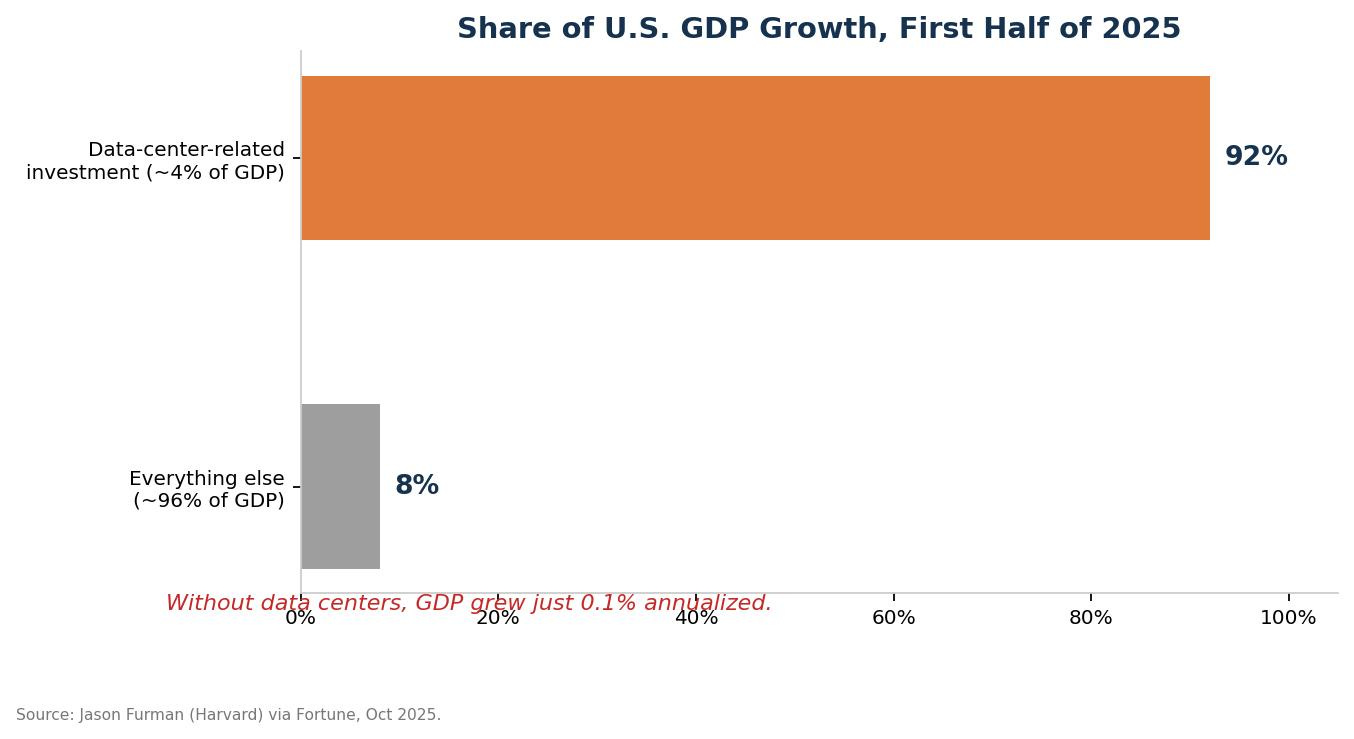
Harvard and Obama White House economist Jason Furman ran the numbers: data-center-related investment accounted for roughly 92% of U.S. GDP growth in the first half of 2025. Strip it out and the economy grew 0.1% annualized (Fortune).
4% percent of the economy drove nearly all of its growth.
Renaissance Macro found something even wilder: in 2025, the dollars the AI buildout added to GDP growth surpassed the contribution of all U.S. consumer spending, for the first time ever (Yahoo Finance). Consumer spending is two-thirds of the economy. The buildout beat it.
Now that’s food on the table.
Quick Ad break: Notion
Stop Being the Human Glue: Build a Company OS in Notion
In the beginning, the founder often is the system. They answer every question, approve every decision, remember every customer detail, and connect every moving part. That level of involvement may feel necessary early on, but over time it turns the founder into the company’s biggest bottleneck.
A lightweight company operating system helps replace constant interruptions with shared context. Instead of asking where the latest deck lives, what was decided in last week’s meeting, or who owns a launch, the team can self-serve from one central workspace. Weekly priorities, project owners, meeting notes, onboarding resources, customer context, and key decisions all have a clear home.
The result is not just better organization. It is more autonomy. When the team knows where to find information and how work moves forward, founders spend less time repeating themselves and more time making high-leverage decisions. A clear operating system gives early-stage companies the structure they need without slowing them down.
Spend less time answering repeat questions and more time building.
Try Notion today and get up to 3 months free of Notion Business with Notion AI.
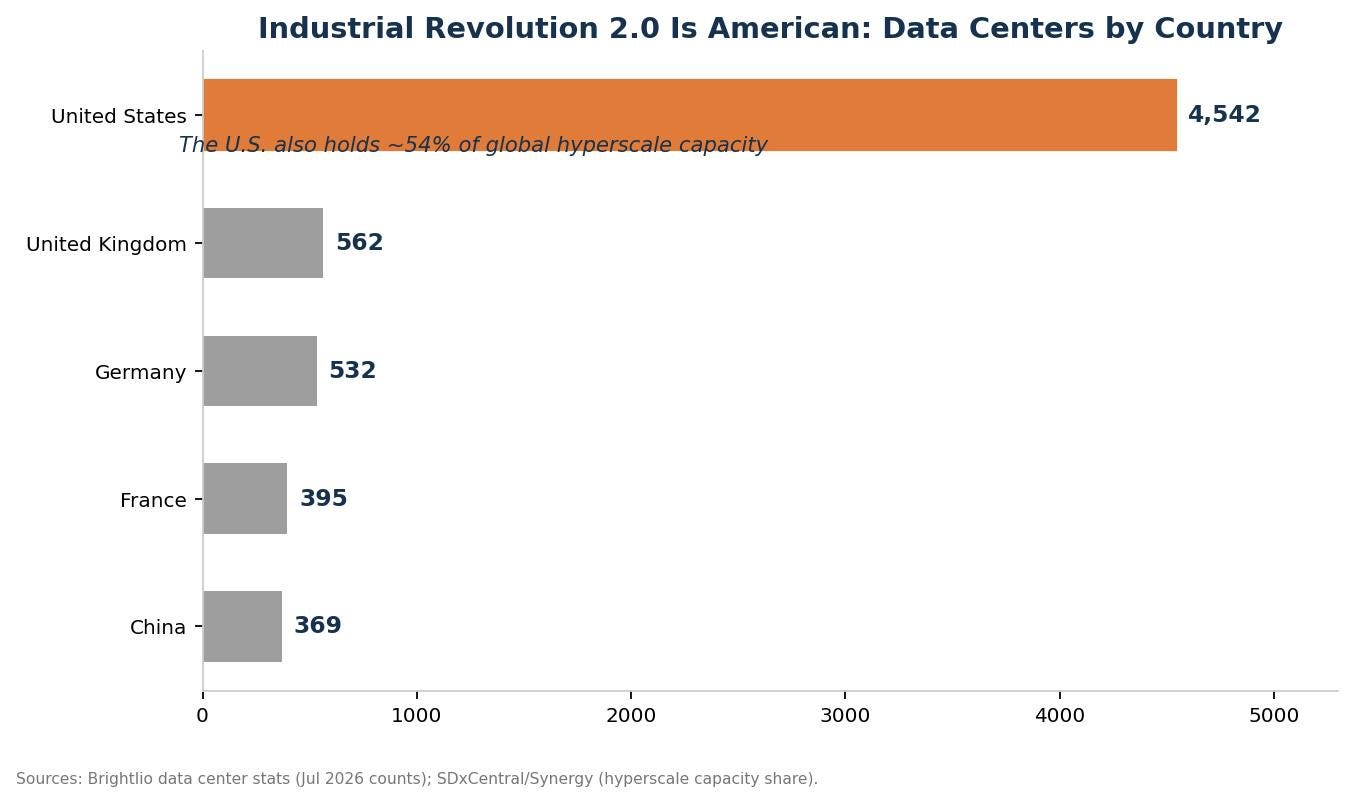
The U.S. holds roughly 54% of the world’s hyperscale data center capacity and about 4,542 data centers, more than the next eight countries combined; the UK is a distant second at 562 (SDxCentral, Brightlio).
The first Industrial Revolution ran on British coal and steel.
This one runs on American chips, American power, and American builders.
Hyperscaler capex is nearing $400 billion a year, and the spending runs the entire vertical: chips and memory, transformers and switchgear, copper, steel, diesel, fiber, and yes, industrial air conditioning. Somewhere an HVAC company salesman is having the best year of his life.
Think about what the last buildouts of this scale did to real estate. The railroads decided which towns became cities. The interstates decided which suburbs got rich. The towns that fought the rail line are the ones you drive past today without stopping. That’s the stakes, and that’s why the mythology around these buildings matters. So let’s take the myths head-on, one by one, with receipts.
But there has been much false information and uninformed opinions, that while perhaps well meaning or intuitive, are just plain wrong.
Let’s start busting some of these myths, and there is plenty of nuance here.
This is the myth everyone “knows,” but the facts say the opposite.
Energy consultancy E3 studied the question with actual statistics instead of vibes and feelings: between 2015 and 2024, data centers pushed average U.S. residential electricity rates modestly DOWN, not up (E3).
How is that possible?
Because the grid is mostly fixed costs: poles, wires, substations, plants. When a giant, steady, always-on customer plugs in, those fixed costs get spread across vastly more kilowatt-hours, and everyone’s per-unit rate can fall. E3 went facility-level and found each Amazon data center it studied generated about $3.4 million a year in net surplus revenue for its utility: the data center paid in more than it cost to serve.
That surplus subsidizes everyone else’s bill.
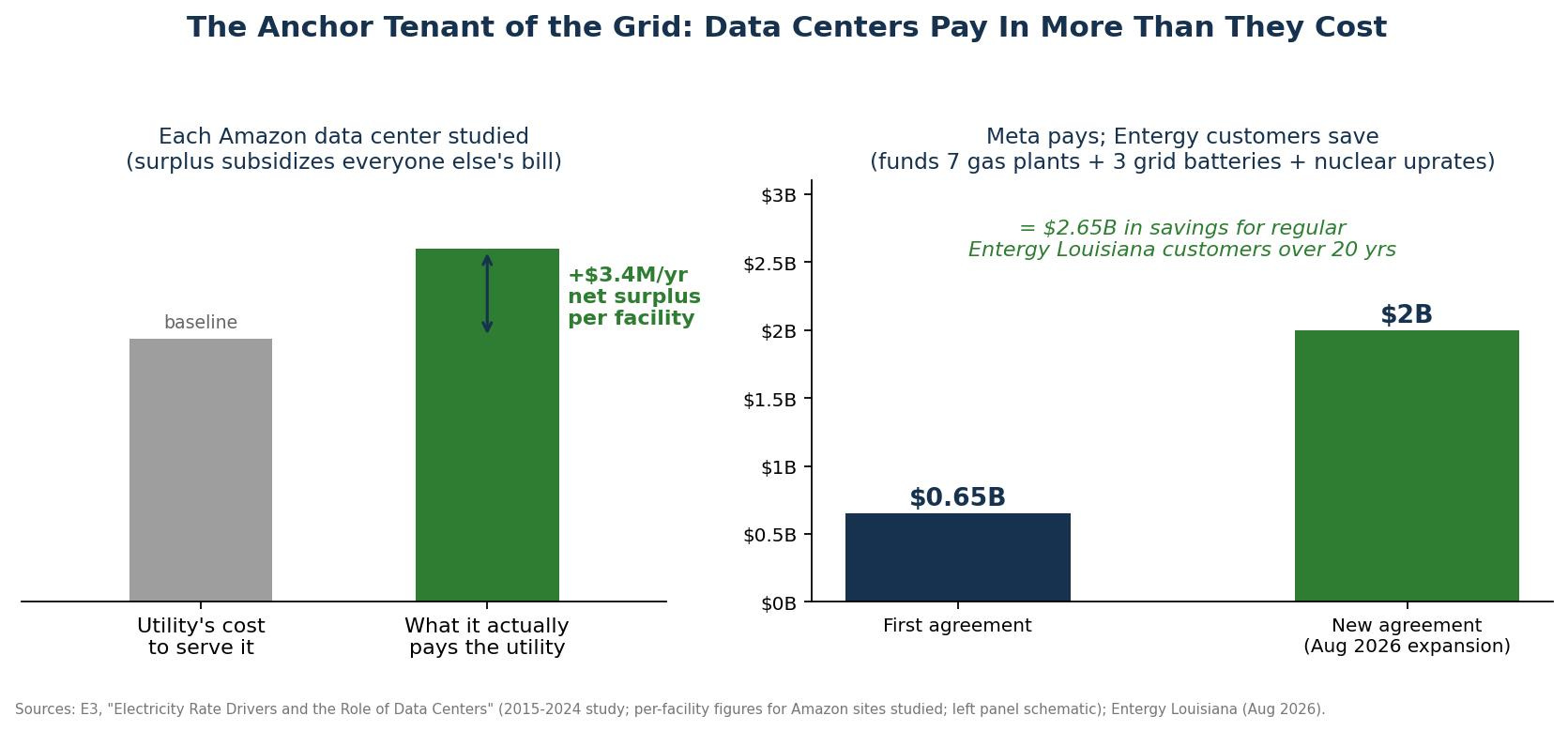
The proof in writing. You can read it. Meta’s power agreement with Entergy Louisiana for the Richland campus is projected to save Entergy’s regular customers more than $2 billion over 20 years, on top of $650 million from the first agreement (Entergy). The deal funds seven new gas generating plants, three grid-scale batteries, and nuclear upgrades. Meta’s stated commitment: it pays the full cost of the energy, water, and infrastructure it uses so consumers don’t.
And it’s not just the trillion-dollar giants building, far from it in fact.
Nebius is building a ~350MW AI campus in Vineland, New Jersey, and its builder DataOne runs a public FAQ for the community (askvineland.dataone.eu). On power, verbatim: “We bring and pay for our own power.” The campus runs on Bloom fuel cells installed onsite, behind the meter, with only ~49MW of grid backup, “without increasing residential electricity bills.” Residents’ gas gets priority on the pipeline if it ever comes to that.
There’s a bonus effect hiding here: data centers are resurrecting American nuclear power. Microsoft’s 20-year deal with Constellation is restarting the Crane Clean Energy Center (the former Three Mile Island plant). Amazon bought 960 megawatts at the Susquehanna nuclear station (FTI Consulting). Firm, clean generation that the whole grid keeps for 40 years, financed by someone else’s balance sheet.
Now the steelman: The E3 result is not guaranteed, and local governments should remain vigilant. It holds when the data center pays its own way and generation keeps up with demand. Where policy lags, residents did pay more for power: Virginia residential rates in data-center country rose 13% in a year, and a state legislative report projects typical bills could rise $14 to $37 a month by 2040 from grid strain (Newsweek).
Those stories are real, or rather, were real.
In the past there were rate-design and policy failures, not data-center inevitabilities. But those stories are old and outdated. A review of reports of electricity price increases show that virtually ALL of them were contracted 6+ years ago, not tied to the AI revolution and before data centers were anywhere close to the builder scale they are today.
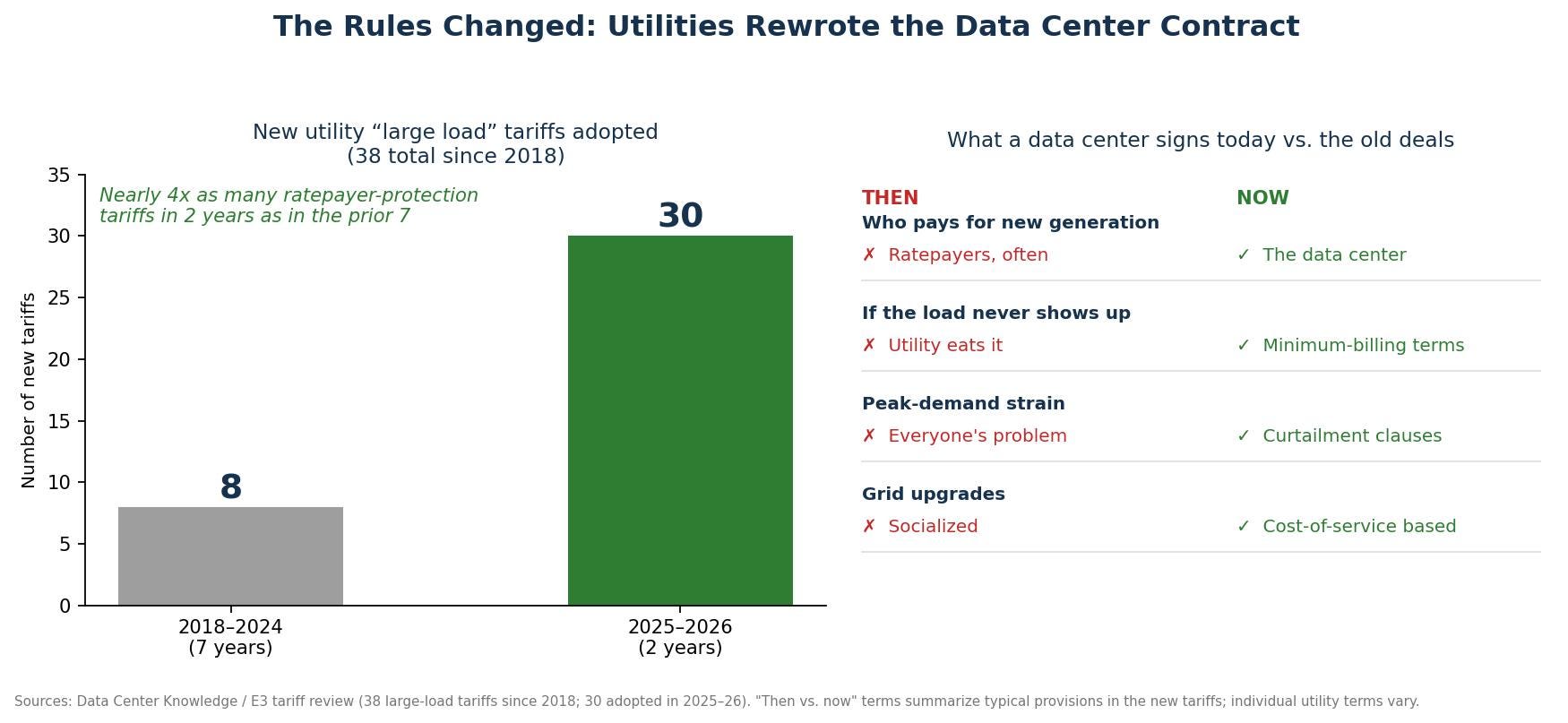
This is exactly why regulators have created at least 38 new “large load” tariffs since 2018, 30 of them in 2025-26 alone, with minimum-billing and protection terms so ratepayers don’t carry the risk (Data Center Knowledge).
Good, sensible pro-building policy. Not NIMBY nonsense.
Key Takeaway: a well-structured data center is the anchor tenant of the grid. It pays more than its cost to serve, and everyone else’s rate benefits. A badly structured one socializes its costs. The variable is the contract, not the building. If you are not paying LESS for your electricity in 2026+, it’s your local government’s fault.
The image in everyone’s head: a server farm guzzling a river while farmers watch their wells dry up.
The reality of modern data centers: they are closed-loop liquid cooling.
Fill the system once during construction, then recirculate the same water for years. Microsoft’s new zero-water-evaporation design cuts water use by more than 125 million liters per facility per year, and every Microsoft data center designed since August 2024 uses it (Microsoft). Satya Nadella’s comparison: a whole AI campus now uses about as much water annually as a single restaurant (Tom’s Hardware).
DataOne’s Vineland FAQ gets even more specific, and I love this detail: a one-time fill of 1 million gallons, then annual consumption “equivalent to eight to nine Olympic swimming pools, mainly for typical office building use.”
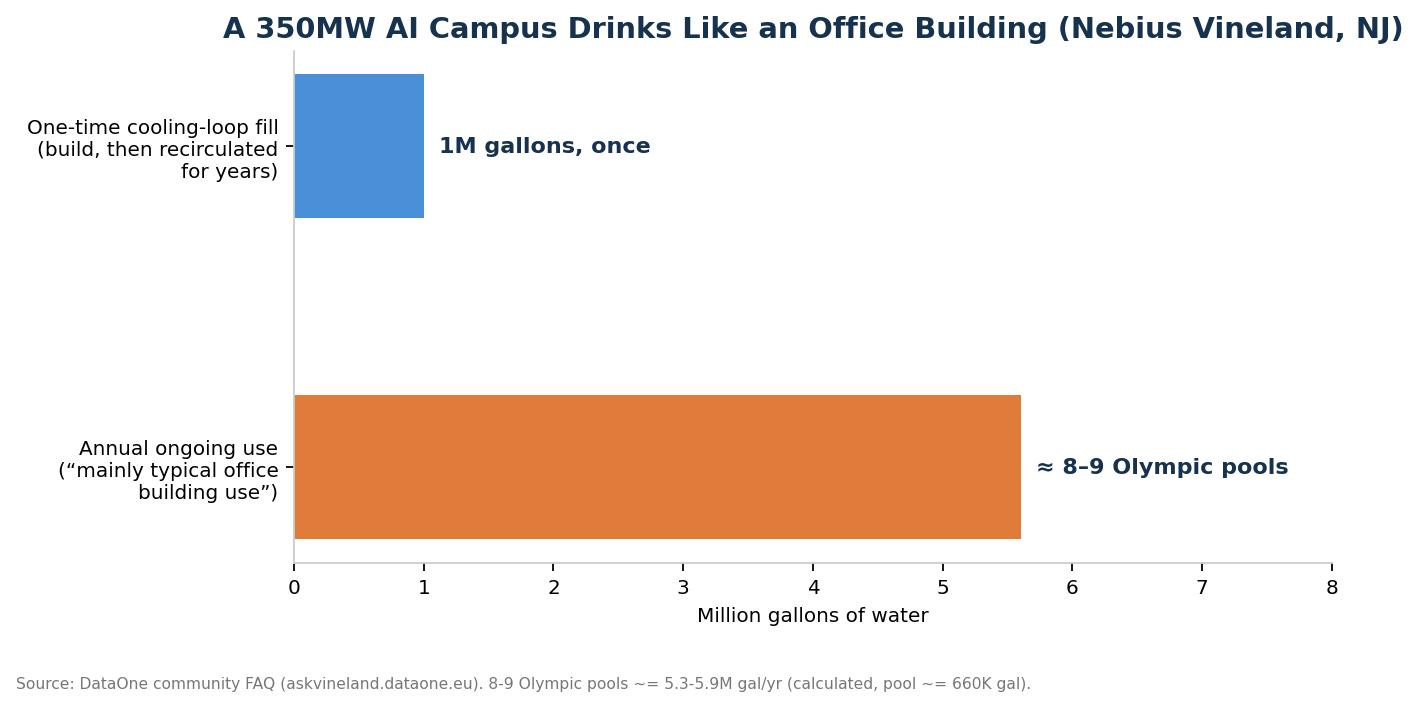
Read that again.
The ongoing water at a 350-megawatt AI factory is mostly sinks, toilets, and break rooms.
Office-building stuff.
The cooling loop just keeps recirculating. No discharge, no pollution, and draw rates tested to not touch neighborhood water pressure (DataOne).
Now put a real number on “office building.” The federal government tracks this.
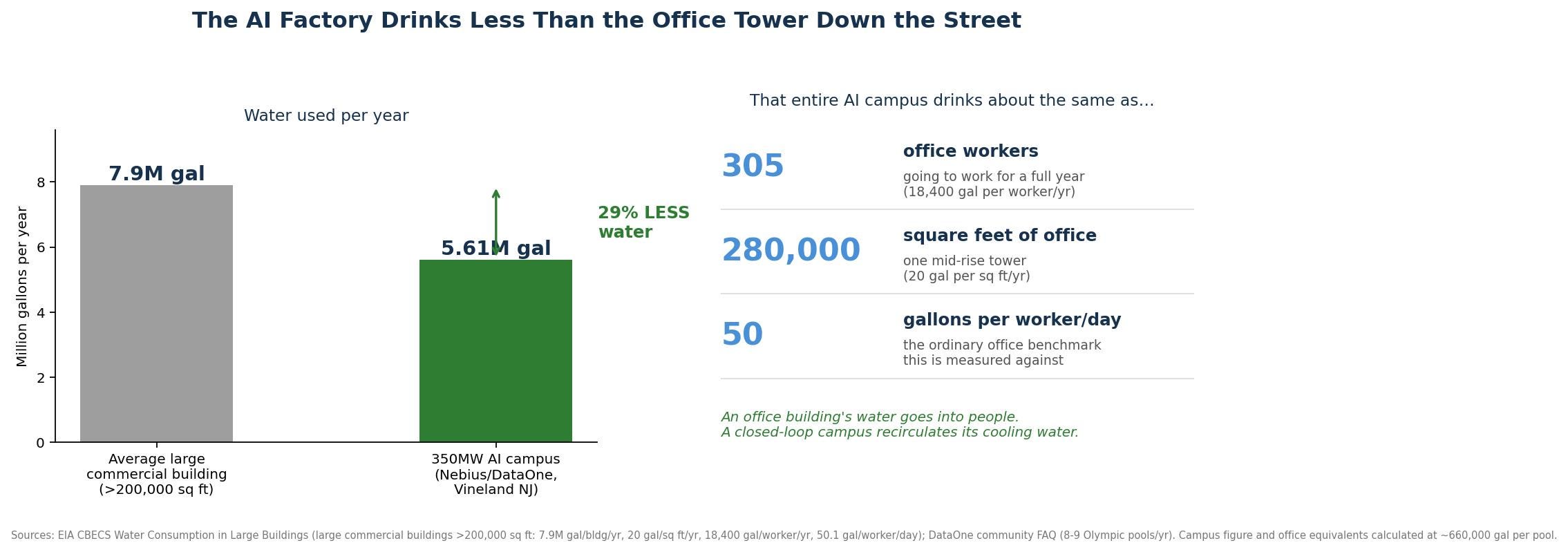
In its most recent water survey, the EIA found that large commercial buildings, meaning anything over 200,000 square feet, averaged 20 gallons per square foot per year, 18,400 gallons per worker per year, and 7.9 million gallons per building per year (EIA CBECS).
On a daily basis that’s about 50 gallons per office worker, per day, mostly restrooms and cooling.
Now line those up against the AI factory. Eight to nine Olympic pools is roughly 5.6 million gallons a year (calculated, at about 660,000 gallons per pool).
The math:
1)) A 350-megawatt AI campus uses roughly 29% LESS water per year than the average single large commercial building in America (5.6 million gallons vs. 7.9 million).
2)) At 20 gallons per square foot, an office building that drank the same amount of water would be about 280,000 square feet: one mid-rise tower. Meanwhile Meta’s Hyperion campus in Louisiana covers roughly 10 million square feet of building. The data center is vastly bigger and still uses less.
3)) Per person, that entire campus’s annual water use is equivalent to about 305 office workers going to work for a year (calculated, at 18,400 gallons per worker per year). Three hundred people. That’s a mid-size accounting firm.
The reason is simple once you see it: an office building’s water goes into people. Toilets, sinks, kitchens, showers, landscaping, cooling towers. A closed-loop data center has almost no people in it, and its cooling water goes around in a circle instead of out a drain.
The noise complaints you’ve read about are the old diesel generator construction, which is now rare. And, frankly, something where local/state governments should require other sources of generation.
The new format? Quieter than a vacuum cleaner.
An industrial diesel generator runs around 85 decibels (industry noise guides). Bloom Energy - a choice provider of natural gas fuel cells including the Vineland campus - runs about 65 decibels, roughly that of an outdoor AC unit, and quieter than a vacuum cleaner. And thats from 10 feet away (Bloom Energy) (remember decibels are logarithmic, 20 fewer of them means about 100 times less sound energy and roughly four times quieter to the human ear).
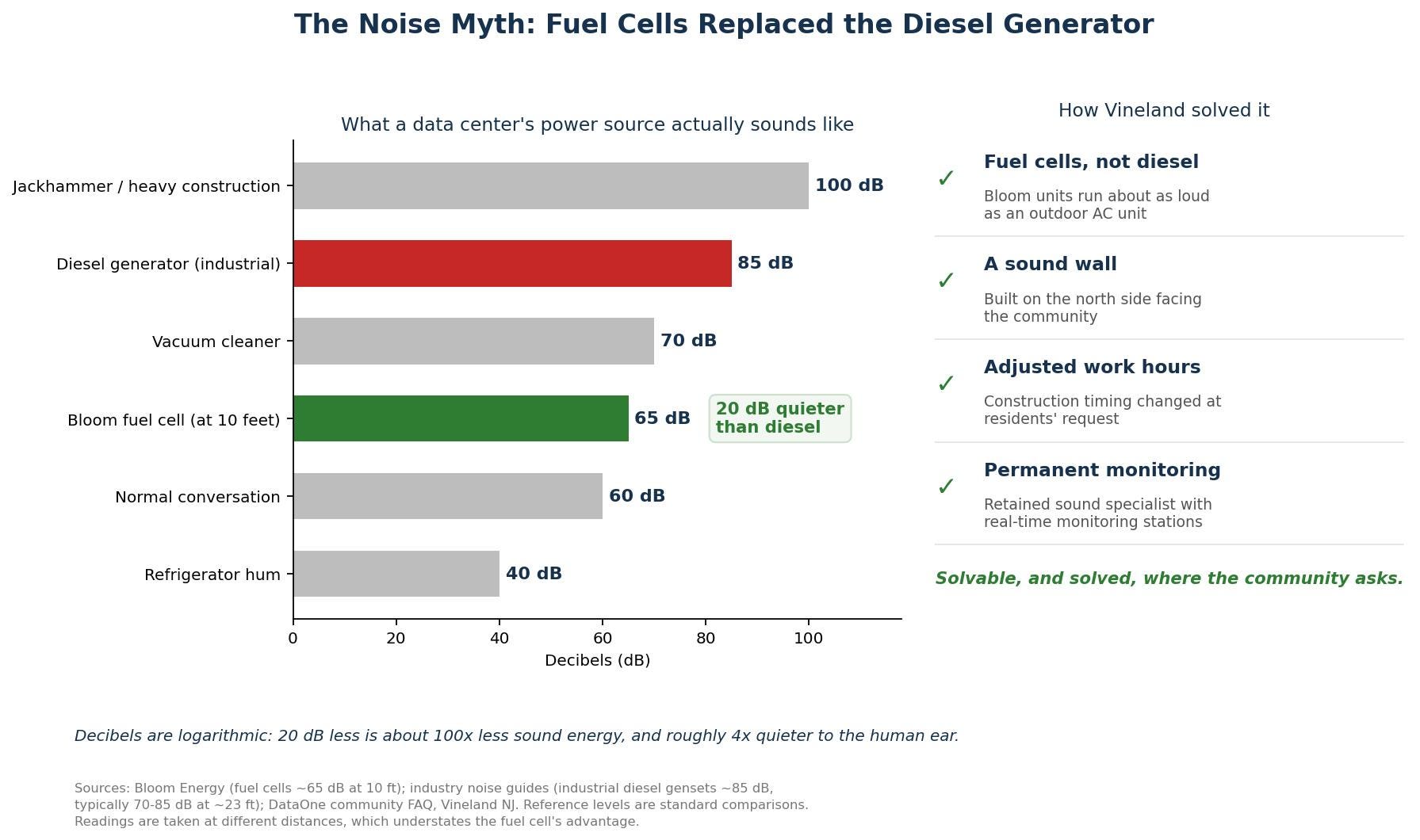
Couple this with data center construction now providing sound walls, managed construction hours adjusted at the community’s request, and retained sound specialist running real-time monitoring stations and noise is no longer a long term concern. The noisiest time will be the normal sounds of initial construction.
Noise has been solved.
Loudoun County, Virginia is the data center capital of the planet: 200+ facilities.
What did this do to the county’s budget and people’s taxes?
Data centers occupy about 4% of Loudoun’s commercial land and generate 38% of its general fund revenue: a projected $1.3 billion this year, between $417 million in real property taxes and $879 million in personal property taxes on the computer equipment inside (Loudoun County). The equipment tax alone went from $466 million in FY22 to $795 million in FY26 (CNBC via Sara Eisen).
What did the county do with the windfall?
It cut the residential property tax rate.
Every year.
For a decade.
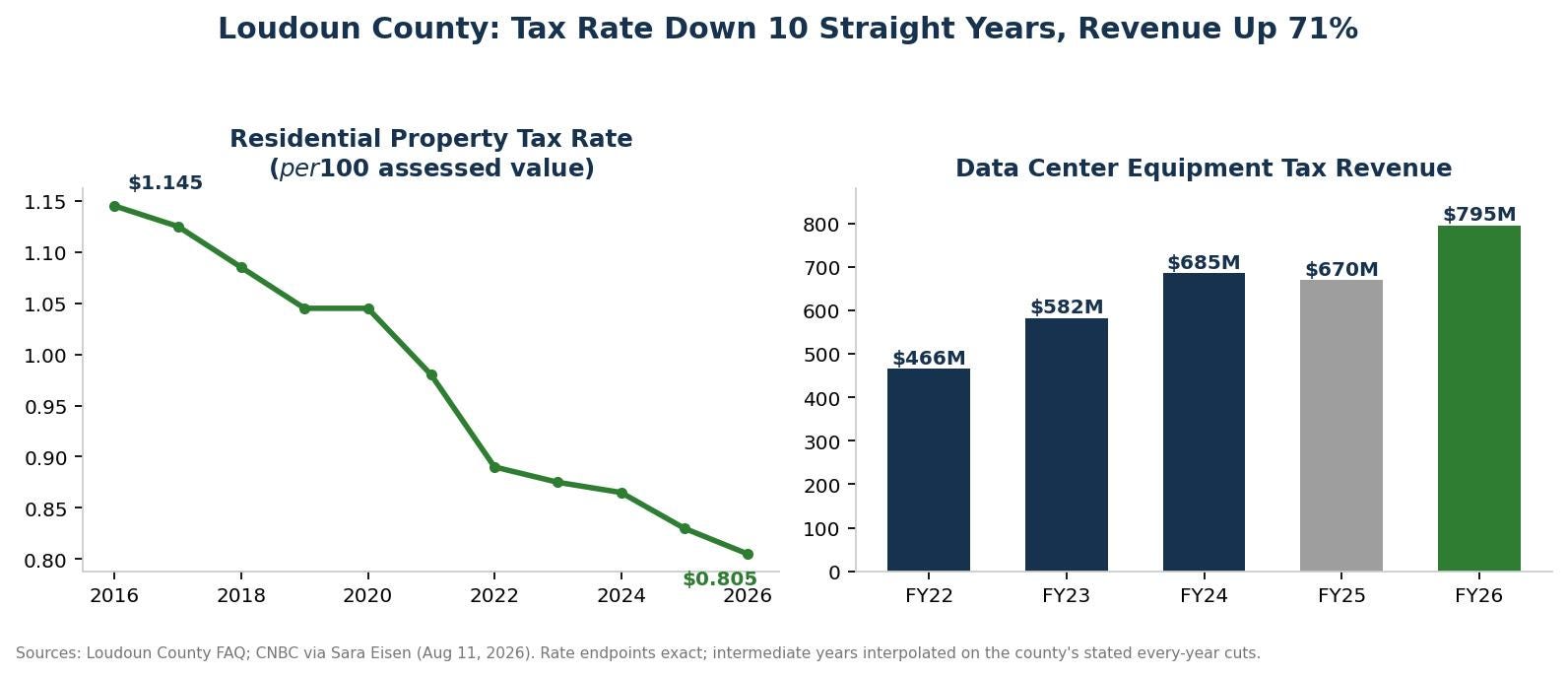
From $1.145 per $100 of assessed value in 2016 to $0.805 in 2026, the lowest rate in Northern Virginia, while still expanding services and pouring tens of millions of new dollars into the school system every year.
In fact, without data center revenue, Loudoun’s residential rate would need to rise about 91% to fund the same budget. The typical homeowner’s tax bill would jump roughly $5,800 a year (Progress Chamber). The silicon is paying for your kid’s school and your new highway.
Now, the windfall for companies. We shouldn’t pretend they don’t exist. Meta’s Louisiana project carries about $3.3 billion in tax breaks (Fortune). Virginia’s statewide sales-tax exemption on data center equipment costs over $1 billion a year (WUSA9). These are real, large subsidies, and any honest accounting shows both numbers.
But, net on net, both Loudoun and Richland counties saw windfall revenues.
What does a reasonable tax incentive/abatement for companies look like?
Here’s the math: DataOne’s Vineland New Jersey deal is a good template: full land taxes from day one, plus a 5-year escalating abatement on the improvement tax only: pay 0% year one, then 20%, 40%, 60%, 80%, then 100% forever after. The shortest program New Jersey offers (DataOne). The company is at full freight by year six, and the town owns a new tax base for decades.
And the tax prize can be back-loaded, it depends on how localities structure the deal.
Case in point: Prineville, Oregon (more on it below) gave Facebook and Apple 15-year abatements; those are now expiring, and roughly $2 billion of taxable value is landing on the town’s rolls, with annual revenue heading from $4 million toward $9 million (CNBC).
The abatement was the price of admission for the locality winning the data center project.
The tax base is permanent.
Enough about Louisiana and Virginia. Let’s do the arithmetic for Davidson County (aka Nashville), because Tennessee’s tax structure makes this fairly straight forward.
We have no state income tax. That means local government here runs on property tax to a degree that would surprise people in other states. And property tax rewards exactly one thing: capital intensity. Not headcount, not square footage. Dollars of assessed value per acre.
A data center may be the most capital-dense building humans currently construct. Roughly $7 to $15 million of investment per megawatt.
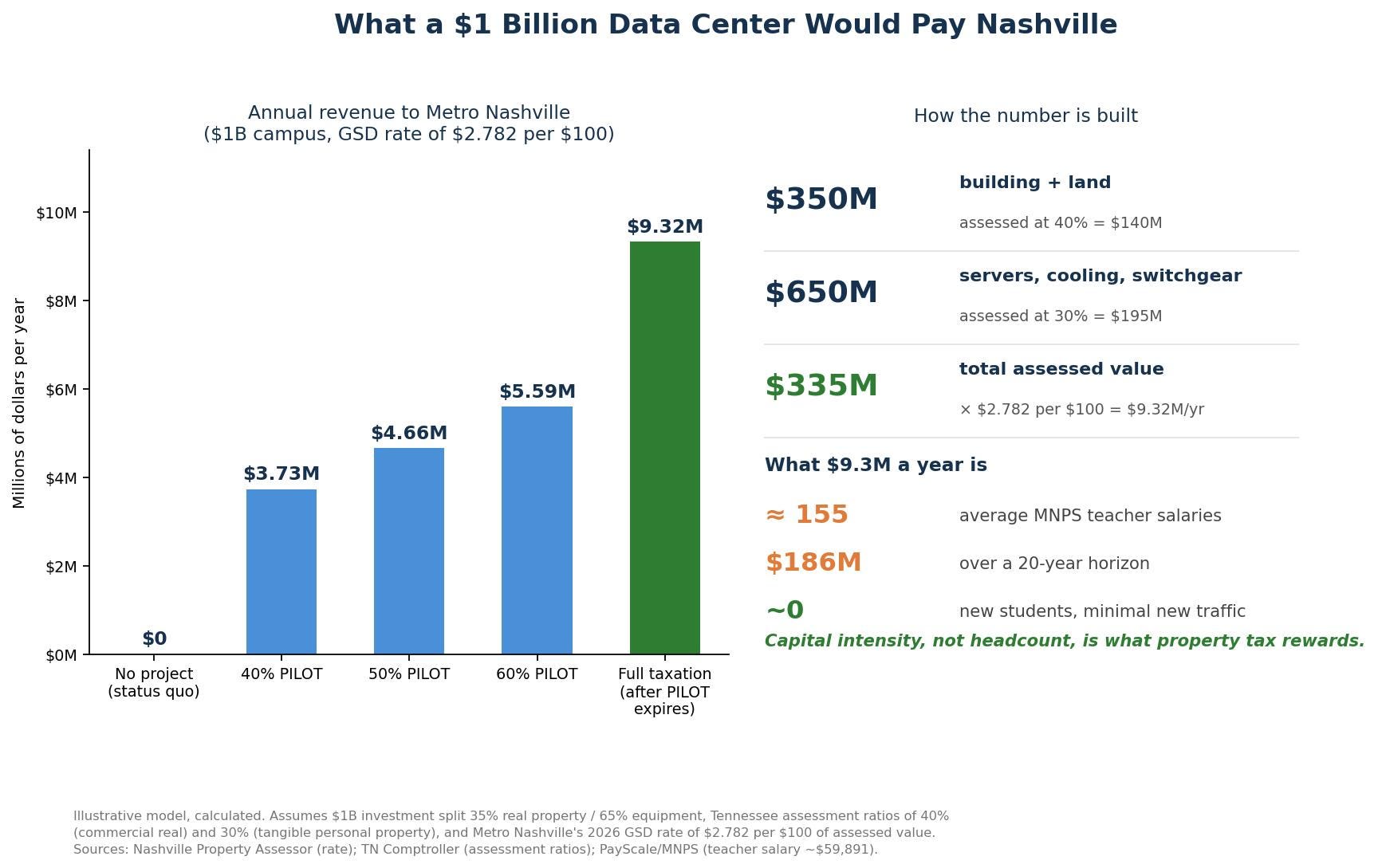
Here’s how Tennessee assesses it. Commercial and industrial real property (the land and the shell) is assessed at 40% of appraised value. Tangible personal property (the servers, the cooling plant, the switchgear, the backup power) is assessed at 30% (TN Comptroller). Metro Nashville’s 2026 rate is $2.782 per $100 of assessed value in the General Services District, or $2.814 in the Urban Services District (Nashville Property Assessor). A campus like this would almost certainly sit in the GSD, so let’s use $2.782 and be conservative.
Now take a mid-size hyperscale campus at $1 billion of investment. Call it 35% building and land, 65% equipment, which is typical for this asset class:
Real property: $350M × 40% = $140M assessed
Equipment: $650M × 30% = $195M assessed
Total assessed value: $335 million
At $2.782 per $100: about $9.3 million a year at full taxation
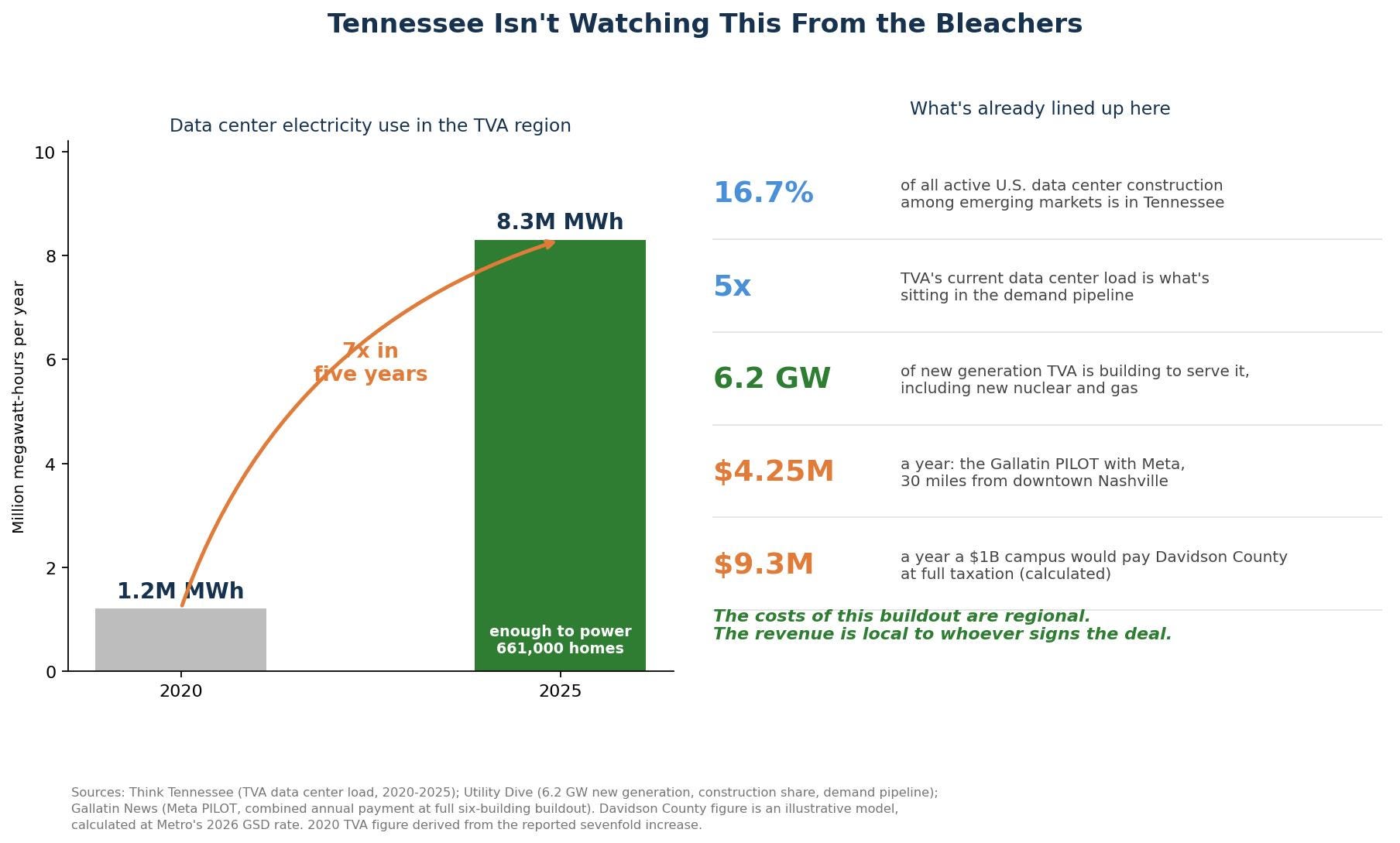
$9.3 million dollars. Every year. From one building on a few hundred acres, with little social services demand, no direct schooling demand, essentially no traffic at shift change, and no new fire or police station required. For scale, the average Nashville teacher earns about $59,891 (MNPS/PayScale), so that single facility’s full tax bill is roughly 155 teacher salaries. Over a 20-year horizon at full taxation, it’s about $186 million.
We opened with the teachers, but wages and bonuses from data centers don’t stop there.
In Richland Parish: classified school employees (aides, cafeteria staff, custodians) got bonuses up to $17,472, up from $3,323 (GovTech).
The sheriff’s office and the Holly Ridge Fire District got new equipment.
Louisiana Delta Community College got $5 million for scholarships, and
Every Richland Parish high school graduate, starting with the class of 2026, gets a full ride for any data-center-related trade certificate (Meta).
Holy moly!
Then there’s the wage floor, my favorite underrated effect.
Meet Scott Holmes, he has run a charter bus company for 29 years. Since Meta broke ground he’s gone from 40 coaches to 102, and his drivers on the site earn over $80,000 a year in a parish where median income is $42,000. A couple started Holy Tacos in Rayville “because Meta was coming to town”; it now feeds hundreds a day. HeBrews Coffee went from 40 customers on a good day to over 130 and is opening its fourth location.
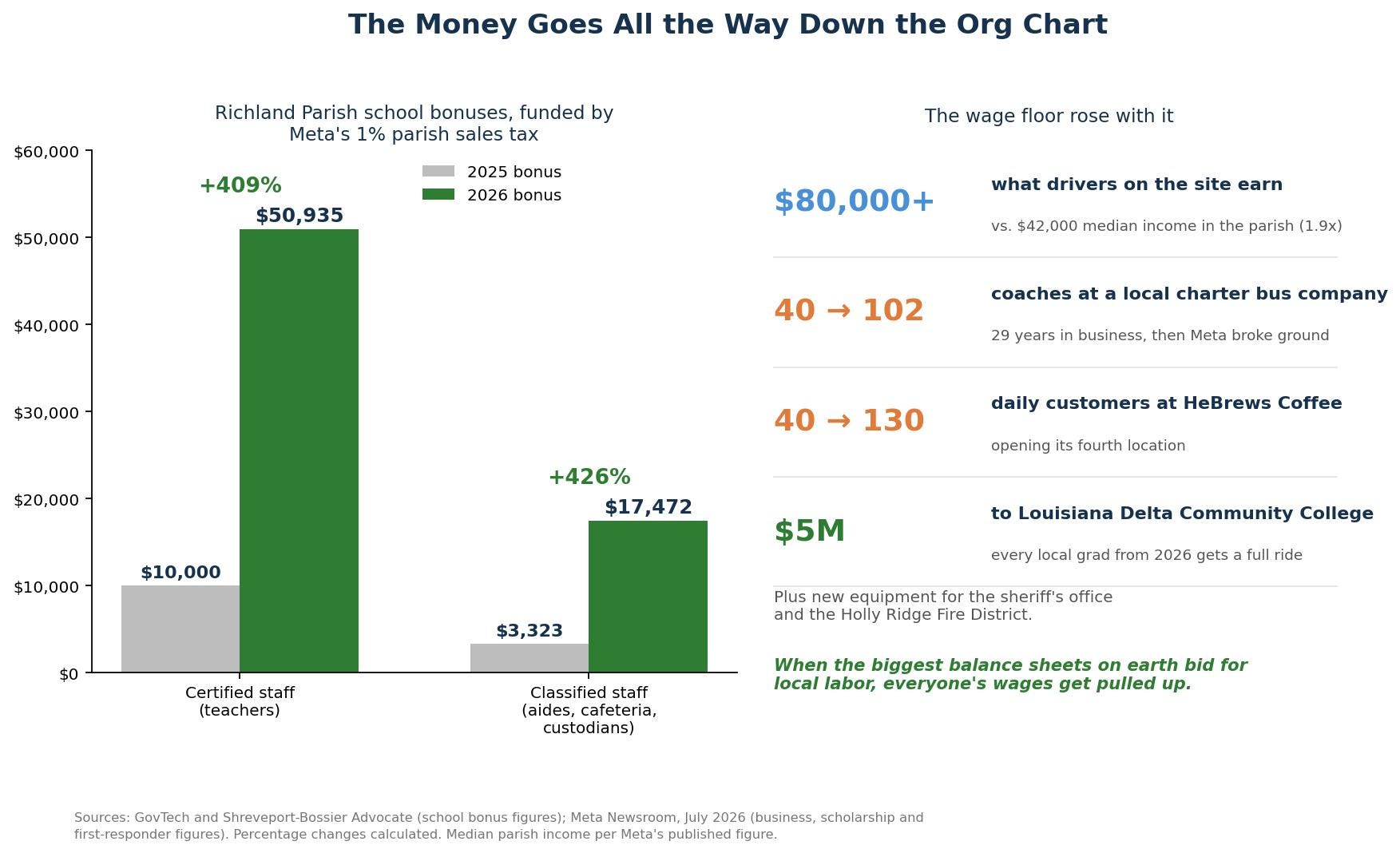
When the biggest balance sheets on earth start bidding for local labor, everyone’s wages appear to get dragged up: the bus driver’s, the electrician’s, the teacher’s. We wrote about this exact force in Eggs Are Cheap Again. Electricians, Not So Much.
The data center buildout is a decades-long boom for the skilled trades and blue-collar workers.
Now this is more of a half truth, so let’s be precise.
True: construction employs thousands (500+ county workers are on the Vineland site right now, and $1.6 billion in contracts have gone to Louisiana businesses at Hyperion), and a finished hyperscale campus runs on far fewer people. Independent studies put typical permanent staffing at 50 to 200 per facility, with big multi-building campuses reaching 400-500 (Brookings). Meta says Richland will support 1,000+ ongoing roles across its 10-million-square-foot campus. Google’s Oklahoma campus runs about 400.
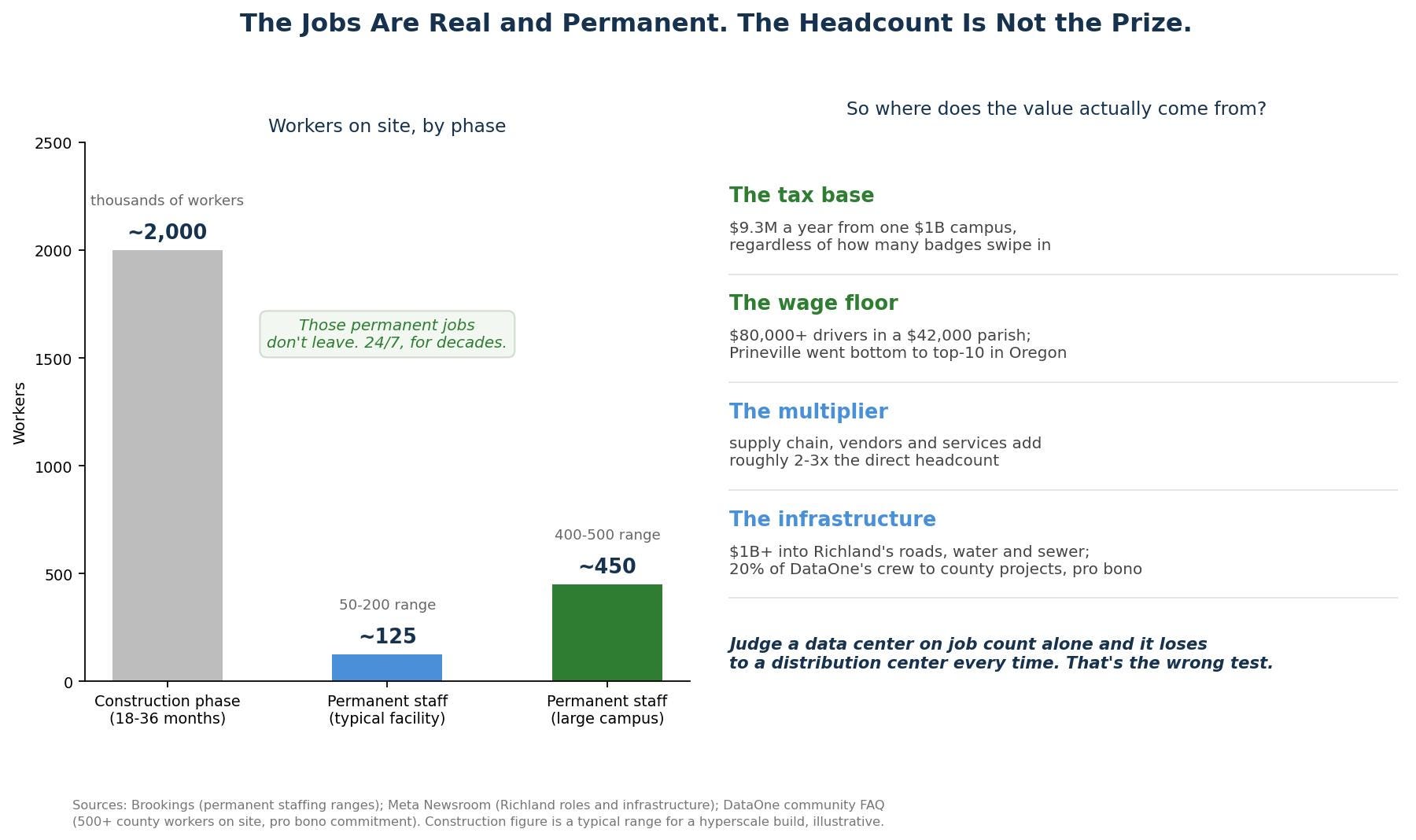
Also true: those jobs don’t leave. Servers need security, electricians, HVAC techs, network engineers, and facilities crews, 24/7, for decades. These are permanent, well-paid, recession-resistant jobs. And they multiply: supply chains, services, and vendors add roughly 2-3x the direct headcount.
But here’s the honest frame, and I’d rather you hear it from me: if a town evaluates a data center on permanent job count alone, it will lose to a distribution center every time. That’s not the prize. The prize is the tax base, the wage floor, and the infrastructure the operator builds and leaves behind: Meta is putting $1 billion+ into Richland’s roads, water, and wastewater systems. DataOne has committed that after construction, at least 20% of its construction workforce goes to Cumberland County infrastructure projects, pro bono. Judge the whole package, not the badge count at the gate.
This is the smartest objection, so it deserves the smartest rebuttal, and it comes from Gavin Baker of Atreides Management, one of the earliest Nvidia investors and probably the most-cited voice on AI infrastructure.
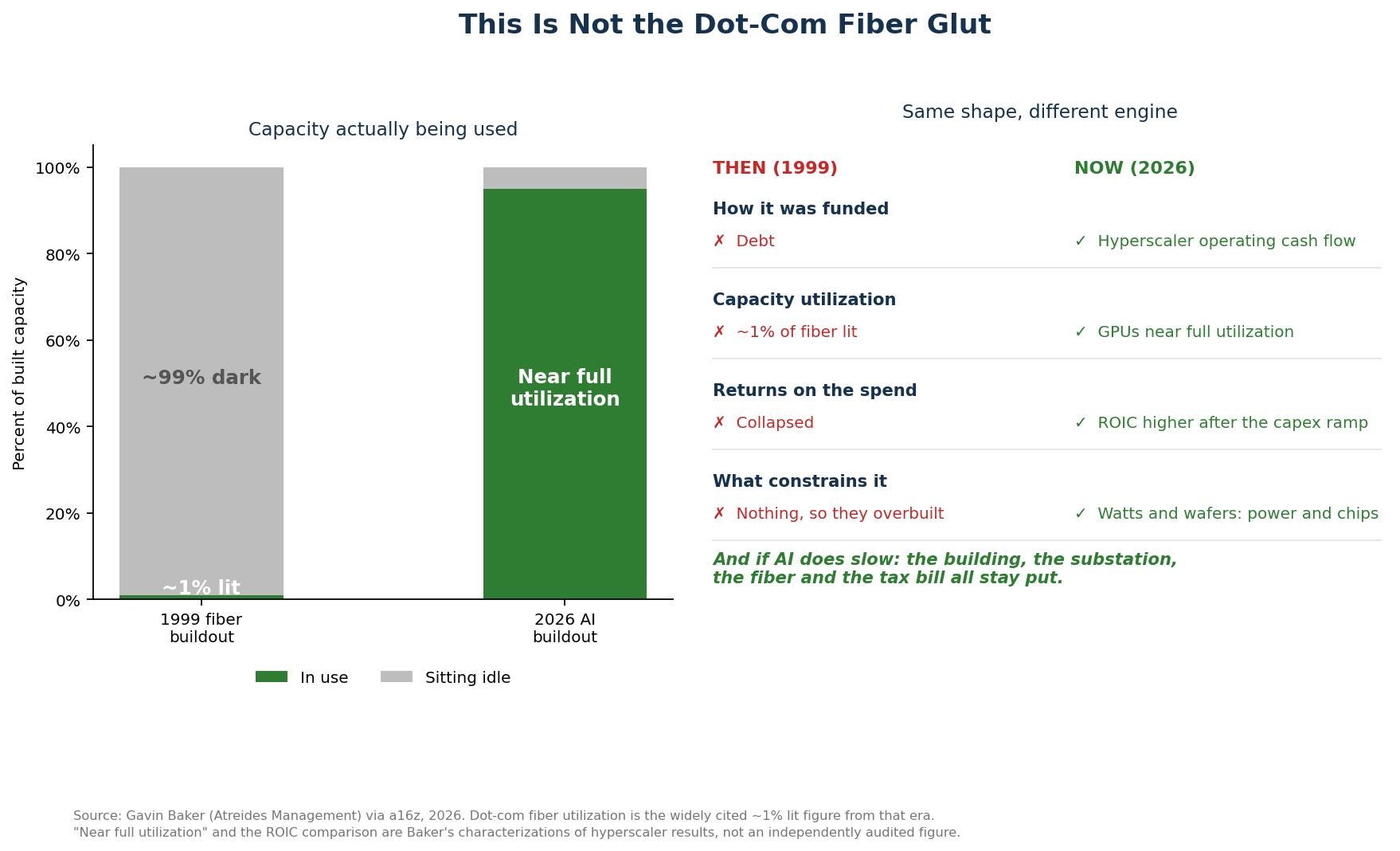
The dot-com comparison fails on the financing. The 1999 fiber buildout was debt-funded, and about 99% of the fiber sat dark when the music stopped. Today’s buildout is funded overwhelmingly from hyperscaler operating cash flow, and the GPUs run near full utilization the day they’re racked (a16z). No debt spiral, no dark capacity.
It’s also, per Baker, empirically productive: he points to audited financials showing the return on invested capital of the big AI spenders is higher today than before they ramped capex. Spending $400 billion a year and getting more profitable while you do it is not what a money pit looks like.
His frame for the whole cycle is “watts and wafers”: the buildout is constrained by physical supply of power and chips, and as long as those stay scarce, overbuilding is nearly impossible. He expects the power shortage itself to ease in 2027-28 as new generation comes online. His honest caveat, which I’ll adopt as mine: if the capex strains power, copper, and capital markets faster than AI raises productivity, the story turns into bottleneck inflation instead. Watch that. But a community weighing a 40-year tax asset against “what if AI slows down” should notice: the building, the substation, the fiber, and the tax bill stay put either way. This connects to the argument we made in Why I Think the Next Fed Move Is a Cut: AI-driven productivity is disinflationary over time, and the physical layer of it is being bolted to American ground right now.
Every data center argument is a forecast except this one. Prineville, Oregon already ran the experiment.
In 2010, Prineville was a busted timber town: five shuttered sawmills, 20% unemployment. Facebook came in 2010, Apple in 2012, lured by cheap land and 15-year tax abatements worth about $45 million each. The town got called naive for giving away the farm.
Fifteen years later: roughly $2 billion in data center development. 400 permanent jobs in a small town. Weekly wages that went from the bottom of Oregon’s rankings into the top 10. A 5% electricity franchise fee that pays the city $2.2 million a year, up from $340,000 in 2010, because the campuses buy $40 million of power annually. And now the abatements are expiring, the $2 billion lands on the tax rolls, and annual revenue is headed from $4 million to $9 million (CNBC).
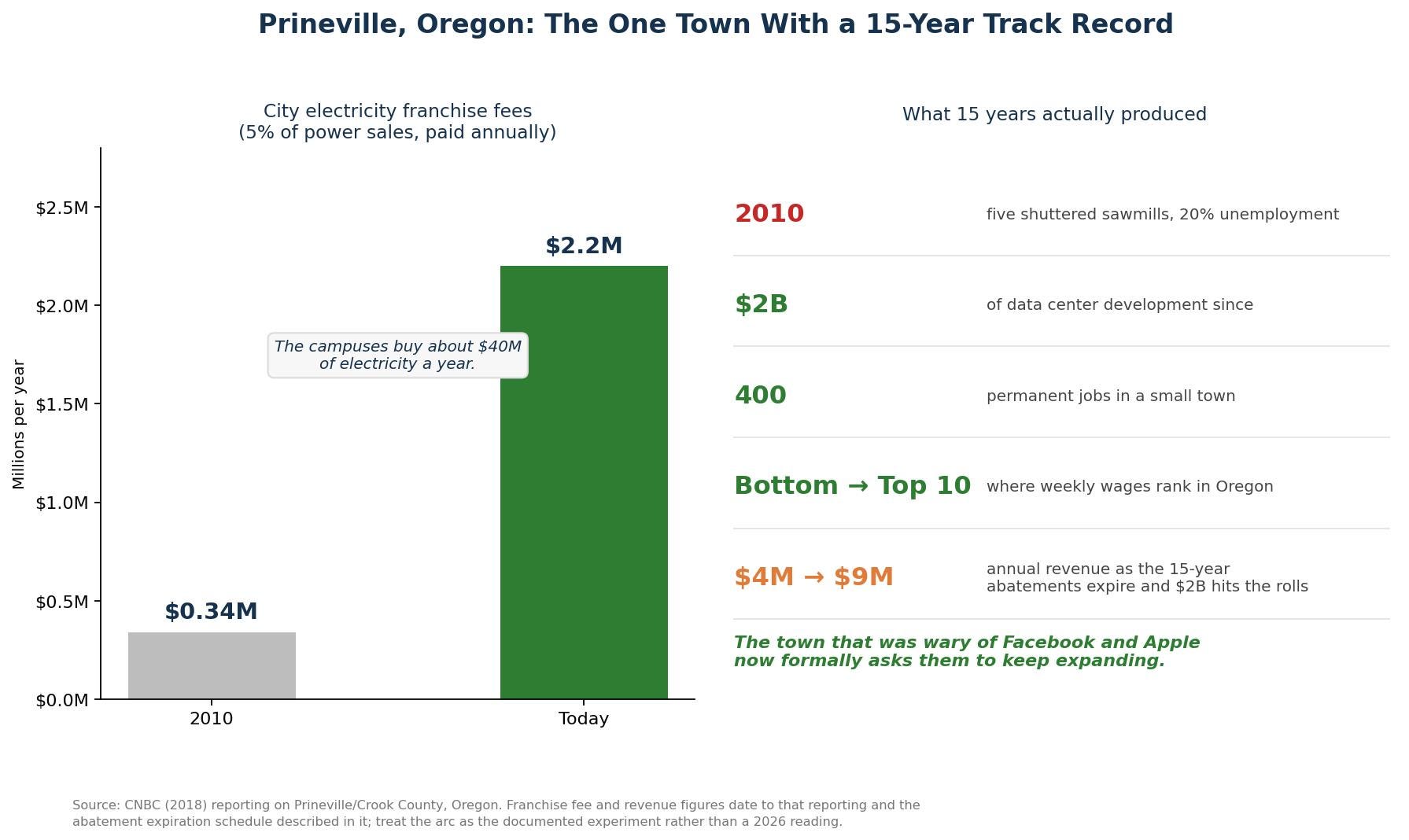
The town that was “wary of Facebook and Apple” now formally asks them to keep expanding. That’s the revealed preference of the one American town with the longest track record. Not a promise. A result.
Tennessee isn’t watching this revolution from the bleachers. We’re in it.
Data center power use in the TVA region grew sevenfold from 2020 to 2025, to 8.3 million megawatt-hours (Think Tennessee). Tennessee now holds 16.7% of active data-center construction among emerging U.S. markets, the demand pipeline is five times TVA’s current load, and TVA is building 6.2 gigawatts of new generation to serve it, including new nuclear and gas (Utility Dive).
Fortunately, we have the land. We have the fiber. And we have the growth story (we made the case in The $6.6 Billion Bet on Nashville).
We have the tax structure that turns all of it into prosperity for everyone.
All it takes is sensible electric generation policy.
So what would it actually mean for TN real estate investors, agents and residents?
A tax base that funds city services without touching your bill. Loudoun County, VA cut its property tax rate ten years running. Nashville homeowners have watched reappraisals do the opposite!
Rural Middle Tennessee counties get the Richland effect. Robertson, Cheatham, Dickson, Maury: places where a single campus could transform a school district’s discretionary money and let it pay teachers competitively for the first time.
Two waves of housing demand for every landlord and agent within thirty minutes. Crews first, operations staff second. Landlords and realtors helping first time homebuyers are going to be busy!
Importantly: TVA has already pledged “electric rate fairness” so new demand pays its own way (Axios Nashville), and the state’s 2026 law makes facilities over 50 megawatts fund their own power infrastructure.
In other words, electricity for data centers in TN is BOYG: Bring Your Own Generator.
The arithmetic here appears friendlier than the politics. Nashville is working through moratoriums, zoning fights, and project-specific opposition, and honestly it’s all political and gross.
But if Tennessee’s cities and counties negotiate like Loudoun and Richland did instead of turning projects away, this will be an age of abundance for Tennessee residents.
Everything above is nice for civics class. Here’s why it belongs in YOUR underwriting. A data center doesn’t compete with your tenants or your buyers. It creates them.
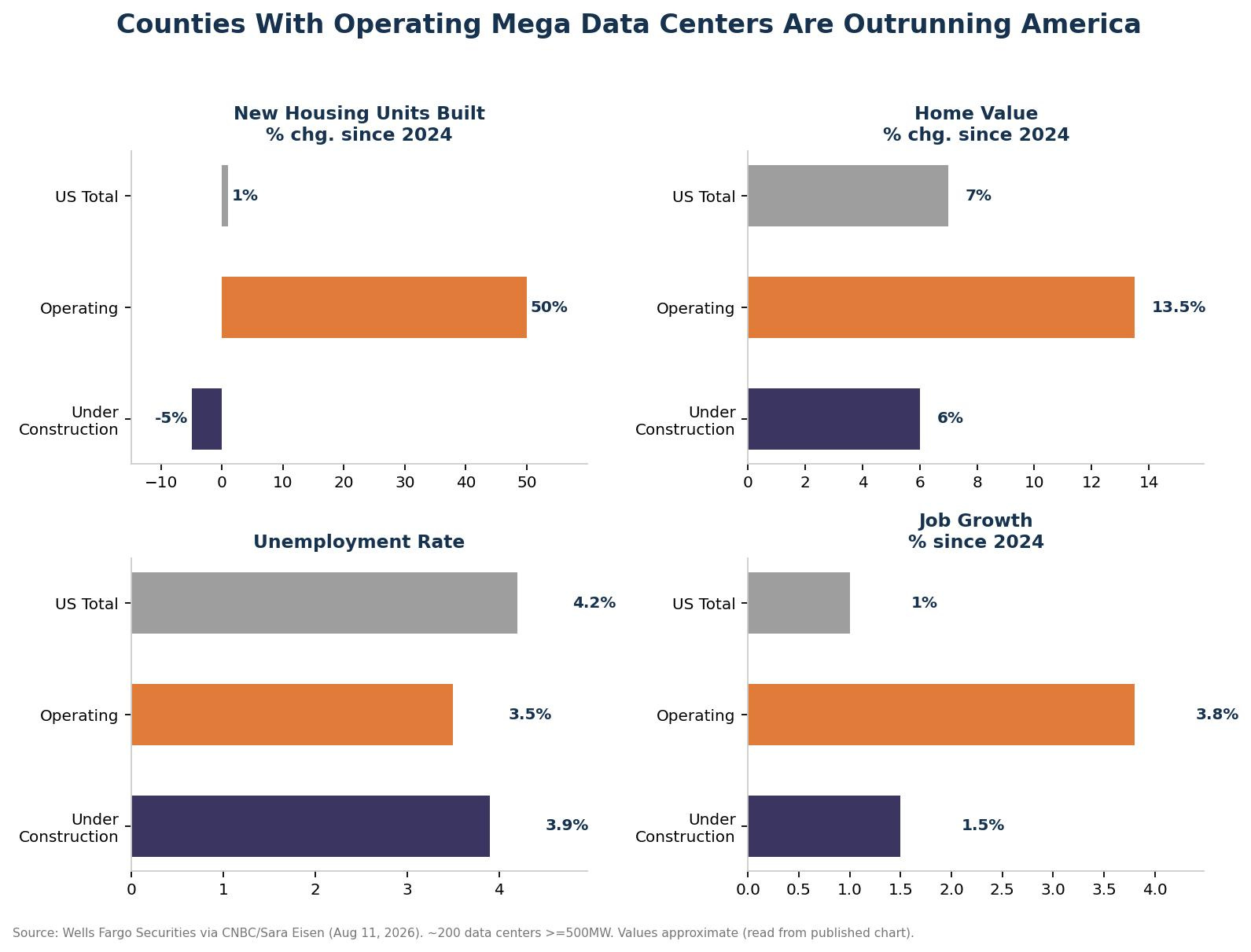
The Wells Fargo receipts. Wells Fargo Securities tracks about 200 mega data centers (500MW+) and compared their host counties to the nation since 2024 (via Sara Eisen/CNBC).
Counties with OPERATING data centers saw:
New housing units built: up roughly 50%, while the U.S. overall built essentially zero net new. Read that again: the data center counties are out-building the entire country. The “they crowd out housing” claim appears not just wrong but backwards. Demand showed up, and supply followed.
Home values: up ~13-14% since 2024, roughly double the national ~7%.
Unemployment: ~3.5% vs. 4.2% nationally.
Job growth: ~3.8%, nearly four times the national ~1%.
One nuance worth respecting: counties where the data center is still under construction don’t show these gains yet. The benefits appear to ramp when the campus turns on and the permanent payroll, the equipment tax, and the vendor ecosystem arrive. If you’re investing in a host county, the reward comes on delivery, not groundbreaking. Patience is part of the strategy.
Two waves of housing demand, and you can rent to both.
Wave one is construction: thousands of workers for 18 to 36 months. They need somewhere to sleep tonight, not in two years. In small host markets this creates a mid-term rental gold rush: furnished units, extended-stay, room-by-room, RV pads. Landlords within 30 minutes of a groundbreaking are suddenly running hotels. (If you own in one of these counties, look up crew-housing rates before you sign your next 12-month lease at the old number.)
Wave two is operations: the permanent staff, plus the bus drivers, contractors, vendors, and coffee shops around them. These are $80K-$120K households in markets where that buys a house. They rent first, then they buy. Landlords capture wave one; agents capture wave two. Richland Parish home prices are up roughly 63% since Meta arrived (Yahoo Finance). That’s not a housing crisis, that’s what it looks like when high-wage demand lands in a market that never had any. Every owner in the parish got paid, and every agent’s volume went up.
Your land has a new buyer. Hyperscalers are paying premium prices for utility-served parcels near power and fiber (HousingWire). To be precise: they bid on land, not houses. Nobody is outbidding a family at an open house. But if you hold dirt near a substation, a transmission line, or a fiber route, the strongest balance sheets on earth just joined your buyer pool. Land near power infrastructure is the new corner lot.
The adjacent commercial / small business play. Holy Tacos and HeBrews Coffee exist because a campus came. Multiply that by every vendor, subcontractor, and service business a $50 billion project needs. Small commercial, flex space, and mixed-use near the site catch that wave, and those are exactly the assets readers of this newsletter actually buy.
The tax-base kicker for home values. This one is subtle and agents should use it. In Loudoun, silicon pays the county’s bills, so homeowners enjoy the lowest property tax rate in Northern Virginia while schools get funded. Lower carrying costs plus better-funded schools is a durable support under home values. “The data center pays your property taxes” is a listing-flyer line that happens to be true.
And the trades. The buildout is a ten-year bid for electricians, HVAC techs, and skilled labor. If you flip or renovate, this is a cost headwind: construction input prices jumped 2.2% in July alone (BLS PPI). If you’re advising a kid on a career, it’s the opportunity of the decade. Both are true.
The five wealth engines I lay out in the book: cash flow, appreciation, loan paydown, tax benefits, leverage. A data center county feeds the first two directly: rents from the demand waves, appreciation from the comps. The other three come along for the ride.
A Quick Ad Break…Your Company Here!
Want to advertise to the more than 60,000 weekly readers of The Skeptical Investor? You can! Advertise with us; we can help you grow your business. Reach out.
Ok, back to business.
Every generation gets one major boom cycle.
Coal and then Oil energy revolution.
Railroads.
The interstate highway system.
The electrical grid itself.
The PC revolution/Internet.
Some were loathed while they were being built: loud, disruptive, enriching somebody else. And each one quietly decided which towns thrived for the next half-century and which ones you now drive past without stopping.
The data center is this generation’s version. Industrial Revolution 2.0, and America is winning it: more than half the world’s hyperscale capacity sits on our soil. Yet the discourse around it has the quality of a mob with pitchforks.
But the data is clear: electric rates down, low water use, property taxes down, and $50,000 checks landing on teachers’ desks in one of the poorest parishes in Louisiana.
I’m not asking you to love the windowless box that may get built next to your zoo.
I’m asking you to notice what it pays for.
The skeptic’s job isn’t to join the mob or the marketing department. It’s to read the contract. The towns cashing teacher bonuses and the towns suing over their power bills are hosting the same building; the difference is likely politics, unfortunately.
Communities don’t appear to get hurt by data centers. They get hurt by bad deals, and bad deals are optional.
And for us, the investors and agents: the map is being redrawn in public, county by county. The counties that land these campuses out-build the country, out-grow it 4-to-1 on jobs, and hand their homeowners a tax cut. That’s not a tech story. That’s a comps story, in my humble opinion the clearest one of the decade in real estate.
And Tennessee is holding one of the better hands at the table.
John F. Kennedy said it in his inaugural address: “Let us never negotiate out of fear. But let us never fear to negotiate.”
Don’t fight the data center. Negotiate it. Then buy that next rental deal two miles away.
Until next time. Stay Curious. Stay Skeptical.
Herzliche Grüße,
-P.S. If this newsletter has been useful to you, the best gift you can give me is free: forward it to one person who’d benefit. I promise you 24 hours of good joo joo.
You can consult one-on-one on the phone with me, The Skeptical Investor!
Get professional advice from someone who actually owns, operates, and brokers real estate. Not just some partner in a fund making money off others.
Want to Grow? - Get clarity on how to grow your business or scale.
Stuck? - Get answers to your problem, let’s hop on the phone and figure it out.
No “guru” trying to sell you an expensive course. No BS. No fluff. Only results.
I’ll give you my frank, brutally honest advice. Book a call with me today.
It’s 2026. Be an owner.
Comments
Nothing yet. Say the first thing.
Sign in to join the conversation.