
By Carlo Rindi Nuzzolo
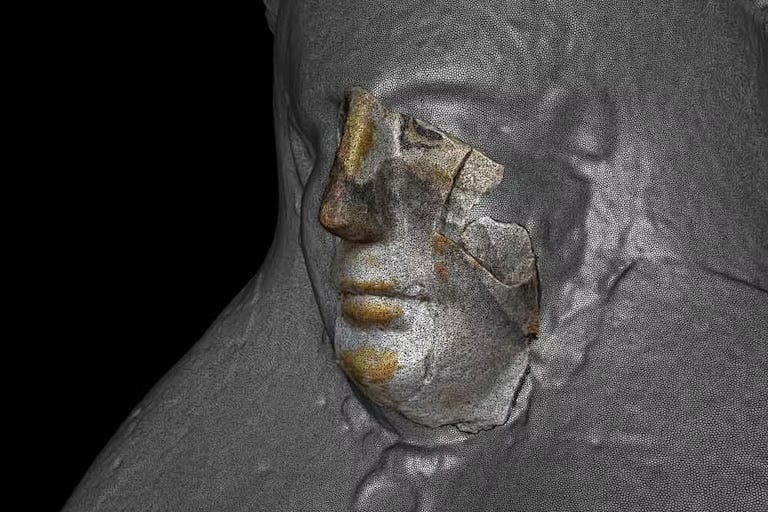
Archaeologists working in the field today regularly uncover fragments: broken pieces of objects that once formed part of something larger. In some cases, those fragments may share the same underlying geometry with objects already held in museums. For example, a mummy’s foot case and a newly found shard may have been produced using the same mold, so they share a consistent three-dimensional form even if they are now separated by time, distance and absence of documentation. Traditionally, evaluating whether a fragment matches up with a specific museum object has relied on visual judgment and incomplete records, rather than a quantitative comparison of shape. Can we use digital tools to test whether fragments and museum objects might be related and, in doing so, recover parts of their histories that were previously inaccessible?

Join the Friends of ASOR Philadelphia Tour from April 16–17, 2026 for exclusive, behind-the-scenes access at the Penn Museum, the Barnes Foundation, and the Philadelphia Museum of Art, featuring expert-led tours by Penn Museum Director Chris Woods, Richard Zettler, Michael Danti, Phil Jones, Steve Tinney, Marie-Claude Boileau, Katy Blanchard, Kaelin Jewell, among others, with special lectures, and insights into archaeology, art, and artifact analysis. Find out more info and reserve your place here!
Predynastic copper alloy tool found in 1920s at Badari turns out to be earliest known rotary metal drill from ancient Egypt. Read more at Sci.news.
Researchers debunk the theory that lead poisoning brought about the downfall of the Roman Empire. Read more at LBV.
Gemstone seal dated to the time of the Kingdom of Judah discovered during construction works in northern Israel. Read more at Arkeonews.

Researchers uncover new evidence of a major medieval Islamic settlement in Menorca. Read more at The Brown Daily Herald.
New study suggests that the ancestors of wheat, barley, and rye were less widespread among the first farmers 12,000 years ago than previously believed. Read more at phys.org.
Newly identified chronicle at St Catherine’s Monastery dated to the 8th century CE is one of the earliest surviving Christian sources discussing the expansion of the Arab-Islamic empire. Read more at medievalists.net.
Rodin’s Egypt runs through March 26 at the Institute for the Study of the Ancient World (ISAW) in New York. ISAW has also put together an impressive virtual exhibition to accompany the physical exhibition.
Heritage DNA: Resilience at the American University of Beirut Archaeological Museum. This public lecture by Dr. Nadine Panayot explores the study and safeguarding of heritage in a city repeatedly shaken by conflict. The lecture (with great illustrations) took place at the Met, and is now posted on their YouTube channel.

Located at the confluence of the Karun and Tigris rivers in southern Iraq, Charax Spasinou (“Rampart of Hyspaosines” was originally founded by Alexander the Great to connect inland waterways to the north and east with the open sea. The early city was destroyed by flooding, but was was refounded and developed in the 2nd century BCE by King Hyspaosines, a local Iranian ruler. The new city was named after him and became capital of the region.
As the biggest port in the region, Charax Spasinou connected the markets of Afghanistan, India, and China with the capitals of the Seleucid and later Arsacid kingdoms. Exactly when the city was abandoned is unknown, but probably came about as the Tigris moved further to the west in the early centuries CE. In modern times, the location of Charax Spasinou was recognized by archaeologists via satellite footage in the 1960s. Since 2016, archaeological exploration has been undertaken by British and German teams through geophysical research and test trenches. This work has revealed that the city at its height was very large – about 7 square kilometers.
Read more about the site and the recent work here, or watch a lecture (organized by ARWA) by the project co-director.
Megalithic Landscapes of Ethiopia from Prehistory to the Modern Era (African History Extra)
The Hidden Threat Eating Away at Museum Treasures (Scientific American)
The Skulls of Jericho (The Ancients | History Hit)
The Case of the Very Different Iron Age Shipwrecks at Dor, or, Underwater Insurance Adjusters, Assemble! (This Week in the Ancient Near East)
By Ianir Milevski and Liora Kolska Horwitz
Capable of carrying heavy loads over rough terrain, the humble donkey was the jeep of late prehistory. Can we determine when and how they were domesticated? Read more here.
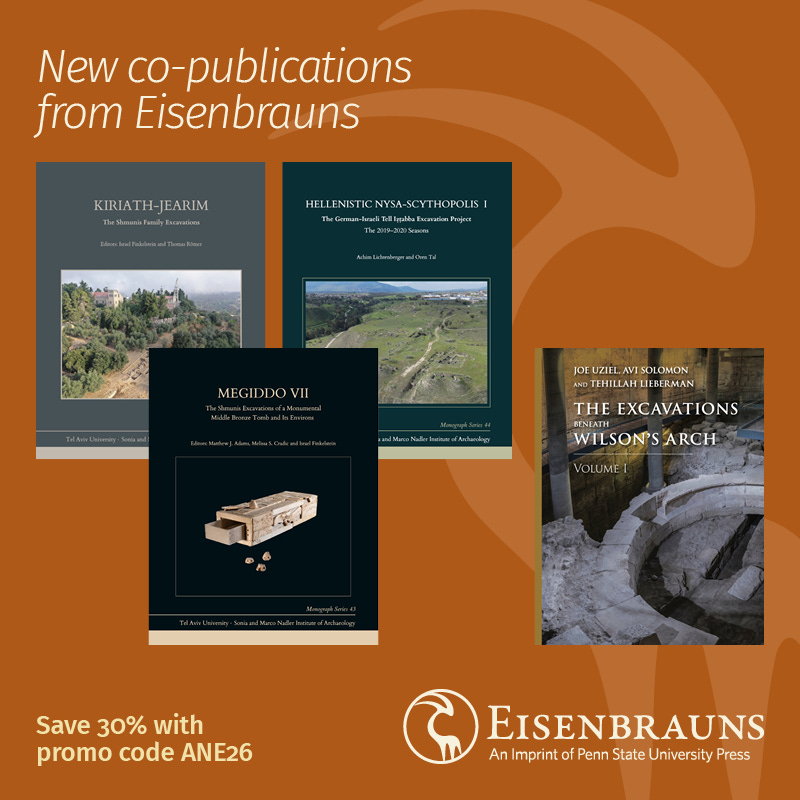
Eisenbrauns is proud to partner with The Institute of Archaeology of Tel Aviv University and Ancient Jerusalem Publications to bring landmark archaeological research to a global audience. These new co-publications present meticulous fieldwork, rich documentation, and fresh interpretations from some of the most significant sites in the ancient Near East. Explore these books and more at eisenbrauns.org, and save 30% with promo code ANE26.
Sign up for BookNews to stay up to date on new and forthcoming titles in archaeology for Eisenbrauns.

Are you in the greater Washington D.C. area? Glenn Corbett (Editor-in-Chief of Biblical Archaeology Review magazine) will discuss some of the top biblical archaeology finds and stories from the past few years, from groundbreaking new discoveries about Jerusalem in the time of the biblical kings to dramatic breakthroughs in our understanding of the history and writing of the Dead Sea Scrolls. Find out which discovery tops the list AND get a sneak peek at some of the fascinating and thought-provoking articles being prepared for BAR this coming year! This lecture will be held on Sunday, February 22 at 3:00 pm (luncheon at 2pm), at Namaste Jalsa Restaurant in Alexandria, Virginia.
Enjoy what you’re reading? Consider supporting ANE Today through a once-off or recurring donation to ASOR.
Published with the assistance of The Lanier Theological Library and Stevan Dana
No posts
Comments
Nothing yet. Say the first thing.
Sign in to join the conversation.