
10 abril 2026
Hola y welcome back to CubaCurious.
Thanks so much for being here.
For years, every time I asked average Cubans how they were doing they often answered the same way. Resolviendo (solving problems) or inventando (inventing solutions).
Understandable responses considering the chronic shortages of everything from cooking oil to toilet paper on the island. But resolviendo and inventando are the permanent state Cubans live in now.
Most Cubans go into problem-solving mode the moment they wake up. Sometimes that happens at 3 am when the power comes back on after a blackout. That’s why people leave their light switches turned on when they go to bed during a blackout. If they want to eat rice for dinner the next day, wash a pile of dirty clothes, or run the water purifier that Tía Berta sent them from Kansas, they have to get up, plug in the appliances they shut off when the power went out (those surges will fry them)—and get crackin’.
What would it be like if Cubans’ energy and resourcefulness could be unleashed from the economic straitjacket the regime uses to ensure no one gets richer than their neighbors (unless they’re in the cupula of power)?
I see signs of great, if exhausted, resilience from average Cubans every day. I thought I’d share some of them with you this week, take a break from another painful human rights update from the island. After all, you wouldn’t be surprised if I told you that not even one of the prisoners released in the last week—of the touted 2010 the regime said it would free—had been in jail for political reasons. Or that the two young anti-regime creatives of El Cuartico, Ernesto “Tico” Medina and Camil Sallas Pérez, are entering their second month in detention for simply saying, publicly, what so many young Cubans feel. They don’t want to live in fear anymore. They don’t want to be punished for thinking differently.
Since the U.S. capture of Nicolás Maduro in January, Venezuela and Nicaragua have freed some political prisoners. But not Cuba—other than 27 of the 51 prisoners released last month in a much-promoted “humanitarian” gesture. And those 27 releasees are under harsh restrictions, deprived of true freedom, and likely—because many remain committed to speaking their minds—to end up in prison again.
So, let’s turn away from what’s been taken from Cubans and look at the creative ways they’re solving the problems their government can’t or won’t address. Each example of Cuban ingenuity below was sourced from El Toque articles mentioned in this recent news video.
An estimated 70% of Cubans face daily water shortages. Maybe your barrio hasn’t had water service for seven months, like the Pitilla and Primero de Mayo barrios in Trinidad. But you’ve been thinking. You know a guy in a nearby barrio that gets water now and then. He’s been looking for a muffler for his car. You scored one the other day on the black market for a great price, knowing he’d be interested. Maybe he’ll barter. A 1978 Ford muffler if he lets you fill a 30-gallon container (which you and your neighbor made from soldered scrap metal) with water that’s as precious as gold right now.
Many Cubans I’ve met or spoken with are skilled at free market, supply and demand basics—not to mention arbitrage. They know if a black market produce vendor in outlying barrio x sells low, they can buy early in the day from him and sell high later to black market customers in the city. Strange, how a communist system can spark capitalistic thinking. That’s a kind of accidental creativity.
Three state aqueduct workers in Trinidad are capitalizing on that kind of thinking, according to townspeople who reported them to El Toque. They say the men have been running a lucrative water supply business for years by shutting it off and making townspeople buy it from them. “That business is backed by the top figures of the PCC (Communist Party of Cuba) and the government . . . people are outraged at the injustice, one of them wrote. “It’s painful to see old folks carrying water because of these corrupt people. This business has been going on for years. They limit water in some zones and open it in others to maintain the appearance that they are supplying it. Everyone knows this is happening. Please publish this.”
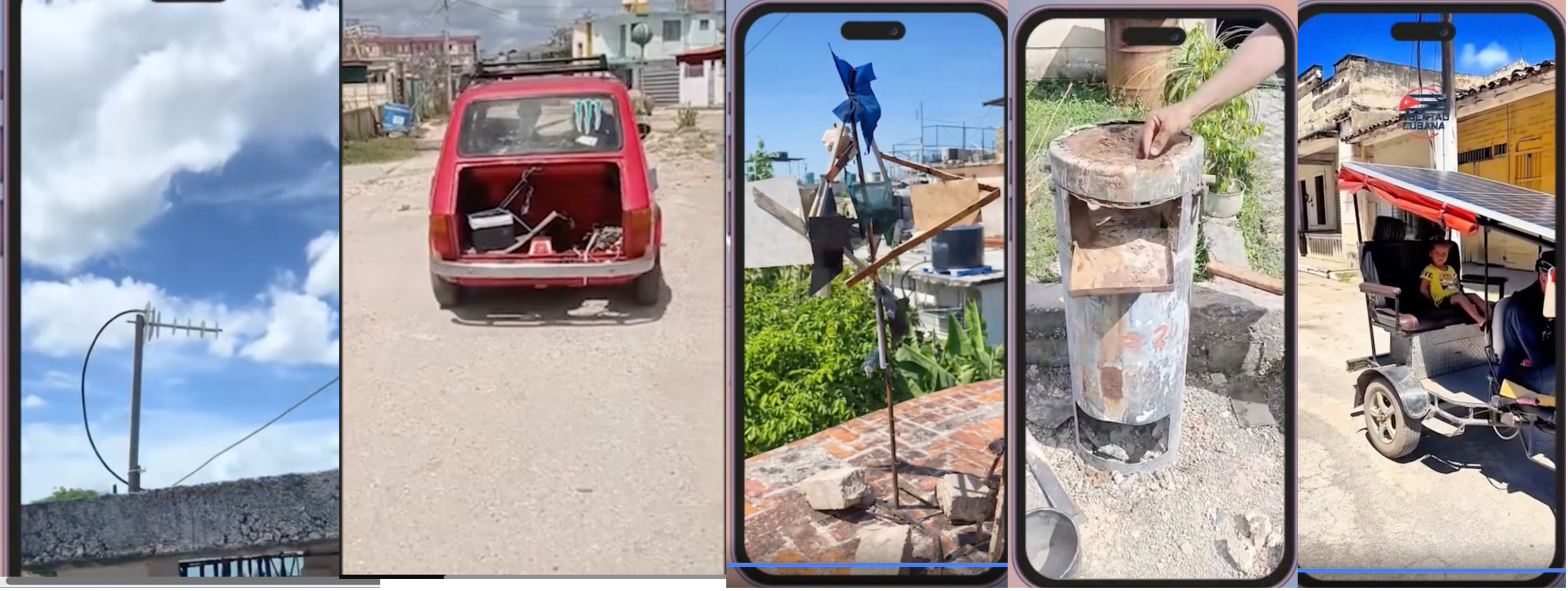
Other Cubans are using their creativity to solve problems more fairly. I read about a cubana who bought “at a very reasonable price” a home-made antenna from a DIY black market telecom guru in her neighborhood. He rigged a coaxial cable attached to a wooden phone stand to a gadget that, to me, looks like an auger. He set the auger-antenna into an inconspicuous area on the woman’s terrace and now she can access 4G internet, a luxury most Cubans can’t afford due to the state monopoly’s exorbitant rates.
“I just have to set my phone on the plug in the little wooden stand,” she said, quite content with her new purchase.
Elsewhere . . . an unemployed man began experimenting on a gasoline-powered Polish-made car and managed to convert it to an electric vehicle that goes 100 kilometers on a single charge. The inventor said he removed the old motor, clutch, gas tank, and modified the back of car, where the new electric motor would go. “I used a Dogma electric battery, 75watt, 75 amperes.” He’s charging about $2000 USD for the conversion, but he says the price might go down as he improves the process.
Thanks for reading CubaCurious! This post is public so feel free to share it.
The cleverest invention I saw this week is a wind-powered pot-banging protest machine. The inventor told El Toque he was fed up with not being able to protest the constant power outages by banging pots and pans in the cover of darkness. The cazerlolazos have become almost routine in Havana each night and are a relatively safe way to protest. But police have managed to identify some protestors and arrest them. The inventor came up with the idea for the machine after Cuba’s “energy grid went down 3 times in 15 days . . . People need to keep protesting,” he said. “It’s not just the power going out. It’s the kid who can’t learn in school, the worker who goes to work without having slept . . . the hospitals that are in the dark while hotels are all lit up.”
Cubans have been both satisfied and disgusted by the outcome of some protests, because the power is quickly turned on when protests get large or loud. “So is there a deficit or isn’t there one?” a protestor said. “There was fuel suddenly for just this little piece of the barrio? I keep asking myself if this is how they’re going to control us. Because at this rate, five Cubans with some pots and pans might be able to open the Strait of Hormuz.”
Large protests don’t always result in power being restored. Besides “we want water, we want light,” the more dangerous chants of “Libertad,” “down with the communism,” and insults against Cuba’s appointed president, Miguel Díaz Canel, are routinely heard during cazerlolazos. Trucks full of Boinas Negras (Black Beret) shock troops have arrived at some recent demonstrations, searched homes, and made arrests.
The determined inventor of the pot-banging contraption says his machine can help protect Cubans who dare to protest.
“This way, if police go up to the roof, they’ll find a ridiculous apparatus, no one can be traced, or blamed.”
That’s the kind of thinking the new Cuba will need. Brave, creative, community focused—free.
Thanks so much for thinking about this with me. I hope you enjoyed the read. If you did, please let me know by clicking the heart at the end, sharing, commenting, or subscribing.
Hasta la semana que viene.
Ana

The Orishas are one of my favorite contemporary Cuban bands. Yotuel Romero, center above, was a co-creator of the Latin Grammy Song of the Year, “Patria y Vida,” which became an anti-regime anthem in Cuba. If you haven’t listened to that song, I strongly recommend you give it a try.
I’m not a huge hip hop fan but when the Orishas are doing the hipping and hopping, they take me with them. Hope you enjoy.
No posts
Comments
Nothing yet. Say the first thing.
Sign in to join the conversation.