
17 abril 2026
Hola y welcome back to CubaCurious.
Thanks very much for being here.
Every time I think I’m getting better at handling the deeply disturbing stories coming out of Cuba, I hit a week like this one and end up reeling.
Dissidents, activists, and average Cubans reported being physically and psychological brutalized for criticizing the regime in recent days. The daughter of an exiled author whose book criticizes the regime was arrested without cause and threatened with losing custody of her children. A university professor was imprisoned for writing an anti-regime slogan. A mother and daughter who live alone were interrogated and warned that “something bad” could happen to them if they continue posting anti-regime content. A political prisoner who completed his five-year sentence was released in a state of severe malnutrition and suffering from untreated throat cancer and Hepatitis B, contracted while in prison. Prisoners at the same jail where a 75-year-old political prisoner is being held reported that he was brutally beaten and transferred to solitary confinement. There are many, many other tragedies befalling Cubans who think differently than their leaders, who want change.
I’m not sure why I held out hope for better news this week. Rather than easing up amid growing protests and U.S. pressure to free political prisoners, the regime has ratcheted up its repression in recent months. Not that you would think that based on Cuban leaders’ statements in the foreign press this week.
Yet the arrests are growing more violent, based on the latest photos of victims and eyewitness accounts. More people in opponents’ social circles and families say they’ve been detained, threatened.
The latest report by Prisoners’ Defenders, a Madrid-based NGO that documents and tracks politically linked arrests, confirms the regime is going putting on its best jack boots. PD documented hundreds of new arrests related to spontaneous civic protests in recent weeks. Twenty nine percent of those arrested were women. There was an increase in the number of teenagers who were arrested for protesting or accused of politically related crimes. The group is tracking 1,213 known Cuban political prisoners.
“That image that in Cuba anyone who speaks against the revolution is imprisoned is a lie.”—Cuban leader Miguel Díaz Canel to NBC News interviewer.
Meanwhile, I watched Cuba’s appointed president, Miguel Díaz Canel, lie to American journalists in televised interviews. He described a Cuba that doesn’t exist. A Cuba where there are no political prisoners, where he serves at the will of Cuban citizens, and where things really aren’t that bad—that’s just a myth created by the U.S. and imperialists bent on defaming the revolution.
MDC told NBC News that “That image that anyone in Cuba who speaks against the regime is imprisoned is a lie.” He explained that Cubans have been victorious, given the devastating impact of the American bloqueo (blockade, the regime’s preferred term for the partial and porous U.S. trade embargo). They’ve made great achievements—and continue to do so, he said. As he wrapped up a spectacular string of lies, MDC pushed his finger against his nose, a body-language tell linked to extreme discomfort or lying. Not that we needed the clue.
When a reporter asked MDC if he’d step down to open a path for U.S.-Cuba negotiations that could improve Cubans’ lives, he went on the offensive. “Would you ask any other leader such a question? Is that you’re question or the State Department’s question?”
Here, MDC revealed his ignorance of what life is like in a country with a free press and basic freedoms. He couldn’t fathom that, one, the reporter works for an institution that is independent, or at least strives to be, from any political party or the White House. And two, he couldn’t understand that in a liberal democracy journalists are charged with asking probing, uncomfortable questions, especially of elected leaders. They search for the truth, hold elected leaders to account, strive to keep independent voters informed. MDC has been protected entirely from that reality, including needing to think about voters at all.
MDC said he serves as president at the will of the Cuban people and would step down the day they say he should.
¿Perdón? How would that happen?
Many Cubans in and outside of Cuba seemed to share my reaction online and in interviews with the independent journalists. He thinks we elected him? . . . If we elected him, then who lost? Because someone has to lose if there’s an election, right? Show me the loser! are comments that captured the general disgust.
Amelia Calzadilla is a Cuban activist now living in Spain. She has 130,000 Facebook followers and is well respected in the activist community. Amelia decided to conduct a survey, using transparent metrics, asking Cubans what they think of MDC’s leadership. You know, he kind of asked for it.
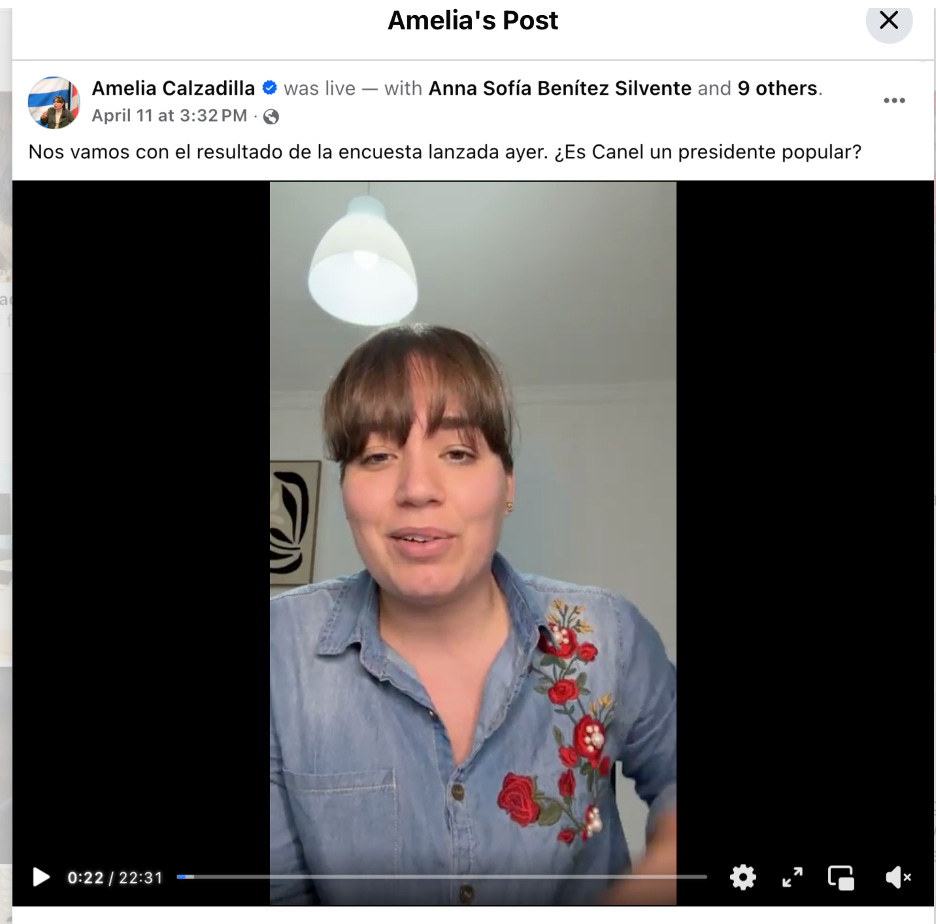
Vote 1 if: MDC has your support and should stay in his post. Vote 2 if: you think MDC is an appointed puppet leader, you did not vote for him, nor would you in your wildest dream ever think of voting for him; he should pack his bags and take the Castros and everybody else in power with him.
In 24 hours, Amelia’s post generated 13,000 comments, 26,000 votes against MDC and 965 voted for him. She knew that most of the 965 pro-MDC votes were made in error. She knows from their past posts that most of those followers do not support the regime and had mistakenly clicked the heart for the wrong option.
But to make it easier, she assumed the full 965 votes for MDC were legitimate. That’s 3% of respondents supporting MDC. In her video opens her account and goes page by page to show the post analytics for the 24-hour period. Roughly 1 million views, something very few of her posts have garnered. And 40,000 interactions/engagements. She shared plenty of other metrics, but those are the big ones.
But the best part about the survey is that 64% of respondents were from accounts inside Cuba, which she proved by zooming in and going page by page through the metrics. Amelia knew the regime would say respondents were members of the gusano (worm) diaspora, paid traitors, mercenaries, the usual accusations it uses to discredit opponents.
“This shows . . . Cubans are speaking loudly and clearly,” she says in the live post where she revealed the survey results. “They don’t want [Díaz] Canel, they don’t want communism and they don’t want the dictatorship to continue . . . And they are hitting “like” knowing it is dangerous, that state security could show up at their door as a result. Now, there are 30,000 other accounts that voted that way. It’s unlikely they’d go after all of them. But they know that their names and data are easily pulled from their accounts. It says a lot about how much they care about this issue.”
“Here’s the data from the Cuban people. . . despite the danger to them, despite the abandonment of their own government, knowing that the international community sides with the dictatorship, seeing the conduct of democratic governments that often back the regime. . . Here’s proof of what Cubans want . . . We want to be free . . . We want to come home.”
Amelia believes in data, hard proof, and an open mic—unlike the regime, which eliminated in the 2019 constitution the only vehicle Cubans had had, at least technically, to bring about change in their government: creating a petition with 10,000 signatures and presenting it to the National Assembly.
“Shame on you,” she said on her post. “You should be ashamed of yourselves,”
Brava, Amelia. ¡Brava!
I have just one short story for you this week, because I think it deserves our full attention.
Thanks for reading. If you appreciate today’s CubaCurious, please share, subscribe, click the heart, tell others so they can join us. Also, let me know what you think of all of this in the comments section.
Gracias.
Hasta la semana que viene,
Ana
Thanks for reading CubaCurious! This post is public so feel free to share it.
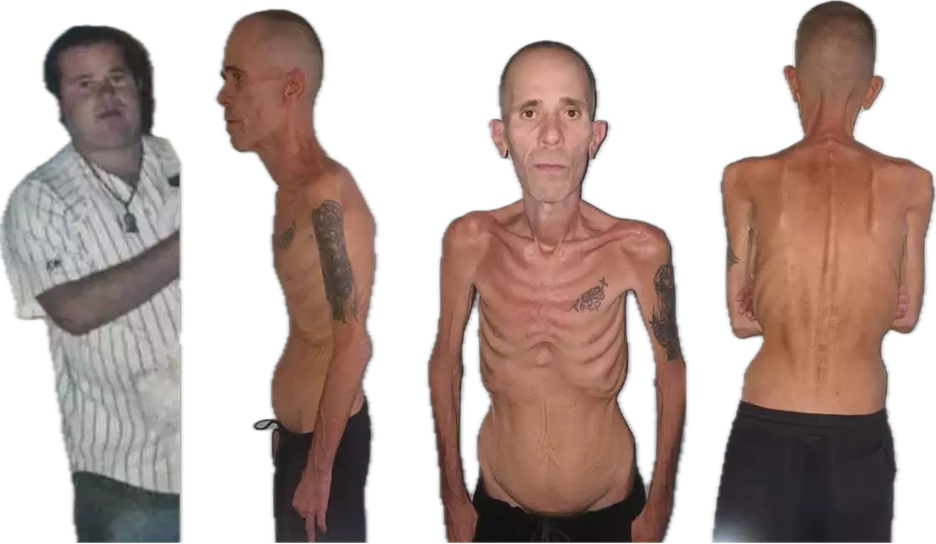
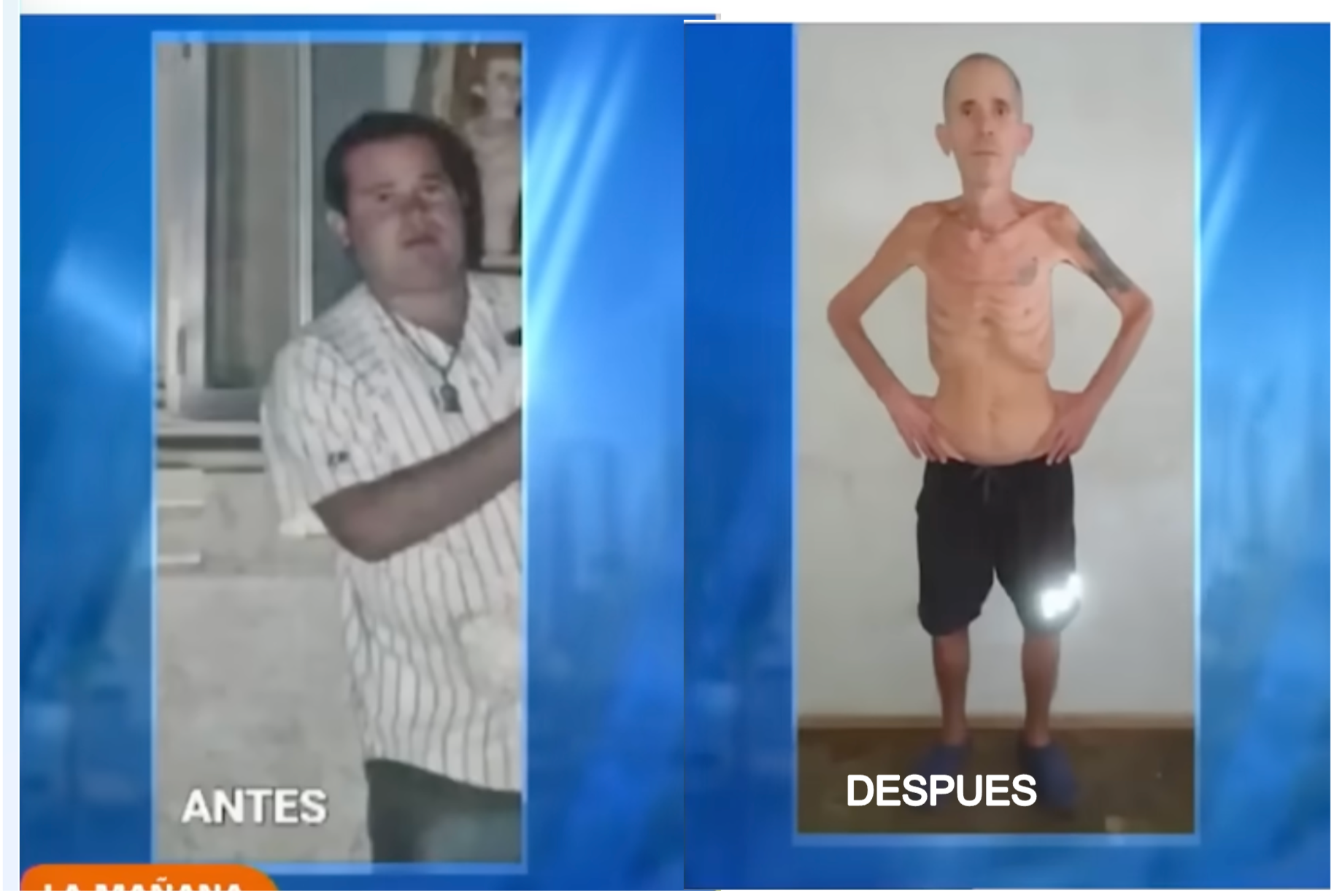
The U.S. Embassy in Havana is evaluating the possibility of a humanitarian visa for recently released political prisoner Alexander Díaz Rodríguez. The 45-year-old was diagnosed with thyroid cancer while he was in prison but did not receive adequate treatment. The visa would allow Díaz-Rodríguez, who also contracted Hepatitis B, anemia, and suffers from gum disease and other symptoms associated with the abysmal conditions of the prison, a chance to go to the U.S. for medical care.
Prisoners Defenders had tracked the case since the activist’s arrest for protesting peacefully in the 11J anti-regime demonstrations. Subjective assessments were used against the activist during his court case, including “poor social conduct,” and “destabilizing actions.” He was given the maximum sentence of five years for “disrespect” and “sedition.”
Legal rights groups and activists denounced the severe judicial irregularities in the case and Díaz Rodríguez’s terminal illness, but the regime denied medical parole. He served his full prison sentence.
The activist’s family said he met the medical criteria for medical parole, but officials were punishing him for his convictions. Díaz Rodriguez was rushed to the hospital several times in critical condition during his 4-year imprisonment but was always returned and did not receive necessary medical treatment. The family also reported threats against them for publicizing the case on social media.
“When I saw the condition he was in, I noticed what I have seen other times in prisoners leaving Cuba: they look like survivors rescued from a concentration camp,” Javier Larrondo, president of Prisoners Defenders, told 14ymedio.
The activist said he was put in isolation cells approximately twelve times as punishment for being “counter revolutionary.” “They were very harsh, very harsh on me. I have gone through quite a few things with conviction for my principles.
The abuse extended to his family, he said. An aunt, the only relative he has left in Cuba, was beaten after demanding his release during one of her visits to the prison.
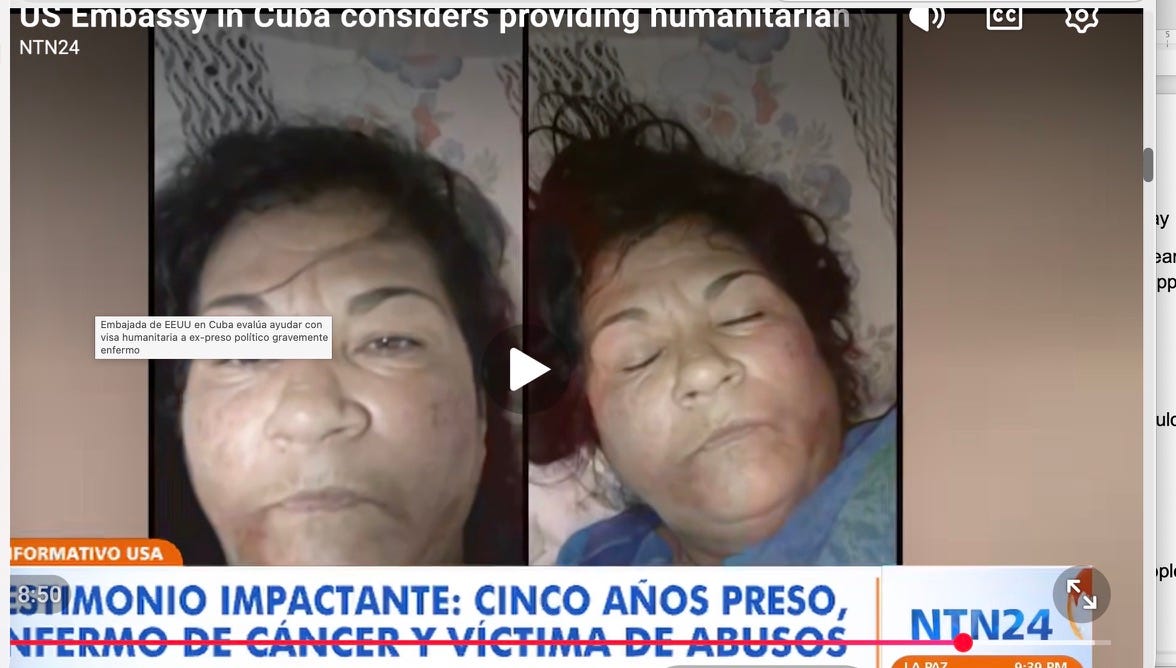
PD petitioned unsuccessfully to have the activist serve the remainder of his sentence at home due to his terminal illness, even presenting the case at the UN.
The activist entered prison weighing about 81 kilograms (178 lbs). He left weighing 37 kilograms (81 lbs). “I’m a bit thin, but I’m alive,” he told NTN24.
PD’s latest, released Thursday, shows a total of 1,213 known Cuban political prisoners.
How many of them are in Díaz Rodríguez’s condition? We can’t know. Cuba is the only country in our hemisphere that does not permit independent prison monitors access to its prisons. Not even the Red Cross.
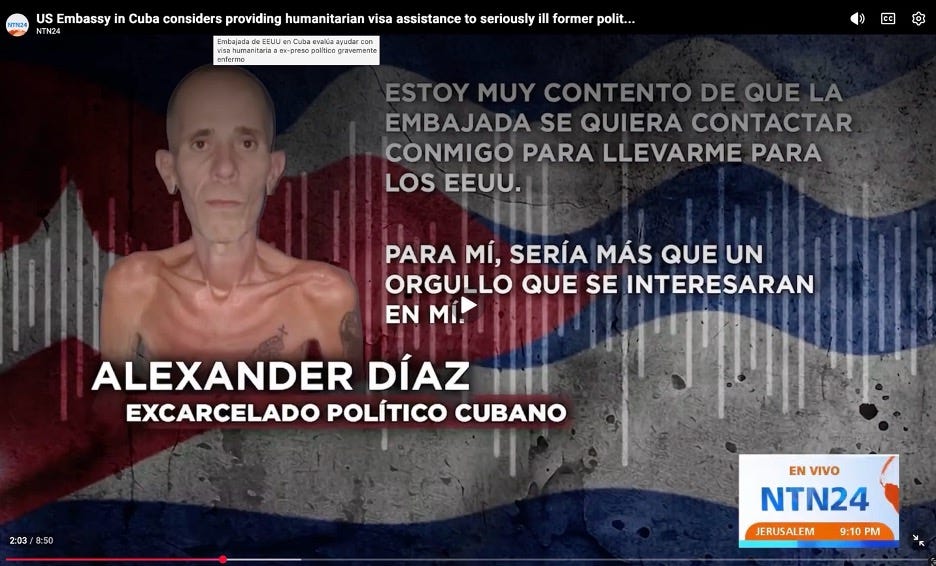
As I listened to Díaz Rodríguez’s interview, I was struck by the gentleness of his voice, his humility, and his deep concern for all Cuban prisoners. He said he felt “very, very weak”, was struggling to move, and in great pain . . . But it’s an honor to have their [U.S. embassy officials] interest in me.”
“A free Cuba. That’s still my dream,” he told NTN24 news.
We’re with you, amigo, and send you wishes for freedom, healing, and peace.
For more details of Díaz Rodríguez’s ordeal, read this 14ymedio article.
I had a fun and meaningful afternoon yesterday working with other Cuban Americans here in Boston who share my dream of freedom for Cuba. Alberto Vasallo, host of WGBH’s “Amplify” tv show, invited five of us who’ve been active in supporting Cuban dissidents to talk about the misconceptions Americans seem to have about post-revolutionary Cuba.
Activists Grecia Ordoñez and Mike Reyes, author Jorge Lucas Álvarez, and educator Cesar Pérez (by video) joined me for the lively conversation, moderated expertly by Alberto. Keeping four Cubans in order while discussing politics is not for the faint-hearted.
The episode airs next Wednesday on WGBH, channel 2, Boston’s public television station, but here’s a video Alberto cooked up after we wrapped.
If we don’t tell our story, someone else will. Right?
¡Viva Cuba Libre!
No posts
Comments
Nothing yet. Say the first thing.
Sign in to join the conversation.