
3 de julio 2026
Andy and I have been binging on documentaries about revolution-era America, our nerdy way of celebrating another 4th of July. We especially enjoyed “Washington,” produced by the History Channel, because it didn’t shy away from the deep flaws of our first president. It also convinced us of the near-miracle of our reaching independence from colonial rule and establishing a country that was at least based on the principle of freedom and equality for all citizens.
Of course I thought about the Cuban struggle for freedom as I watched our fledgling country on its awkward first flight. The 1959 revolution didn’t deliver what it promised: the end of dictatorial leadership, the restoration of the 1940 democratic constitution, and free and fair elections. Instead, it flipped Cuban society upside down, imposed single-party rule, and created a political apartheid state, where Cubans who proved their loyalty to Fidel, the revolution, and communism had a chance of a decent life, but those who didn’t were pushed aside, silenced with repression, punished with imprisonment, and sometimes executed. Their family and friends didn’t fare much better.
Brave, freedom-loving Cubans have been standing up to their “revolutionary” government since 1959—and paying dearly for it. Right now we know there are at least 1281 Cuban political prisoners, thanks to international NGOs that track and try to support them. The regime says it has none at all, that the musicians, pastors, teenagers, mothers and fathers, who are behind bars because they challenged the revolution and the regime, are vandals and thugs, criminals who’ve threatened the peace and broken the law.
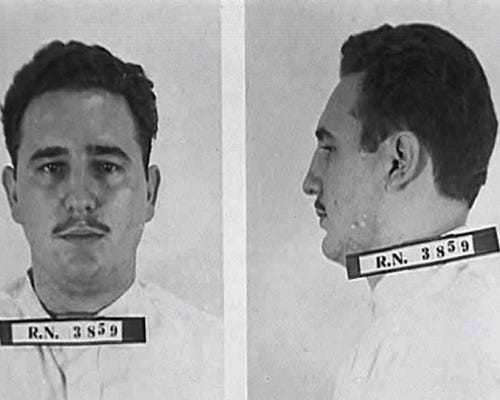
Some people say the way prisoners are treated tells us all we need to know about a country. If so, we can conclude that Batista’s dictatorship (1952-1959) was a far kinder country than post-revolutionary Cuba. Fidel’s own path through Cuban courts and prison is a good example.
He led a group of rebels in an attack on a military barracks, Moncada in 1953, the first major attempt to start a revolution and oust Batista. They were tried and sentenced in public trials guided by an independent judiciary and covered by a free press, who were free to interview all involved. Family, friends, and supporters were allowed to attend the trials. The rebels had killed 19 soldiers, according to some reports some in their hospital beds. But the rebels were freed from their comfortable imprisonment only 18 months after they arrived. Catholic leaders and the mothers of some of the rebels had mounted a successful amnesty campaign that was promoted by Cuba’s roughly 65 independent daily and weekly newspapers.
There are no legal independent news outlets in Cuba today. And Fidel’s group faced prison conditions that were like a day at the beach (according to one letter Fidel wrote while in prison) compared with the subhuman conditions Cuba’s prisoners face today. Fidel and his rebels were held apart from common criminals, something the current regime has never done. They were fed well and had access to clean water. They were allowed to have hot plates to cook up snacks, given clean clothes and access to a library of more than 600 books. They could sleep late, read after lights-out, gather together, play ping pong and volleyball, and engage in political debates. They received care packages—including a refrigerator—and visitors regularly. They slept with the lights off. None of those benefits are given to Cuban political prisoners today.
In a letter dated 4 April 1954, Fidel described the good meals he was eating in prison, which included spaghetti with shrimp and freshly brewed coffee. He complained that people back home were ignoring his request to stop sending him things. “When I go out in the sun in the morning, in my shorts, and I feel the sea breeze, I feel like I’m on a beach . . . People would think I was on vacation! What would Carl Marx say about such revolutionaries?”
Contrast this with the subhuman conditions that Cuba’s political prisoners endure today: vermin infested, over-crowded, unventilated cells; mattresses so filthy prisoners prefer to sleep on the concrete floors, open latrines, one small meal a day of often-rotting food, scarce water that is so foul it is undrinkable, only occasional calls home or visits from friends. Good luck getting a shower, let alone an aspirin.
We know about these hellish conditions from the testimonies of released political prisoners over the decades, their family members’ reports, or notes smuggled out by sympathetic fellow inmates who’ve been released. Cuba bars independent prison monitors from its prisons, even the Red Cross, despite the ongoing calls from international governments and groups for such visits.
On this 4th of July my thoughts will be with Cuba’s political prisoners and the not-so-average Cubans who stand against injustice and a revolution that never delivered the independence, freedom, or democracy it promised them.
Thanks for reading and thinking about Cuba with me.
Wishing you and your loved ones a super happy and very safe 4th of julio.
Hasta la semana que viene,
Ana
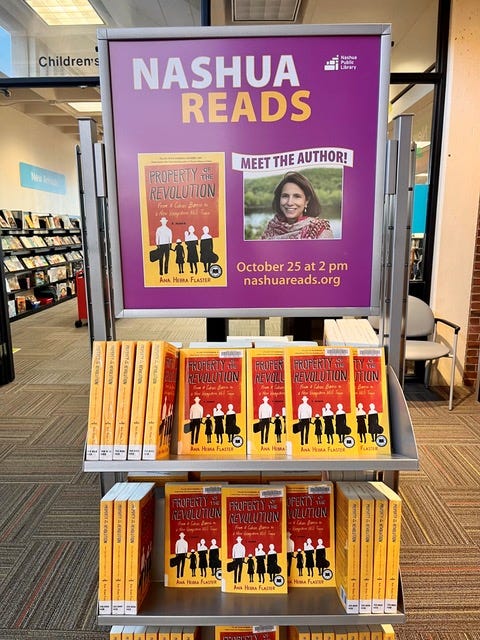
I hope you’ll forgive this reel in this spot. It’s a musical announcement by the Nashua (NH) Public Library that they chose my memoir, Property of the Revolution, as the 2026 One City, One Read, just this past Monday.
I can’t access a clickable image that takes you directly the reel, so I’m sharing an image of the stand at the library—and the reel, clickable in the link in the first sentence.
There will be lots of events and programming around refugees, immigrants, and Cuba, with the big event on 25 October at the Nashua Public Library.
This is a great honor and a little trippy for me. I remember going to the Nashua Public Library for the first time on a first grade field trip. We’d just gotten here from Cuba. I can still smell that beautiful aroma of books and paper and old wood floors, see the stained glass windows, feel the smooth card I got that day. Magic. To see “Property Of The Revolution” on those shelves is a dream unfolding.
Thank you to all the readers and book lovers behind this, especially my dear friend Anne LaPlante Phillips, who told me about this and got the ball rolling last year.
Here’s to friends like Anne and to free libraries and the free people who support them!
No posts
Comments
Nothing yet. Say the first thing.
Sign in to join the conversation.