
24 abril 2026
Hola y welcome. Thanks for being with me for this week’s CubaCurious.
This week you’ll meet three courageous Cuban women activists, all battling the regime’s escalating repression against them. Anna, Mileydi, and Eliannis are alone and asking for the international community’s support for themselves, their children, and their political prisoner relatives.
They haven’t hurt anyone, called for protests, damaged property, stolen anything, or advocated for violence. They simply want political change and freedom. They’re afraid, but not too afraid to stay silent. That’s a problem for the regime and, therefore, for them.
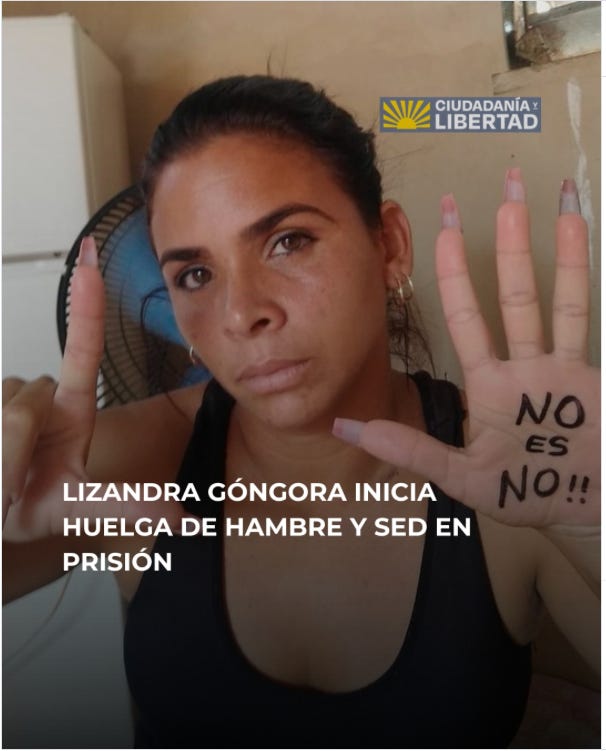
The three women are free, for now, but Lizandra Góngora, who is serving a 14-year sentence for marching in the anti-regime demonstrations of July 11, 2021, is not. The political prisoner began a hunger strike this Wednesday to protest the recent declarations on NBC News by Cuban leader Miguel Díaz Canel denying that Cuba has political prisoners. MDC said people claiming to be political prisoners were jailed for vandalism and crimes against the Cuban constitution. Sounds a little political to me.
Lizandra is the mother of five children and has been seriously ill several times during her imprisonment. She was diagnosed in March with a 5-centimeter uterine fibroid that has caused hemorrhages. Prison officials denied her surgery, saying there is a lack of specialists in their region.
Cubans won’t read about these stories in the state-run media. In fact, many Cubans call the news “el menticiero.” Noticias = news. Mentira = lie. Put them together and you get Cuban newscasts: menticieros. All the news that’s fit to print—if it serves the purposes of the revolutionary government. You won’t find investigations of people in power, state agencies, institutions, alleged wrongdoing, or the dark reality Cubans face every day. One Cubana told me she stopped watching the menticiero a long time ago. “They talk about a Cuba that I don’t know.”
Maybe that’s why ever since the 1959 revolution came to power, many Cubans consider the word-on-the-street, Radio Bemba (Radio Big Mouth) in Cuban slang, the most accurate source of important news. Radio Bemba told you how to cheat on your ration card. Where to find the best potatoes on the black market. Who the snitches were.
Sixty-five years ago last Friday, 17 April, Cubans tuned into Radio Bemba to find out where their relatives had been taken when they were arrested as the Bay of Pigs Invasion began. Thousands of Cubans suspected of being anti-revolutionary, or perhaps lacking sufficient revolutionary zeal, were hauled off to prisons, stadiums, and other holding centers. You weren’t going to learn those details on el menticiero.
One of the diciest problems in those first years was finding out how to obtain a permiso, the exit visa the revolutionary government instituted to prevent the exodus of Cubans searching for freer ground. Until the 1959 revolution, Cubans had enjoyed the right to leave and return to their country at will, like the citizens of most countries. El menticiero wasn’t going to spell out how to apply for your permiso, but Radio Bemba knew.
Today, Cubans have a new Radio Bemba. They can access areas of the internet (the regime blocks many sites)—when they have electricity, the government hasn’t cut their access, or they aren’t running around searching for food, water, and Tylenol. Facebook and X are the new Radio Bemba plazas where Cubans share survival strategies, vent (up to a point), and inform and support each other.
Mobile internet access is relatively new in Cuba; it dates to December 2018. The regime had given years of excuses, blamed the U.S., dragged its feet, until it finally delivered the service. It was through the state’s monopoly (ETCSA), at exorbitant rates, slow speed, and convenient shutdowns at times of social unrest. But at least Cubans had a shot at the Web.
Dictatorship’s don’t like free information flow. So it’s no wonder that one of the juiciest news stories this week came from a leaked report in the U.S. media. USA Today, which appears to have some shy but talkative contacts in the State Department, revealed that U.S. officials traveled to Havana on 10 April with time-sensitive demands for the regime: free high-profile political prisoners, give Cubans uncensored internet access, and ease restrictions on foreign investment—within two weeks, which means time is pretty much up.
When the news broke, Cuban officials scrambled to control the narrative. Yes, they’d had a meeting with the U.S., but they denied any demands, said the talks were “respectful” and that no conditions were linked to the discussions.
Radio Bemba was crackling mad. Cubans complained about having to rely on foreign media for information about their lives and their future. Many cheered Cuba’s stated historic “enemy” for defending Cuba’s estimated 1,200 political prisoners, pressuring it to give uncensored internet access to citizens, championing Cubans’ right to start businesses of their own, and to be paid directly by foreign employers—not through the regime, after it collects workers’ salaries in foreign currency, takes a cut, and pays them in worthless pesos.
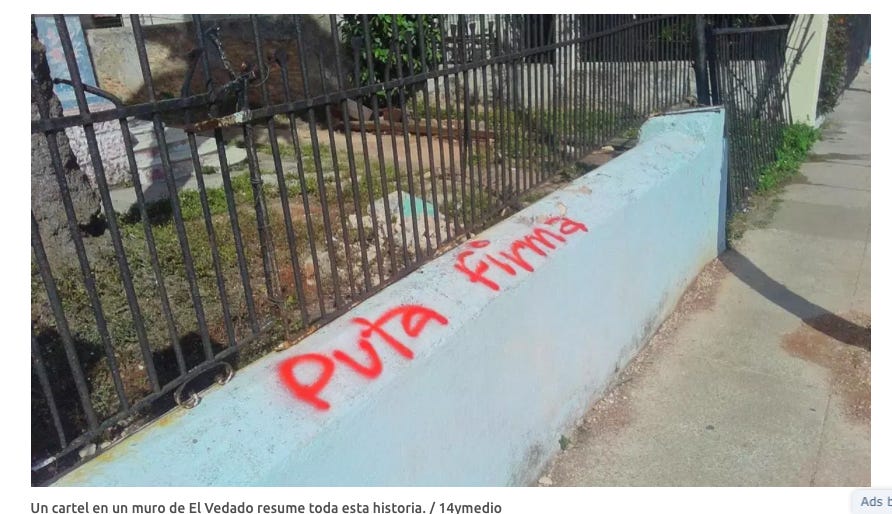
And there’s an insult on top of the injury, because the regime has a campaign underway to collect signatures showing support for the revolution and the government. Cubans are complaining about having to sign the petition in public, at work, at school, in front of neighbors. With so little time in their stressful days, with so many problems to solve, this is what their government wants from them.
Who wouldn’t go on Radio Bemba and let it rip?
Ah, but that’ll get you in a heap of trouble, as the women you’ll meet below will tell you.
Their courage inspires me. I hope it will do the same for you.
Hasta la semana que viene,
Ana

Anna Sofía Benítez Silvente may tip the scales at 100 pounds on a lucky day when she’s found enough to eat. The anti-regime influencer lives alone in Havana with her mother, who is ill. Anna Bensi, as she is also known, is not a member of any activist groups and has never called for a protest. But she is an effective, popular, and fearless critic of the Cuban dictatorship on social media.
The regime, which has threatened and harassed Anna for years, unleashed non-stop persecution against Anna and her mother in the last few weeks. Agents are posted at their door, on the corner. Six or seven young men follow them wherever they go. They play loud music, laugh at them, comment about them.
Mother and daughter are routinely called in for questioning. They receive threatening calls. They’ve had their WhatsApp accounts shut down, their live posts cut off. Their neighbors are harassed, warned to keep their distance. Both women are being investigated and have pending court cases, Anna for being “counter revolutionary,” her mother for allowing it.
When Anna’s older sister, Elmis, visited from the U.S. recently to bring her mother medicine and offer support, a state security agent arrived and ordered Elmis to appear at the local police station just hours before she was due to board her plane home. She needed to resolve an issue with her passport, was the excuse.
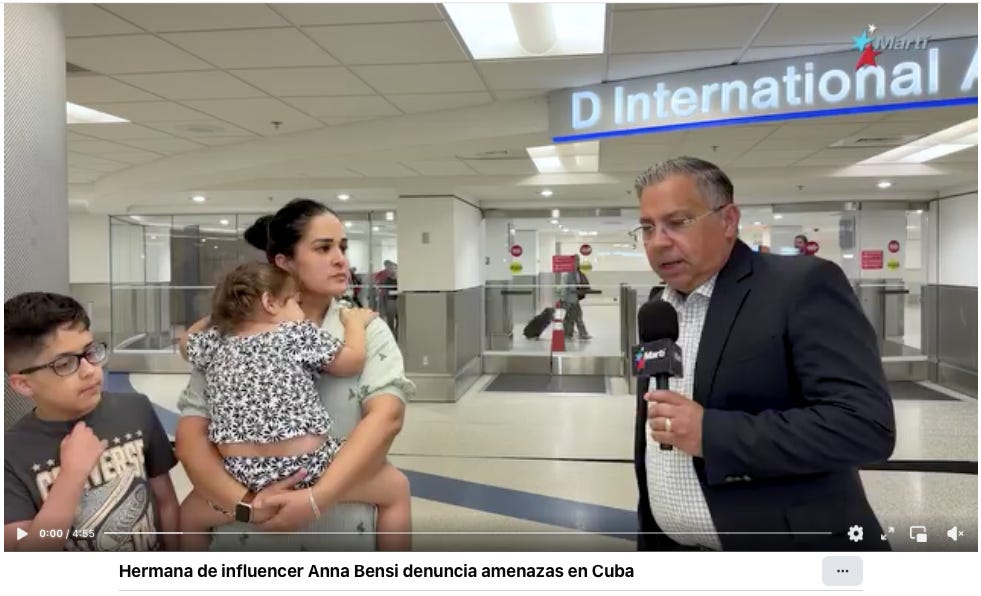
The passport didn’t come up during the interrogation but Anna’s “reactionary behavior” did. “Aren’t you afraid that something could happen to her,” Elmis said one of the officials asked her. She was terrified she’d be arrested, her children—who were just outside the interrogation room—taken from her. “Your sister and mother are alone. Anything can happen to them.” Elmis said she could hear her children crying outside throughout the interrogation.
“They asked me about Mike Hammer (the U.S. embassy’s head of mission in Havana), if he was trying to incite young people to rise up.” Elmis told Martí Noticias. She had not expected Hammer’s visit, but was glad when he arrived. She and her children are U.S. citizens. Elmis said she told the agents that Hammer’s visit was a courtesy, to see if she and her family were safe. “He is a wonderful human being,” she told a Martí Noticias in an interview at Miami International Airport later the same day. “They treated me very, very badly.”
The agents ruined the last few hours the family had together, but they let Elmis go and she made her flight. They let Anna’s mother go as well, but they kept Anna for an interrogation. Three agents who never identified themselves interrogated Anna for over two hours.
Anna managed to make a live post on Facebook later in the day. “They don’t respect anything. Anyone . . . It’s such a disgrace that I have to face this, that my family has to face this, just because I want to say what I think.
“Two men and a woman . . . They tried to act like my friends,” Anna said in a live post that same day. “What are your dreams? You like to sing, don’t you? . . . We can help you with that career . . . But your reactionary posts must stop . . . Your ideas, your videos, leave those aside . . . ”
Anna said she will not be silenced and will never be complicit with “a dictatorship . . . that has the Cuban people in misery, hungry. Never.”
Her disgust was palpable, especially when describing the male agent. “He was almost whispering the whole time . . . ‘You are this close to being arrested. We have everything ready. And after a week, no one will even remember you. . . You’re getting into a mess that makes it a good idea to leave the country.’ Why?” Anna asked. “Why do I have to leave? Why don’t you leave?”
The agents told her to think of her mother, of how much she will suffer.
“Pure repression,” Anna said in her post. “They want us isolated. They’ll stop at nothing . . . I thank all of you, because it is the visibility you’ve given me that is keeping them from doing more against me. Thank you.”
“My conscience is clear . . . I do this for myself,” she said, tapping her chest, “so I can let things out. I’ll never be part of an injustice. Never.”
If you’d like to support Anna, like her posts, follow her on social media. That’s all she has for protection right now. It’s a small step but means a great deal to her and her family.
—Mileydi Machin, mother of political prisoner
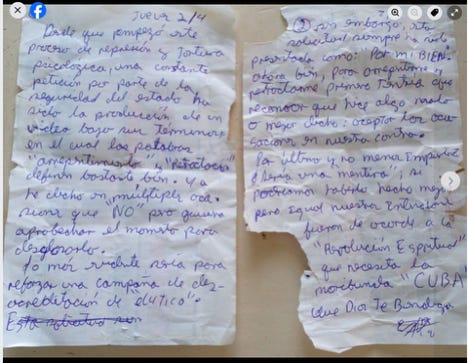
Mileydi Machin believes that “truth cannot be held back, it is like a river.”
So, despite threats from officials to stay silent, she shared a note smuggled out of the prison where her son, political prisoner Ernesto Ricardo Medin, is being held. Ernesto and his partner Kamil Zayas Pérez are the creators of El4tico, an audio-visual project that exposes the dictatorship’s incoherent policies and demands. It is extremely popular among young Cubans. And that’s what landed Ernesto and Kamil in a dungeon 72 days ago.
Mileydi called out Cuban leader Miguel Díaz Canel’s in her post. “Our president says there are no political prisoners in Cuba, then what is he (Ernesto) accused of? Terrorism? Is he causing terror with a pencil and some paper, with an idea? You may imprison him, but you can’t imprison his ideas, nor the people’s. People are quiet but they cheer when someone raises their voice against injustice.”
“I don’t want to disobey anyone. I just don’t want to stay silent. . .” she added, referring to the coercion used by officials to keep political prisoners’ families quiet.
Excerpts from Ernesto’s note are below. He and his mother will surely pay for publicizing his unjust imprisonment and exposing the regime’s manipulation. But silence keeps the injustice hidden. Visibility is the only weapon activists and political prisoners have. I hope you’ll consider a comment, a like, a show of support for Mileydi Machin and Ernesto.
“Since this repression and psychological torture began, State Security has constantly demanded I record with the words “repentance and retraction.” I have aleady said on multiple occasions “NO.”
The most obvious reason is it would reinforce the campaign to discredit El4tico. They’ve always presented this as “For my good.” But to repent and retract I’d have to admit that I did something wrong, accept the accusations against us.
That would be a lie! Our goal is only to support the “Spiritual Revolution” that moribund Cuba needs.
God bless you.”
—Christian pro-democracy activist Eliannis Villavicencio reacting to agents’ latest threats.
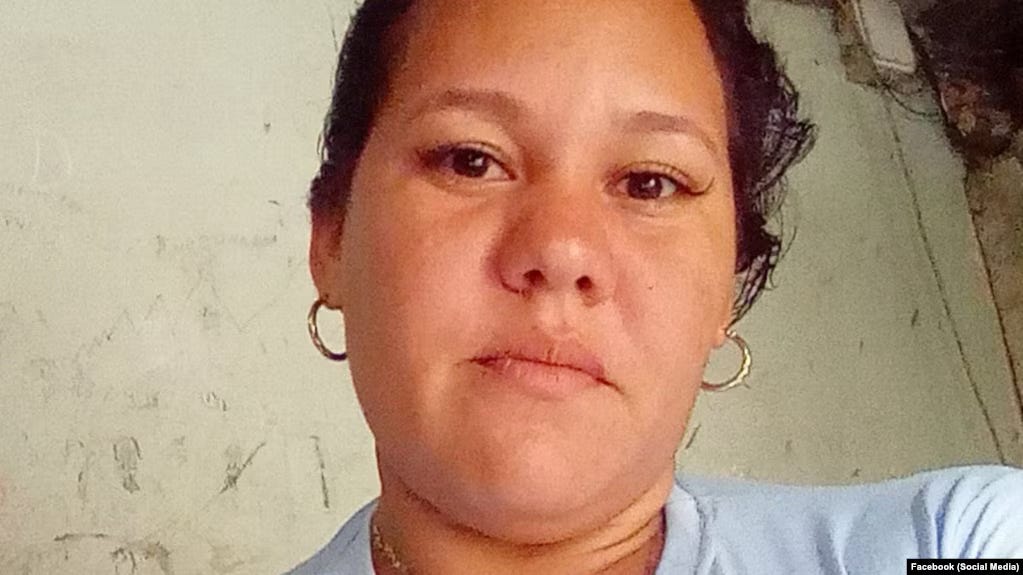
Eliannis Villavicencio is a Christian pro-democracy activist who has worked alongside her husband, political prisoner Alexander Verdecia, for eleven years. Wife and husband have been persecuted for their activism and their Christian faith for as long as they can remember. That has not dissuaded them from working with their group, UNPACU, to bring about peaceful democratic transition in Cuba.
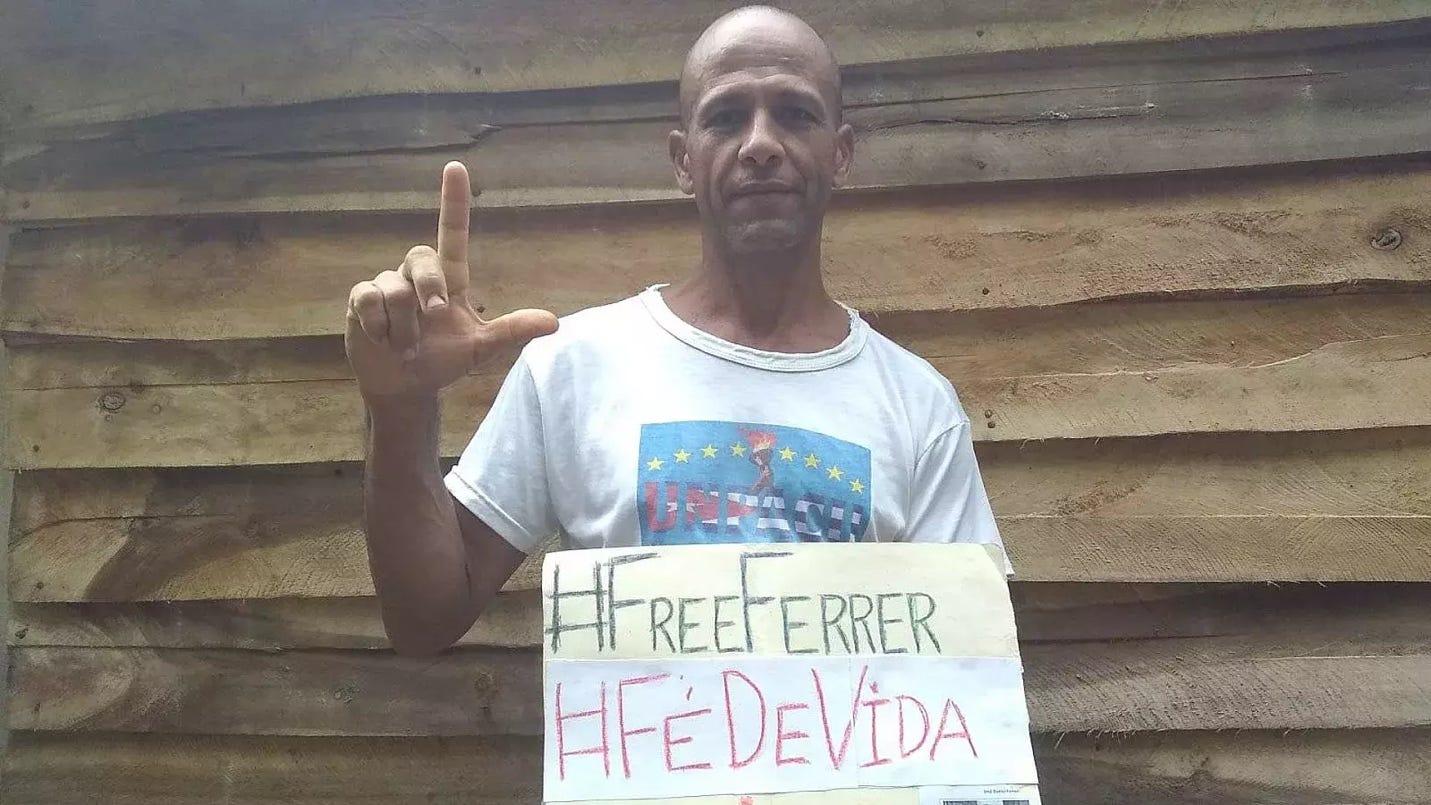
Eliannis has not stopped demanding freedom for her husband.
In the last weeks, she was served citations at home for posting about her husband and for using his account. (Who knew Cuban State Security was moonlighting at Facebook, helping Zuck keep users in line?)
Eliannis told Martí Noticias that she was summoned to a local operations center and fined by “a telecommunications inspector.” Later, a political police agent who goes by the name Rolando threatened her.
“He said they have everything ready to arrest me,” the activist said, adding that in the eleven years of working with Christian pro-democracy group UNPACU she has never felt so much fear. “I’m not afraid of going to prison, nor the fine.” She is in anguish about her daughters, 7 and 11 years old, who “would be completely alone” if she goes to prison.
In Eliannis’s case, like Mileydis and Anna’s, speaking out may help but it will certainly hurt, because the reprisals will come. That’s a given. The families are left to weigh the risks each time they raise their voices, hoping they rack up enough followers, likes, hearts, and comments and that some protection comes their way.
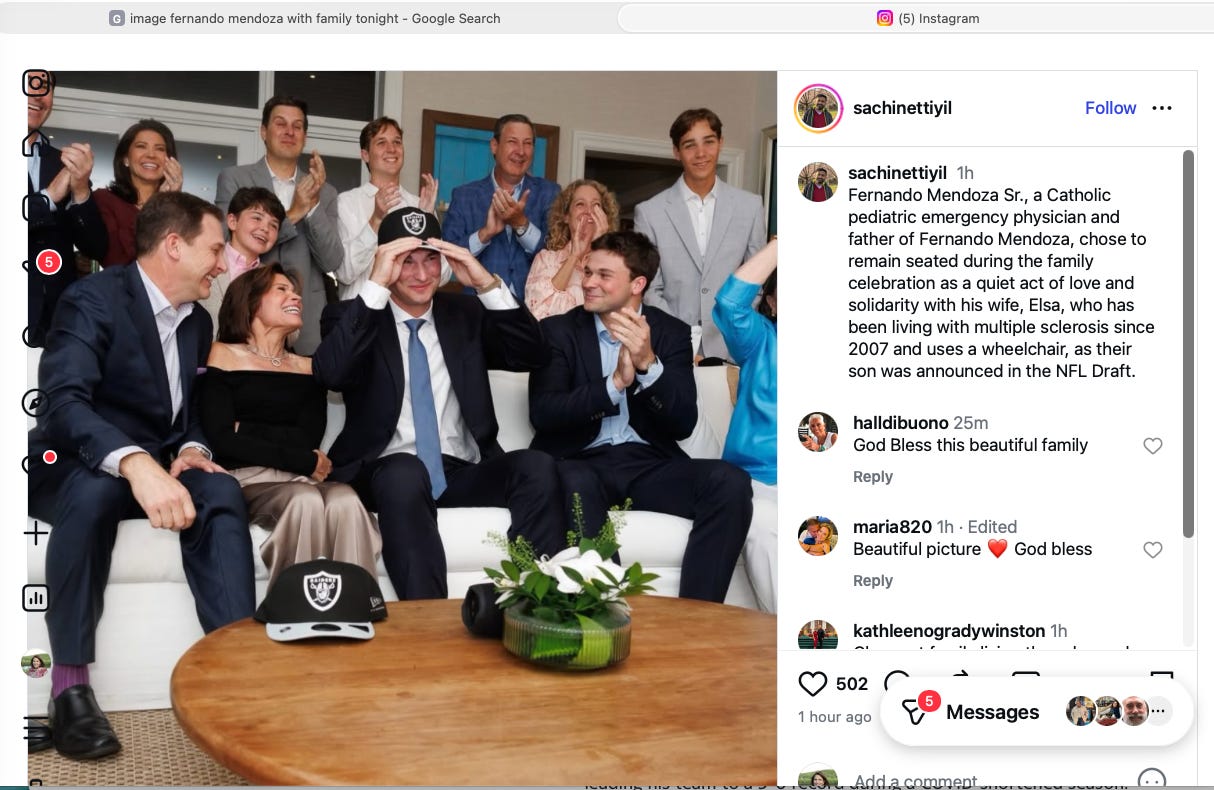
As expected, Cuban American quarterback Fernandito Mendoza was the No. 1 overall pick in last night’s 2006 NFL Draft. What may not have been expected is that he stayed home with his family rather than attend the ceremony in Pittsburgh. He said he wanted to be with them and open the celebration to a large group of friends and supporters. They only allow a small number of guests at the event, so Fernandito said, Yo me quedo en casa. I’ll stay home.
I think that’s worthy of a Cuban Treat of the Week slot. Not being the No. 1 pick. The love of family and gratitude for the folks that got him to where he is today.
No posts
Comments
Nothing yet. Say the first thing.
Sign in to join the conversation.