
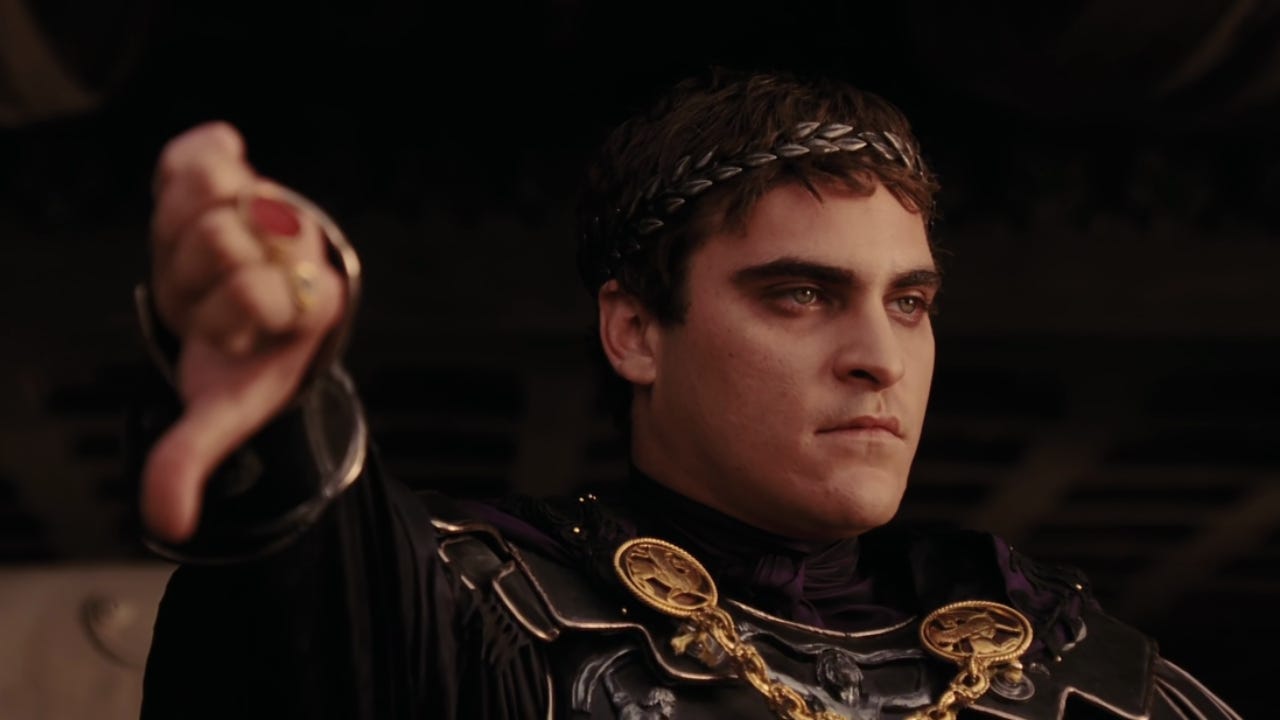
It’s been a while since we’ve seen each other around here. The thing is, I’ve been busy moving to Copenhagen, and between packing boxes, sorting through all our stuff, and finding a school for my children, I haven’t had time to write. I have, however, found time to watch Bridgerton and read Stella Gibbons (stick and carrot), amongst other things. For example, the other day I was reading Ignacio M. Giribet ‘s opinion piece about a crass comment made by Timothée Chalamet. Mr. Chalamet, who, judging by the profile of his girlfriends, seems to be into TikTok and reality TV1, said that people don’t care about art forms like ballet or opera, and therefore, he has no interest in working in those artistic fields. I read this BBC article with some very spot-on comments from people a bit more educated than the actor, which I encourage you to read.
I know nothing about cinema. I haven’t seen a single TC film (typing ‘Timothée Chalamet’ is getting tiring), and they say he’s good at what he does. I’m happy for him. That’s why I’m not going to comment on his skills as an actor. However, this man’s comment sends shivers down my spine, particularly because these days it’s people like him who are given a platform: they voice opinions on matters they don’t understand, and people nod along as if the Oracle of Delphi had spoken.
I still remember my music teacher when I was 14, playing Vivaldi for us and explaining how the movements evoking the four seasons differed. I remember the structure of an orchestra and the differences between a harpsichord and a piano. All this knowledge, which I studied because someone realised it was good for my 14-year-old brain, has proved extremely useful in shaping my ideas to this day and constructing arguments from different perspectives. Culture isn’t for showing off; it’s for thinking better.
To give an example, the other day I was coming back from P’s guitar lesson. We’d met his new teacher, who’s an expert in classical Spanish guitar. After listening to P play Radiohead’s No Surprises, he set about explaining that he was going to teach him more technique. P came out of the lesson a bit disappointed because he just likes playing rock music. Knowing musical notes and chord progressions is not a passion of his. I managed to explain that if things started to get a bit tedious, we’d speak to the teacher to see if he could mix a bit of technique with modern music, but that he had to remember that the Spanish played a key role in the development of the guitar2 and that if he wants to play like Jimi Hendrix, he’ll have to learn some technique. I convinced him, and he started practising at home.
And this is what I mean by cultural education. It’s not about forcing people to love something, nor is it about imposing tastes. It’s about providing tools. Cultural education is not indoctrination: it is the very foundation of critical thinking. You don’t have to be passionate about opera to appreciate it and understand how it has helped shape society in ways that are often invisible.
Without education, there is no critical thinking, and that is when you end up as cannon fodder for whatever the charlatan with the biggest platform decides to sell you (Instagram, X, Facebook, right, left, choose your own charlatan).
How dangerous it is to confuse personal tastes with knowledge, especially when that confusion guides collective decisions, from cultural matters to public health. If ignorance in culture produces ridiculous opinions, ignorance in public health has people dying.
Thinking about this as I opened my health economics textbooks, I was reminded of the economic concept of welfare3. To put it very simply: in welfare economics, it is assumed that what we consume reflects what is good for us. If you are willing to pay for something, it is interpreted as improving your well-being. Even if that very thing is actually harmful to you. The logic is that of a ‘win-win’: you consume, you’re happy, we make money.
I think a lot about this win-win when I walk through the aisles of the supermarkets in my neighbourhood in Copenhagen. I think about it too when my children tell me that at school there are children who bring chocolate biscuits for their lunch (something completely forbidden in Swedish schools, which take child nutrition and the rising obesity rate very seriously).
Denmark, hailed as the country with the happiest people in the world, has a cancer mortality rate higher than the European Union average4. If we compare health indicators with its Nordic neighbours, the results look even bleaker. The reasons are complex, and I won’t go into them here, but one of the causes experts cite is the rate of obesity5, smoking and alcohol consumption, which is much higher than in Sweden, Finland and Norway—whose governments, to give an example of public health regulation, have a monopoly on alcohol sales and therefore lower consumption.
You can have a bloody brilliant healthcare system, but if your citizens don’t take care of themselves… well… thoughts and prayers, my little grasshoppers.
I wander through the streets of my new neighbourhood, decked out with election banners, and practise my Danish by reading the slogans. There’s a party X demanding less ‘social control’ for children. Who knows what their political leanings are, because they fit into both extremes. If my children were to choose less ‘social control’ (and I can tell you they would), they’d be eating Oreos for breakfast, Doritos for lunch, and for dinner possibly one of those buckets of Kentucky Fried Chicken, which they’ve never tried, but as I told you back in the day, the marketing people are very clever and even KFC looks delicious. With less ‘social control’, my children would eat with their mouths open and burping at the table (or anywhere else) would be great fun. With less social control, the man at the newsagent’s in my village used to sell cigarettes to 11-year-olds back in 1990. I still remember going to the shop to buy lollipops and seeing kids come out with chewing gum, sweets and cigarettes (ten pesetas per cigarette).
Perhaps I’m confusing the term ‘social control’ with education. I don’t want my children to be told which books they can read, but I do want them to be taught how to read. By ‘read’, I don’t mean simply putting letters together to form words; I mean interpreting texts and, after reading widely, forming their own opinions. I don’t want them to be told what music they have to listen to, but I do want them to understand the role of music in human expression and how it has evolved throughout history, from the cántigas of Alfonso X the Wise to Bad Bunny. And then they can listen to reggaeton until their ears bleed, if that is what they wish, but let them also know how to recognise a Strauss waltz. And of course, don’t sell them cigarettes with their sweets.
If we cannot read the world, we cannot read nutrition labels, advertising biases or epidemiological risks, nor can we spot dangerous rubbish disguised as entertainment, food or freedom.
Just as you cannot play like Hendrix without learning technique, you cannot live healthily without discernment. And discernment does not arise on its own: it is cultivated by education, sustained by culture and protected by public institutions6.
I see this every day in my practice. No one should be forced to undergo a treatment they do not wish, but we do have a duty to provide accurate information so that decisions are made in full knowledge of the facts. I often meet women who arrive at the clinic very frightened, having been diagnosed with cancer, and who have watched a video on YouTube of a woman who claims to have been cured by vitamins and exercise. Whilst exercise is very good for you, cancer cannot be cured by lifting weights, thank you very much.
It is my duty to set the record straight and present the science so that they can choose what they believe is best for them based on knowledge, not on ignorance and fear. I’m often surprised that some women get angry when I don’t simply echo what they tell me they think they need. I’ve had to say the words: “The thing is, I’m actually on your side” because they’ve read some nobody who writes that doctors hide the ‘real’ knowledge to achieve social control. I’d laugh if I didn’t feel like crying. If I lie, they put me in prison; if someone with a TikTok channel lies, the legal system does little to nothing.
Health is a commodity that nobody appreciates until they lose it.
If the markets have the right to seduce us with rubbish, who teaches us to recognise it? And most importantly: when we fail to do so, who pays the price?
This is a bit of a gossipy comment, but one can’t help but marvel at the fact that love is blinder for some than for others. For my readers living in the deepest, most delightful ignorance: the object of this actor’s affections is one of the Kardashians. Apparently, the one with the least personality… if we take it that personality is inversely proportional to the amount of silicone hidden in one’s body.
Appealing to pride in one’s ancestral roots from time to time gives you an edge.
It is important to distinguish between welfarism and the welfare state: the former is based on a utilitarian concept of well-being, centred on the sum of individual utilities; the latter incorporates criteria of equity, redistribution and social protection.
For anyone who wants to check this out for themselves (which is always a good idea), here is the report by the European Commission and the OECD on cancer in Denmark. If you don’t feel like reading the whole thing, Figures 1 and 3 get straight to the point. https://www.oecd.org/content/dam/oecd/en/publications/reports/2025/02/eu-country-cancer-profile-denmark-2025_198228f3/ffe5127e-en.pdf
Many people are unaware of this, but obesity is a risk factor for developing cancer. https://www.cdc.gov/cancer/risk-factors/obesity.html
I need to clarify this point. Public institutions are not the same as politicians. And I’m not going to write about how it turns my stomach when politicians use public institutions to push their ideologies left, right and centre. I don’t talk about politics for the sake of mental health (my own).
Comments
Nothing yet. Say the first thing.
Sign in to join the conversation.