
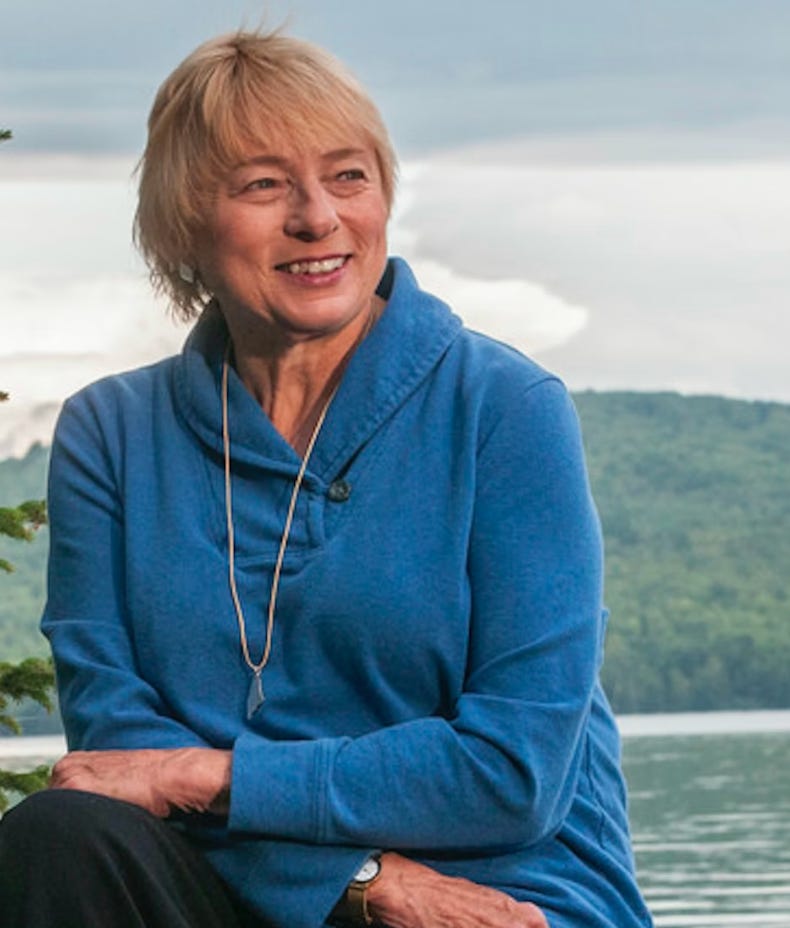
Gov. Janet Mills wearing her Maine necklace in the great outdoors.
As the adage goes, all politics is local. After Janet Mills has suspended her campaign for Senate, national pundits weighed in. But their assessments, focused as they were on national dynamics, can only go so far.
While broader political currents were important for this race, some aspects specific to Maine affected the outcome.
Andy O’Brien’s discussion of back-to-the-landers and the influx of new migrants during and after the pandemic does a great job of discussing a Maine demographic dynamic that’s been overlooked. But there’s more to the story.
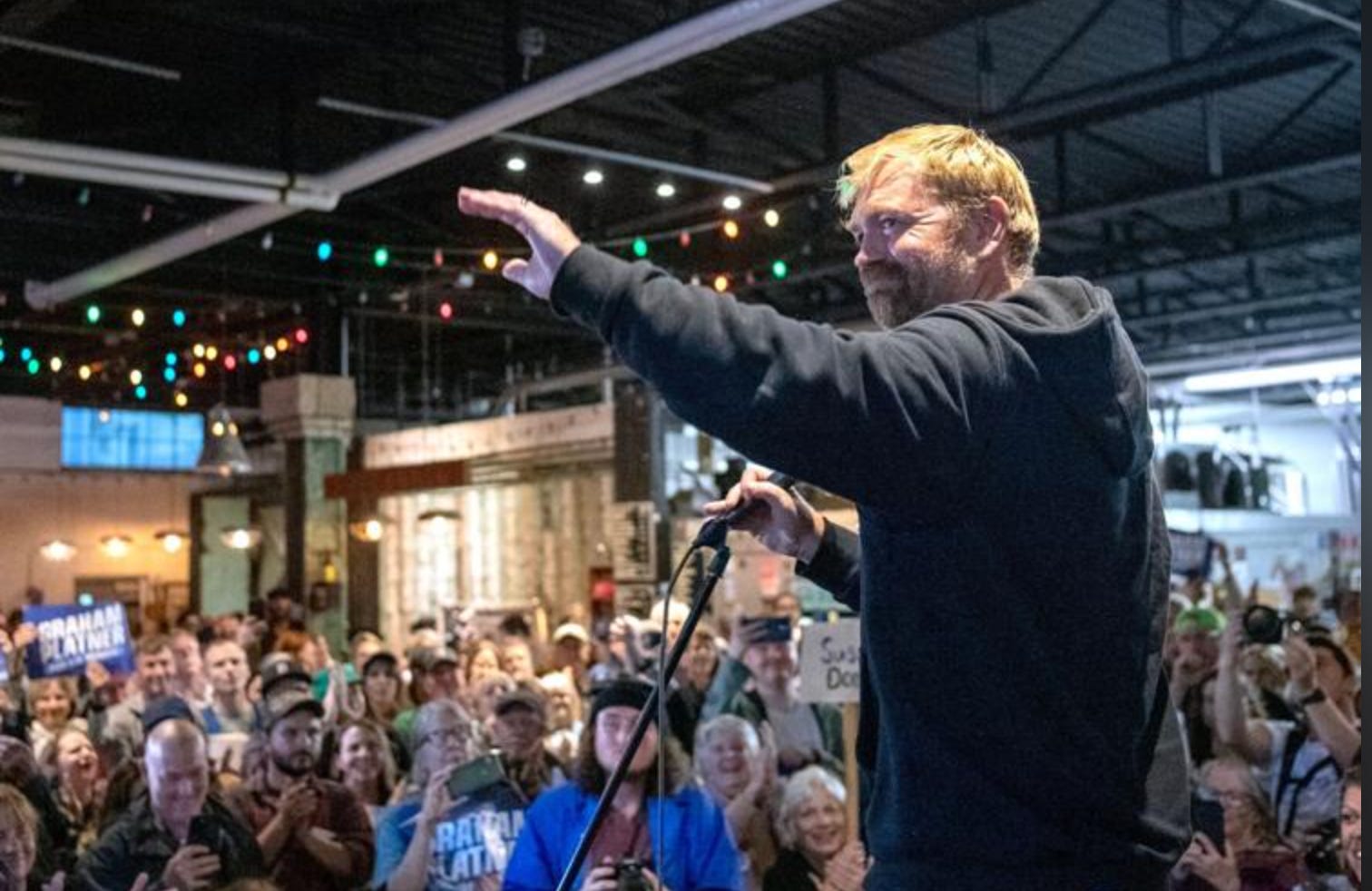
Graham Platner at a town hall in Portland. [Daryn Slover: Portland Press Herald]
The start of Trump’s first term saw a flourishing of organizing in Maine that’s continued. Groups like Indivisibles connected with other groups ranging from unions to Wabanaki Reach.
One thing groups like the Indivisibles requested Senator Susan Collins do is hold town halls. They’ve wanted to ask her questions and push her on her positions and votes.
But Collins refused. Instead, she kept talking at venues the general public wasn’t invited to, or spoke at places that received federal funding for a new rec center, or just gave press conferences.
Now, grassroots organizations didn’t pressure Mills to hold town halls, or, if they did, I missed it.
But the call for Collins to be open to constituent queries set the stage for Graham Platner’s myriad public appearances.
Platner showed up all over the state, answering lots of questions, even tough ones. Not everyone was satisfied with his answers, but in a case of “the medium is the message,” Platner’s very appearance delivered the message of youth, vitality, and transparency.
There has never been a campaign like this in a Maine Senate race and, indeed, it’s uncommon for any Senate race.
In contrast, Janet Mills suffered by comparison because she didn’t get out there to talk to larger groups of voters.
To be sure, Mills has a demanding day job as governor. She also never had to campaign like that. Her previous statewide campaigns followed a more typical model of talking to organizations, holding house parties, giving press conferences, and speaking at some larger events. And that’s what she did in her Senate race.
Janet Mills is as sharp as a tack and has lots of energy.
But at a time when there was a lot of chatter about her age, Platner’s greater level of campaign activity mattered by creating a contrast.
Platner’s town halls also provided an opportunity to recruit volunteers. An active field campaign can matter in a close race, so this is important purely pragmatically.
Indivisibles Bangor also pressured Rep. Jared Golden to show up to town halls and tired of asking, they planned one with several other groups. It was held more than five months before Platner launched his. campaign.
During this open seat town hall at the Bangor Public Library, lots of people called on Golden not to run again, and Secretary of State Matt Dunlap’s name was bandied around as an alternative.
Dunlap has said that these exhortations encouraged him to primary Golden, which, despite a strong strain of dissatisfaction in the base, no other Democrat would do.
About a month after Dunlap declared, Golden announced he wouldn’t run again, although he didn’t attribute it to having a primary challenge.
Still, Bangor Indivisibles’ open seat town hall shaped the ME-2 race.
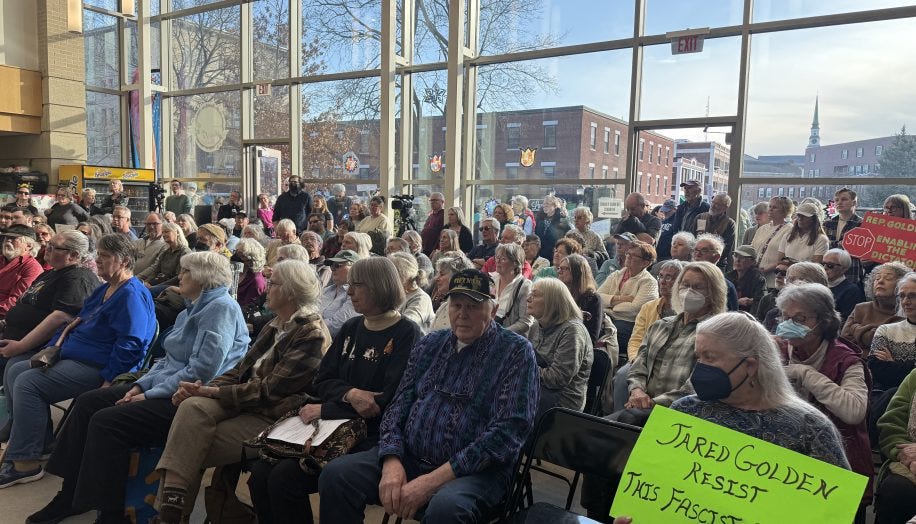
Hundreds of Mainers rally in Bangor on Saturday, March 22, 2025 for the “empty chair” town hall. Photo by Megan Smith. Maine Beacon.
Dunlap got bragging rights for his willingness to challenge establishment, D.C.-based Democrats who didn’t want him to run. He can legitimately argue that he’s both stood up to his party and to Donald Trump. None of the other primary candidates can say the same.
As for the Senate race, Platner’s many town halls happened after movement organizations and numerous Mainers wanted Collins to show up and take questions. This will be a continuing issue in the general election.
A key Maine issue the national press has overlooked is tribal sovereignty, but it generated a great deal of activism across the state and ultimately harmed Mills’ standing with many Democratic legislators and the party’s base.
A focus on tribal rights far predates Mills’ governorship.
Mills’ predecessor, Gov. Paul LePage, generally had an awful record on this and many other matters, although to his credit, he set up the Maine Wabanaki-State Child Welfare Truth and Reconciliation Commission, which operated from February 2013 to June 2015.
But in April 2015, LePage rescinded an executive order requiring that Maine’s tribes would be part of discussions over matters affecting their people. Citing LePage’s actions, representatives of the Passamaquoddy and Penobscot people withdrew from their non-voting seats in the Maine Legislature the following month.
As Attorney General, citing existing laws, Mills opposed some efforts for greater tribal rights.
When Mills was sworn in in January 2019, it seemed a new day might be at hand for tribal relations.
At the inauguration, Mills greeted tribal leaders and “made a reference to former Penobscot Nation Chief Joseph Attean, the tribe’s first elected chief and a guide for Henry David Thoreau during one of his visits to Maine.”
Maulian Dana, the Penobscot Nation Tribal Ambassador spoke during the ceremony.
“I am so grateful for Governor Mills’ genuine desire to listen to me during her campaign, for insight and conversation, for laughter and for some advice.”
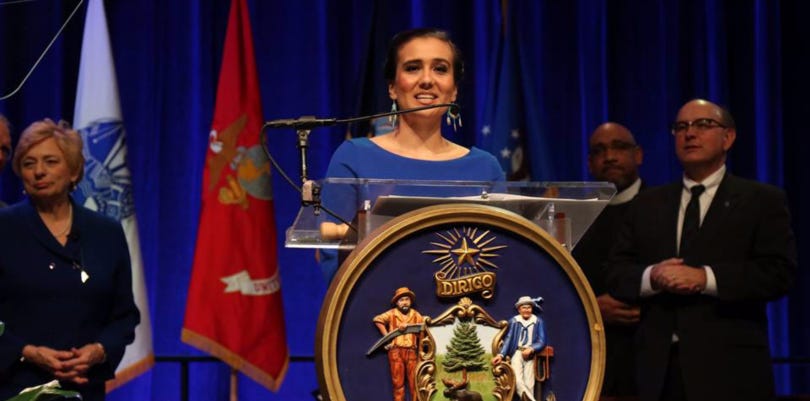
Tribal Ambassador Maulian Dana speaking at the 2019 inauguration of Gov. Janet Mills
In the nearly eight years of Mills’ governorship, she moved toward greater tribal rights.
Just take a look at a January 2026 press release from the Governor’s office, which cites numerous laws and other steps, and includes praise from the leaders of Maine’s tribes.
For instance, Chief Sheila McCormack noted:
“For almost 20 years, our Nation struggled to gain the ear of Maine’s governors, but under the leadership of Governor Mills, and her commitment to respectful and open communication, our jurisdiction has been reestablished. The Mi’kmaq Nation is proud to call Governor Mills a friend and ally.”
But Mills didn’t back full sovereignty.
Activists were part of a broad tribal rights and sovereignty coalition for which there was enormous frustration with Mills.
When she became a Senate candidate, upset over this issue hurt her.
Not only was the progress Mills achieved ignored, but many times I saw people claim that the governor was a racist because she didn’t support full tribal sovereignty. I think that’s a terribly unfair characterization, but it shows how much her position turned off some in the base.
Timing is everything in politics.
Gov. Mills announced her candidacy late. This allowed Platner to develop his candidacy. It also kept out other candidates with governing experience who waited for Mills to decide.
The Mills campaign highlighted her “See you in court” confrontation with Trump, although that would have been more powerful if it had launched closer to her exhortation.
Her campaign also didn’t focus enough on her accomplishments.
Most voters don’t follow policy closely. That includes activists, who are involved more than others but may not be inclined to see shades of gray or accept partial progress in some areas.
Mills won two statewide races convincingly by being unapologetically progressive on some issues and centrist on others.
Mills enacted some of the most progressive policies in the country on reproductive rights, LGBTQ+ rights, immigration, health care and climate change, and was among the strongest governors in standing up to Donald Trump.
Gov. Mills also kept being her pragmatic but independent self, drilling into policy details and tradeoffs, but not so focused on managing a coalition that was unhappy with her decisions in some areas. She alienated unions in some ways but took business and labor concerns into account in legislating and attending to economic development.
But the first Trump term has been a time when Democrats all over, including in Maine, were not in a mood for what they saw as half-measures.
Given unhappiness with national Democratic leaders, many Maine Democrats were not at all pleased with Senate Democrats’ official campaign arm supporting Mills’ candidacy. (Oddly, the House Democrats’ official campaign arm, the DCCC, just made the same move by backing ME-2 candidate Joe Baldacci, whose fundraising lags primary opponents Dunlap and Wood.) This is just not a good time to be associated with DC-based, establishment Democrats.
Another national trend that mattered was that Mills ran at a time when being an outsider is more valued than being experienced, and Trump’s influence made personal scandals less scandalous. Being an older candidate mattered more this year and women candidates are often judged more harshly.
Mainers frequently say they dislike negatively campaigning. Although it works sometimes, as it did for Collins in her 2020 race against Gideon, there was blowback against Mills her campaign did it.
Once a large polling gap opened between Mills and Platner, it became harder and harder for her to raise money, creating a negative feedback loop.
After Gov. Mills suspended her campaign, Platner graciously gave her plaudits:
“Janet Mills has dedicated her career to this beautiful state. We are all eternally grateful for her service to Maine as Governor, Attorney General, district attorney, and in the legislature.”
As her days in office move toward their conclusion, no doubt more accolades will arrive for Mills.
Primary voters can still rank Mills or the other two Platner alternatives, David Costello, who has wide policy and political experience, or the write-in candidate Andrea LaFlamme, a health policy professor, union leader, and activist.
The Mills campaign tested Graham Platner, as contested primaries should. It demonstrated he could counter attacks based on his Reddit statements and his tattoo, at least among the primary electorate. He’s developed his candidate skills and attracted many supporters and volunteers.
And now the race moves on, as Maine activists continue to engage and strive to beat long-time incumbent Susan Collins.
No posts
Comments
Nothing yet. Say the first thing.
Sign in to join the conversation.