
Typically Maine Democrats view ranked choice voting (RCV) a lot more positively than Republicans. These perspectives shape how candidates run their campaigns.
When RCV was on the ballot for both times for voters’ consideration and then, before its initial uses in 2018, there was tons of discussion and information about it, like this video by then Secretary of State Matt Dunlap.
This year polls suggest that ranked choice tallies will will probably determine nominations for the Democratic gubernatorial and second congressional district primaries and maybe the Republican one for governor.
So how are candidates pitching themselves in this ranked choice environment? Party matters but not exactly like it has before.
A whopping seven Republicans are in the gubernatorial primary.
In such a crowded field, some are saying voters should rank them and someone else.
Robert Wessels encouraged his supporters to rank rival Jonathan Bush number two on their ballots—an offer that Bush eagerly promoted. Wessels, a retail store manager who has trailed his opponents in some polls, said he is not dropping out of the race but would work with Bush, a health care executive.
Similarly, David Jones announced an “alliance” with fitness entrepreneur Ben Midgley during a live, televised debate hosted by WGME and the Bangor Daily News. “And we are going to work together,” Jones said. “And I am going to tell you this: that if you are voting for me, please give me your first vote and give me your second.” Midgley then added: “If I get your first vote, Dave would make a great second vote.”
Now, this is interesting.
Maine Republicans have been rather negative about ranked choice. They’re right that the first election of Republican Tea Party Gov. Paul LePage with 37% of the vote prompted a lot of interest in ranked choice (although the voting system was introduced in the Maine Legislature before that).
And many Republicans were angry that in 2018, the first year it was used, Democrat Jared Golden beat ME-2 incumbent Bruce Poliquin after Poliquin had a plurality in the first round.
Poliquin sued in federal court, but lost in front of a Trump-nominated judge. Poliquin stayed mad.
When I saw him speak at the New England Political Science Association Annual Meeting in April 2019, Poliquin repeatedly and angrily called ranked choice a “scam,” leaving the audience of political scientists noticeably puzzled. We knew RCV is just another voting system and has no partisan slant. Australia adopted it in 1918 and Aussies have elected people across the political spectrum since.
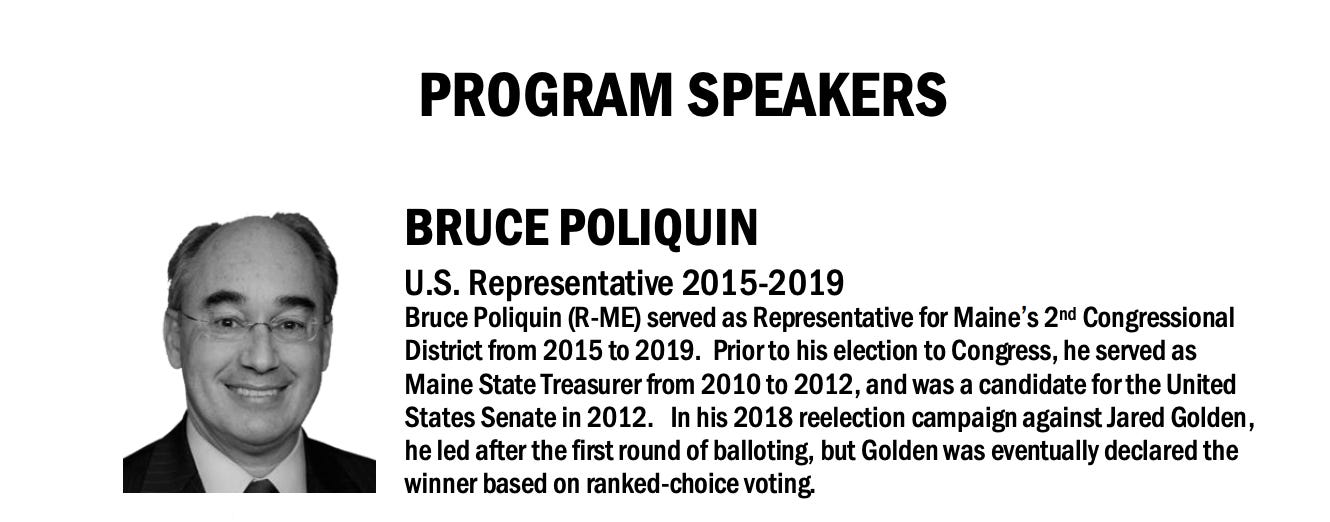
Screenshot from the 2019 program of the 2019 New England Political Science Association Annual Meeting. Presumably Poliquin wrote or signed off on his description, which included him saying he lost after “Golden was eventually declared the winner based on ranked-choice voting.”
So any Republican RCV alliance is novel. It’s also a stark contrast to what MAGA candidate Bobby Charles is saying.
What makes Charles’ take on ranked choice stand out is not just the negativity. It’s the way he’s asking people to use it and the proposition that Secretary of State Shenna Bellows is a nefarious force interfering in GOP business.
One of his fearmongering FB posts says:
Don’t let Shenna Bellows meddle in our primary and don’t accept being treated like a pawn by Augusta politicians desperate to cling to power.
Another, accompanied by an AI slop image with Bellows in a white lab coat and clipboard, blares:
Don’t let Shenna STEAL THE VOTE. The best way to work around her Ranked Choice Voting is to fill in the bubbles for ‘CHARLES, ROBERT’ - all the way across the sheet.”
But if you just want to vote for one candidate, there is no reason to fill in every bubble.
If voters only want to vote for a single person and no one else, they can do that by picking them as their first choice and then not ranking others.
Moreover, Bellows didn’t set up ranked choice; Maine voters did —twice. Bellows just follows the law Mainers adopted and she is never the sole person working on vote counting.
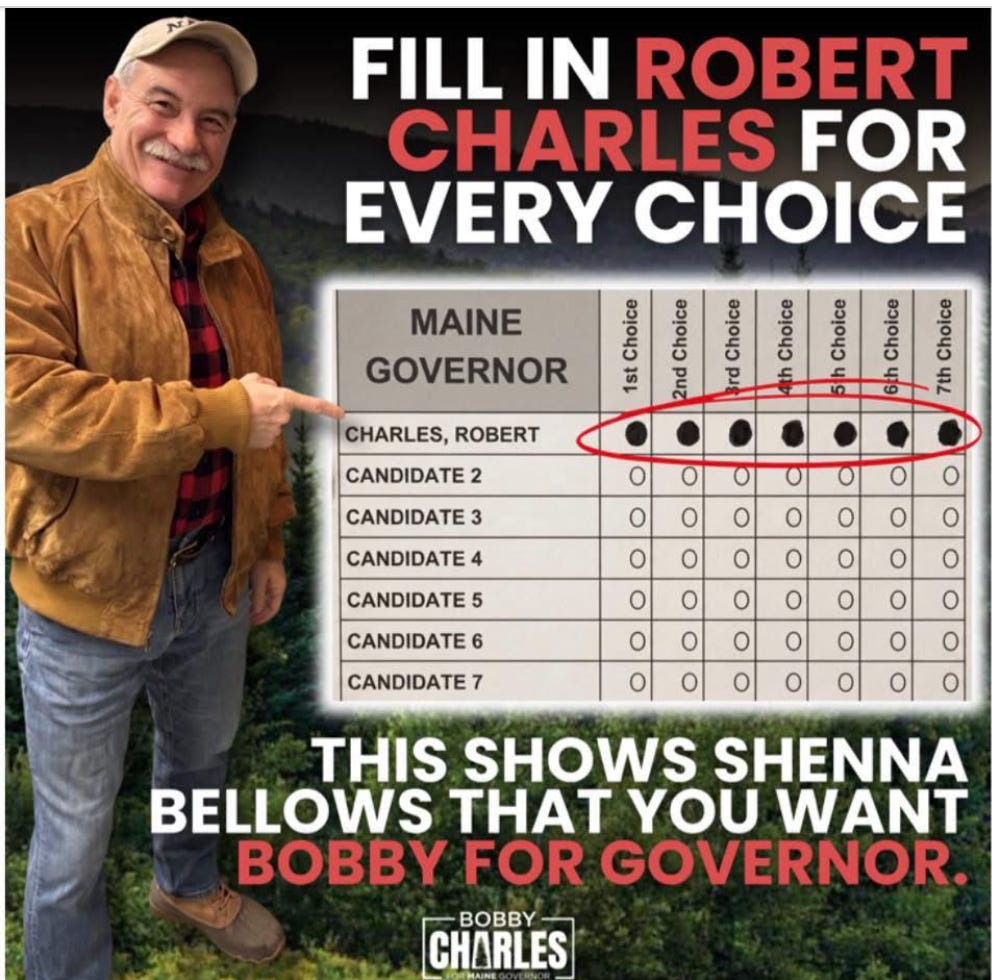
If Charles is suggesting that somehow Bellows would be able to add choices beyond him in first place, that shows a few things.
One is a conspiratorial view about how elections are conducted. As he’s a Trumpy guy, that tracks.
Another is ignorance about how votes are counted in Maine. They’re always counted by town clerks with party observers.
Then if no candidate in a ranked choice race gets an outright majority, the state police are responsible for delivering ballots or memory devices to Augusta.
When they’re tallied there, it’s done publicly, with observers from the parties and press and streamed to the public.
Watching the RDV tally from afar is a combination of observing paint dry with an occasional jolt of excitement. And it’s a very secure process.
Moreover, Charles’ strategy could mess himself up.
If Bobby Charles hypes up Republicans in part with his attacks on RCV and dissing of Secretary of State Shenna Bellows and gets over 50% on the first round, then he’d move on to be the GOP nominee.
But what if Charles doesn’t win a majority on the first round?
Then the voters who chose a different candidate as their number one and ranked at least one more person will determine the winner of the primary.
Charles may end up leaving such votes behind. He’s been hostile to other Republican candidates. He also hasn’t made any effort to encourage other candidates’ supporters to rank him second or in any rank.
Given his aggression and lack of alliances, it’s possible Charles will end up with a plurality on the first round and then lose after the full rankings are complete. If so, cue the “stolen election” claims and heads exploding.
His intense RCV take is a stark contrast to what we’re seeing among Democrats.
In the governor’s race, there’s somewhat of a love fest. Candidates talk about how they’ve worked with a lot of the other candidates and how they’re friends. They’ve been playing up their strengths, not identifying their opponents’ weaknesses.
In the events I’ve seen, both Shenna Bellows and Hannah Pingree will say something like “Please rank me first and if you don’t, please rank me second.”

While this civility is pleasant, it doesn’t surface areas that deserve scrutiny, even criticism.
For instance, there’s been virtually no coverage about how the PAC ME-2 candidate Jordan Wood’s been “tied to” gave less than 2% of the money raised to candidates, parties and campaigns. (That stat comes from an analysis by Stanford University political scientist Adam Bonica, who isn’t involved in Maine politics.)
And critiques can be helpful other ways. The contested Senate Democratic primary tested Graham Platner and voters were able to see how he responded to ads about him from the Mills campaign which will be much worse from Republicans if, as highly, highly likely, he’s the nominee.
Whoever wins the Democratic nominations for ME-2 and governor will face all sorts of hits and it would be good for primary voters to get a sense of how they’ll react.
No matter how much Maine Republicans dislike ranked choice voting, they’ve never seriously tried to get rid of it. Mainers passed it twice and there’s no indication a majority want it gone.
Now we’re seeing primary candidates from both parties shape their strategies and appeals around it. Whether through strategic alliances, conspiratorial bubble-filling or pleasantries, RCV is a key factor in Maine campaign appeals and survival.
No posts
Comments
Nothing yet. Say the first thing.
Sign in to join the conversation.