

2026 Democratic nominee for ME-2 Matt Dunlap.
When some reporters wrote about the Democratic primary for Maine’s second congressional district, it generally went like this: “Joe Baldacci is the favorite. Maybe someone else can win but it doesn’t look likely. And he’s the best candidate for Democrats to beat LePage.”
These pundits and national observers were wrong about the primary and how they were wrong shows why the nominee, Matt Dunlap, has a very good chance of winning in November.
Joe Baldacci ran a traditional, establishment-aligned campaign, and in some election cycles, that institutional backing could have been enough, although perhaps not in a district with a populist, independent streak.
Much has been made by non-Mainers about Dunlap’s links to Bernie Sanders. That wasn’t a political negative this year.
Nor did using that ideological lens to define him capture all that Dunlap is, such as his cultural affinity with a district full of people who hunt, fish and enjoy the great Maine outdoors, or his mix of progressive and centrist positions, or his record of community engagement and service to folks needing help.
Dunlap also has the combination of a great deal of governing experience and a record of principled political leadership.
Last year “State Auditor Matt Dunlap’s annual review of Maine’s compliance with various federal programs flagged several potential problems” regarding “Medicaid and how the state handles contracts.”
Dunlap also challenged Jared Golden when the DC party opposed such a challenge.
When Secretary of State, Dunlap meticulously applied the law and judicial rulings affecting a marijuana legalization measure, invalidating signatures then respecting a court ruling going otherwise.
He went on Trump’s 2017 vote fraud commission when voting rights experts said he shouldn’t because that legitimized it, but then sued and got it shut down.
Dunlap is personable and can talk to anyone while his toughness, integrity and independence helped him win the primary and it will help him beat LePage this fall.
The Democratic Congressional Campaign Committee (DCCC) endorsing Baldacci caused his opponents, Dunlap, Paige Loud and Jordan Wood, to issue a statement together. I don’t know about how that missive came to be, but the national party’s decision, this effort and the trio’s common stance affected voters’ rankings.
Paige Loud came in fourth and was the first candidate to be eliminated. Just 957 Loud voters ranked Baldacci second, while Wood received 2,665 second rankings and Dunlap the most, 2,748.1
And when Wood was next to go, 6,632 voters preferred Baldacci next, while Dunlap received support from 10,243. Dunlap thus leapfrogged Baldacci, ultimately receiving 52.5% vs Baldacci’s 47.5%.
You can see how the votes flowed with this excellent graphic created by Derek Lane.
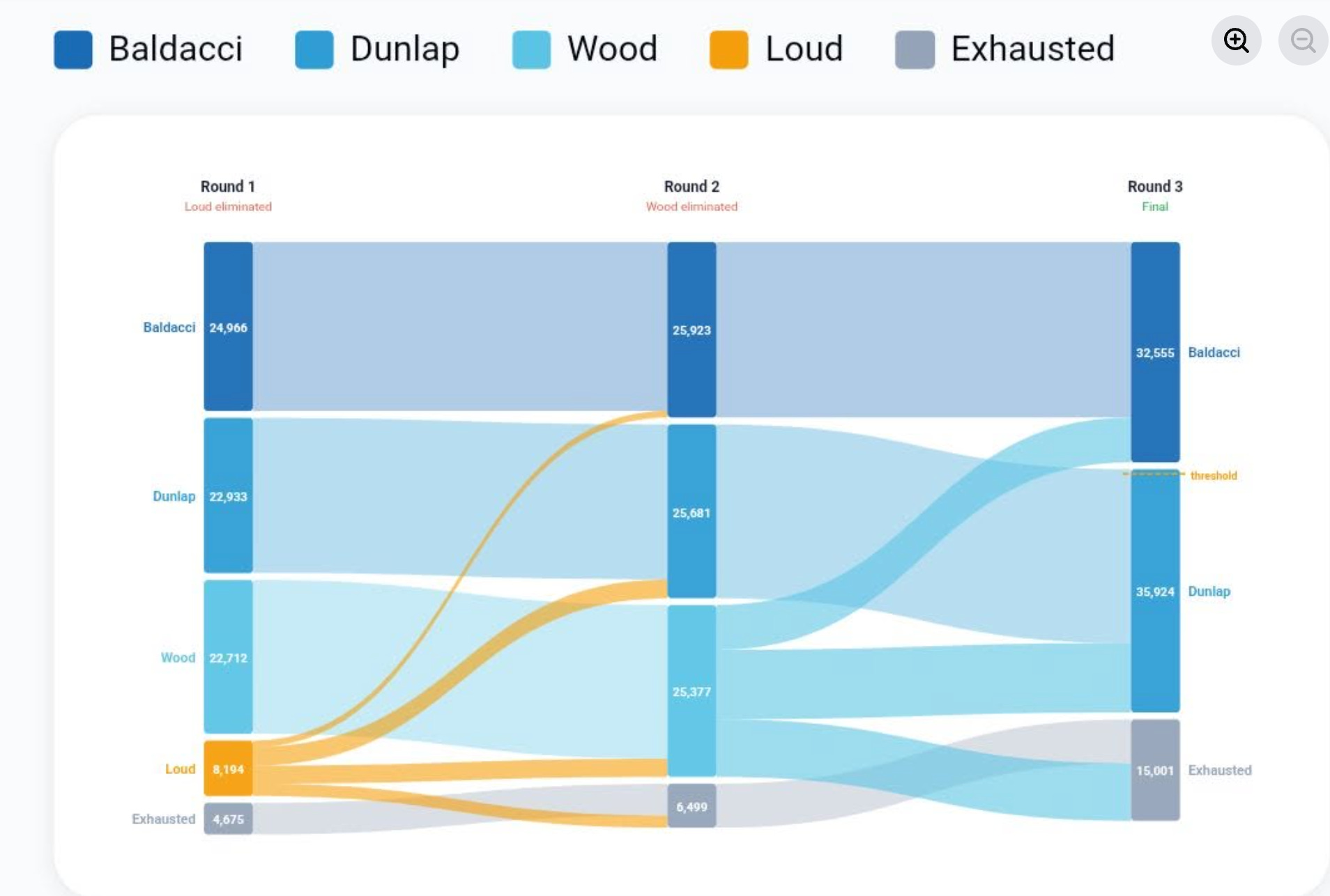
Not only did Dunlap capture and consolidate the anti-DC establishment vote, it demonstrated coalition-building skills critical to defeating LePage in November.
And that happened despite Dunlap favoring fewer gun restrictions than other candidates, not a minor issue in a district that saw a mass shooting a few years ago.
The two biggest cities in ME-2 are Lewiston and Bangor. Election returns show that Wood got the most first rankings in Lewiston and Baldacci did the same in Bangor. Wood also got the most top rankings in Auburn and Baldacci in Augusta and Belfast.
LePage lost all of those places in his 2022 run against Janet Mills and in the fall it’s likely he will lose them again. With hard work, Dunlap can run up big margins there.
With his rural roots and credibility on many policies, including sportsmen’s issues, Dunlaps can cultivate support from independents and turn out Democrats in those areas. Early in his candidacy he garnered endorsements from former ME-2 Rep. Mike Michaud, a centrist, and people who had backed Rep. Jared Golden before Golden left the race. All this helps him cut Republican margins in areas LePage will win.
Dunlap’s primary messaging included having stood up to Trump. It was unquestionably true.
Now Trump’s approval is down with virtually every voting bloc everywhere. ME-2 is a pretty rural district and voters in rural areas have also turned against the president.
According to Newsweek, in June,
“Trump’s net approval rating among rural voters stood at -10 points in a new poll from NPR/PBS NewsHour/Marist…marking a significant downturn in support from a voting bloc that was a key part of the coalition that bolstered his successful 2024 presidential campaign.”
No doubt Republicans will call Dunlap a socialist or commie radical for supporting universal coverage, but rural areas have borne the brunt of cuts in Trump’s One Big Beautiful Bill.
Oh, and you know who else ran on Medicare for All? Democrat Jared Golden in 2018, and he won. Golden also won re-election after voting to impeach Trump. And like Dunlap, Golden talked a lot about the power of big money in politics.
Moreover, the contrasts to LePage are striking.
When he was governor, LePage made it harder for people to get affordable health care, stopping Medicaid expansion after the state legislature passed it repeatedly and even after voters passed a referendum for it.
Dunlap is a voting rights champion who understands election systems. LePage is still saying he was won the 2022 governor’s race but was cheated by Janet Mills. In reality, Mills trounced LePage with a 90,000 vote statewide margin (while LePage barely won in the second district).
When governor, LePage made news for angry, often personally insulting pronouncements.
LePage doesn’t look anti-establishment like he did in 2010 at the height of the Tea Party movement. Yes, he certainly has his supporters. But he’s also a nearly 80-year-old man who’s on his second return from Florida to campaign for yet another office, at a time when his party is struggling to turn out its voters and attract independents.
Health care and the times help Dunlap.
Both pundits and the polls underplayed Dunlap’s strength.
At some point, Pan-Atlantic polling should explain how they consistently gave Joe Baldacci rather big primary leads. In a survey they conducted for Baldacci before he announced, Baldacci was 32 points ahead of Dunlap. Their mid-February to early March one had a Baldacci lead of +22, and that was repeated exactly in their May poll. The samples were small in all of them and, sure, polls are just snapshots, but really? These are big misses.2
In any case, despite the press downplaying Dunlap, he just kept campaigning as he had when he challenged Golden, with a combination of seriousness, calmness and humor.
When the Baldacci campaign aggressively questioned Dunlap’s record on choice, Dunlap drew a firm line and pushed back successfully, demonstrating the campaign’s ability to do rapid response.
Even after the winner was announced, the Bangor Daily News proclaimed “the biggest surprises came in the 2nd district” without taking into account that their poll had a first round sample of 190 people with fewer still in each runoff round; thus its potential error was quite large.3
The paper’s analysis also never seemed to consider the political contours of the race which made it seem unlikely to me and others that supporters of the three candidates who criticized national Democrats meddling in the race would disproportionately rank the DC party’s choice after their initial picks.
Meanwhile, Dunlap has shown himself to be persistent and tough and that will serve him well in the fall.
Given the competitiveness of ME-2, this will be a hard fought race.
To beat LePage, Democrats need to come together. That appears to be happening as all of Dunlap’s competitors conceded quickly and pledged to support the winner. They’re all interested in keeping Paul LePage out of Congress. It also serves their personal interests to work hard on this race if they plan on running again as Democrats.
Now Matt Dunlap needs to keep running a strong campaign.
His primary themes are good but he could now talk more about his experiences as the son of parents with a small business and what they taught him while continuing to tell others about all the jobs he’s done. Dunlap’s a hunter and fisherman with a deep understanding of and work on sportsmen’s issues. He can stress the range of support he’s received and his history of listening, learning and dialogue. Dunlap should keep talking about how having health care is both about affordability but also about dignity and the ability to pursue new dreams and endeavors.
Dunlap has a strong commitment to democracy and deep historical knowledge. This enables him to speak well about the beauty of our constitutional order and the threats it faces.
With energetic volunteers and strong financial resources, and an active, civil, accessible, tough, and clear-minded campaign that draws critical distinctions about what matters to voters, Dunlap can succeed.
In November 2025, I wrote that “Dunlap is a pragmatic coalition builder with experience, warmth and decency. He authentically cares about jobs and health care and being accessible. He’s a hunter and fisherman who fits the district’s culture. And Dunlap isn’t afraid to challenge party insiders.”
Those strengths won Dunlap the nomination, and they and other reasons are why he can win the seat in November.
Two of the three Pan-Atlantic polls were commissioned by the Baldacci campaign. (The February-March one was a public poll.) The May one, which had Baldacci ahead of Dunlap by 22 points had a sample of 169 likely voters. They also sampled more people for a general election matchup and found Baldacci ahead of LePage by 8 points, but never released data on how other Democratic candidates did versus LePage. Either they didn’t poll that or the results weren’t good for the Baldacci campaign so they held this information privately. There’s been a dearth of general election polls, but the ones we’ve seen showed Dunlap and Baldacci doing the same versus LePage.
There were 155 people in the second ranked choice round of the poll and just 119 in the third. Besides the rather small sample sizes for this poll and the Pan-Atlantic primary polls, it’s possible that Baldacci backing voters were a bit more likely to respond to a pollster and that introduced a sampling bias.
No posts
Comments
Nothing yet. Say the first thing.
Sign in to join the conversation.