

It hasn’t been a good year to be associated with the DC Democratic establishment.
Primary Election Day has come and gone, but the political drama is just getting started in Maine.
That’s to be expected with two critical, competitive federal contests, the Senate seat and the House seat in ME-2, hanging in the balance. One Democratic primary has been resolved, while the other is heading toward a ranked-choice showdown.
To defeat formidable opponents in November, the victors must bridge divides within the Democratic coalition itself, while reaching out to the independent and moderate swing voters necessary to cross the finish line in a general election.
All this must happen in a state that’s had a massive pragmatic streak and in a time of rising anti-establishment sensibilities, two things that don’t necessarily fit together.
Graham Platner won a strong victory, carrying virtually every municipality in Maine.
On election night, he spoke of himself, his criticisms, his remarkable 15,000 volunteers and his political vision, taking the time to praise the service of Gov. Janet Mills.
Susan Collins is unpopular and so is Trump. With the rise of progressive populism, difficult economic circumstances and the extreme unpopularity of Trump and Republicans, Platner has a great chance to beat her.
But given her past successes and the wiliness and toughness of her seasoned campaign staff, no one should take unseating her for granted.
What I’m looking for is how Platner cements his likely and potential allies. While most, probably nearly all of the 27.6% of primary voters who picked someone else, will vote for him in November, that’s not guaranteed.1 It’s also not enough to win. He needs virtually all Democrats and a number of independents. .
As I wrote the other day, Platner’s next stage in coalition-building has to start with accountability.
Platner could become a better candidate and elected official if his shifts in how he treats women are backed by a deeper understanding of gendered violence, abuse, and women’s rights. So many women live in fear and have suffered trauma due to men who scared and harmed them; a credible policy agenda matching that reality helps build a stronger coalition.2
I’m lately struck about how Platner talks about how neighbors and community members help each other in contrast to powerful people who don’t care most folks.
There’s more to say about that and other things the campaign has and could be doing, which I’ll consider in other posts.
Before moving on to the ME-2 race, I have to say that Donald Trump attacking Platner directly is an in-kind contribution to the Platner campaign. While Susan Collins wants to separate herself from Trump and run as her own brand, that further cements a link between Collins and Trump, who lost Maine the three times he ran.
In looking at the results, it looks to me like Joe Baldacci’s candidacy faces real headwinds.
Baldacci, the national Democrats’ chosen candidate, got the most votes Tuesday night, with a 31.5% vote share. While he won his hometown, Bangor, he lost his state senate district.
Thus this race will go to ranked choice tallies. (So will the Democratic and Republican gubernatorial races.)
Matt Dunlap and Jordan Wood were close behind Baldacci and clustered together with 29% and 28.7% respectively. Like Baldacci, they had experience in government. Dunlap served in multiple officers, while Wood was a congressional staffer.
Meanwhile, Paige Loud, who ended fourth, got a substantial number of votes (7764) for a first time candidate, nearly 11%.
It’s very doubtful Baldacci will get many second rankings from Loud’s voters. That’s because she was the furthest left candidate and she, Dunlap and Wood together criticized Baldacci for taking the endorsement and dollars from the DC Democratic establishment.
Want to play around with some possibilities for how the ranked choice runoffs might go?
Then I highly recommend checking out Derek Lane’s interactive RCV calculator. Using the arrows, you set how many ballots are exhausted per round and use the sliders to set how voters’ later choices are allocated.
For instance, I ran a simulation in which 95% of Loud’s voters ranked someone second. Since 5% didn’t rank anyone second, those ballots were exhausted. 16% of those ranking Loud first ranked Baldacci after Loud, and the rest split their second rankings between Dunlap and Wood. Dunlap would move to first place, Wood would be eliminated, and the ranked-choice runoff would go to another round.
Then if 5% of Wood’s ballots were exhausted and Dunlap picked up 54% of Wood’s second choices and Loud’s third choices, he’d beat Baldacci with a final tally of 51.4%.
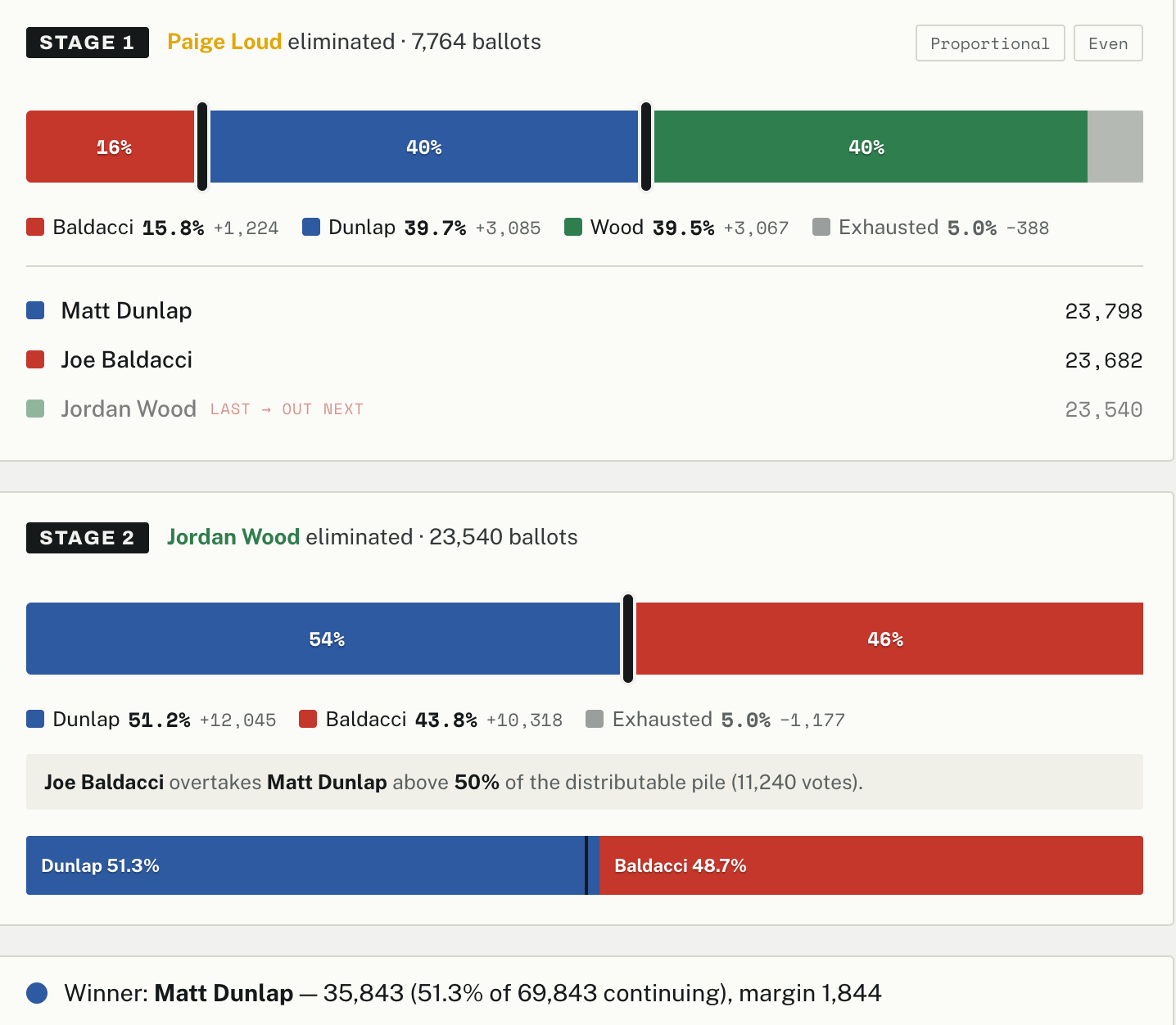
Again, this is but one scenario.
Baldacci certainly could do better than this in both stages. It’s also quite possible that more Loud voters picked Wood over Dunlap for their second ranking. This could be for any number of reasons, from wanting a younger candidate who hadn’t held office to temperament or some issue position.
Who becomes the Democratic nominee for ME-2 is still an open question but this race, like the Senate one, suggests that support from national Democrats isn’t all that helpful to candidates.3
An anti-establishment undercurrent is widespread and a key dynamic in American politics today. As such, perhaps it should also worry Maine’s senior senator, Susan Collins, as well as the GOP’s ME-2 nominee, former two-term governor Paul LePage.
Notably in 2020 Sara Gideon did just a little worse than Platner in her primary, with 28.5% of Democratic primary voters picking someone else. Of course that race was different in many ways.
Despite women being more than half of voters, male officeholders who actually seem to care about women are not that common. Moreover, Platner could become a policy leader on such matters if elected. Look at what happened when Joe Biden was a senator. Judiciary Chair Biden was roundly criticized for how Anita Hill was treated when she came to testify at Clarence Thomas’s confirmation hearing. Rather than avoiding talking about sexual harassment, Biden spent two years talking to experts and women’s rights activists. Then he wrote and passed the landmark Violence Against Women Act.
Baldacci’s earliest polls showed him with significant leads, albeit not with majorities. Then again, his best polls were all conducted by a single pollster, Pan Atlantic, which used rather small samples.
No posts
Comments
Nothing yet. Say the first thing.
Sign in to join the conversation.