
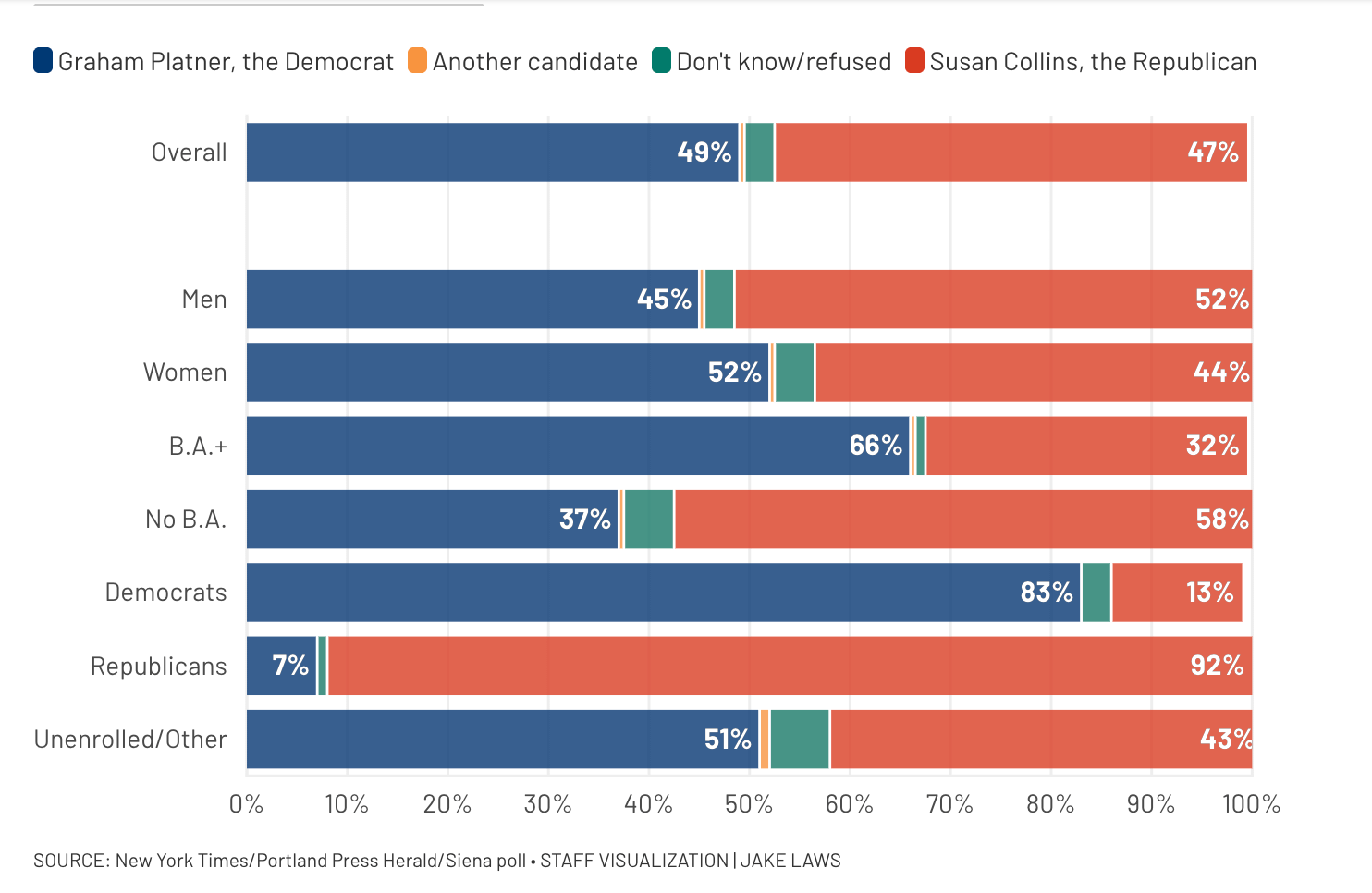
The first high quality pollster (NY Times/Sienna, with the Portland Press Herald) has its first general election poll in the Maine Senate race and it shows a tight race. (Poll write up and graphics here, crosstabs and more detailed poll results here.)
The topline: Platner 49%, Collins 47%, with a margin of error of 4.8 percentage points.
It’s looking more like 2020 than Democrats would like, which I’m sure triggers a certain amount of PTSD among them. But there are bright spots and worries for both parties.
Democrats are currently less united than Republicans, with 83% backing Platner, while 92% of Republicans support Collins. At the same time, Platner’s currently winning unenrolled voters, 51-43%.
Platner is also not doing as well among Harris voters as he could, nor doing as well among Trump voters as he and some of his campaign predicted. 10% of Harris voters back Collins but only 4% of Trump voters support Platner.
I never thought that Platner would pull many Trump voters. However, I do think he can do more to appeal to some more Harris voters by showing he takes issues of gendered violence and abuse seriously. Previously I’ve discussed how he could lean into these concerns and demonstrate greater understanding and support for an accompanying policy agenda.
In 2020, per the exit poll, the Portland area favored Gideon over Collins 62-32%.
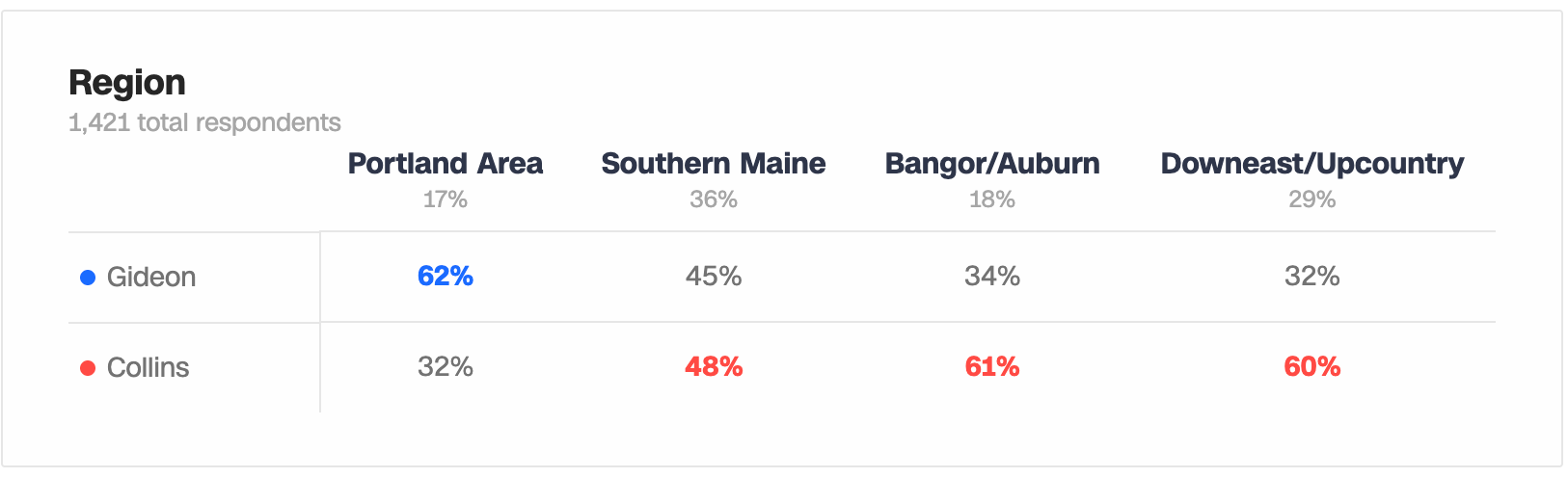
Now, as the Press-Herald explains:
“Platner’s largest base of support continues to come from college-educated voters from wealthier parts of the state, especially in the Greater Portland and Midcoast areas.”
Here’s the detailed breakdown.
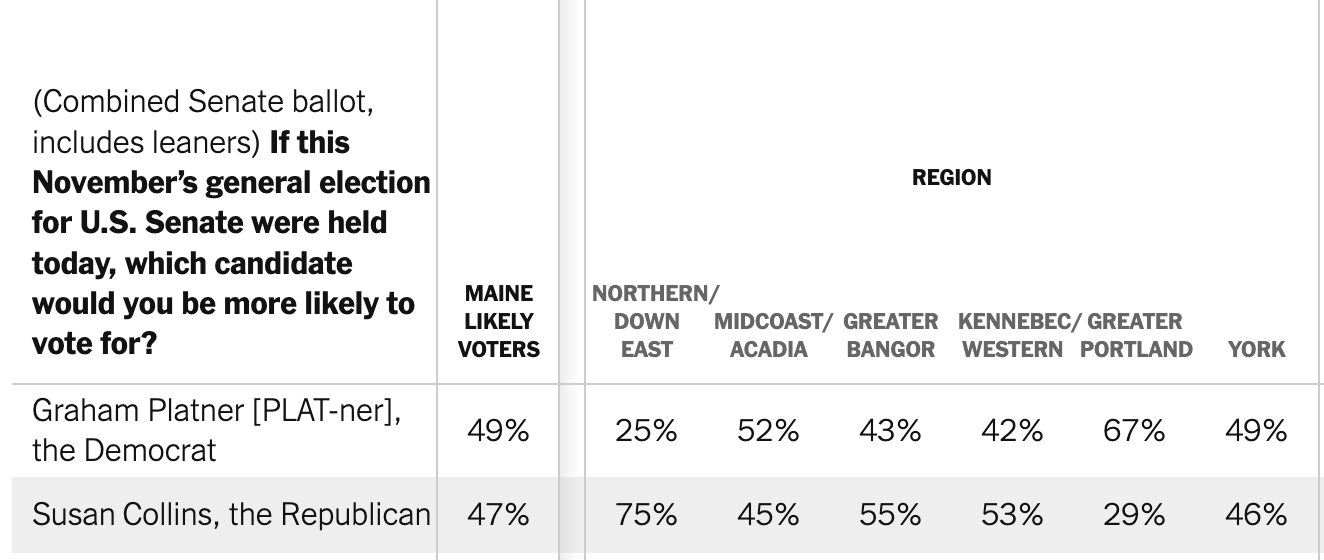
Note that Platner is currently running ahead of where Gideon finished in the Portland area, with 67% compared to 62% for Gideon in 2020, while Collins is doing worse in what they call Greater Bangor, with 55% now compared to a 61% finish in 2020.
As the Press-Herald puts it:
Much has been made about Collins’ unpopularity, but the Times/Press Herald/Siena poll found she and Platner were each viewed unfavorably by 50% of respondents. Collins had a slightly higher favorability rating, 48% to Platner’s 45%.
These can change, of course. Platner’s message that Collins is corrupt and benefitting financially could drive down her favorables. At the same time, he could do events that highlight his personality and commitments in a way that bring up his favorables.
Meanwhile Collins and her allies will keep putting Platner on full blast, with lots of negative ads.
Often these Collins swing voters are older working class Democratic women who like and respect her.
Check out these interview quotes:
Cindy Foss, a 66-year-old retired nurse who lives in Athens, said she plans to support Collins, because “she’s been there long enough to know what’s good for both our state and country.”
Foss, a Democrat who responded to the survey, said she’s been put off by Platner since his launch — well before any of his personal controversies came to light.
“He’s a blowhard — he thinks he’s all that,” Foss said. “This is a saying we have: if you could buy him for what he knows, and sell him for what he thinks he knows, you’d be rich.”
There’s a real tension in the data related to national politics.
In 2020 Collins won while Trump lost Maine statewide.
She’s still ahead of Trump. Only 39% of respondents think Trump is doing a good job as president while 60% disapprove. A whopping 57% strongly disapprove.
Currently, despite Collins voting with Trump 95%, only 34% think she is “too extreme,” while 47% think that about Platner.
Moving more of those Trump disapprovers to Platner will be a focus of the campaign. That’s helped by two things.
One is that Platner is more likely to be seen as better at “being an independent voice.” 50% say that about him and only 43% about Collins.
And 54% of respondents want Democrats to control the Senate, versus 42% who want continued Republican control.
93% have heard a lot (76%), some (12%) or a little (5%) “about various controversies surrounding Graham Platner, such as his old social media posts, text messages he exchanged with women while married, or a tattoo he got in his 20s.”
This suggests more advertising about these have little if no future returns.
On the other hand, any other controversies could decrease his support or lead soft backers to move to Collins. There is a real risk, given that 9% of non-Collins supporters say there’s some chance they could vote for her, compared to 5% of non-Platner supporters who say there’s some chance they’d vote for him.
A lot of voters, 48%, think Platner is “too inexperienced to be an effective senator.” Platner can’t change what he’d done in the past but he can show command of policy details and that may mitigate that concern.
61% say Collins would do a “better job of bringing money and resources to Maine,” compared to 34% saying Platner would do so. While Platner can’t compete on past earmarks, he can continue discussing how Collins’ votes have harmed Maine structurally by undermining major social programs.
Platner has the advantage on numerous policies and importantly, 50% of respondents he’d be better on “doing what’s best for ordinary Mainers” versus 46% saying this about Collins.
Being ahead despite being seen as less experienced and less able to help Maine specifically shows real resilience for Platner, support for his messages and weakness for Collins.
Debate performance will be one stage on which to show policy knowledge and positions, and no one in the Platner campaign should downplay Collins’ competence in debating.
It’s never smart to lower expectations for one’s opponent and Collins has many more debate performances under belt. She typically picks away at details, suggesting her opponent doesn’t know what she or he is talking about, thus delivering and reinforcing a meta message on inexperience and competence. Platner can emphasize big picture matters but he should be prepared to counter Collins and correct her.
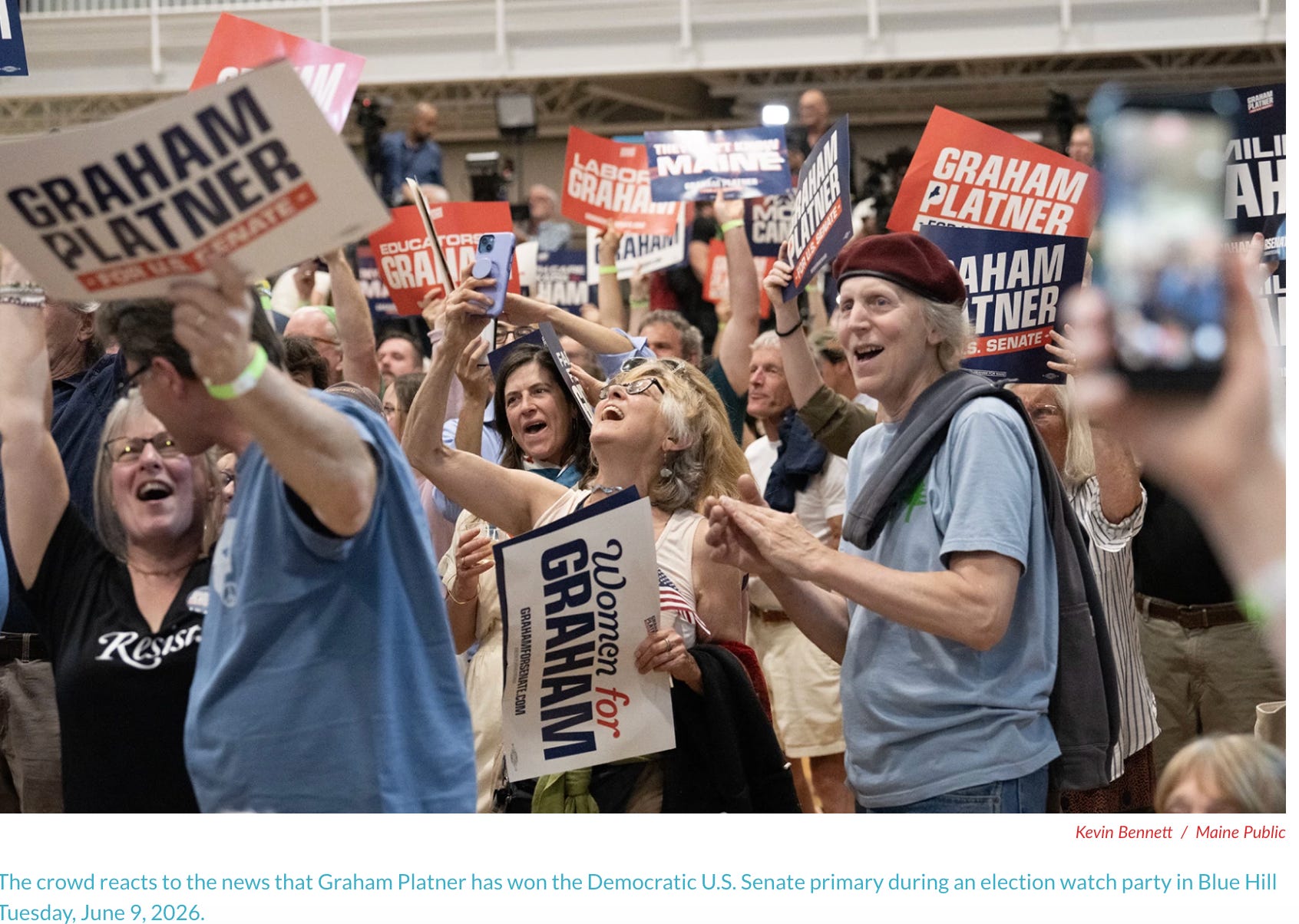
A whopping 91% of Platner voters are very (71%) or somewhat (20%) enthusiastic about voting for him, compared to 85% of Collins backers, with 52% very enthusiastic and 33% somewhat enthusiastic.
Moreover, Platner has mobilized an extraordinary number of volunteers who, if they stay engaged, can make a difference in turnout for him.
Maine voters do generally have high turnout already, but this activity and greater enthusiasm for Platner matters.
As always, polls are just snapshots and blurry ones at that. This poll has good and bad news for both candidates, with opportunities to both, while favoring Platner overall.
We have a long way to November. If you want to make a difference before then, donate, talk to your friends and neighbors and volunteer.
No posts
Comments
Nothing yet. Say the first thing.
Sign in to join the conversation.