
This week I’ve been head down “productionising” the AI Swimsuit Index, so this edition’s a shorter run than usual. I am aiming to ship an online tool with FTSE data bolted onto the S&P, plus the insights that fall out of my analysis next week. Excited about having a proprietary framework to track AI deployment progress here.
1. American AI now runs on ad-hoc permits
Mythos reopens, narrowly.
Commerce Secretary Howard Lutnick sent Anthropic a letter clearing roughly 100 vetted partners, some of them US government agencies, to regain access to Mythos. Lutnick was explicit that this runs on his own discretion, reserving “the right to reevaluate and adjust the scope of license requirements... should circumstances change”, which is the confirmation we didn’t need that frontier models now sit under an ad-hoc licensing regime with no congressional or executive-order basis (nor apparently, technical expertise).
GPT-5.6 arrives on the same leash.
Last week also brought OpenAI’s GPT-5.6 - a trio of Luna (cost-efficient), Terra (GPT-5.5-level at half the cost) and Sol (the new flagship) - launching, at the government’s request, only to a small set of trusted partners rather than the public. OpenAI said plainly this isn’t the rollout it wants (”It keeps the best tools from users, developers, enterprises, cyber defenders, and global partners who need them”), and Sam Altman backed staged releases in principle while noting “this isn’t quite the process that we think is optimal”. On the numbers, Sol reportedly beats Mythos on Terminal Bench 2.0 (a benchmark for evaluating how well AI agents can independently perform complex, long-horizon computer tasks). Even Terra and Luna (neither obviously ahead of GPT-5.5 or Opus 4.8) are being held back, which suggests Washington has paused releases across the board rather than targeting only the frontier.
Fable 5 and Mythos 5 come off the blacklist.
As I predicted two weeks ago the White House has lifted export controls on Fable 5, allowing Anthropic to restore customer access from Wednesday. To get there they’ve added a new safeguard targeting the reported bypass that triggered the ban, and Commerce’s Center for AI Standards and Innovation validated both the old and new protections. The timing tracks the administration’s balancing act between frontier-model risk and keeping pace with China, with the industry now pinning its hopes on a forthcoming executive order to replace these one-off calls with something predictable.
Meanwhile, OpenAI angles for Trump’s blessing - and the public’s.
In an attempt to buy goodwill and headlines while the fight over licensing and safety carries on… OpenAI has floated handing 5% of the company to a sovereign wealth fund modelled on the Alaska Permanent Fund (roughly $42bn at today’s valuation) with it still unclear whether the government would buy in or simply be gifted the stake. It has also made the rather absurd proposal that Google and Meta join the 5% club and contribute their own equity - none of them have commented.
Wrapping up the Fable saga: The Economist remind us why politicians should stand back, pleading for America not to imprison frontier AI.
2. The capability curve keeps outrunning the jobs story
The automation frontier has more than doubled.
The Center for AI Safety’s updated Remote Labor Index, which grades models against paid-professional deliverables across freelance work like 3D modelling, architecture and video editing, now has Fable at 16.1%, well clear of Opus 4.8 (8.3%) and GPT-5.5 (6.3%). That’s up from 2.5% when GPT-5.2 topped the index less than a year ago. Fast progress but CAIS is careful to note that today’s models still fall short of professional quality on most projects: 16% automation still leaves humans needed 84% of the time.
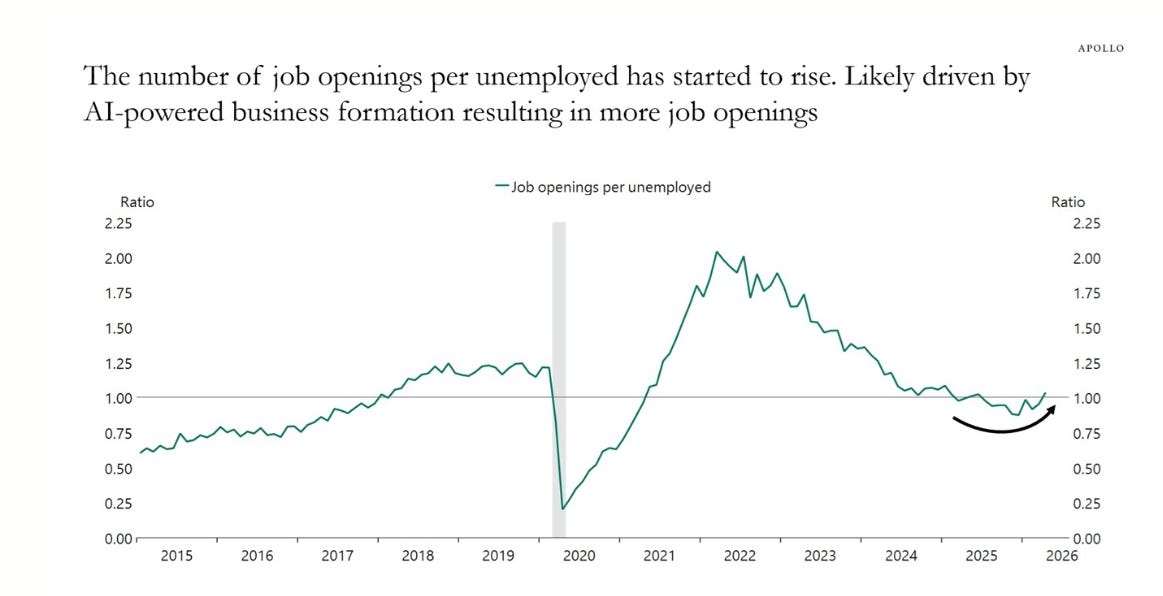
Debate still very much open on jobs macro fears.
A new study of 22,000 US companies pushes back on the idea that generative AI is about to trigger broad job losses: white-collar worker numbers increased 10.2% overall at companies that used generative AI most intensely in the last two years.
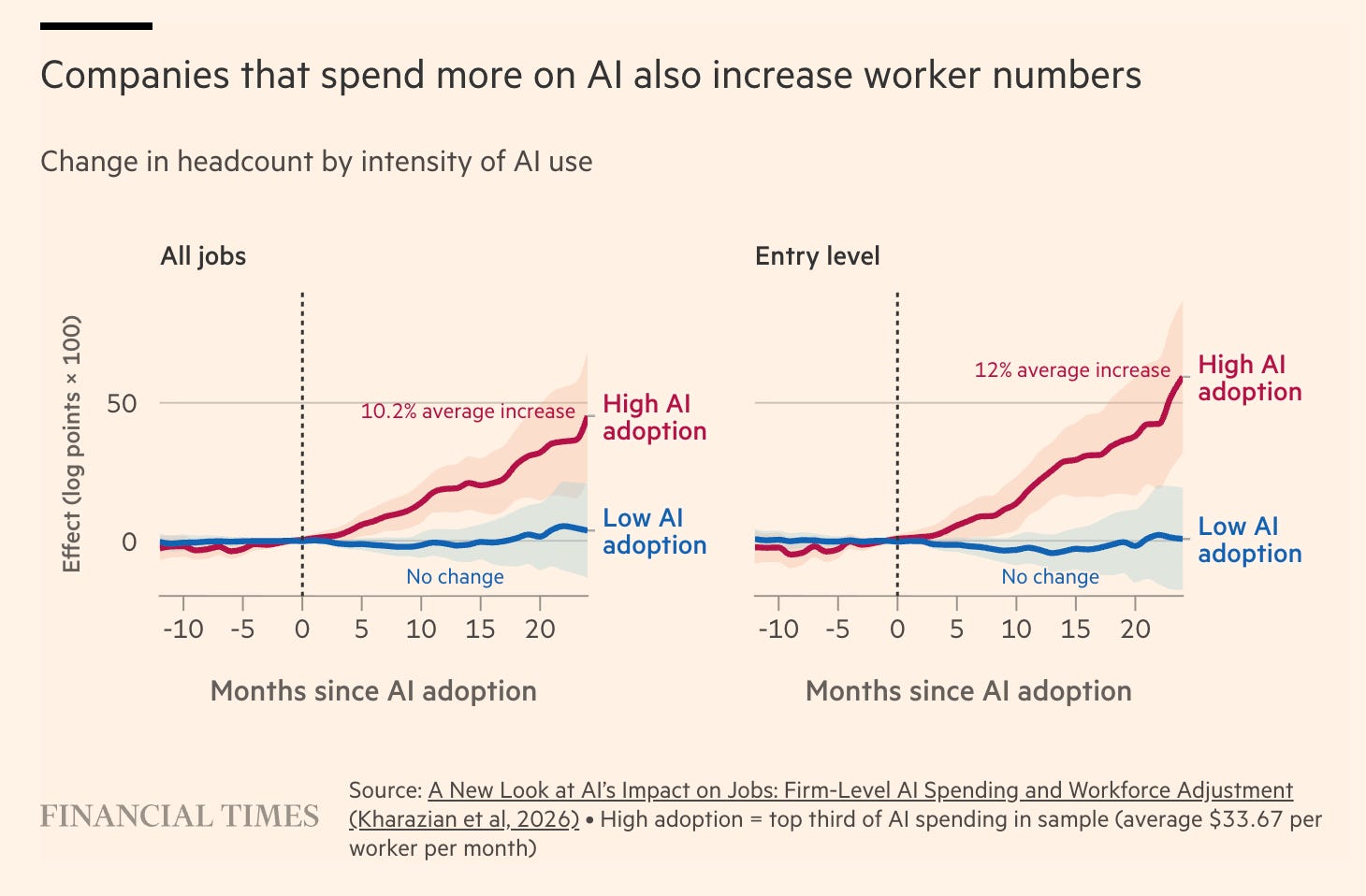
Source: FT, study of 22,000 US companies.
Task-level capability is climbing fast while economy-wide displacement remains hard to detect, as Apollo’s Torsten Stok reminds us:
Where the gains do land, discovery is the binding constraint.
A new INSEAD/HBS field experiment across 515 high-growth startups reveals that firms simply told how others had reorganised production around AI found 44% more use cases and went on to complete 12% more tasks, win 18% more paying customers and generate 1.9x the revenue of the control group. The authors name the friction the “mapping problem”: discovering where in your own production process AI creates value is what gates the returns. Treated firms grew fast while cutting demand for external capital by 39.5% and holding labour flat, as AI expanded the top end of what they could achieve without pulling in more headcount.
3. More DeployCo news, same underlying problem
AWS is putting $1bn into a new organisation of “forward deployed engineers” to help business customers use AI, with Frontier AI VP Francesca Vasquez saying they’ll work alongside staff from OpenAI, Anthropic and others, implementing both AWS and third-party products across healthcare, government and financial services. It’s the Palantir FDE model again, with AWS retraining its solution architects into the role.
Everyone is now selling AI deployment - OpenAI’s DeployCo, Anthropic, every management consultant under the sun, countless smaller outfits standing up practices and stamping "FDE" on the door. But the people you get allocated have, in all likelihood, never solved the problem you're facing at scale. Enterprise leaders should proceed carefully: a flood of offers is not a sign the hard part is now handled and easy, and the thing that can turn into long-term advantage is organisational know-how, earned only by deploying (and let’s face it, failing) wave after wave. I laid out the full argument here.
No one gets to sit this one out and leapfrog the firms who put in the reps early. "It's moving too fast to commit" is the new "we're monitoring the situation” - comforting to those watching while their competitors build their institutional capacity to absorb the next wave.
Bonus: your recommended read of the week
If this has left you wanting more… Exponential View have published their annual State of the AI Economy report.
There’s many but this slide in particular caught my attention as a reminder we’re not out of our short-term thinking phase yet… “Glass half full view”: the real prize (new demand & growth) is there for the taking.
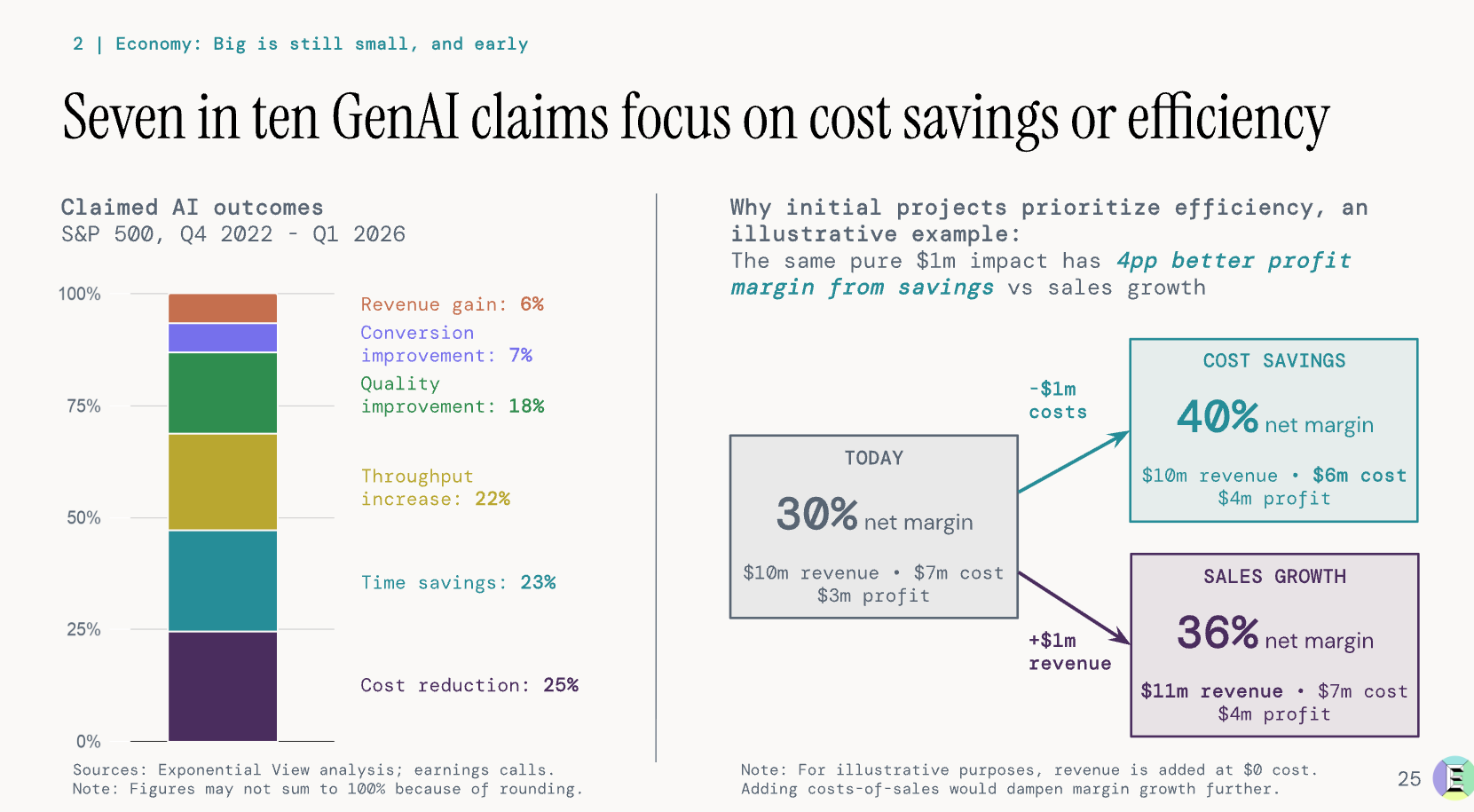
It’s exactly the kind of data I’m trying to delve into with the Swimsuit Index. Help surface more evidence behind real-world deployments for AI planning and benchmarking purposes. Until next week!
Thanks for reading The AI Value Gap! Subscribe for free to receive new posts and support my work.
About
I analyse AI progress beyond the headlines, focusing on enterprise execution, incentives, and real-world economic impact.
Comments
Nothing yet. Say the first thing.
Sign in to join the conversation.