

The US economy has become one enormous bet on artificial intelligence: stocks, venture capital, credit, and GDP growth itself. Those bets are still priced on the companies selling AI; yet returns will be decided by the far larger group buying it, and whether they can turn AI spend into earnings. To find out who can, and to separate AI-washing from AI impact, I built an index across major S&P 500 deployers that measures disclosed AI proof. It shows that only one in five can attach a monetary figure to AI, and exactly one company ties a saving to a trackable line in its reported financials. The market has spent two years pricing narrative as if it were execution… the proof gap is where that assumption gets tested.
When the tide goes out
Warren Buffett liked to say you only discover who has been swimming naked when the tide goes out. For two years the entire corporate world has been in the water together, with the tide firmly in. Every large company has an AI story, a slide on how agentic expands their market opportunity, a press release about a pilot driving productivity gains, and a few have job cuts rebranded as AI readiness (the markets love those). The water has been high enough that nobody has had to show very much.
The tide is starting to turn though, as the first numbers finally arrive. JPMorgan claims roughly $2B of savings against $2B of AI spend; Johnson & Johnson reports nearly $500M of measurable value from its genAI projects; Procter & Gamble says autonomous AI media-buying agents save it more than $100M a year in a single division. As these land, the burden of proof begins to move, away from the companies selling AI and towards the companies buying it, who now have to show it works.
The whole market is one big AI trade
Strip out AI and the American economy looks far less exceptional. The market has effectively become a single position: the Magnificent Seven delivered 42% of the S&P 500's 17.9% return in 2025, with Nvidia alone accounting for 15.5% of the index's gain. Capital spending leans the same way, as the largest hyperscalers guide towards roughly $750bn of capex in 2026, about 2.5% of GDP.
The macro arithmetic is starker still, though the exact figure is contested. Pinning down AI's exact contribution to growth is hard - the answer depends on how you treat imported chips, gross versus net investment, and what even counts as "AI" - so estimates differ. But most land in the same place: information-processing equipment and software drove the bulk of America's growth through 2025. At the strong end, Harvard economist Jason Furman puts it at some 92% of first-half GDP growth last year, with the rest of the economy close to flat. Either way, AI capital spending has become a swing factor in US growth - and perhaps the one doing most to flatter the headline number.
Capital markets show the same gravity. Apollo’s Torsten Slok finds AI now accounts for 87% of venture funding and roughly half of investment-grade bond issuance. Debt, equity, venture, and public markets are all leaning on one theme at once.
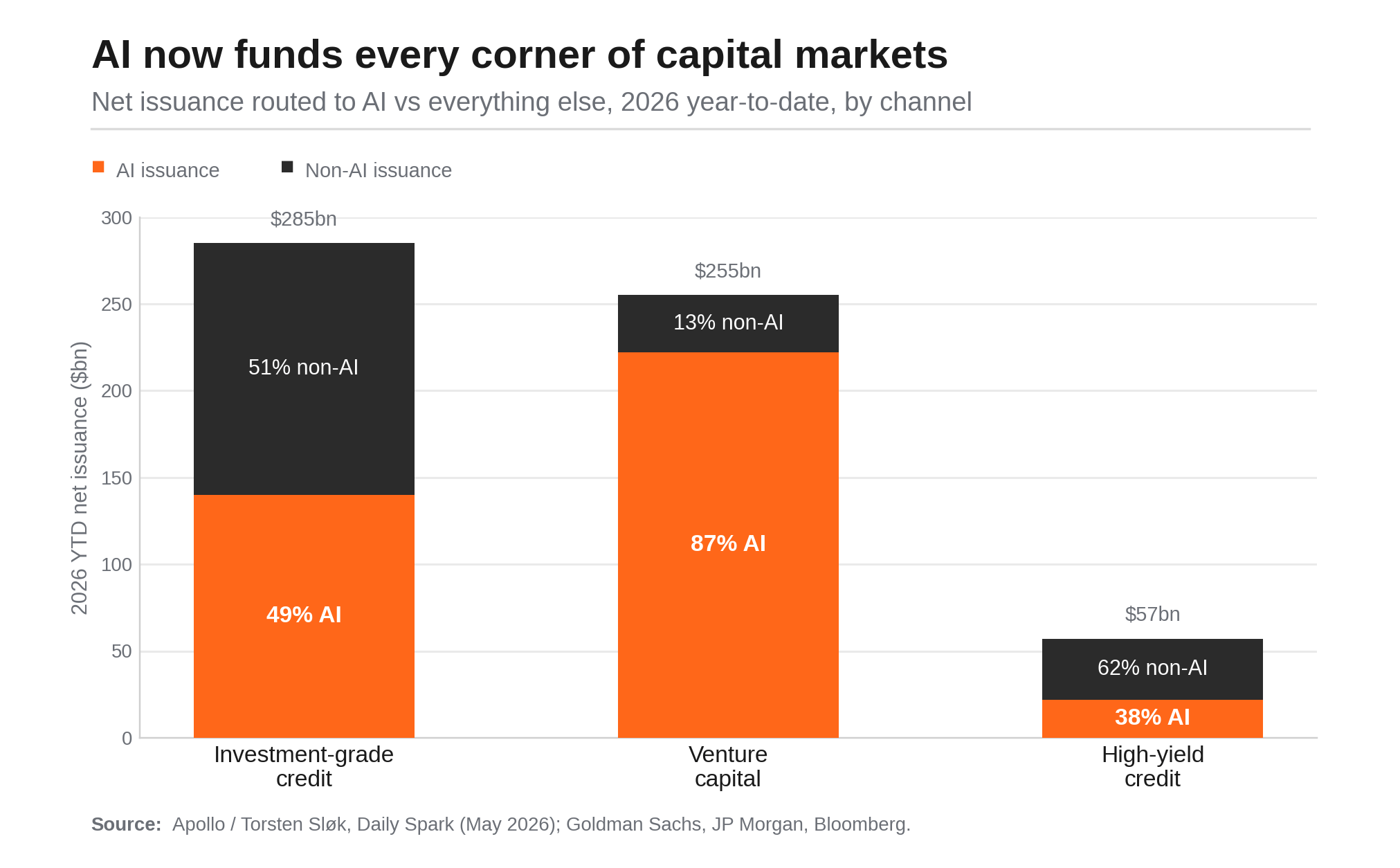
Every one of those numbers is priced on the companies that sell the picks and shovels. The buyers face a different question entirely.
The sellers cannot validate the trade alone
The value chain, from hyperscalers and chipmakers to model and platform companies, is priced for a future it cannot deliver alone. The Magnificent Seven trade at about 31 times forward earnings against 20 for the rest of the S&P 500, and hold around 35% of the index's market value while generating roughly a fifth of its profits. That premium is a claim on AI revenue nobody has booked yet: roughly $450bn of that 2026 capex is earmarked for AI infrastructure, set against an AI industry generating an estimated $60-80bn of revenue a year - barely a sixth of the build.
Realised earnings tell a similar story. In 2023 the Magnificent Seven grew profits roughly 35 points faster than the other 493; by 2025 that lead had narrowed to under ten points, as their growth normalised from the high thirties and the rest of the market accelerated into mid-single digits. On delivered earnings the field is catching up, even as the valuation premium holds.
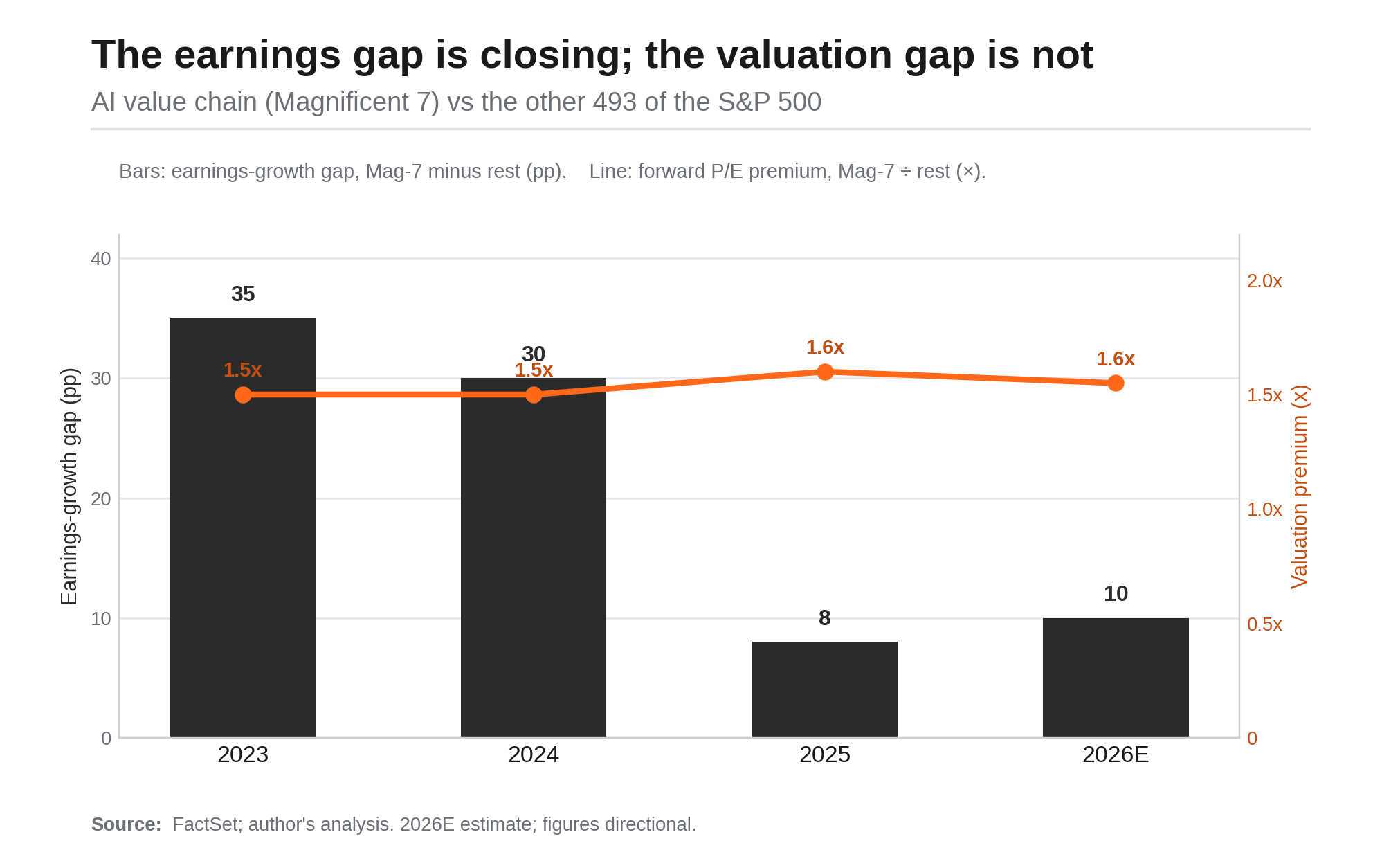
So the premium rests on revenue the value chain has yet to earn. Revenue that can only come from its customers, the ordinary companies expected to buy AI and convert it into profit. The market keeps asking whether the hyperscalers are overbuilding; the answer runs through whether their customers can turn that spend into earnings.
Introducing the AI Swimsuit Index
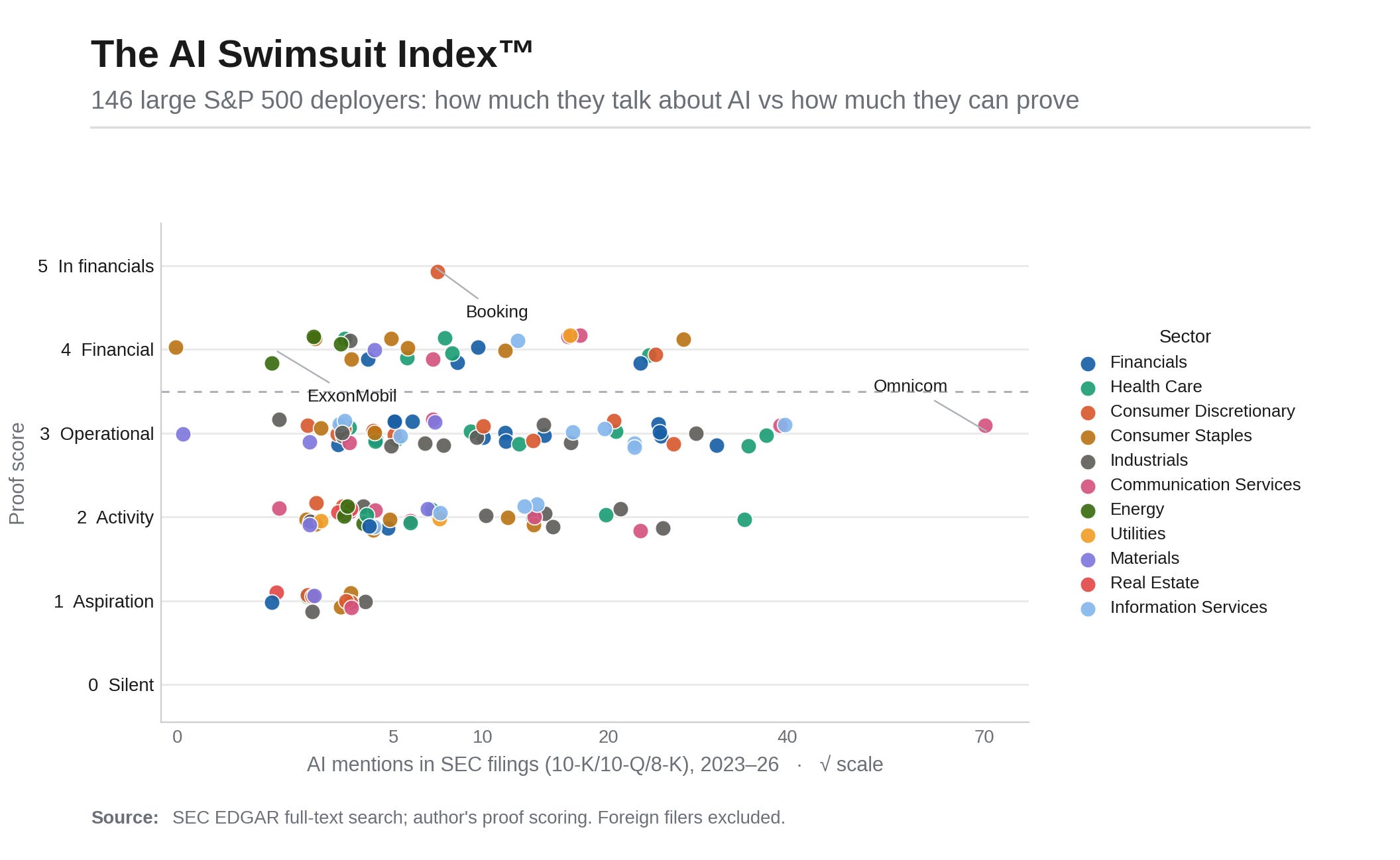
To answer it with evidence, I built a scoreboard. I excluded the AI value chain itself - hyperscalers, semiconductors, AI infrastructure, and model and platform companies - and reviewed the filings, earnings calls and investor materials of 146 of the largest S&P 500 deployers: those above $25B in revenue, plus data and information-services names - together about 70% of the group’s revenue. Each is scored on two axes: the first is how loudly it talks, measured as the number of times "artificial intelligence" appears in its SEC filings from 2023 to date (10-K, 10-Q, 8-K). The second is a Proof Score from zero to five built from evidence management has chosen to disclose in filings, earnings calls, investor decks and press. Zero is silence, one aspiration, two named projects, three a quantified operational result, four a monetary figure, and five AI-linked revenue, savings, or unit economics visible in reported financial performance.
I call it the AI Swimsuit Index, because it asks the Buffett question clearly: when the AI tide goes out, who has covered themselves with proof?
One caveat before the results: the index does not prove that low-scoring companies have created no value as it only measures whether management can evidence AI value in a way an outsider can underwrite. Some firms may be saving real money and choosing not to disclose it. Others may be reinvesting the gains before they reach reported margins. But widespread hidden value would be a strange equilibrium in a market hungry for AI proof. Either way, the market can only price what a company can show, so here, value that cannot be evidenced is value that does not count.
The result: how few can show the money
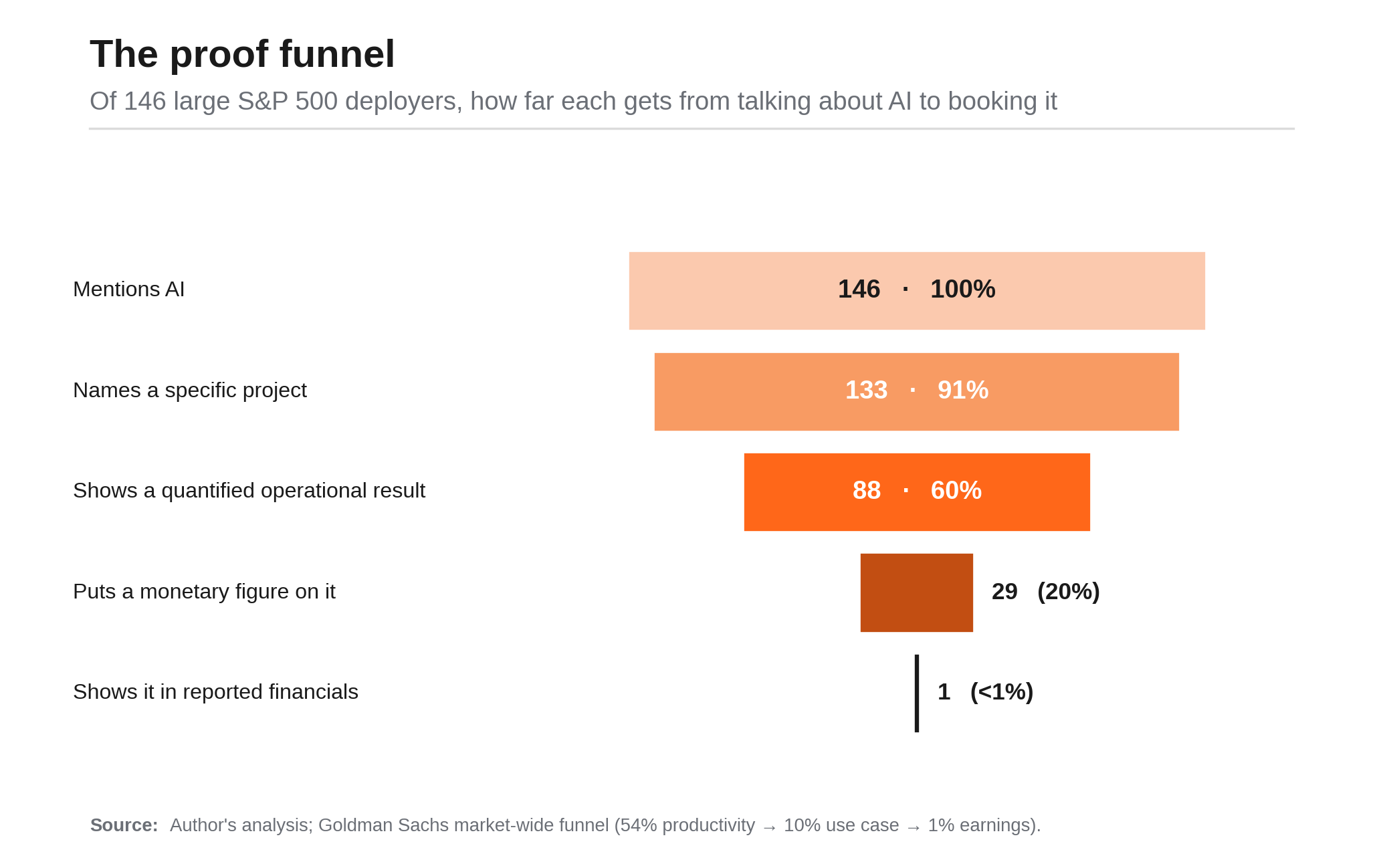
The results are humbling, and show how much of the AI talk is still just talk. Only about a fifth (29 of 146) can put any monetary figure on AI at all, and only one ties that figure to a trackable line in its reported financials.
AI is everywhere, and 91% of companies can point to a named project - but the median company appears to reach operational proof and stop there: a time saving here, an adoption rate there, nothing that reaches the bottom line.
Going a step further: the relationship between AI mentions and financial proof is flat. In other words, how much a company talks about AI tells you almost nothing about whether it can back the talk. Omnicom files the phrase “artificial intelligence” more than any other deployer in the index and sits at proof level three; ExxonMobil mentions it once and reaches four.
An aggregate study from Goldman Sachs points to the exact same shape: a number on AI is common, a number that reaches the earnings almost nonexistent. Their recent review of S&P 500 earnings calls found that 54% of companies tie AI to productivity, 10% can put a number on a use case, and just 1% quantify an effect on earnings. That last 1% - the sliver tying AI to the earnings line - is almost exactly where my scale lands at level 5, where I find one company in 146.
The cleanest case: Booking Holdings, the only firm that can point to AI in its reported numbers, with genAI having cut customer-service cost per booking by a double-digit percentage.
The difference between Booking and the level-four claims is observability. JPMorgan’s $2B is top-down and unfalsifiable from outside: you cannot decompose it, watch it, or check whether it persists. Booking’s claim is pinned to a disclosed unit metric on a named operating line, which an outsider can follow each quarter to see whether the effect holds as volume goes up or down. A top-down number is also the easiest place to launder a story: cut headcount for ordinary reasons, attribute the saving to AI, and the press release writes itself. A tracked unit cost is much harder to dress up.
That is also why the emptiness at level 5 is not an accident. A tracked AI metric is a rod for your own back, and most AI savings are too diffuse to pin to one line anyway… so the incentive runs the other way: name one big number that impresses and cannot be checked. The firms that do disclose a trackable AI line tend to be the ones forced to: the software vendors who must prove to investors that their AI is selling.
The sorting has started
But even within deployers, we can already see the market dividing into those who can prove it and those who cannot. At one end sit the companies banking it: JPMorgan, J&J, CVS with hard cost-savings figures; the insurers: AIG, Allstate, Travelers - turning underwriting into measurable cycle-time gains; Booking driving cost per booking down. And at the other end sit eight companies that, on my scoring, talk about AI at high volume and score two or below. Among them Coca-Cola, Disney, Paramount and Chevron. For the first three, AI is mostly a story told to the market: a marquee Microsoft partnership at Coca-Cola, gen-AI in the parks and on screen at Disney and Paramount… fluent on intention but no number attached to the result (that might change quickly with Paramount’s new owner). Chevron is interesting: it is cutting $2-3B of cost while talking AI at every turn, yet credits those savings to a reorganisation and keeps AI out of the number: a rare case of management refusing to launder ordinary restructuring.
The distance between an AI narrative and an AI result is still hard to see in public-market pricing. It may be buried inside sector multiples and margin assumptions, but nothing yet measures it explicitly. The index exists to put a number on it.
Whole sectors are sorting too. Inside information services, Thomson Reuters and Nasdaq are booking AI revenue while peers of similar size are still issuing press releases - the early outline of an industry splitting between firms becoming AI infrastructure and firms still defending legacy information products with AI wrappers.
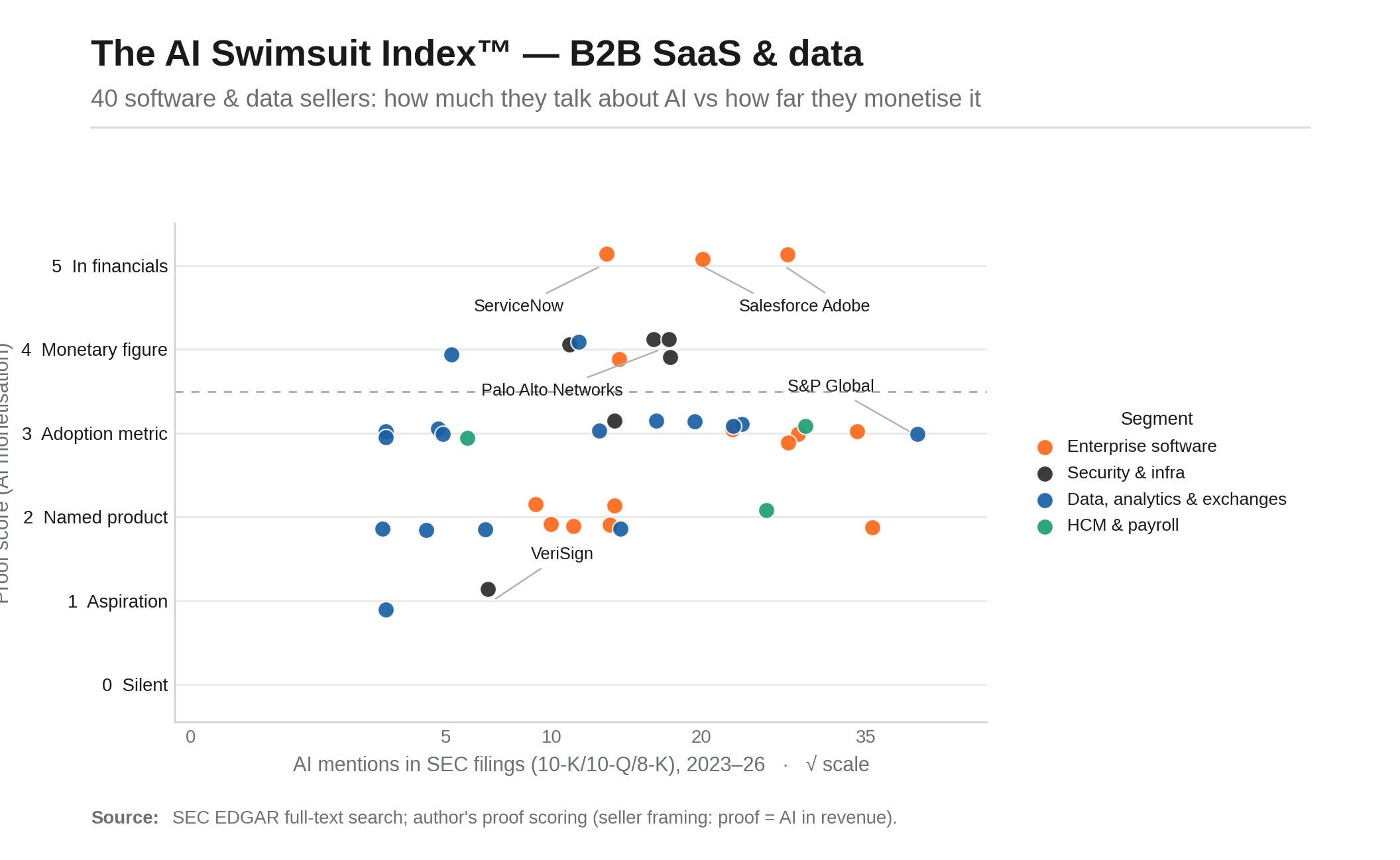
I ran the AI sellers themselves: the S&P 500's B2B software and data companies as a separate sample, and even there three-quarters cannot put a figure on their own AI product, a roadmap-washing that mirrors the cost-side version. It is a companion finding rather than the centrepiece, but it points the same way from the other end of the value chain.
The reckoning runs through the buyers
The bet on AI is, in the end, a bet on its customers. The valuations, the capex cycle, GDP expectations: all of it assumes the ordinary companies buying AI will pay enough, soon enough, to justify what is being built for them. My scoreboard says only one in five of the largest can yet show the money, which means the expectations priced into the sellers are running well ahead of the demonstrated ability of the buyers to monetise what they are sold.
For an investor, the proof gap is starting to look like a repricing signal. The market has spent two years rewarding AI exposure as if exposure and execution were the same thing, handing a similar re-rating to the company running a deployed, measurable system and the company running a press release. The next phase should be less forgiving. Once AI value starts to show up where it can be seen and tracked: in margins, retention, cycle times, revenue per employee - a high-proof deployer earns a different multiple from one still substituting narrative for evidence. The index is built to anticipate that moment.
That gap closes one of two ways. Either the deployers convert AI spend into earnings at scale and the evidence catches up to the valuations, or the valuations come down to meet it.
For now, the burden has moved to the buyers. When the tide goes out, proof is all they will have left.
Thanks for reading The AI Value Gap! Subscribe for free to receive new posts and support my work.
About
I analyse AI progress beyond the headlines, focusing on enterprise execution, incentives, and real-world economic impact.
Comments
Nothing yet. Say the first thing.
Sign in to join the conversation.