
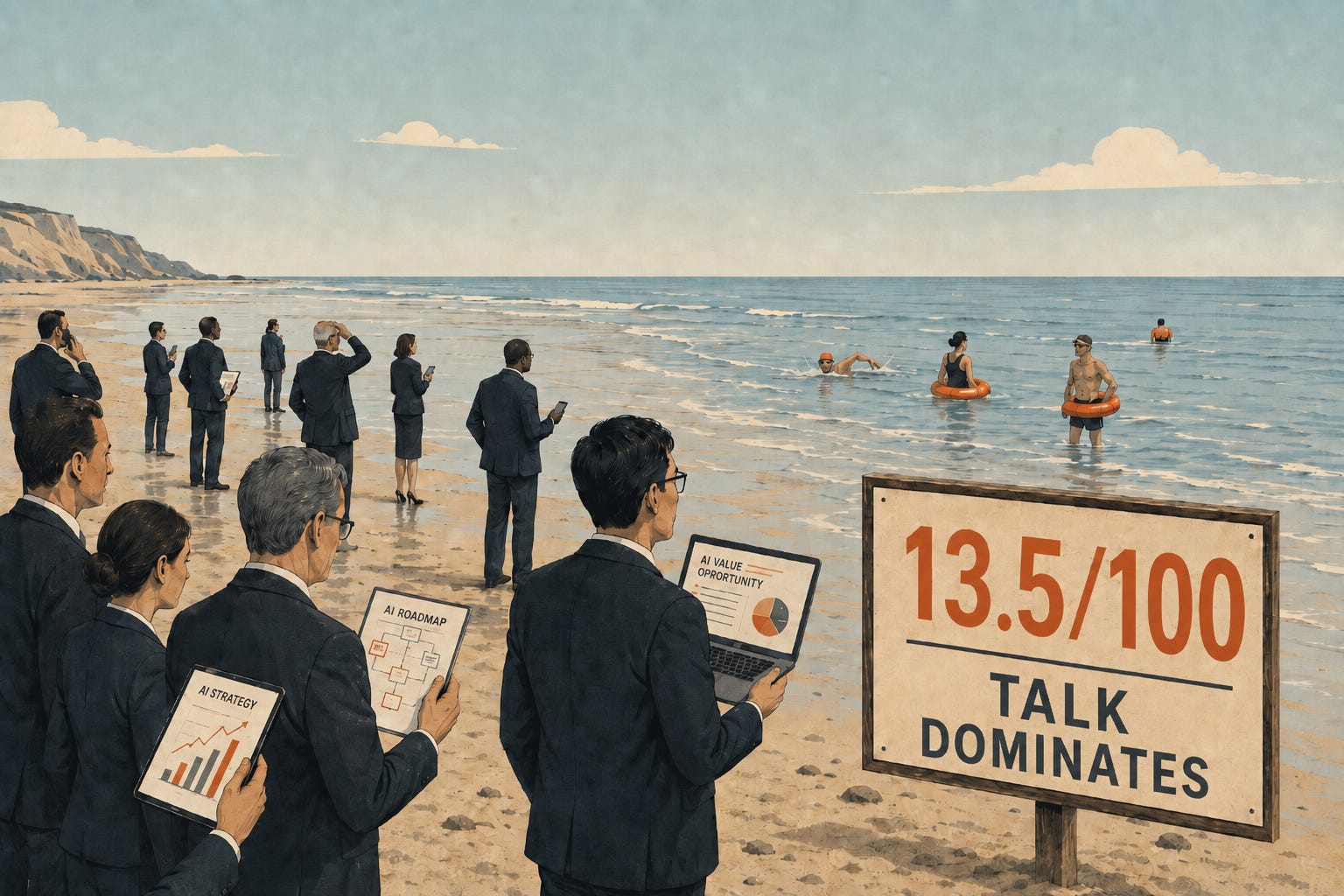
Across 536 of the largest US and UK companies, AI value is overwhelmingly claimed, not proven. Nearly three-quarters cannot disclose a single quantified result.
“Only when the tide goes out do you discover who’s been swimming naked.” — Warren Buffett
For three years AI has been a rising tide, lifting valuations and vocabulary alike. This is the first measure of how much of the AI value enterprises expect is actually being realised. The demand-side lens on the AI bubble debate.
The index measures what companies disclose, not every AI result they may be creating internally.
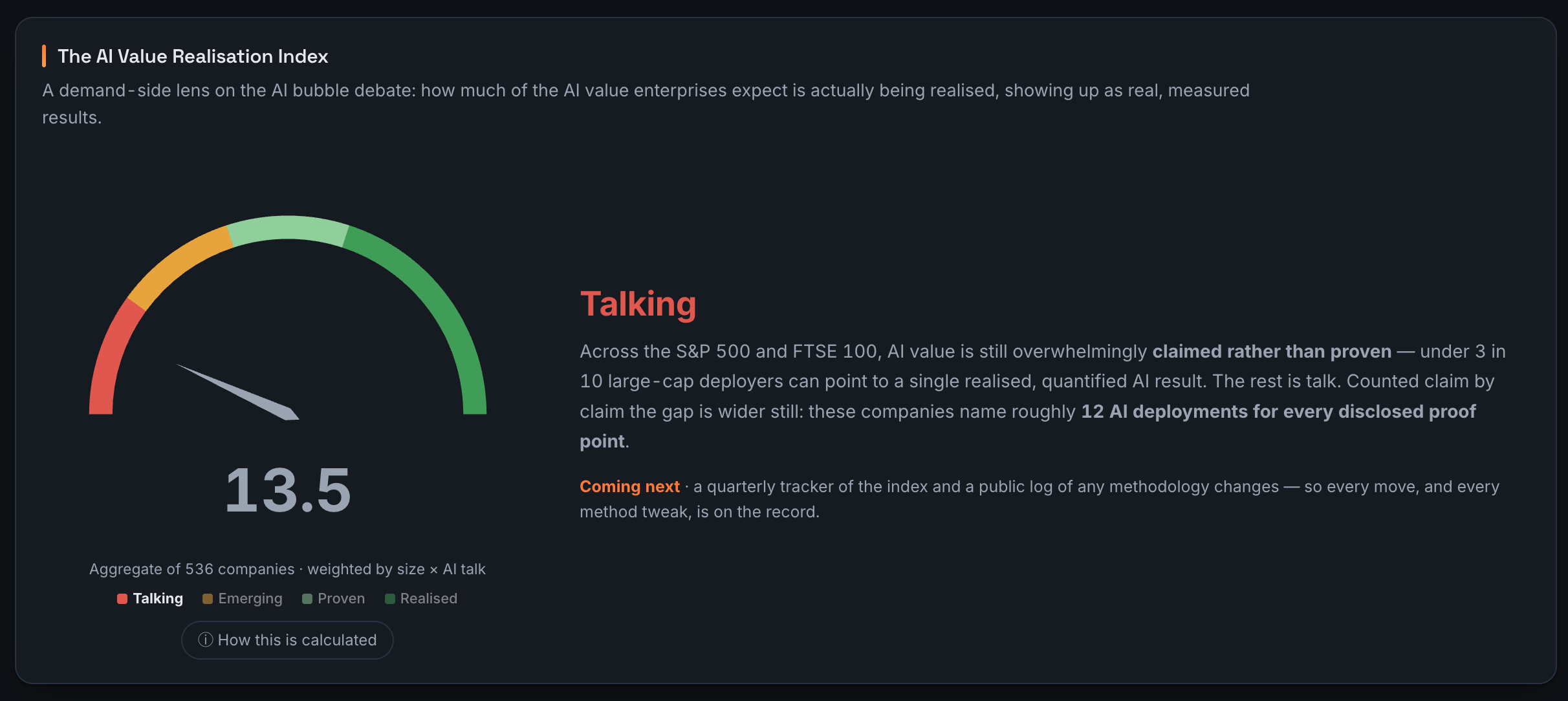
The AI Value Realisation Index is a single number showing how much of the AI value enterprises expect is appearing as quantified, publicly disclosed outcomes. It’s the demand-side of the AI-bubble debate: capex, chips and valuations tell you what’s being spent; this tells you what’s landing.
Its first reading is 13.5 out of 100: the bottom band. Weighted by size and how loudly companies talk about AI, only about a seventh of the market’s AI narrative is backed by realised, quantified evidence. 29% of companies can point to a single realised, quantified AI result. The other 71% score zero.
At that level, investors are being asked to price a transformation whose results remain largely invisible, incomparable and impossible to track over time.
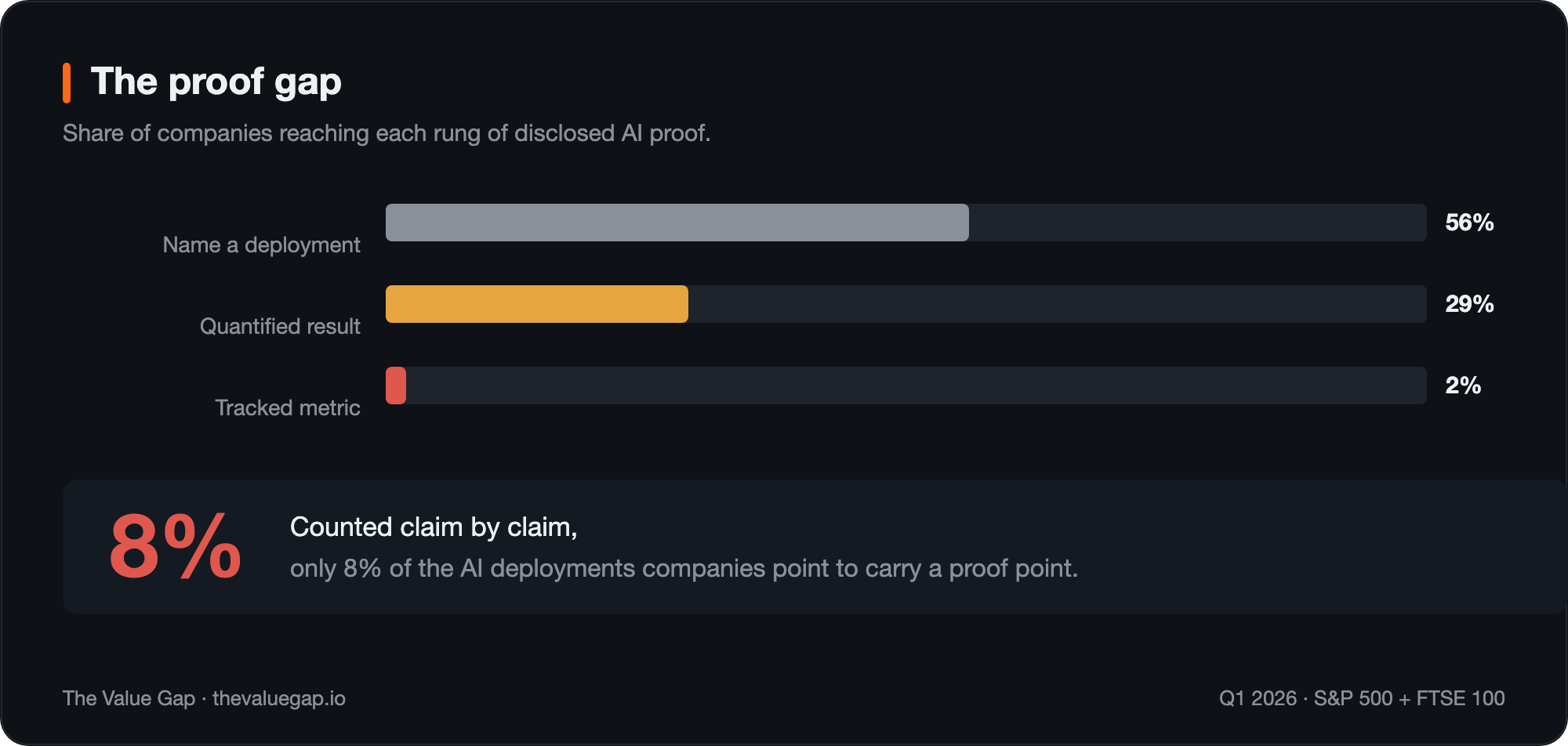
Follow the money down the ladder and the story gets starker at every rung:
56% of companies name an AI deployment in their filings.
29% get as far as a quantified result - a real number attached to it.
2% disclose a tracked metric an outsider could follow quarter to quarter.
And counted not by company but claim by claim (every AI claim identified in its disclosures) only 8% carry a proof point at all. The AI story is being told at enormous volume; almost none of it is being backed.
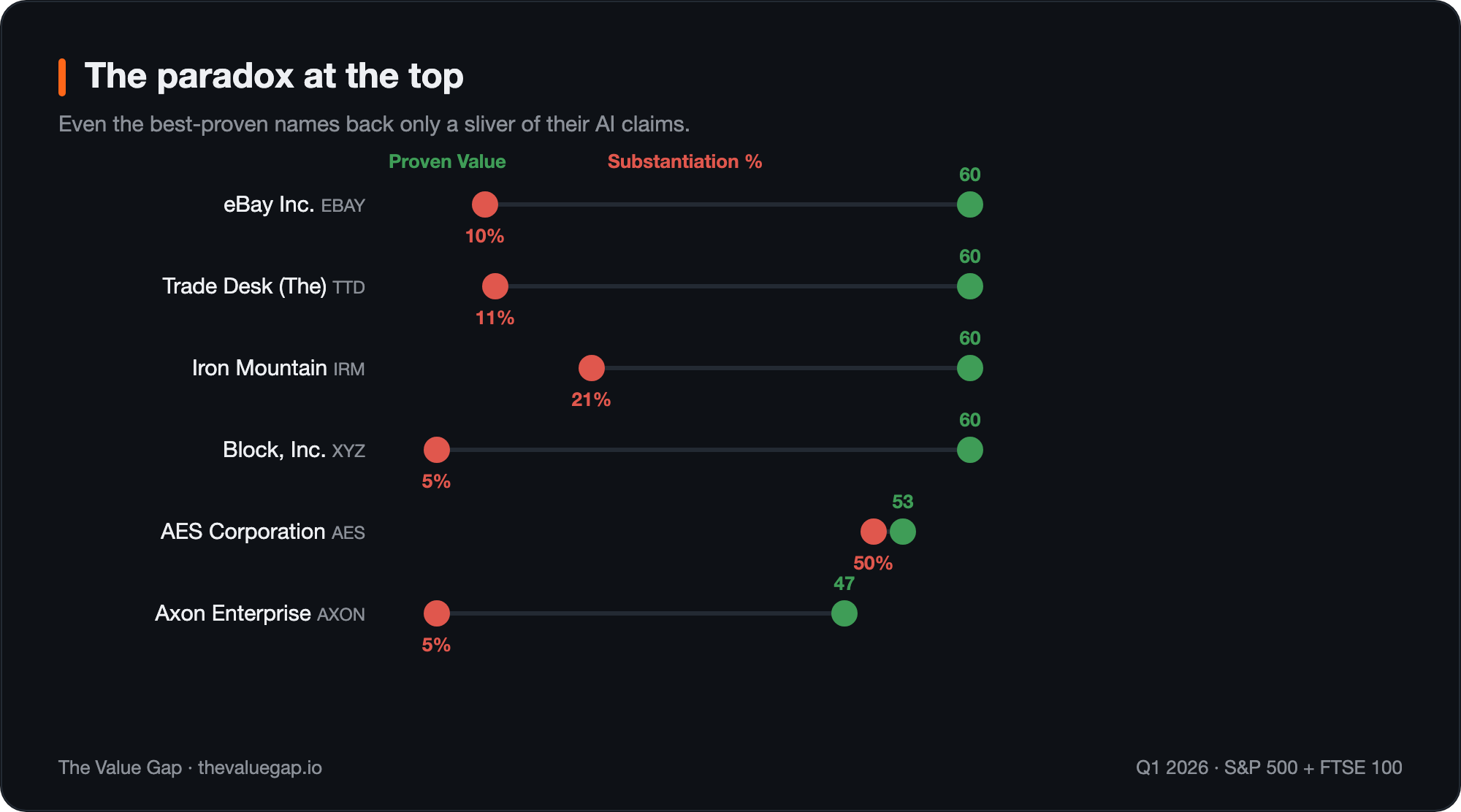
A handful of companies disclose quantified results across multiple dimensions of value. Four top the board at the current ceiling of 60/100 - each proving quantified AI value across all three areas that matter (cost, revenue and customer):
eBay: AI-written listing titles driving >50% more new listings per seller.
The Trade Desk: retail-media campaigns lifting conversions 88% and cutting cost-per-acquisition.
Iron Mountain: an AI document platform that drove >$500M of digital revenue in FY2025.
Block: Cashbot AI doubling support resolution from 30% to over 60%.
No one clears 60. A perfect 100 would require separately tracked, repeatable metrics across cost, revenue and customer outcomes, with at least one reflected in formal financial reporting. No company currently meets that standard.
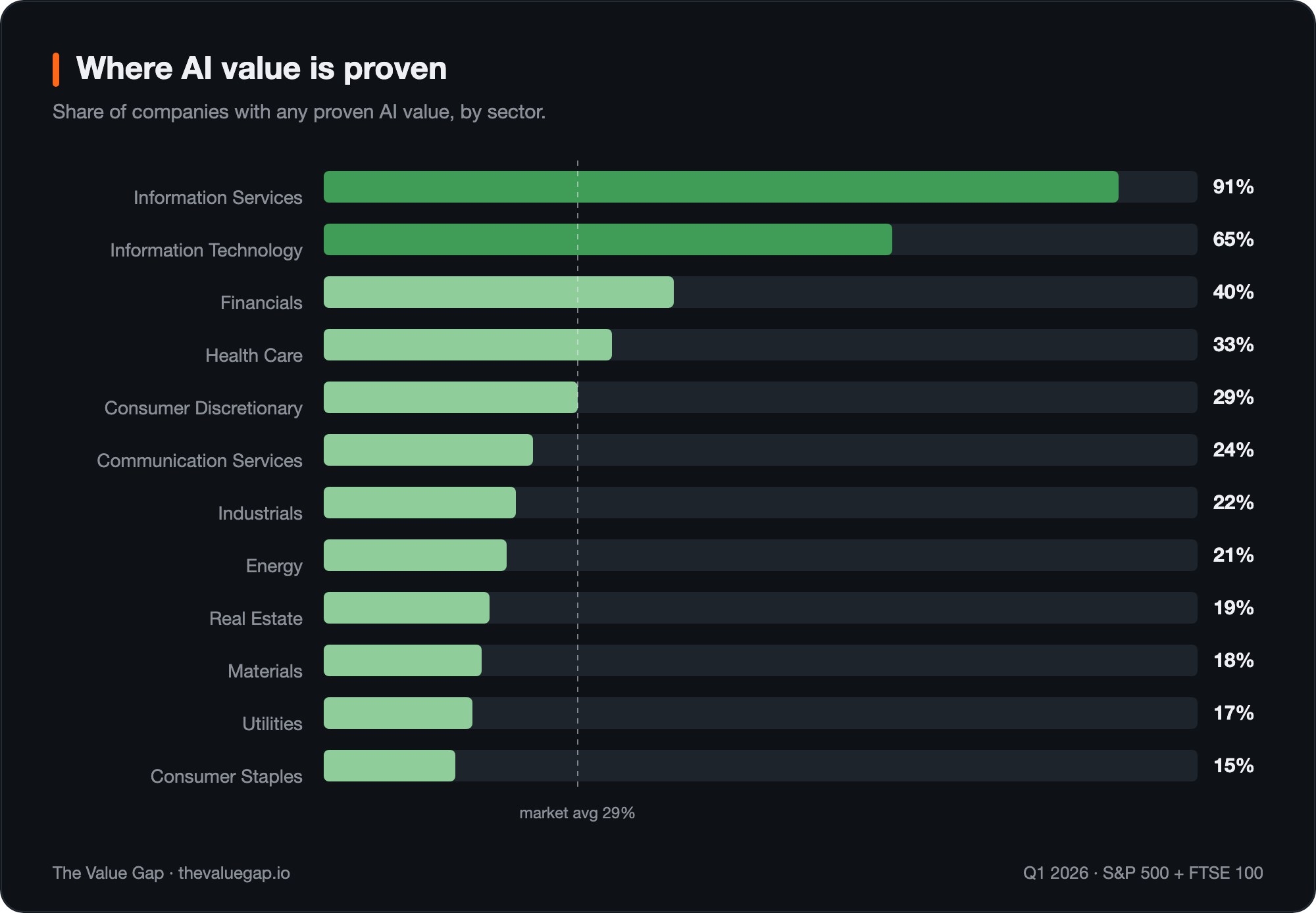
Proof is not spread evenly. It clusters where AI is embedded in a customer-facing product or service.
Information Services: 91% of companies have proven something (avg 25/100), by far the highest.
Information Technology: 65% (avg 17).
And it thins to almost nothing where AI is a back-office tool:
Consumer Staples: 15% scored (avg 3).
Materials, Utilities, Real Estate: under 20% each.
Proof is strongest where AI sits inside a customer-facing product and its impact can be observed through usage, revenue or campaign performance. It is weakest where AI is dispersed across internal workflows and benefits disappear into broader cost lines.
The single most telling number isn’t at the bottom of the table. It’s at the top. Block is the joint-#1 company for proven AI value, and it backs just 5% of its own AI claims. Of 219 AI claims identified across its disclosures, 12 carry a proof point. Even the best in the market is talking far more than it’s proving. That’s the value gap in one line.
Every company’s AI talk (investor filings and earnings calls) is scored against its disclosed proof on a 0–5 ladder; only realised outcomes (tier 3+) count toward value. The index does not claim to capture every AI result created inside these companies. It measures what investors and outsiders can actually verify from public disclosure.
The AI Swimsuit Report is published quarterly by The Value Gap.
No posts
Comments
Nothing yet. Say the first thing.
Sign in to join the conversation.