
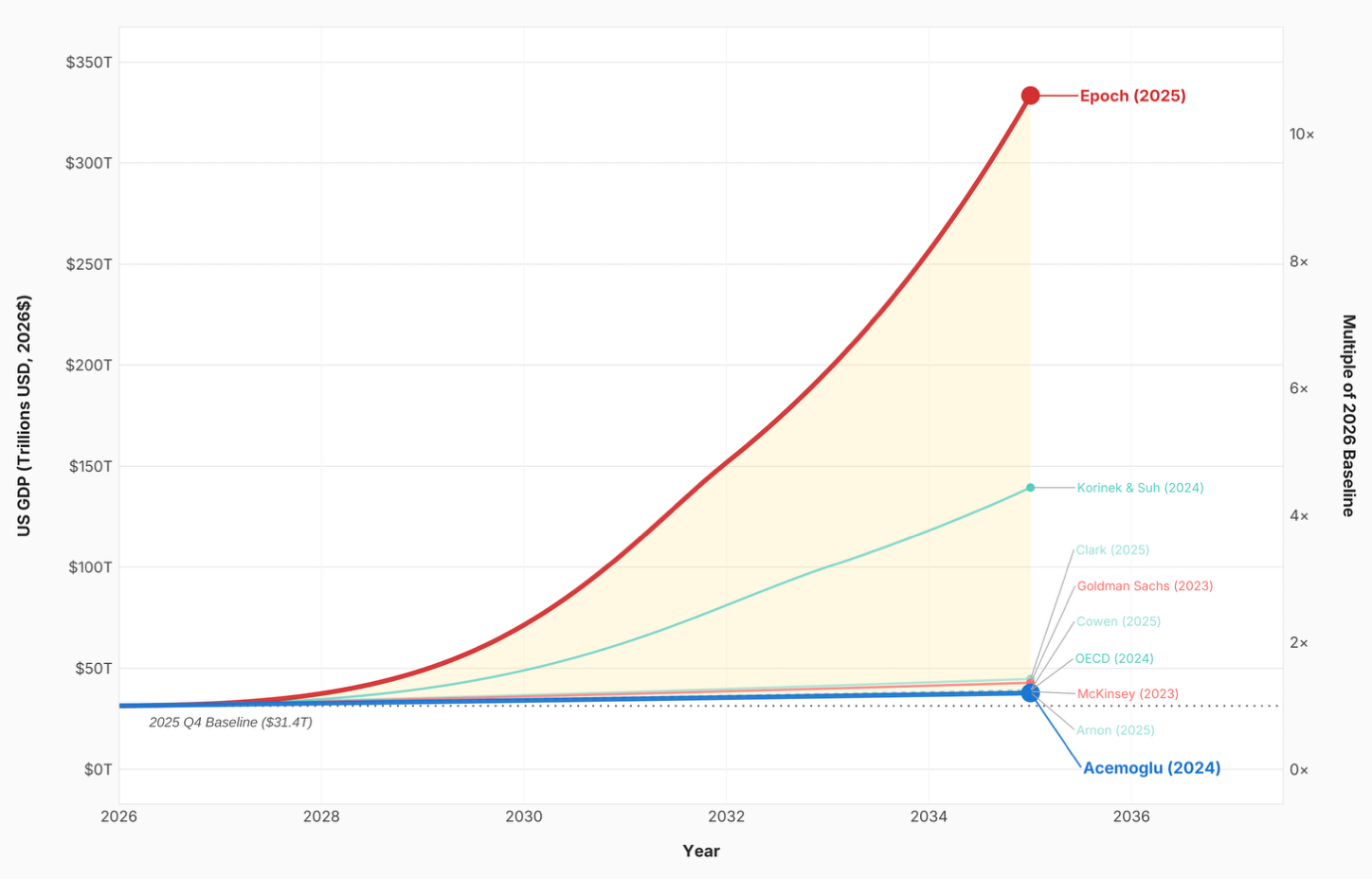
Source: Andrew McAfee, “This Week in Putting AI to Work,” May 15, 2026, drawing on work by RAND economist Anton Shenk.
“In the three years since OpenAI launched ChatGPT, economists and AI researchers have published forecasts projecting that, over the next decade, AI will add to annual growth by amounts ranging from as little as 0.1% to as much as 30%. By 2035, the gap between these forecasts nears a quadrillion dollars: an amount that exceeds a decade’s worth of current global output.”
Even if we discount the “transformative AI” scenario where AI does most cognitive labour: economists still disagree by an amount equivalent to roughly 4x current US GDP.
Whether you are running an enterprise AI programme or setting public policy, the move is to proceed cautiously, build your own monitoring, then adapt in real time as evidence accumulates.
This week, three different access asymmetries showed how that uncertainty plays out on the ground for the mid-market. Let’s get into it.
Three more announcements landed on top of the OpenAI/Anthropic PE-backed deployment ventures we covered last week, each one staking out a different tier of the market. At the enterprise top, Google Cloud CEO Thomas Kurian and CRO Matt Renner announced hundreds of forward-deployed engineers inside Cloud, pitching it as showing up for customers with technical resources instead of “an ocean of salespeople.” At the SMB floor, Anthropic launched Claude for Small Business, shipping 15 productised workflows wired into QuickBooks, HubSpot, Canva and the rest of the SMB stack. That collapses AI deployment for the SMB tier to a credit-card purchase. In the gap between them, Ciridae - founded by an ex-Apple ML lead and an ex-a16z partner - raised $20M from Accel, a16z and General Catalyst with a pitch that is literally “we serve the missing middle.” (Ciridae is already at high-seven-figure 2025 revenue across more than 20 partners).
The issue: FDE army economics break below a certain deal size, and SMB packaged models break above a certain workflow complexity. Meanwhile, the mid-market: companies with complex workflows, real regulatory exposure and no billion-dollar IT budget, sit between the two and gets neither. The macro problem is the scale of what gets bypassed. US mid-market is roughly 200,000 companies, one-third of private-sector GDP and 48 million jobs, with SMBs taking another 43% of GDP and 46% of the workforce. Europe is structurally worse off: the US mid-market revenue band covers most of what the EU classes as “enterprise,” which means the industrial fabric of the continent sits below the FDE economic threshold by definition. If AI deployment only lands in the Fortune 500, there will be no AI macro story to write, and the US-EU competitiveness gap will expand faster.
Make no mistake - the PE-lab joint ventures are expensive talent contracts dressed as consulting plays. Blackstone, Goldman, KKR et al. are buying access to a scarce pool of model-and-FDE talent at preferential rates - Bain’s Max de Groen told The Information DeployCo is explicitly hiring “Palantir alums” and chasing “that level of talent.” Palantir, the model every lab is copying, has roughly 4,400 employees. While famous for its alumni network, the total operator pool behind it, current and ex, sits in the low thousands which might be a little short to deploy-engineer the global economy. In short: the talent pool has to broaden, and the only realistic way that happens is inside companies, through up-skilling people already in seats.
The labs will hire the rare hybrids who have done it before; everyone else builds the team around their best operators. If forced to choose where to spend training budget, favour the domain and process side - it is harder to teach than AI tooling, which gets easier every quarter.
Last week we covered the FDA-for-AI moment and the policy scramble around Mythos. Further developments this week make the original story both more concerning and real.
First, capability. AISI tested a new Mythos and the gap with the next-best AI widened sharply. On AISI's hardest cyberattack simulation - a 32-step test of breaking into a corporate network - this newer version succeeded 6 times out of 10, against 3 of 10 for GPT-5.5. Mythos was also the first AI ever to crack AISI's harder second test. AISI estimates the complexity of cyberattacks AI can run on its own is doubling roughly every 4.7 months; it turns out Mythos and GPT-5.5 are moving a lot faster. The chart below shows Mythos getting through 25 of 32 attack stages for around $900 of compute, with no sign of slowing. Ethan Mollick called it "the second scaling law of AI remains undefeated" - throw more compute at these models, and they keep getting better.
 and GPT-5.5, as a function of cumulative API token spend")
Source: AISI, “How fast is autonomous AI cyber capability advancing?” (May 13, 2026)
Second, defence. Mozilla published a behind-the-scenes piece on Firefox hardening: 423 bugs found and patched in one month using Mythos, more than the previous 15 months combined. Security researchers separately used Mythos to break into Apple's macOS, known as one of the hardest mainstream operating systems to crack. They wrote “once it has learned how to attack a class of problems, it generalizes to nearly any problem in that class.”
Third, the attacks are happening in the wild. Google told The Information it observed hackers using AI to find a previously undiscovered security flaw and intercepted what the threat actor planned as a "mass exploitation event." China- and North-Korea-linked actors are confirmed doing the same. Anthropic cut off suspected Chinese hackers last year. The "this is hypothetical" frame is gone.
The vetting debate from last week was half the question. The US government is moving to be the gatekeeper before the gatekeeper, which addresses “should this ship?” The harder question is “who gets it when the answer is no?” Anthropic, OpenAI and Google still decide which Fortune 500 security teams, which national CERTs and which select universities get the restricted models. They are both vendors of bespoke defensive cyber capability and curators of its access list. Dual-use export controls historically sat with regulators in consultation with industry, with the access list reviewed by people who didn’t also sell the product. That separation is gone here.
Mid-market firms were already on the wrong side of the deployment talent fence. They are now on the wrong side of a second fence, this time on defensive cyber - cut off from the bespoke hardening that Mozilla and Apple’s security researchers are demonstrating in real time, and from any restricted-model access the labs choose to extend. The attacker side does not have the same problem: state actors are already using frontier capability in the wild, and they are not waiting for an access list.
Local opposition to data centres is now one of the defining questions of the next election cycle. Heatmap News reports 20 projects cancelled in Q1 2026 in the US alone, a new record. Data Center Watch puts blocked or delayed builds at $64B and total cancellations over three years at $85B. Fourteen states have moratoriums; Virginia alone has 42 activist groups. Utah’s Stratos data centre just had its water rights request withdrawn after 3,700-plus protests landed with the state water regulator. The IEA projects global data-centre electricity demand doubling from 485 TWh in 2025 to 950 TWh by 2030, with AI’s share rising from 5-15% today to 35-50% in five years.
The supply-side answer to the sustainability question has mostly been missing so far, with the enterprise market denied the ability to distinguish between green and not green. As a response, two veterans of Hugging Face and Salesforce launched Sustainable AI Group on Wednesday, with a specific thesis: if enough enterprise procurement teams start asking for greener AI, providers will respond. SAIG is building tooling to auto-route workloads to fit-for-purpose models, with Hugging Face’s AI Energy Score leaderboard as the public-facing benchmark for efficiency.
Most enterprise use cases do not need frontier LLMs, and smaller specialised models running on-prem can work better. Sustainability should join cost, latency and privacy as the fourth dimension of the enterprise decision framework behind workload routing.
The argument that resonated with me is the idea of reframing sustainability as “de-risking AI use”: when a data-centre provider loses water rights or hits a state moratorium, your AI compute supply is at risk too. This pulls sustainability into supply-chain risk territory, where CSOs who have been losing budget fights for three years now have a stack of arguments behind them.
Procurement is the lever enterprises actually control: hyperscalers move faster for paying customers than for public protests. But the lever only works for buyers who can pull it. Building routing infrastructure, running energy-score benchmarks, and getting a hyperscaler account manager to take the call on green mix are all functions of scale. The Fortune 500 procurement team has the headcount and the spend to make the conversation worth having; the mid-market firm has neither and takes the default contract.
The window where any of this works is now, before the supply crunch fully lands. The IEA forecast says demand will outpace permitting, grid capacity and renewable build-out together for the next five years. In a tight market, even large buyers take the kilowatts on offer and, realistically, the green mix is the variable that gets dropped first. This means the optionality large buyers are securing today is itself a closing window. For everyone else, the window was never open.
The third access fence of this issue: deployment talent, defensive cyber, and now sustainable compute. The mid-market will need to find its own way through before scale is the only moat left.
About
I analyse AI progress beyond the headlines, focusing on enterprise execution, incentives, and real-world economic impact.
No posts
Comments
Nothing yet. Say the first thing.
Sign in to join the conversation.