
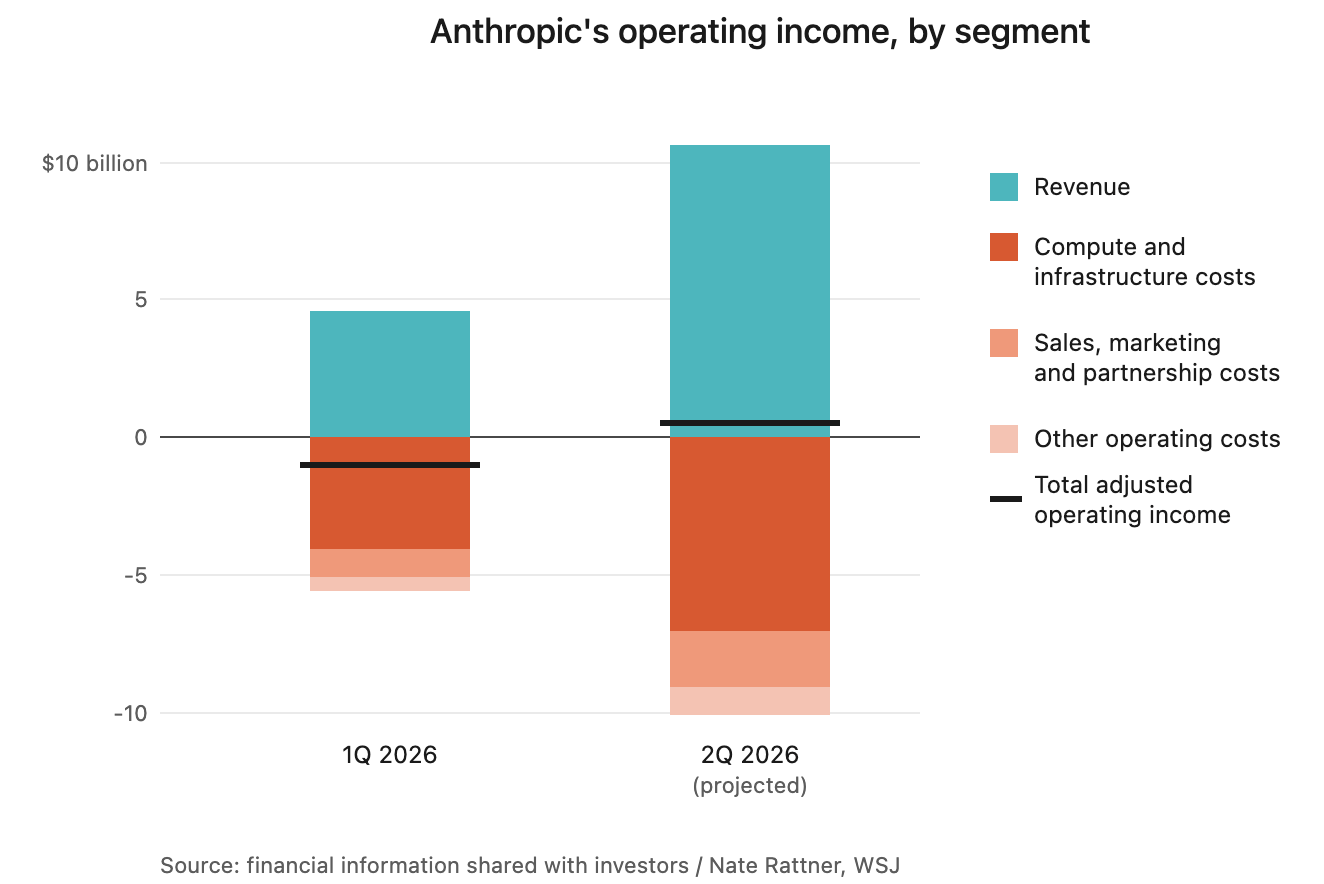
There was a time (six months ago!) when Anthropic was managing market expectations down: no profit until 2028. Who could blame their CFO for missing the meteoric 80x growth rate that is slated to take the company to its first $10B+ revenue quarter… and profit alongside it.
There are caveats (e.g. a compute discount from SpaceX)… but the big story is the operating leverage finally showing up: inference costs are falling as a percentage of revenue. The unit economics on model serving that turn a research lab into an actual business, and that we weren’t sure we’d see - certainly not this soon.
Three recent labour-market data points sharpen a conclusion that's been forming for a while: AI is acting as a complement to expertise at the top of the income distribution and a substitute for entry-level labour at the bottom. I've been fighting the “AI as great equaliser” line for a while (most recently in No.17: The Return of the Polymath). The comforting story that the tools democratise intelligence is sleep-walking us into an accelerating concentration of cognitive advantage and wealth.
The FT-Focaldata poll of 4,000 US/UK workers shows top earners use AI daily at 60%; lower earners at 16%. The heaviest users are 30-somethings with longer tenures, with corporate training the single biggest driver. Lawyers, accountants and software developers all use AI heavily whether junior or senior, while people in lower-paid occupations in the same industries use it much less.
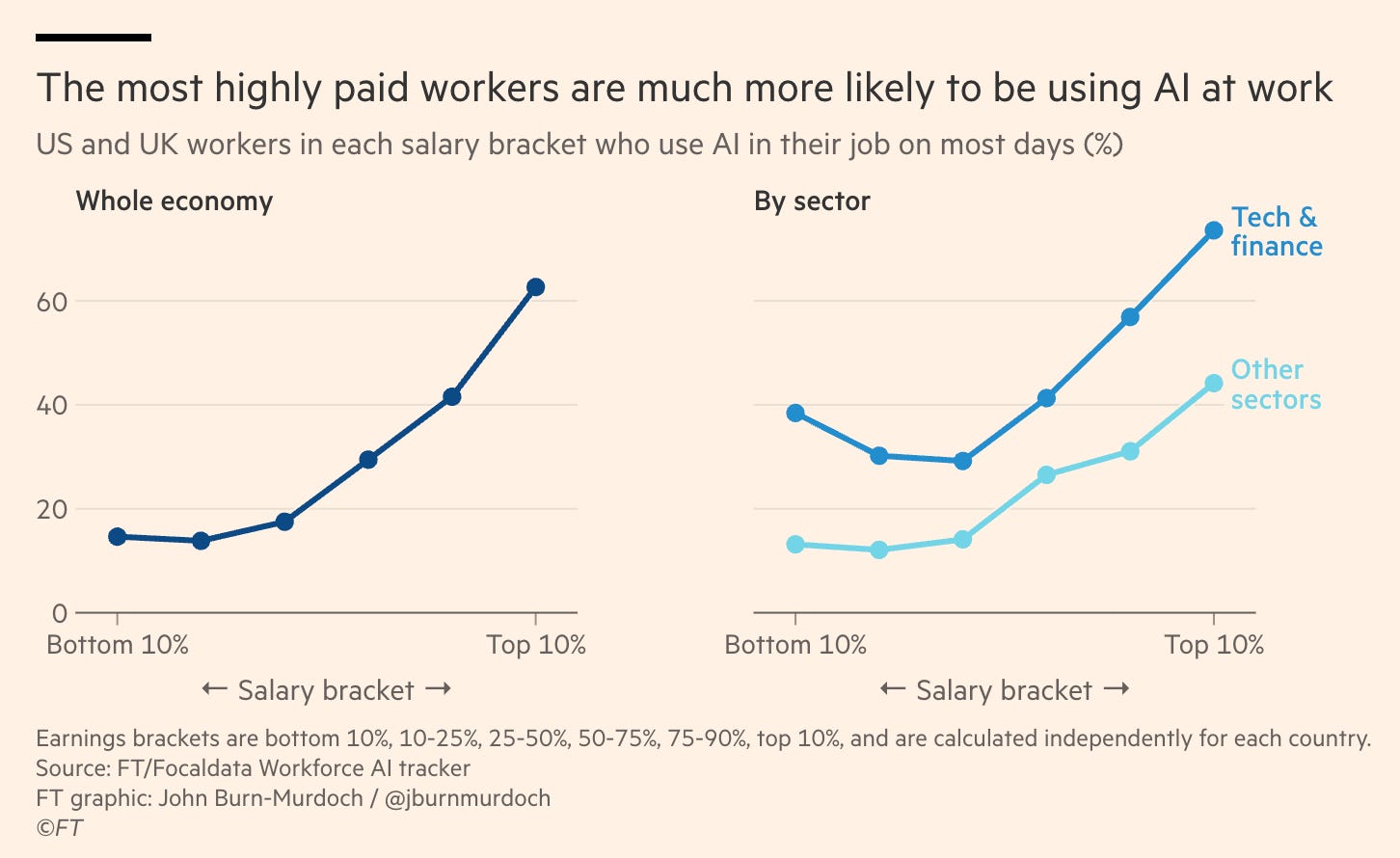
The author’s frame: “AI is going to increase inequality between labour and capital [...] as you require a certain degree of education, abstract and quantitative skills, familiarity with computers and coding in order to be using the models.” Putting the mechanism plainly, they added “the more intelligent technology we invent, the more your intelligence matters.”
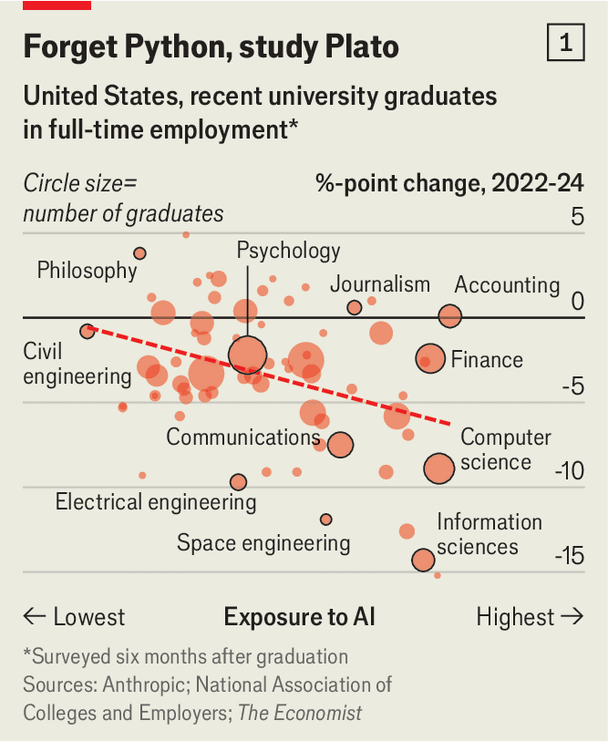
On the other end, more data confirming the squeeze on graduate hiring. The Economist’s analysis of National Association of Colleges and Employers data shows graduates in the most AI-exposed fields (computer science, computer engineering, information science) saw full-time employment fall 6.6 percentage points between 2022 and 2024, against 1.5 percentage points for least-exposed fields (education, philosophy, civil engineering).
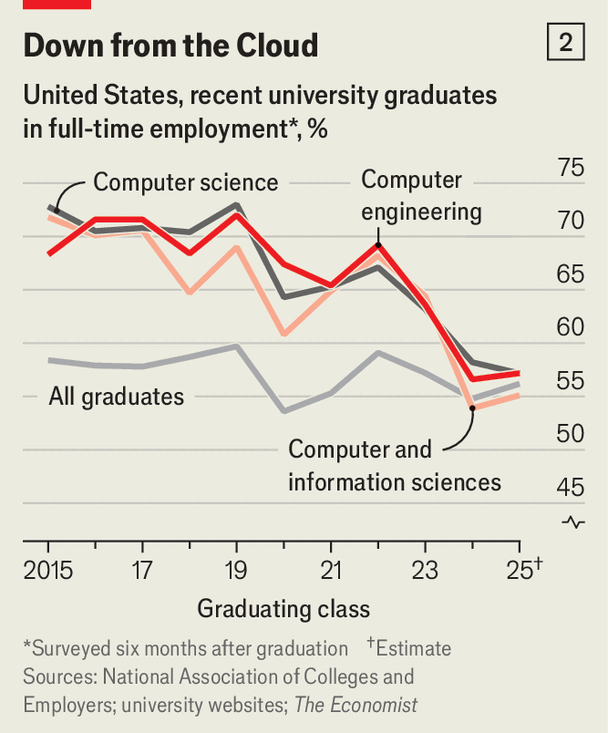
For the most-exposed cohort, full-time employment dropped from roughly 70% to 55% over three years. Computer-science undergraduate enrolment fell 11% in 2025; computer programming dropped 26%.
Those numbers map the substitution side. The augmentation side has had fewer concrete proof points, but some are now arriving. Affirm, the fintech, shared the outcome of running software engineering "truly AI-first" for a week: pull requests roughly doubled, with two-thirds of output agentic.
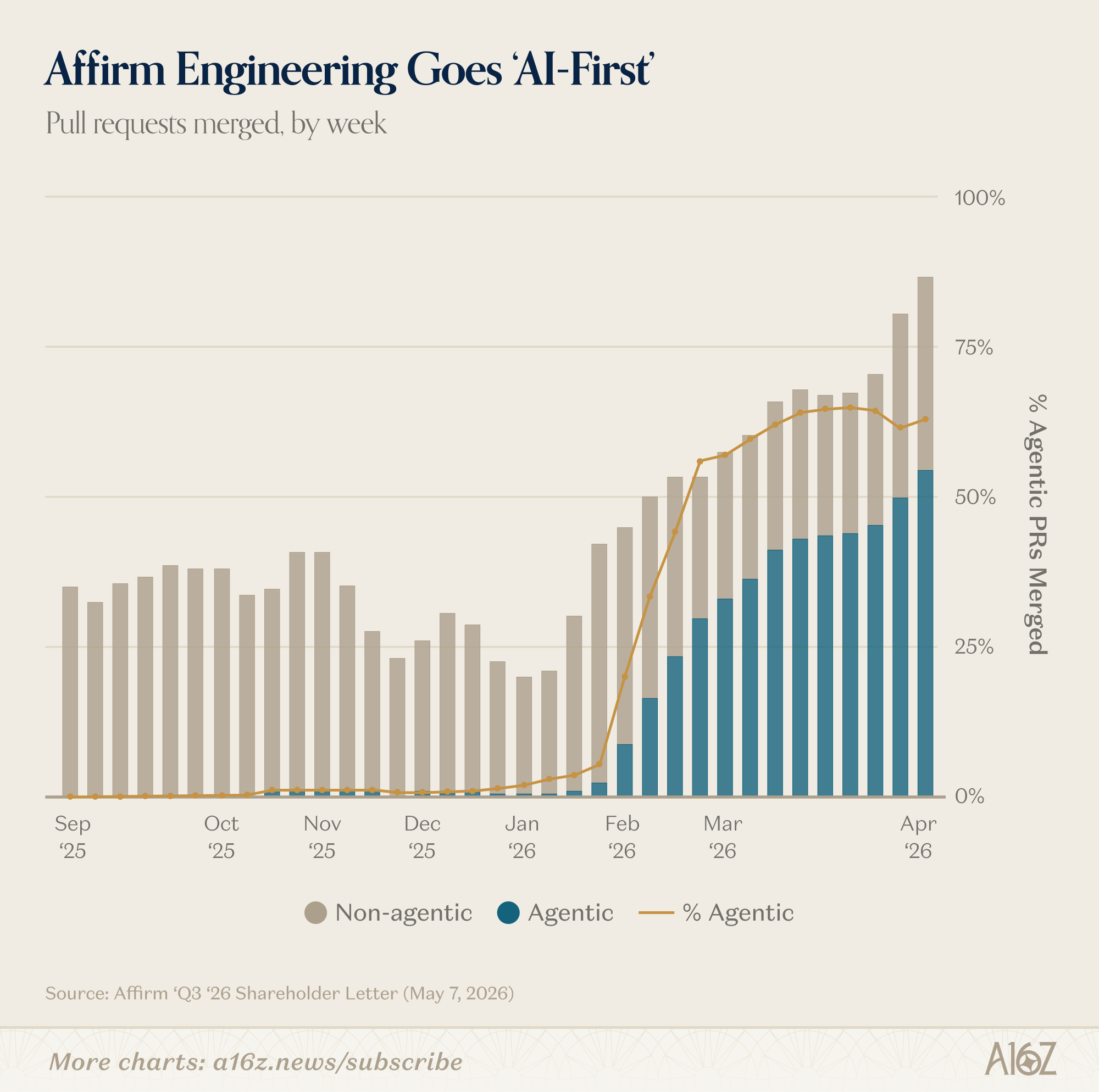
Affirm’s leadership wrote that “the limiting factor for Affirm has always been engineering cycles, not ideas for what to do with them,” so the company plans to grow the engineering team modestly. Where ideas exceed human capacity, AI is a force-multiplier with positive hiring effects.
But the augmentation case has a real human cost too. Harness research on 700 engineering practitioners shows 89% of engineering leaders say AI coding tools improved developer productivity, 46% of developers report unsustainable work pressure and feeling surveilled, and 31% of developer time goes to invisible work - reviewing AI-generated code, fixing bugs, switching tools. Adapting to these new ways of working is its own programme, separate from the tooling decision.
The combined picture: top earners accrue advantage by adopting first and deepest, entry-level workers in AI-exposed fields lose the bottom rung of the career ladder, and the firms that redesign around the technology capture the multiplier while the rest watch the gap widen.
This week, Google held I/O, their annual developer conference. Thirteen product announcements and not a single coherent answer to the question every other lab has answered: what are you actually trying to win?
Anthropic chose enterprise and code; OpenAI chose consumer ubiquity (and then enterprise and code!); Google chose… all of it, or none of it, depending on how you want to see it. Their headline model, Gemini 3.5 Flash, is fast - 3x quicker than 3.1 Pro - but trails Opus 4.7 and GPT-5.5 on most evals and costs roughly 20x what Gemini 2.0 Flash did. Early testers describe a verbose model that explodes into unnecessary tool calls. With the end of the chatbot-era price subsidy dominating the enterprise conversation around the world, the “best low-cost” model slot was sitting wide open and Google walked right past it, preferring to focus on speed.
Then there's Gemini Spark, the always-on background agent that keeps working when your laptop is shut. The launch demo had it drafting status updates and triaging email (i.e. work) but it’s shipping without the admin controls or system integrations any IT lead would need before letting an autonomous agent loose. Packaged for consumers, demoed for work, probably not good enough for either. Meanwhile Antigravity 2.0, Google’s coding play, graduated from a coding-tool feature to a standalone product: coding agents that run from a desktop app, work on a schedule, or coordinate in teams. The product is credible, but every capability listed is one that Claude Code and Codex shipped first. Google is closing an architecture gap competitors opened a year ago. The enterprise turfs that matter most right now: coding agents on one front, and the “Clawification of work” (personal agents embedded in the working day) on the other have Google without a differentiated position in either.
Demis Hassabis closed the keynote with “we are standing in the foothills of the singularity.” Commentators have found that difficult to square with a product slate built around a slightly better Gmail - and I can’t blame them. Anthropic and OpenAI have clearly laid out the path to AGI as running through their products. Better coding agents are the literal mechanism for recursive self-improvement, which is why Karpathy (star AI researcher, OpenAI co-founder, ex-Tesla) joining Anthropic this week “to use Claude to accelerate pre-training” was the bigger story for most enfranchised AI watchers. At Google, Demis is doing science and the product org is shipping consumer features; the two tracks don’t seem to meet.
This made the week’s most distinctively-Google story feel like an orphan. DeepMind’s Co-Scientist, a multi-agent system designed to accelerate research, has helped Stanford identify a drug that blocked 91% of liver-fibrosis responses in lab tests, with similarly promising results from separate research teams around the world. Borrowing techniques from AlphaGo, plugged into AlphaFold, ChEMBL, and UniProt - a showcase of the in-house scientific infrastructure Anthropic and OpenAI structurally cannot replicate. It got buried under AI Mode updates nobody will remember next Tuesday.
Google might still win consumer by gravity alone: 900M monthly AI users, 2B on Gmail, a near monopoly on search, the list goes on… The open question is whether that distribution moat carries forward to the next default: the AI assistant users open first for everything.
Meanwhile: Demis is building toward AGI, Sundar is building AI features for Search, and Sergey's strike team is trying to catch up on coding. How that adds up to a Google strategy is unclear.
CMOs are now allocating 15.3% of marketing budgets to AI, per the new Gartner CMO Spend Survey - and only 30% say they’re ready to scale. The familiar shape of the AI value gap, now showing up in the function with the least excuse to be late.
Tooling debates and “how do we get better outputs from AI” are the comfortable terrain, but the budget allocation has moved past the point where incremental gains can close the readiness gap. The question we should ask now is how should the function be structured differently, not how the current structure can squeeze more out of the tools.
A new HBR piece co-authored by the former Intuit Mailchimp CMO makes a version of this case. Their prescription is a “brand code” - a machine-readable knowledge base encoding brand strategy, customer insights, and business rules that humans and agents can both act on, sitting underneath specialised agents handling content, experimentation, distribution, and reporting. Worth a read as one of the few pieces actually engaging with the redesign question in practical terms.
It is hard enough to find best practice/success stories nowadays. So finding a leader openly saying “we got it wrong” is rare, refreshing and valuable.
Duolingo’s CEO Luis von Ahn has walked back parts of his viral AI-first memo from last year. The sharpest line in the interview is about quality at scale: “AI demos really well… it can write a story. But we may need to write 1,000 different stories. Then you’ll find 20% of the things were just pure slop.”
He’s also dropped the mandate to evaluate every employee on AI usage, after staff started “using AI for AI’s sake because you’re going to evaluate me on that.” Mandate-from-the-top creates mandate-shaped behaviour.
And worth noting for the cost-out crowd: Duolingo's headcount grew alongside its AI usage. "I want to hire more people because they can do more." Same shape as the Affirm story above.
Trump has declined to sign the long-awaited executive order on AI safety, after a Thursday call with David Sacks (whose 130-day term as White House AI czar has formally expired). Sacks warned that even the order's voluntary testing regime could open the door to mandatory regulations - slowing the US in its race with China. He framed the order as a win for "doomers," and Trump, already wary, killed it within hours of the formal announcement. Looks like the deregulatory faction still has a direct line into the Oval. The order's defenders, if there are any with political weight, have not yet surfaced.
About
I analyse AI progress beyond the headlines, focusing on enterprise execution, incentives, and real-world economic impact.
No posts
Comments
Nothing yet. Say the first thing.
Sign in to join the conversation.