
Chart of the week: The fastest ramp in software history… accelerates
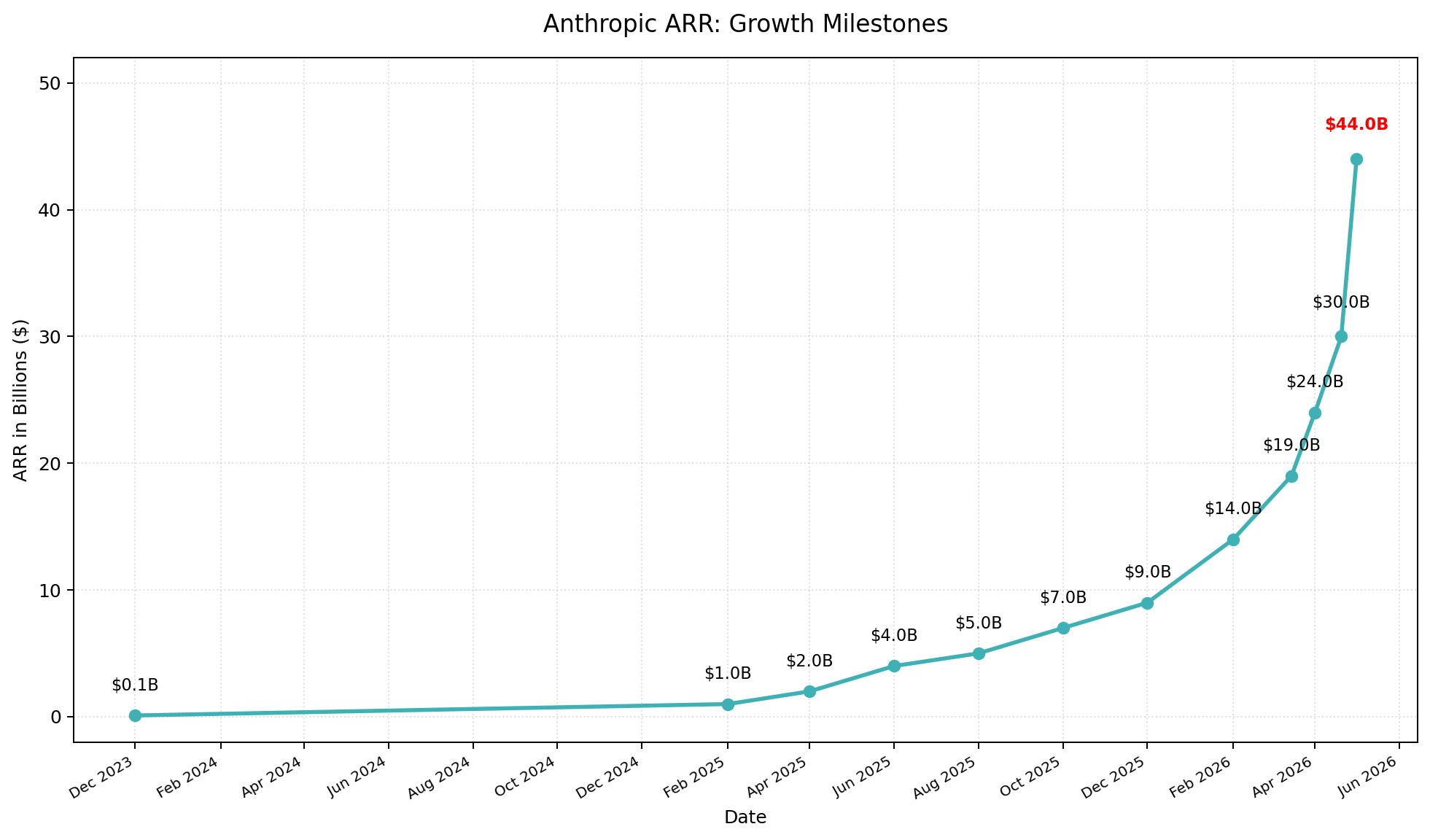
Anthropic's ARR has reportedly hit $44B this month, up from $9B at the end of 2025 and $30B… last month!
That is over $330M of new ARR every day since February. They are fielding offers to raise at a $900B+ valuation - up from $380B at the Series G in February. Dario Amodei has called the pace "just crazy" and "too hard to handle" as they planned for 10x growth this year and got 80x (read that again!), with compute demand outrunning forecasts and breaking internal capacity assumptions. Hence the SpaceX Colossus 1 deal to plug the hole.
The Reality Check
From “I’m not here to talk about AI safety” to “FDA for AI”
Anthropic’s Mythos (full back story in No. 22) has done what no policy paper or congressional hearing has managed: spook the Trump White House out of its “hands-off AI” stance. The model is so good at finding software vulnerabilities that Anthropic isn't releasing it publicly. What we didn’t know is that even their limited rollout to ~70 companies under Project Glasswing got an icy "we don't agree" from the administration. Instead, the White House is now drafting an executive order for FDA-style pre-release vetting of frontier models, led by a government-industry working group.
At the same time, CAISI: Biden’s AI Safety Institute, rebranded and gutted by the same administration is now reviving its mission, and has just signed deals with Google, Microsoft and xAI for pre-deployment evaluation.
The issue at stake is perfectly illustrated by the UK AI Security Institute’s evaluation showing OpenAI’s GPT-5.5 is roughly on par with Mythos on offensive cyber. The GPT-5.5 build AISI tested was missing some of the guardrails on the public version, but the underlying capability is right there. Anthropic decided Mythos was too dangerous to release; OpenAI is rolling out GPT-5.5-Cyber to a group of partners: same capability, different judgement call. (Note: Mythos leaked anyway via a third-party vendor breach, less than a month into Glasswing!).
In other words: the labs are not converging on what “too dangerous to ship” means. (And even if they were, why should they be the ones making the call.) Every other frontier lab is only a few months behind, and that is a problem voluntary self-regulation cannot fix.
US Treasury Secretary Bessent is also leading a renewed AI dialogue at the Trump-Xi summit on 14–15 May: frontier-model safety, autonomous weapons, open-source misuse, even a future AI hotline. It would revive the Biden-era 2023 track that produced the joint position humans should retain control over nuclear-launch decisions, openly framed in Cold War terms (”stability, not alignment”). Whether Beijing engages substantively is open - it put the Foreign Ministry rather than a technical body in charge last time.
My take: the case for external vetting and international collaboration writes itself when one lab calls a capability too dangerous to ship while the one next door ships it. But US vetting means models get built for Washington's taste from training onwards with no obvious stopping point. The excuse of a safety review could quickly become a machinery to bake in political bias. CAISI itself depends on the labs voluntarily sharing models, including with safeguards reduced, which makes the foxes-guarding-the-henhouse critique hard to dismiss. And as Ethan Mollick pointed out, our benchmarks for AI risk are too crude to write vetting criteria that aren't hopelessly vague. Also… where is Europe in all this? The EU spent two years positioning itself as the global AI regulator - AI Act, AI Office, the lot - but as is the custom nowadays, the conversation has shifted to a US-China dialogue with no seat for Brussels.
The Missing Economics of AI and Jobs
Nothing annoys me more about the techno-narcissist doomer view than its complete failure of imagination. The argument requires you to believe two things at once: AI is the most powerful productivity unlock in history, and humans will respond to that unlock by sitting down. Every previous wave has done the opposite. Cheaper inputs unlock categories of demand we couldn’t previously afford, people keep finding new problems to solve, and new jobs appear that nobody could have named in advance - six out of ten jobs people hold today didn’t exist in 1940.
The Silicon Valley consensus/hallucination I’m taking on gets its cleanest articulation in Jasmine Sun’s NYT piece a couple of weeks ago (”Silicon Valley Is Bracing for a Permanent Underclass“): superintelligent machines arrive, most knowledge work evaporates, the labour share collapses, and a one-time window closes on ordinary people building wealth. Amodei has 50% of entry-level white-collar jobs gone by 2030. Suleyman has all white-collar work automated in 12-18 months. The list goes on.
Something shifted this week. For the first time I've noticed, the bull-case essays outnumbered the doomer ones.
Taken together, five of them - Alex Imas’s “What will be scarce?“, Ezra Klein’s “Why the A.I. Job Apocalypse (Probably) Won’t Happen“, Brian Albrecht’s “You are not a horse“, David George’s “The ‘AI Job Apocalypse’ Is a Complete Fantasy“, and Scott Galloway’s “Apocalypse No“ - build a meticulous rebuttal of the underclass thesis.
First, the reframe. Economics is the study of scarcity, and even in a world of AI-driven abundance, something is always scarce. The real question is what becomes scarce once machines can do most of what humans currently do. Imas’s answer (which Klein echoes) is the human element itself: as commodity production gets automated and incomes rise, spending shifts toward things where a human is part of the value - care, hospitality, craft, education, anything with provenance.
Second, the mechanism. When AI saves a dollar by automating a task, that dollar gets redirected to whatever’s still scarce. For human labour demand to collapse, the redirection has to fail at every layer at once: the saved time inside a job buys nothing else; the displaced job goes unreplaced inside the same sector; the dollar saved in a shrinking sector finds no home with humans in it. The doomer case is an unusually long stack of independent claims that all have to break the same way.
Third, the data. Klein has the VisiCalc precedent: the spreadsheet was supposed to kill bookkeeping in 1979; the number of accountants quadrupled over the next 40 years. George has the agriculture and electrification versions: farming went from a third of US employment to 2%, and the workers ended up doing something else: factory work, then office work, then knowledge work. George pulls together Yale Budget Lab, NBER, Atlanta Fed and Census - all find no statistically significant aggregate AI effect on employment so far. Tech employment has been flat since 2023, and AI-augmentation outranks AI-substitution on earnings calls roughly 8-to-1. Galloway adds the motive critique the others leave implicit: the companies most aggressively predicting white-collar carnage are the ones whose valuations depend on you believing it.
None of which means every part of this wave is just the last wave repeating. The cadence is novel: electrification took 30 years to diffuse, the spreadsheet 20, AI a few. The scope is broader, with AI substituting across whole domains including the coordination and judgment layers that historically created new work. The long-run reallocation may still hold, but the transition could be unusually painful: partial displacement is harder for the political system to absorb than total displacement as most rich economies have built retraining infrastructure sized for slow waves. Those are real concerns about the journey, but they’re not the same as conceding the destination.
The "this time is different" line is doing all the work in the Silicon Valley argument, with very little evidence underneath it. Every previous wave was accused of substituting for the irreplaceable human capacity of its era; each time, that capacity turned out to be a moving target. The burden of proof sits with the people claiming this is the wave where it finally stops moving. So far all they have are confident predictions from people who profit from the fear.
This week's shift could be a blip. I can't help hoping it marks the start of a more constructive conversation.
Inside the Enterprise
Tokens or Talent: Owning the Cognitive Layer
OpenAI and Anthropic unveiled rival PE-backed joint ventures within minutes of each other on Monday, both designed to push their models deep into private-equity portfolio companies. OpenAI’s “Deployment Company” closed at a $10B valuation - $4B from 19 PE investors led by TPG, Brookfield, Advent and Bain Capital, plus $1.5B from OpenAI itself, with super-voting shares retained by OpenAI and a reported 17.5% guaranteed annual return floor for the PE backers over five years. Anthropic’s $1.5B venture, anchored by Blackstone, Hellman & Friedman and Goldman Sachs, is an even more pointed shot, designed to send forward-deployed engineers into mid-market portfolio companies in healthcare, manufacturing, retail and financial services. Days later, Bloomberg reported Blackstone, KKR and EQT are in talks with Google for a different version of the same trade: licensing of Gemini direct to portfolio companies, with no separate consulting layer (Vista Equity already has a similar deal with Google Cloud).
Neither announcement surprised anyone. The AI consulting gold rush is already running hot. Abhishek Vijayvergiya notes there are more FDE job openings in the US right now than there are FDEs currently employed. We’ve been arguing for a while that model capability outpaces organisations’ ability to absorb it, meaning there’s probably a 10+ year slog before all businesses are “agentified”.
Going downstream is strategically obvious when value lives in embedding the model as deep inside operations as possible, but the play raises four questions.
First, the labs face a real conflict. Selling tokens makes you infrastructure; selling forward-deployed engineers makes you a services firm competing with your own ecosystem. Goldman’s Marc Nachmann said the venture would “democratize access to forward-deployed engineers” which is a polite way of saying Anthropic and OpenAI now sit across the table from the consultancies that resell their APIs (remember the Frontier Alliance?).
Second, lock-in is the last thing enterprises should want right now. Compute is squeezed, pricing is moving every few weeks, and task-level model routing is becoming a real competitive edge. A portfolio company with Anthropic’s engineers running its sales ops cannot casually move to GPT the next quarter; switching costs in services run an order of magnitude higher than in API plumbing.
Third, the labs are fundamentally in the business of selling tokens. Companies need to balance process quality, total operating cost, and LLM spend. The labs only get paid on the last one. So when the same lab designs your workflow and sells you the inputs, who decides whether the agent runs three calls or thirty?
Fourth, in those setups enterprises end up outsourcing their cognitive layer. The model holds company context, data, knowledge - the actual thinking part of running a business - and all of that now sits with a lab’s engineers embedded in your operations. That is a different kind of dependency than IT outsourcing, and a different risk profile when the provider raises prices, gets acquired, or pulls a model.
I believe that yes, help is needed, and the AI transformation market will explode. But three things have to happen for it to land properly. First, the entity that builds the plan needs to be the one delivering it. Second, vendor-agnostic is the only sustainable posture: help with the integration work, yes; permanent lock-in to a single lab, no. Third, the cognitive layer has to stay inside the company. Real AI transformation means the org itself transforms: people upskill, AI fluency rises, context and decisions accumulate inside owned agents. Outside help on the build is welcome; outside ownership of that layer is what you should be paying to avoid.
Bonus
The 2026 Work Trend Index Annual Report
"Most organizations are not yet built to capture the value of expanded human agency."
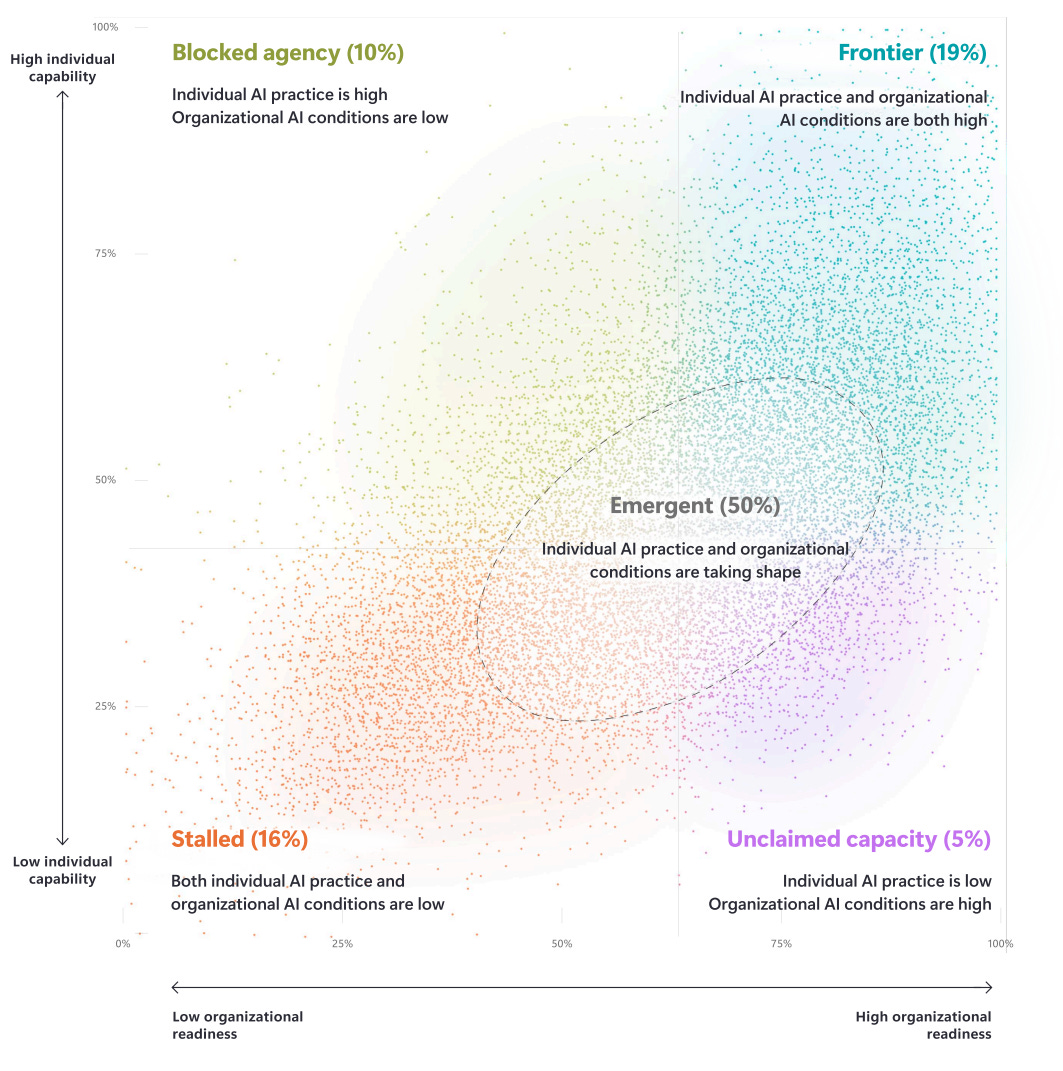
That's the headline finding from Microsoft's 2026 Work Trend Index. Of 20,000 AI users surveyed across 10 countries, only 19% land in the "Frontier" zone where individual AI capability and organisational readiness reinforce each other. 10% are skilled workers stuck in companies whose systems haven't caught up. Organisational factors: culture, manager support, talent practices, account for roughly two-thirds of reported AI impact; individual mindset for a third.
AI transformation is organisational transformation, and as long as skill keeps travelling faster than structure, the AI value gap will keep widening.
Thanks for reading my substack! Subscribe for free to receive new posts and support my work.
About
I analyse AI progress beyond the headlines, focusing on enterprise execution, incentives, and real-world economic impact.
Comments
Nothing yet. Say the first thing.
Sign in to join the conversation.