
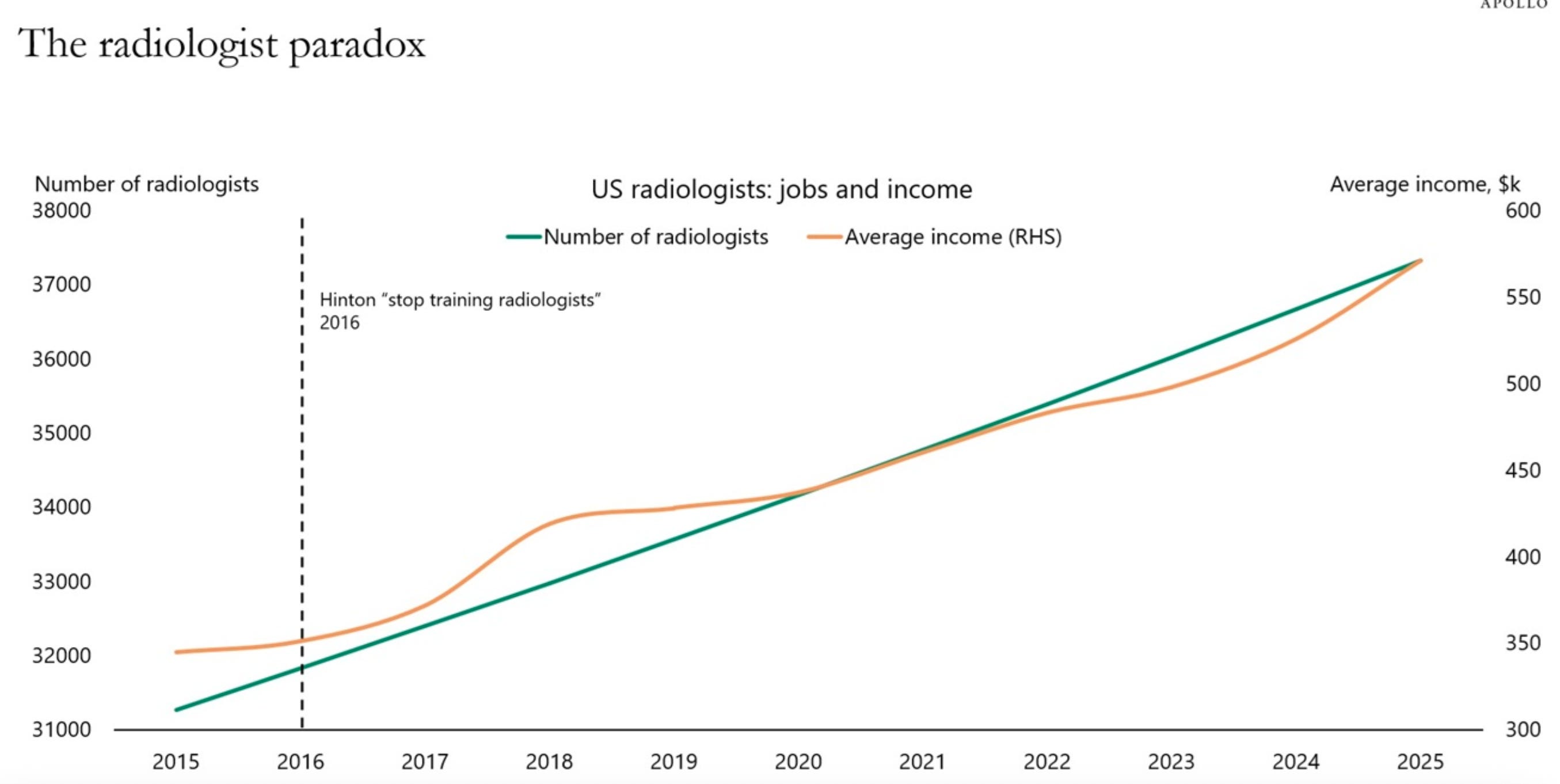
Exactly ten years ago, a group of very smart people including Geoffrey Hinton declared radiologists “like the coyote already over the cliff” and suggested we should stop training them as AI takes over (I wrote about it here).
Since then, radiologist employment has grown steadily (while technology improved even more dramatically), and average income now exceeds $500k in the US. Making imaging cheaper didn’t reduce the need for radiologists, it expanded it with more scans and earlier diagnoses.
When the cost of doing something falls, and that reduction unlocks new use cases, demand tends to rise rather than collapse. As shown again below and evidenced by the rise of software engineering job openings.
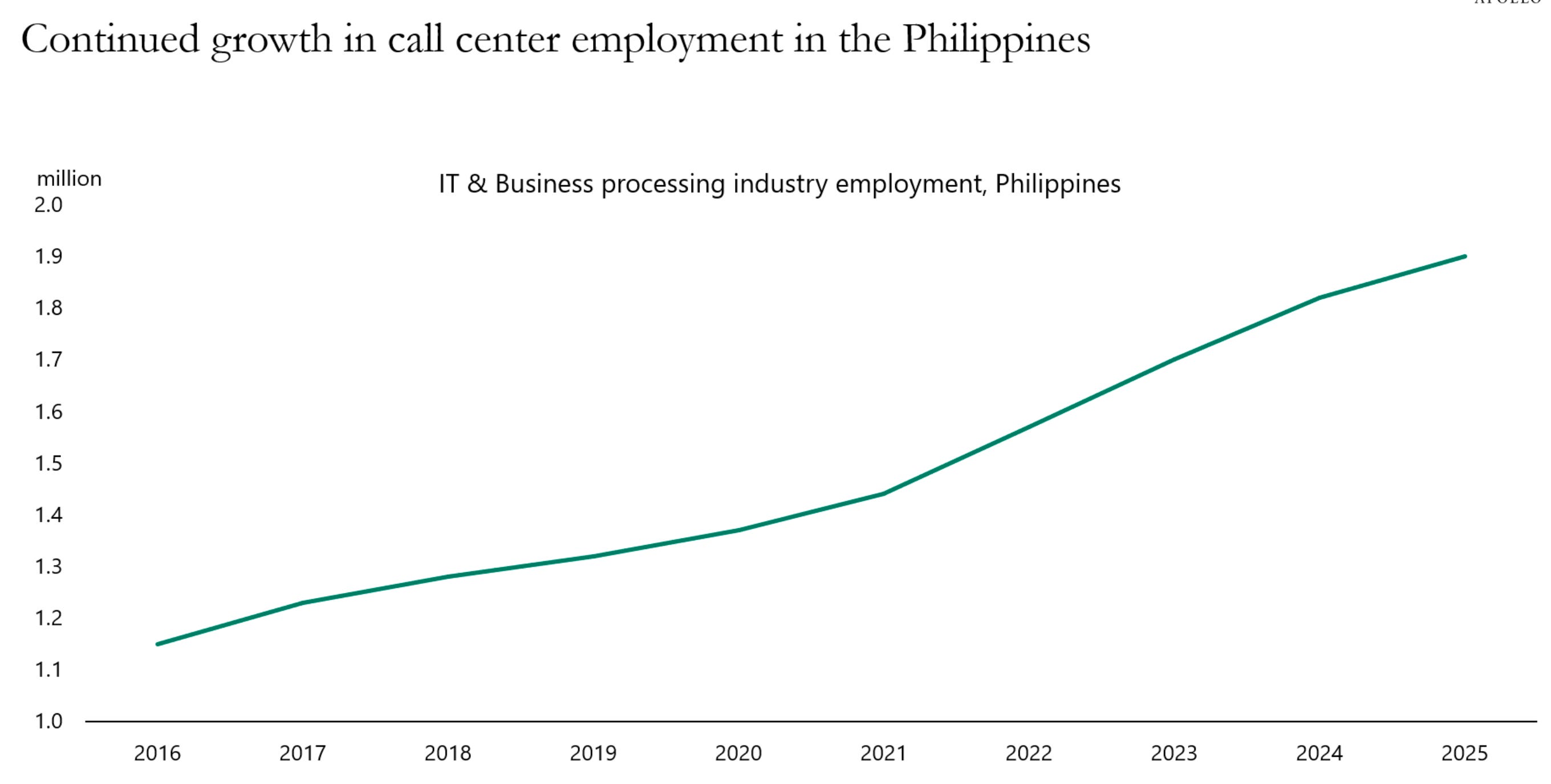
Source: Torsten Slok, Apollo.
I think this is the story of 2026 so far. Up until fairly recently, the AI bubble debate ran on whether the labs were overspending and whether real demand and productivity gains would ever materialise. While the macro picture's still stubbornly mute on productivity, agentic demand and usage at scale have inverted the exam question. Compute supply is tight and getting tighter, and the prices that subsidised it are coming apart. Ironically, AI might still end up a bubble… if the staggering new demand cannot be met.
The clearest sign so far is the end of the flat-rate era for enterprise AI tools. Anthropic shifted Claude Enterprise customers from a flat $200-per-seat monthly fee to a $20 base plus usage-based charges at API rates, and blocked third-party agent tools from its Pro and Max subscriptions. The lab also briefly removed Claude Code from its $20 Pro tier last week before reversing under backlash. GitHub Copilot followed: from June 1, using Claude Opus 4.7 in its top tier will cost developers roughly 3.5x more per request, and Gemini 3.1 Pro and GPT-5.3 Codex - previously included at no extra charge - now carry a 6x premium. Cursor had moved in the same direction last summer.
Two weeks ago I wrote here that the compute wall was about to hand model builders real pricing power, as agentic workloads accelerated into a tightening supply ceiling. Two weeks on, the final remnants of chatbot-era pricing economics are disappearing.
What broke the subscription model is simply the agent. A chatbot exchange burns a few thousand tokens; an autonomous agent running in the background can burn 700 million tokens per week per agent, by one industry estimate. OpenAI’s Codex assistant went from 200,000 weekly active users on January 1 to 4 million the week before GPT-5.5 launched in April. SemiAnalysis tracks Claude Code now authoring around 4% of public GitHub commits, with a projection to clear 20% by year-end. And Anthropic told investors it doubled its revenue projections in two months, largely on the back of its agentic coding tools. Subscriptions were sized for chatbot economics, and agentic workflows broke them.
The demand vs. compute gap is not one the labs can paper over with extra capital and a magic wand. The Economist’s print headline this week is “Silicon ceiling”: hardware-makers underinvested into the demand, and the bottleneck is now chips, memory, and datacentre capacity (basically everything). McKinsey puts AI datacentre capex at roughly $5.2 trillion through 2030; but the physical buildout is slipping faster than the capital can land. As I covered here, around 40% of this year’s US datacentre projects are at risk of three-month-plus delays, and most projects pencilled in for 2027 haven’t broken ground. Meanwhile, the labs' own books are showing the strain. OpenAI's CFO Sarah Friar has walked Altman's $1.4 trillion compute promise back to $600 billion in private investor meetings, after the company missed its 2025 user goal and multiple 2026 revenue targets - with Friar also reportedly pressing internally to push the planned IPO from 2026 to 2027. Anthropic, whose quarterly ARR additions have now overtaken OpenAI's on SemiAnalysis's tracking, is publicly compute-bound. Cheap AI ran on a subsidy that no longer adds up.
The post-subsidy regime's first feature is usage-based pricing. At a simplest level, two operating responses follow. First, route across multiple model suppliers: cheap open-source models (Qwen powering Airbnb, Kimi K2.5 underpinning Cursor's internal model) for the bulk of tokens, frontier models for the harder quarter. Second, invest in cost-aware orchestration as a product layer - what the AI Daily Brief named the "Model Sommelier", sitting between intent and inference.
Earnings season printed the demand case with a dizzying array of results. Google Cloud grew 63% year on year, AWS 28% (its fastest in nearly four years), Azure 40%, and Meta 33% on revenue (its strongest since 2021). The numbers settle the demand-side question raised in the section above: 2025’s worry about under-consumption has effectively evaporated, with all hyperscalers now visibly supply-constrained.
Let's start with Google. Cloud customers signed enough new commitments in a single quarter to take the backlog from $240 billion at end of Q4 to $462 billion - committed future cloud spend now larger than Alphabet's entire 2025 revenue. And Pichai told analysts current-quarter cloud revenue would have been higher still if Google could meet demand… They are now processing 16 billion tokens per minute, up 60% quarter on quarter. Paid Gemini enterprise customers grew 40% in a single quarter. And search ad revenue grew 19% - the strongest counter so far to last year’s “AI will kill search” worry.
AWS posted similar numbers. Coming out of a 12% growth trough in 2023, it’s now a $152 billion ARR business growing at 28%, its fastest pace in four years. Andy Jassy noted that most new capacity is already spoken for before it comes online. In the last fortnight, Anthropic committed $100 billion to AWS over a decade, and OpenAI moved frontier models onto Bedrock (AWS's enterprise AI model platform) the day Microsoft's exclusivity expired. Both labs are pre-buying capacity Jassy hasn't yet built.
Microsoft's headline numbers held up - Azure at 40% YoY (one point above last quarter's 39%), Copilot at 20 million paid enterprise seats. That is up from 15 million in January, but still a drop in the ocean against Microsoft's ~320 million Office 365 paid seats. The forward-looking signal that caught the market’s attention: first signs of heavy AI usage compressing margins. As Copilot scaled, Microsoft Cloud gross margin fell roughly five percentage points to 66%. The more customers used the product, the more it cost to serve them - a complete inversion of SaaS unit economics. Nadella committed to extending consumption-based pricing across the entire product portfolio: "Any per-user business of ours - whether it's productivity, coding, or security - will become a per-user and usage business."They raised 2026 capex by another $25 billion to $190 billion, as a function of higher memory and chip prices for the same planned buildout.
Meta delivered another record quarter - $56.3 billion in revenue, up 33% - and was the biggest loser of earnings night, down 5% overnight. The reason? Fresh, more aggressive capex guidance from $135 billion to $145 billion for the year, with CFO Susan Li telling analysts Meta has “continued to underestimate our compute needs”. The market doesn’t yet see it and thinks Zuckerberg should do better to tie the spend to a specific payoff the way the others can.
Across the four companies, annualised AI infrastructure spend is now approaching $720 billion. In November I sized the prisoner's dilemma the hyperscalers are stuck in: clearing the maths requires roughly $2.9 trillion of AI revenue by 2030, with sustained 68% annual growth for five years at a scale that has no precedent.
The new framing according to which the build-out spree is funded by cutting heads doesn’t survive the maths. Combined cuts across the four hyperscalers save roughly $20-30 billion in annualised wages against $725 billion of planned 2026 capex, or about 3-4% of the bill. The real story: the AI build has compressed free cash flow down towards zero: Amazon’s Q1 FCF was $1.2 billion, down 95% year on year; Microsoft’s came in at $15.8 billion, down nearly $6 billion; Meta’s is forecast to fall close to 90% across the year. At that pace, every dollar counts at the margin, and the optics of being seen as “AI ready/efficient” matters probably more than the saving itself.
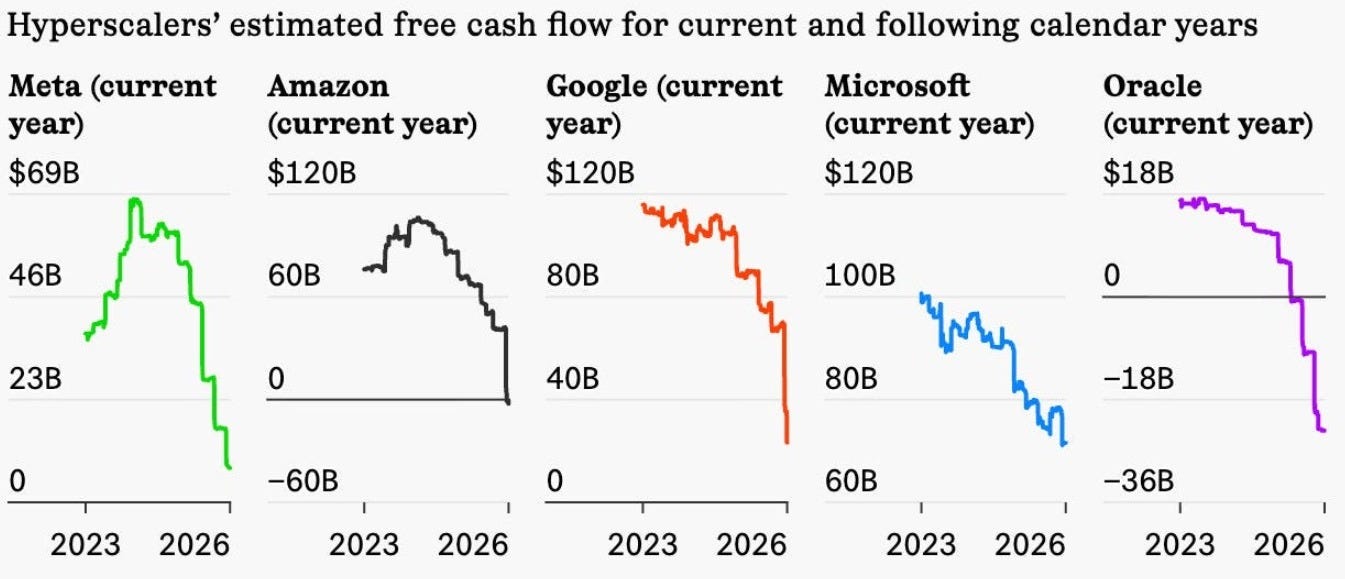
Source: Alphaville and Luke Kawa.
Last week Meta announced they are laying off around 8,000 people, or 10% of its workforce, with Zuckerberg tying the cuts to the $145 billion AI buildout. As I argued in March when the rumour of a 20% cut started spreading, that framing is AI-washing a headcount correction. Two separate decisions packaged as one strategic story. Microsoft has also offered voluntary redundancy to about 7% of its US workforce - roughly 8,750 employees out of 150,000. Amazon has cut more than 30,000 corporate and tech jobs since October, and Oracle laid off another 30,000 in the year’s single largest reduction. Industry-wide, more than 92,000 tech workers have been let go in the first four months of 2026, with March posting the worst single month of tech cuts in over two years.
Outside Big Tech, where the narrative is now clear, it's harder to get a read as most big-company CEOs are avoiding the topic, and when they do speak they tend to avoid the antagonising claims. That said Verizon's Dan Schulman recently decided to break ranks: he's cut 13,000 jobs - the largest round in his company's history - and is now calling on peers to acknowledge AI's destructive potential, predicting unemployment could climb to 20-30% within two to five years. I was relieved to see Jensen Huang push back over the weekend at the other end, calling the "AI eliminates 50% of entry-level jobs" line (a jab at Anthropic’s CEO) "ridiculous" and turning the criticism on the CEOs making it: "somehow because they became CEOs you adopt a God complex, and before you know it you know everything." His positive case is that AI is creating new demand - more code to write than ever, more engineers needed, and software engineering hiring at the major firms is in fact climbing, as I covered recently. His ask was simple: ground the discourse in facts. The pushback is self-serving, of course, and Huang is no stranger to grand claims himself, but the ask still lands. Amen to that. (full video here).
Interestingly the first regulatory pushback has just landed out of China. A Hangzhou court upheld a wrongful-dismissal ruling against a tech firm that had replaced a quality-assurance supervisor with a large language model, holding that AI cost savings do not qualify as legal grounds for termination.
China stands alone for now. EU regulators and governments are MIA and the US government is busy preventing regulation. It's about time we got moving!
About
I analyse AI progress beyond the headlines, focusing on enterprise execution, incentives, and real-world economic impact.
No posts
Comments
Nothing yet. Say the first thing.
Sign in to join the conversation.