
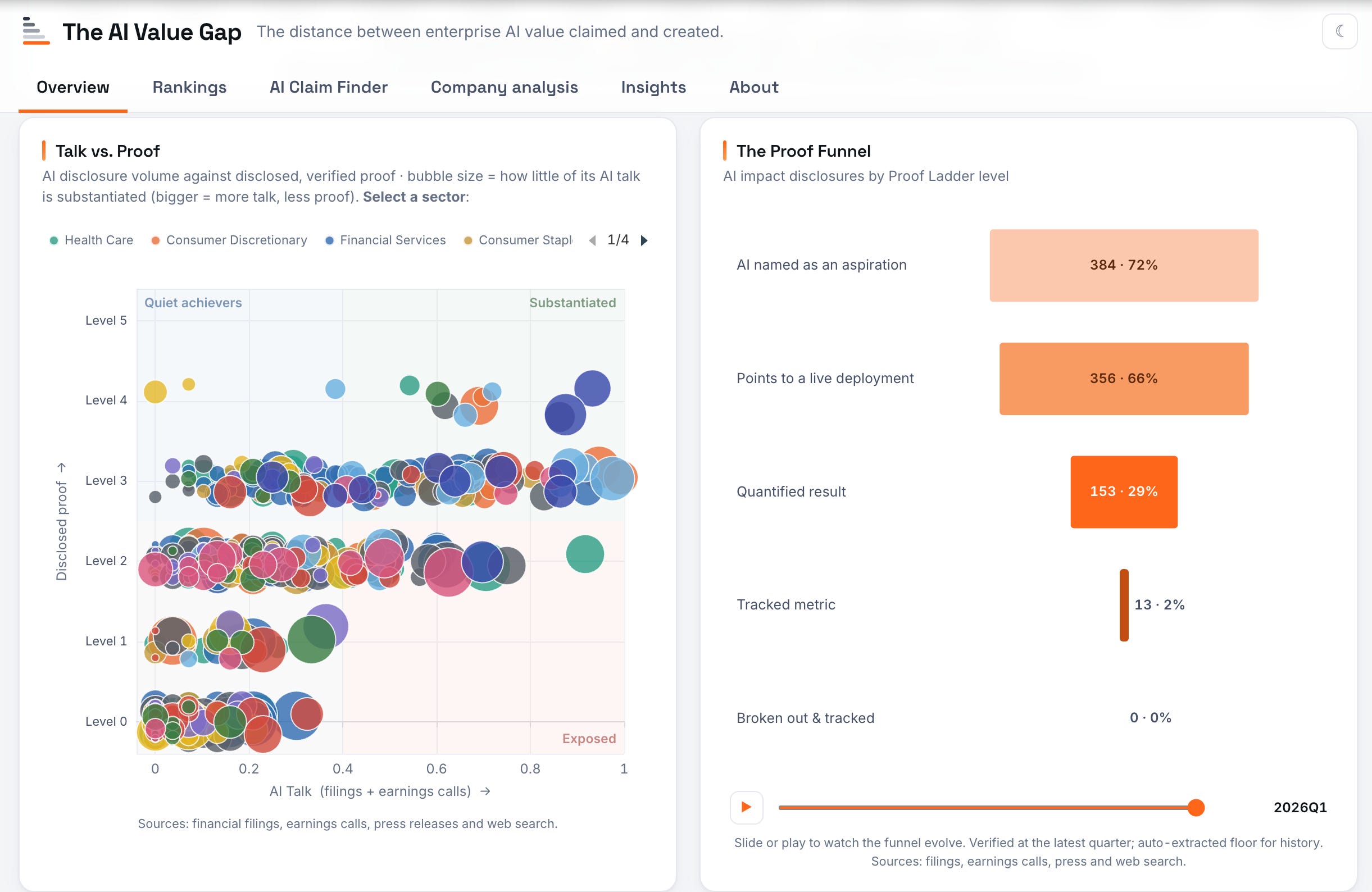
The AI Value Gap (ex-Swimsuit Index) is now live here, scoring more than 500 of the largest US and UK companies on how loudly they talk about AI against how much disclosed proof they can show. In Buffett’s terms, it asks who is still wearing a swimsuit when the tide goes out. The first thing I did with it was test whether markets already pay a premium for AI deployment quality, across all S&P “AI Deployers” and the full FTSE 100. The answer: almost nothing measurable. No reliable premium for provable AI, and a talk premium too small to call. My read is that the market can't yet price AI deployment quality because the proof is too scarce, too soft and too inconsistent to be legible.
My data tool covers all S&P 500 AI Deployers and the full FTSE 100, with a scorecard for every company - its Talk and Proof scores, sector and market rankings, and the evidence behind each score. It also includes an AI Claim Finder: a searchable record of the AI results companies disclose, indexed by metric: cost savings, productivity gain, adoption, revenue, and other measurable impact. It is a benchmark for AI proof: if you run Investor Relations, Strategy, AI or Transformation in a large organisation, you can see how your sector talks about AI, what competitors disclose, and where the bar for credible proof is moving. Every new quarter of filings feeds the dataset, so the proof gap (and who is closing it) can be tracked over time.
Loud AI talk sits near the top of most CEO agendas, on the assumption that the market expects it. The claims I’ve gathered let me test that assumption: does the market really pay more for the companies that talk about AI, or for the ones that can prove it is paying off? There are far more talkers than provers - are the talkers rewarded, and can we separate real deployers from the crowd?
(By "AI Deployers" I mean the S&P 500 with the AI value chain removed: the chipmakers, hyperscalers, and AI-platform and model companies, for whom selling AI is the business).
I used each company’s “Talk” score: AI-mention density across filings and earnings calls; and “Proof”: a 0–5 ladder of disclosed, verified AI value. The ladder is a far harder version of my first attempt in No.33: it used to rank on the type of metric disclosed; it now blends observability (whether an outsider can track a figure quarter to quarter) with the type of impact, from a one-off efficiency proxy up to a durable, tracked economic result. It also screens out targets, pilots and one-off boasts. I then regressed each company's sector-relative forward P/E on both, with sector fixed effects and controls for size, growth and margins.
Here are the results:
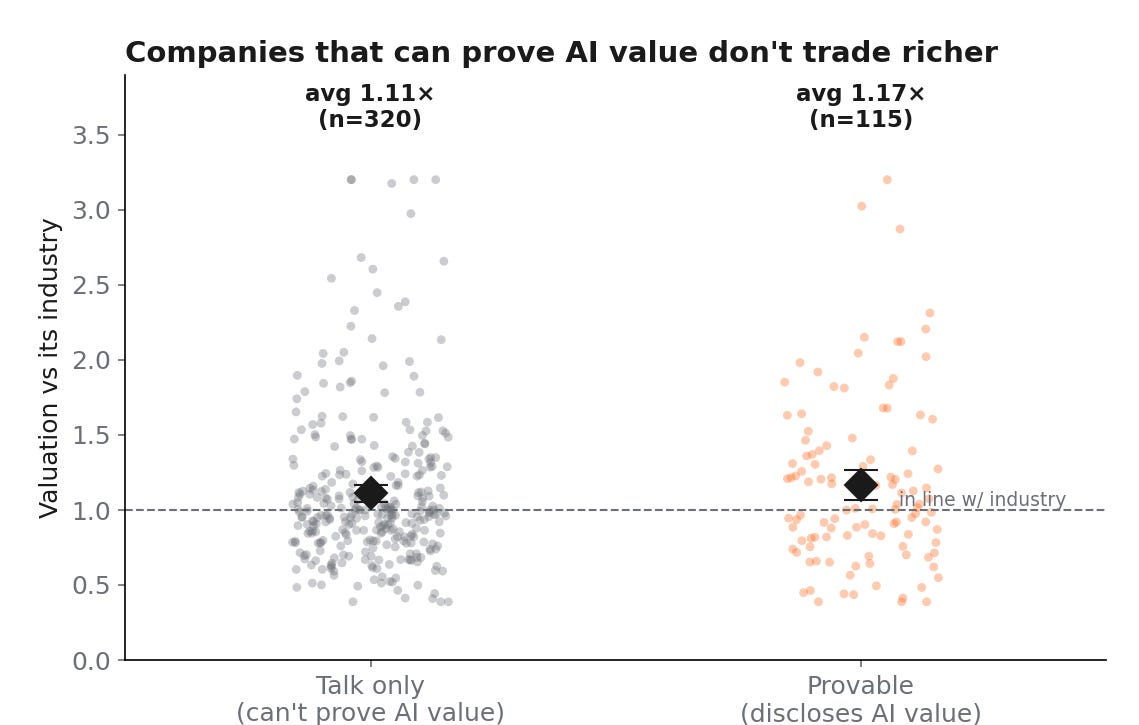
Companies that can show AI is working don't trade richer than their peers, a result that holds across every version of the test. So far, the market is not rewarding the companies that can back their AI claims over the ones that only talk.
Because I hold growth and margins constant, I have already stripped out the channel “real AI” would flow through: faster growth, fatter margins. So what is left is whether the market pays anything on top of the fundamentals, and it doesn’t. That reads as a disciplined market, closer to the opposite of the dumb-money story everyone (including myself, at times) tells about the AI trade.
The heavy talkers look a shade richer, but the effect sits inside the noise. That is somewhat reassuring for anyone worried the market is blindly rewarding AI theatre, though two very different explanations fit and I can’t separate them.
Either AI talk is now table-stakes: everyone does it, so while silence may cost you, volume earns nothing extra. Or the market is more sophisticated than the caricature, discounts cheap and unverifiable talk, and would pay for proof if proof were common and legible.
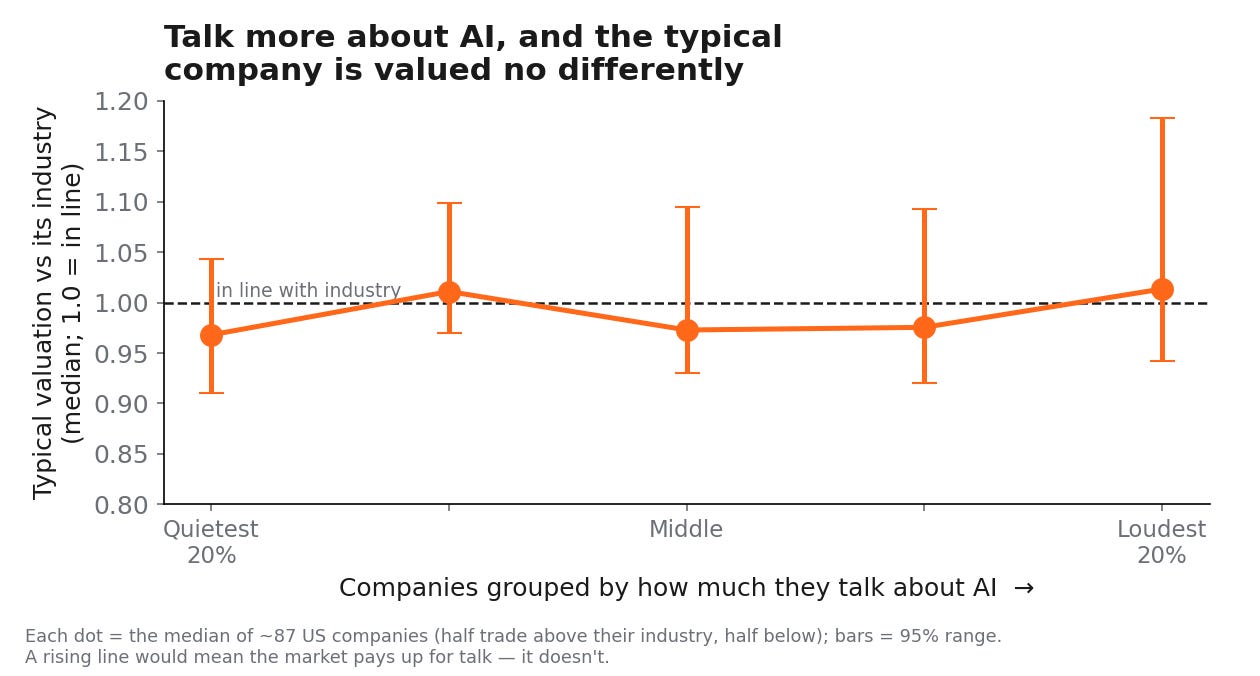
Over the last three years, when a company ramped up its AI talk, its stock was no more likely to beat (or lag) the market that same quarter. The link simply isn't there, in either direction: the temptation to hype pays nothing.
My read is that proof earns no premium because the priceable kind barely exists. Naming an AI deployment is now routine - though at 56% across S&P 500 and FTSE 100, lower than I'd expected (looking at financial filings only). 29% attach a soft number; but the trackable dollar number still sits at 2% (Level 4 of the Ladder).
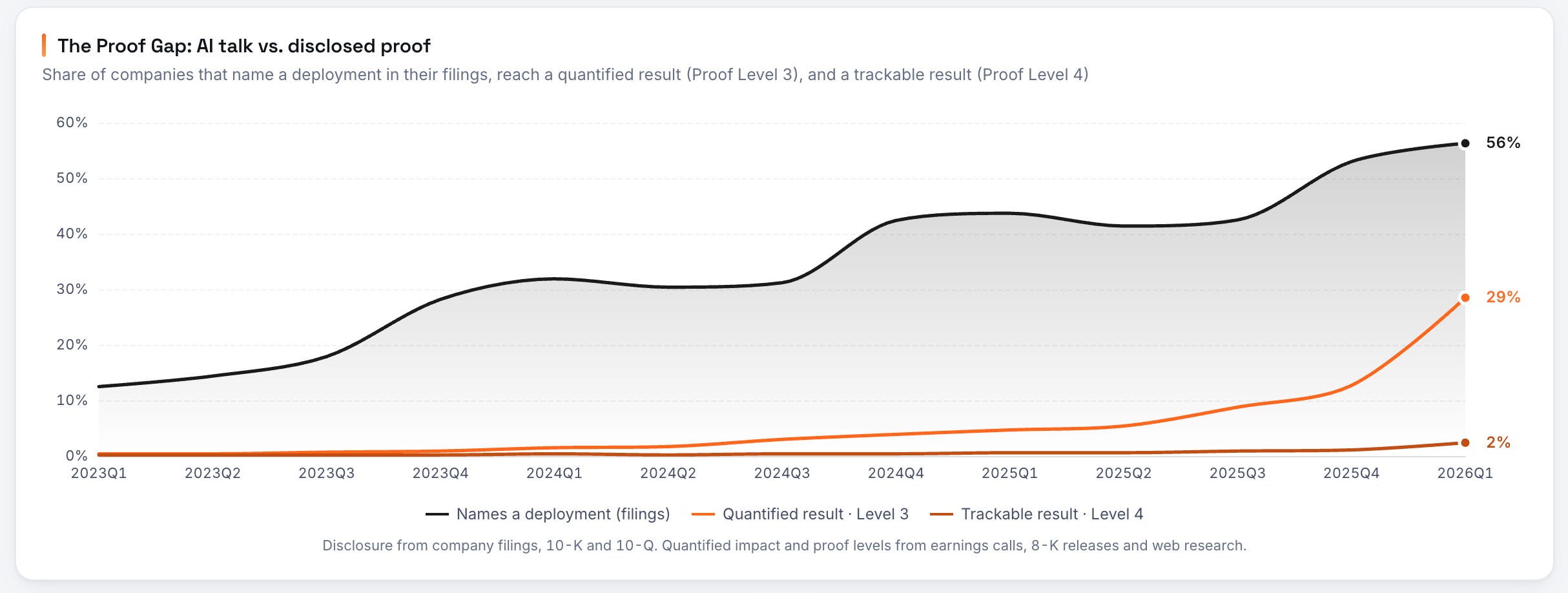
The talk-to-proof gap is closing, but a second has opened in its place - between a soft, one-off figure and a trackable hard metric or dollar number.
Therefore, the market can't yet read AI impact. Analysts have no standard framework for it, IR teams don't report it consistently, and the ladder itself had to be built from scratch because nothing equivalent existed. The evidence isn't legible enough for a separate premium to form, and among deployers there is still little to reward. The premium sits with the AI pick-and-shovel names, while software gets the mirror image - marked down when it can't show AI. For the others, the users of AI and the great majority: no verdict yet, and no blueprint to reach one.
Right now, the market assigns no visible premium to a real, measured AI deployment over a better-packaged AI press release, because it does not yet know what good looks like. Once the legibility gap closes, the market should be able to start telling the two apart. Whether it rewards the provers is the real question.
A re-rating only follows if AI deployment changes expectations. A multiple prices what a company will earn and for how long: how fast the gains come, how durable the edge is, the risk it fades. What allows the market to revise those expectations is legible AI value, showing up where it can be tracked - in margins, retention, new revenue or revenue per employee.
The catch is that not every AI gain deserves a multiple. A one-off “$1B saved” carries little forward signal: it already sits in this year’s earnings. Even a durable saving may not move the multiple if it comes from a tool every rival can buy. It gets competed away, lifting the floor for everyone while multiples stay flat: the pattern most technology waves have followed, from ERP to the cloud.
This means the lasting-dispersion thesis requires a durable edge and uneven diffusion: proprietary data, reworked operations, share taken and kept. On today’s evidence, most disclosed proof is still cost efficiency, meaning convergence is the default and a genuine pull-away the exception to watch for.
About
I analyse AI progress beyond the headlines, focusing on enterprise execution, incentives, and real-world economic impact.
No posts
Comments
Nothing yet. Say the first thing.
Sign in to join the conversation.